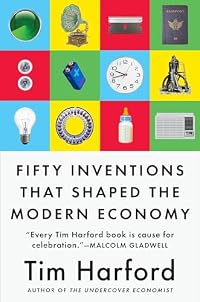
Fifty Inventions That Shaped the Modern Economy
by Tim Harford
On This Page
Description
"In [this book], author and economist Tim Harford paints an epic yet intimate picture of economic change by telling the stories of the ideas, people, and tools that have had far-reaching and unexpected consequences for all of us. Drawing on his hugely popular BBC radio program and podcast ..., Harford expands on them with fascinating glimpses into the inventions that have transformed the ways, we work, play, and live. From the plow to artificial intelligence, from Gillette's disposable razor show more to IKEA's Billy bookcase, Harford recounts the memorable story of each invention and introduces us to the characters who developed them, profited from them, and were in some cases ruined by them."--Jacket. show lessTags
Recommendations






Member Reviews
В последние годы держится мода на «микроистории» вещей, изменивших мир. Интересные и полные неожиданных нюансов, они тем не менее часто оставляют после себя ощущение, что автор хватил лишку. Носки, конечно, вещь нужная, но так, чтобы они кардинально изменили ход истории? Вряд ли. Тиму Харфорду, автору колонки Undercover Economist в Financial Times и нескольких хороших книг об экономике окружающей нас повседневности, show more похоже, удалось избежать близорукости и мозаичности. Все пятьдесят отобранных изобретений, от плуга до криптовалюты, не висят в вакууме, а связаны в единую ткань новых возможностей как с последующими, так и с предыдущими. А чтобы было интереснее, Харфорд оставил за бортом несколько уже поднадоевших хитов рейтингов вроде компьютера и колеса. Помимо конкретных вещей (колючая проволока, таблетки от зачатия, «телеужин», iPhone) это и концепции (консалтинг, право собственности, государство всеобщего благосостояния, банки), и технологии (радар, процесс Габера, на который и сейчас уходит 1% всей вырабатываемой энергии). Злоключения изобретателей и инициаторов — отдельный большой бонус. show less
Without trying to quantify the most influential inventions, this book explores the profound changes that simple tools or ideas can effect. Harford also emphasizes the hidden legal and political structures that make inventions possible — for example that all the major technologies behind the iPhone were developed under military or government agencies. It’s a very thought provoking read, with interesting stories of the people behind the innovations.
Fifty Things That Made the Modern Economy is a book that I wouldn’t seek out. I found it while browsing in a bookshop I trust for great recommendations. It’s a book you can dip in and out of as it’s divided into chapters for each ‘thing’ that are relatively short. This was good in some ways – brevity is appreciated when you’re not really into the thing (for me, that’s cuneiform and tradable debt). For things that I was really interested in, the chapters weren’t quite long enough at times (think the cold chain, video games and the iPhone).
However, it can’t be disputed that Tim Harford and his team have put a lot of work into summarising the invention, problems and impact of each item that had an impact on the modern show more economy. These range from the light bulb to radar, Google to the S bend. Each item makes you pause and think about how it has revolutionised the world for good or not so good (e.g., leaded petrol). It’s also a good taste of items you might want to read more about. For example, I wasn’t aware that the inventor of TV dinners was a woman. Nor was I aware of the financial issues of the inventor of the diesel engine, who has saved me money on fuel economy!
Overall, it’s an interesting idea in a book format that’s good to read in small chunks as there’s no real need to remember the chapters before. Harford writes clearly and concisely, and I’d love to read more from him where subjects are explained in more depth.
http://samstillreading.wordpress.com show less
However, it can’t be disputed that Tim Harford and his team have put a lot of work into summarising the invention, problems and impact of each item that had an impact on the modern show more economy. These range from the light bulb to radar, Google to the S bend. Each item makes you pause and think about how it has revolutionised the world for good or not so good (e.g., leaded petrol). It’s also a good taste of items you might want to read more about. For example, I wasn’t aware that the inventor of TV dinners was a woman. Nor was I aware of the financial issues of the inventor of the diesel engine, who has saved me money on fuel economy!
Overall, it’s an interesting idea in a book format that’s good to read in small chunks as there’s no real need to remember the chapters before. Harford writes clearly and concisely, and I’d love to read more from him where subjects are explained in more depth.
http://samstillreading.wordpress.com show less
Another clever introduction to historical economics and thoughts on trade, climate change, and the difficulties that the world faces. Some of the material in here will be over surprise to you, and some of the things that are highlighted would never have come to mind when thinking about the 50 inventions that shaped the modern economy. Worth looking at for those that are not just economic scientists, but those with an interest in hell we got where we are.
A fun, bite-sized read and lighthearted meditation on how inventions push and pull on the world around us. Organized in such a way that is approachable and fulfilling.
A good pick if you're not a traditional reader, but want to develop the habit.
A good pick if you're not a traditional reader, but want to develop the habit.
After reading this book, I feel proud to be a human. Through quick 3-5 page summaries describing and defending the 50 inventions that shaped the modern economy, Tim Harford educates and delights this reader.
With each chapter, one gets a little smarter and appreciates how (miraculous) far we humans have advanced.
4.5 stars
When discussing inventions that shaped our modern society, it might seem like a daunting task to choose a certain number. You might miss one that seems essential or include an example that is useless. With Tim Harford’s Fifty Inventions That Shaped The Modern Economy, I suppose fifty was the sweet spot to his writing. Starting with the Plow in all of its different iterations, I would say that the book has an unusual structure. Usually, with such a book you would expect the Introduction first and then the entries. This one switches it around though and has it where the Plow comes first followed by the introduction. It really threw me off for a little bit. Other than that there isn’t really anything of note.
The book includes show more inventions that aid our modern economy or assisted in its development. So the Plow is an obvious choice due to our dependence on Agriculture for our food. With the different types of soil came different types of Plow, and the more northern regions becoming more populated. This is merely an example, though. Some of the inventions are so ubiquitous that you don’t even notice them. Take Barbed Wire for instance. Harford argues that it helped to tame the American West and develop the idea of property rights, which is not a connection I would have noticed. Each invention is noted to have a bad or negative side as well. Even the Luddites, the famed technophobes, were not against the technology itself, they were against it leveling the playing field to people of less skill. Going back to the Barbed Wire invention, Barbed Wire did all of those things for property rights, but it also took away land from the Indigenous American Tribes of the West.
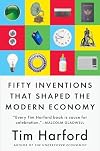
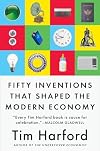
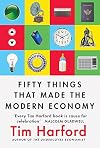
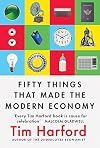
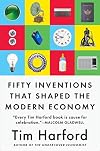
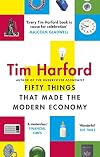
So the book is interesting in that sense and it reminds me of Freakonomics in that it takes a phenomenon or event and connects it to something else in an unusual manner. The list of inventions doesn’t really bear repeating, you can probably find it somewhere if the book is too long or arduous for you. Though I can’t really imagine that since Harford’s style is really friendly and conversational. The cover displays twelve of the fifty inventions, and I can list those right now. It appears to be Radar, the Gramophone, a Safety Razor or Disposable Blade of some kind, the Passport, the Elevator, a Nine-volt Battery, a Clock, the Diesel Engine, the Light Bulb, the Morning After Pill, Infant Formula, and an Air Conditioning Unit.
In any case, the fifty inventions are divided into categories of how they changed society. You might have one that is purely in the realm of ideas, like Cuneiform Writing or The Compiler. Then you get to one like the Google Search, which enabled us to find useful things on the Internet. I remember the bad old days of Dial-Up, where search engines were used but all you could find was pornography since the makers of the sites would put keywords all over their web pages. I was a teenager though, so I don’t remember minding all that much. The Internet would become unusable if that were the case today though. Trying to buy a used car and finding Porn would become annoying.
This book was really enjoyable and quite well written. As I mentioned before, Harford has an engaging, friendly, and conversational style. I can’t really find any fault with it besides the aforementioned switch of the first entry and the introduction. I assume he had his reasons for doing so though. show less
The book includes show more inventions that aid our modern economy or assisted in its development. So the Plow is an obvious choice due to our dependence on Agriculture for our food. With the different types of soil came different types of Plow, and the more northern regions becoming more populated. This is merely an example, though. Some of the inventions are so ubiquitous that you don’t even notice them. Take Barbed Wire for instance. Harford argues that it helped to tame the American West and develop the idea of property rights, which is not a connection I would have noticed. Each invention is noted to have a bad or negative side as well. Even the Luddites, the famed technophobes, were not against the technology itself, they were against it leveling the playing field to people of less skill. Going back to the Barbed Wire invention, Barbed Wire did all of those things for property rights, but it also took away land from the Indigenous American Tribes of the West.
So the book is interesting in that sense and it reminds me of Freakonomics in that it takes a phenomenon or event and connects it to something else in an unusual manner. The list of inventions doesn’t really bear repeating, you can probably find it somewhere if the book is too long or arduous for you. Though I can’t really imagine that since Harford’s style is really friendly and conversational. The cover displays twelve of the fifty inventions, and I can list those right now. It appears to be Radar, the Gramophone, a Safety Razor or Disposable Blade of some kind, the Passport, the Elevator, a Nine-volt Battery, a Clock, the Diesel Engine, the Light Bulb, the Morning After Pill, Infant Formula, and an Air Conditioning Unit.
In any case, the fifty inventions are divided into categories of how they changed society. You might have one that is purely in the realm of ideas, like Cuneiform Writing or The Compiler. Then you get to one like the Google Search, which enabled us to find useful things on the Internet. I remember the bad old days of Dial-Up, where search engines were used but all you could find was pornography since the makers of the sites would put keywords all over their web pages. I was a teenager though, so I don’t remember minding all that much. The Internet would become unusable if that were the case today though. Trying to buy a used car and finding Porn would become annoying.
This book was really enjoyable and quite well written. As I mentioned before, Harford has an engaging, friendly, and conversational style. I can’t really find any fault with it besides the aforementioned switch of the first entry and the introduction. I assume he had his reasons for doing so though. show less
Members
- Recently Added By
Author Information

26+ Works 7,445 Members
Tim Harford is an award-winning columnist, broadcaster, and economist. He is the author of Messy, Fifty Inventions That Shaped the Modern Economy, and the million-selling The Undercover Economist, and is the host of the .Cautionary Tales podcast. He is an honorary fellow of the Royal Statistical Society, and in 2019 he was awarded an OBE for show more services to improving economic understanding. show less
Awards and Honors
Classifications
Statistics
- Members
- 365
- Popularity
- 85,788
- Reviews
- 12
- Rating
- (4.03)
- Languages
- English, French, Portuguese, Spanish
- Media
- Paper, Audiobook, Ebook
- ISBNs
- 16
- ASINs
- 4