
Derek Thompson (1) (1986–)
Author of Abundance
For other authors named Derek Thompson, see the disambiguation page.
Works by Derek Thompson
Tagged
Common Knowledge
- Birthdate
- 1986-5-18
- Gender
- male
- Education
- Northwestern University (BA|Journalism, Political Science, legal studies) 2008
- Occupations
- writer
journalist
author - Organizations
- The Atlantic
- Nationality
- USA
- Birthplace
- McLean, Virginia, USA
- Associated Place (for map)
- Virginia, USA
Members
Reviews

Many contend that American politics is in a transition time from an old paradigm into something new, but few can divine what the future might hold. One of the social tensions is rhetoric between scarcity and abundance, and Ezra Klein and Derek Thompson wholeheartedly want to focus on ways that America can lead to abundance. They lay out an agenda for the political left, their natural conversational home, to reform itself so that they can advocate for a better future.
The authors envision a show more future empowered by technology and science. In fact, they suggest reforms to government-empowered research which often leads to social advance. They want to address a sense that government isn't taking any big risks for big projects anymore. They want us to invent, build, and deploy in a way that might cut out some unnecessary regulations but raise our collective stature.
Of note, their approach to China, our biggest rival, isn't to engage in more petulant rhetoric but to beat them by innate American ingenuity. They fault America for not bringing big ideas to market but instead for inventing ideas for other countries to adopt. They blame shortsighted politics for overlooking advances like solar power that can provide us with energy independence and cheaper energy.
Many Americans express disgust about the direction the political right is leading us but simultaneously anguish about how the political left doesn't articulate a vision for the future. To remedy, these authors share one that I can wholeheartedly support. They don't want bigger government; they want better government, which is a lot more complex to implement than simple rhetoric can provide. They don't posit one-sized-fits-all solutions but suggest careful decisions based on individuals and data.
My biggest concern remains, though, is a simple question: Are the American people listening anymore, or are we too caught up in petty partisanship to rally behind a noble vision for the common good? show less
The authors envision a show more future empowered by technology and science. In fact, they suggest reforms to government-empowered research which often leads to social advance. They want to address a sense that government isn't taking any big risks for big projects anymore. They want us to invent, build, and deploy in a way that might cut out some unnecessary regulations but raise our collective stature.
Of note, their approach to China, our biggest rival, isn't to engage in more petulant rhetoric but to beat them by innate American ingenuity. They fault America for not bringing big ideas to market but instead for inventing ideas for other countries to adopt. They blame shortsighted politics for overlooking advances like solar power that can provide us with energy independence and cheaper energy.
Many Americans express disgust about the direction the political right is leading us but simultaneously anguish about how the political left doesn't articulate a vision for the future. To remedy, these authors share one that I can wholeheartedly support. They don't want bigger government; they want better government, which is a lot more complex to implement than simple rhetoric can provide. They don't posit one-sized-fits-all solutions but suggest careful decisions based on individuals and data.
My biggest concern remains, though, is a simple question: Are the American people listening anymore, or are we too caught up in petty partisanship to rally behind a noble vision for the common good? show less

Summary: A vision of an American future where we invent and build what’s needed and for government that enables rather than hobbles growth.
Ezra Klein and Derek Thompson open this book with what seems an idyllic dream in the not too distant 2050’s. Abundant water floods the West because oceans provide desalinated water to our taps, allowing a resurgence of tapped out rivers and the greening of desert cities. Fresh food from local “skyscraper farms” and lab grown meat fill your show more refrigerator, allowing the re-wilding of land. Miracle drugs manufactured in space extend life. Electric transport has cleaned up the air. Work weeks have shrunk through the use of AI. Homelessness, health, and climate crises are a thing of the past.
I have to admit reading this sounded like an exercise of constructing castles in the air. The authors would disagree. They boil their contention down to this: “to have the future we want, we need to build and invent more of what we need. Our housing shortages, infrastructure woes, energy needs, and technological challenges are not insurmountable. And the answer for them is not “less is more.” Technology is an engine of incredible growth. The vision is one, not of a static, but expanding pie.
What is striking is that Klein and Thompson are two progressives, who write primarily to progressives. While critiquing conservative efforts to hobble government, their critique is far more focused on the ways progressives have hobbled growth and innovation through excessive and labyrinthine regulation. Much of it was well-intentioned to provide for safe housing, a cleaner environment, and more equitable contracting. Environmental litigation hamstrung housing growth in places like California, where it is most needed.
Perhaps the most telling example in the whole book is California’s efforts to build high speed rail, beginning in 1982. As of the writing, none of the 500 mile system is operational while costs balloon. Meanwhile, China has built more than 23,000 miles of high speed rail. The problem is not know how, with the U.S. long a leader in rail transport technology. Rather, the problem has been regulations and the protracted negotiations, environmental reviews, and lawsuits these entailed.
The issue is not that government can’t work. For example, Houston permitted more housing units than San Francisco, the Boston and New York Metro areas combined during a recent year. In Houston, the median home price was $300,000 versus $1.7 million in San Francisco. Houston has land use but no zoning rules whereas the others have layers of regulations and restrictions that make construction processes lengthier and far more expensive. Contractors build fewer housing units. And none of it is affordable.
America has led the world in innovation due to our commitments to basic research. Once again, in more recent years, research has been hamstrung by reporting requirements that stifle many of the most creative. They observed that we haven’t studied the creative process. Not only that, increasingly, we don’t build what we invent, but offshore it. The authors argue that the country that can both invent and build what it invents is destined to be an economic powerhouse.
Finally, they highlight the importance of strategic deployment, citing examples from Kennedy’s moonshot program to Trump’s operation Warp Speed, which produced a vaccine that might normally take ten years in ten months during a global health emergency. It means logical, streamlined processes and the ruthless removal of bottlenecks. They raise the question of AI development and the wisdom of allowing the innovation and implementation infrastructures to be located offshore. Is it such a good idea to contract this out to the Middle East, they ask?
On one hand, Klein and Thompson offer a trenchant critique of the failures of progressives, one of miring growth and innovation in regulative processes. Likewise, they offer a compelling vision of the possible. What I don’t find here are substantive proposals of how to go about removing the regulative barriers to growth apart from dismantling them, as the current administration seems to be doing. I also think they are optimistic about the ability of technology to save us. I find that technology is always doubled edged. The electric future they envision relies, at least in part, on battery and nuclear technology. Both of these carry significant downsides.
I also think the authors are caught in a binary of scarcity versus abundance. A third alternative that I don’t see here is one of “enough.” In a society with obscene extremes of wealth and poverty, it seems we lack a commitment that everyone would have enough–of housing, transport, health care, education, and economic opportunity. We have an abundance in our social, intellectual, and material capital for everyone to have a high standard of enough. The problem is not merely regulatory but structural and spiritual. I fear that without addressing these problems, the vision of these writers is indeed of “castles in the air.” show less
Ezra Klein and Derek Thompson open this book with what seems an idyllic dream in the not too distant 2050’s. Abundant water floods the West because oceans provide desalinated water to our taps, allowing a resurgence of tapped out rivers and the greening of desert cities. Fresh food from local “skyscraper farms” and lab grown meat fill your show more refrigerator, allowing the re-wilding of land. Miracle drugs manufactured in space extend life. Electric transport has cleaned up the air. Work weeks have shrunk through the use of AI. Homelessness, health, and climate crises are a thing of the past.
I have to admit reading this sounded like an exercise of constructing castles in the air. The authors would disagree. They boil their contention down to this: “to have the future we want, we need to build and invent more of what we need. Our housing shortages, infrastructure woes, energy needs, and technological challenges are not insurmountable. And the answer for them is not “less is more.” Technology is an engine of incredible growth. The vision is one, not of a static, but expanding pie.
What is striking is that Klein and Thompson are two progressives, who write primarily to progressives. While critiquing conservative efforts to hobble government, their critique is far more focused on the ways progressives have hobbled growth and innovation through excessive and labyrinthine regulation. Much of it was well-intentioned to provide for safe housing, a cleaner environment, and more equitable contracting. Environmental litigation hamstrung housing growth in places like California, where it is most needed.
Perhaps the most telling example in the whole book is California’s efforts to build high speed rail, beginning in 1982. As of the writing, none of the 500 mile system is operational while costs balloon. Meanwhile, China has built more than 23,000 miles of high speed rail. The problem is not know how, with the U.S. long a leader in rail transport technology. Rather, the problem has been regulations and the protracted negotiations, environmental reviews, and lawsuits these entailed.
The issue is not that government can’t work. For example, Houston permitted more housing units than San Francisco, the Boston and New York Metro areas combined during a recent year. In Houston, the median home price was $300,000 versus $1.7 million in San Francisco. Houston has land use but no zoning rules whereas the others have layers of regulations and restrictions that make construction processes lengthier and far more expensive. Contractors build fewer housing units. And none of it is affordable.
America has led the world in innovation due to our commitments to basic research. Once again, in more recent years, research has been hamstrung by reporting requirements that stifle many of the most creative. They observed that we haven’t studied the creative process. Not only that, increasingly, we don’t build what we invent, but offshore it. The authors argue that the country that can both invent and build what it invents is destined to be an economic powerhouse.
Finally, they highlight the importance of strategic deployment, citing examples from Kennedy’s moonshot program to Trump’s operation Warp Speed, which produced a vaccine that might normally take ten years in ten months during a global health emergency. It means logical, streamlined processes and the ruthless removal of bottlenecks. They raise the question of AI development and the wisdom of allowing the innovation and implementation infrastructures to be located offshore. Is it such a good idea to contract this out to the Middle East, they ask?
On one hand, Klein and Thompson offer a trenchant critique of the failures of progressives, one of miring growth and innovation in regulative processes. Likewise, they offer a compelling vision of the possible. What I don’t find here are substantive proposals of how to go about removing the regulative barriers to growth apart from dismantling them, as the current administration seems to be doing. I also think they are optimistic about the ability of technology to save us. I find that technology is always doubled edged. The electric future they envision relies, at least in part, on battery and nuclear technology. Both of these carry significant downsides.
I also think the authors are caught in a binary of scarcity versus abundance. A third alternative that I don’t see here is one of “enough.” In a society with obscene extremes of wealth and poverty, it seems we lack a commitment that everyone would have enough–of housing, transport, health care, education, and economic opportunity. We have an abundance in our social, intellectual, and material capital for everyone to have a high standard of enough. The problem is not merely regulatory but structural and spiritual. I fear that without addressing these problems, the vision of these writers is indeed of “castles in the air.” show less
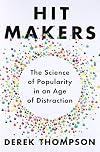
There are so many products, so much art, so much music, so many fashion trends, so much of…everything in this world, but only a tiny fraction becomes popular. Why? In Hit Makers, Derek Thompson explains this phenomenon (the “science of popularity”). The book was a hit for me, as interesting as Thompson’s articles in The Atlantic, and articulated with the precision of a born writer.
His thesis is that when it comes to what becomes a hit, simply being talented isn’t enough. History show more has shown time and again that “hit makers”—networks of people or one influential enabler—need to be in place to tip the scales in the right direction. That hit maker could be a gifted speechwriter, a born salesperson, an uber-popular celebrity who retweets your tweet…some special someone who works the right magic at just the right time. “The Age of Distraction” in the subtitle refers to the challenge of standing out in an era of so much noise: social media, plentiful choices, the competition of numerous other things vying to become hits.
Hit Makers is chock full of a varied range of examples from different time periods. To name just a few, Thompson explains how Disney grew to become as popular and influential as it is; how Bumble and Hinge took off when Tinder was already popular; why Claude Monet’s work became one of the most recognizable in the world while the talented Gustave Caillebotte, an artist painting at the same time as Monet, is barely known. For every wildly successful someone or something, hundreds may be just as, or even more, skilled or promising, but because they didn’t have a hit maker they sank into obscurity.
Thompson also explores the psychology behind our taste preferences. We’re sensitive to social influence, particularly the allure of popularity (e.g., equating “best-seller” to “best quality” or “most interesting”). However, there’s more: As Thompson says, “People don’t make decisions individually. They aren’t just creatures of influence (‘I bought it because it’s popular’). They’re also creatures of self-expression (‘I bought it because it’s me’).”
I think most readers know that when it comes to certain things, we humans are easily influenced, and we know connections can make or break a person’s success. At the least, helpful connections can give us a leg up. But reading the psychology and the many examples in Hit Makers (each strengthening Thompson’s thesis but unique in their jaw-dropping stories) takes a truth we may not think about deeply and magnifies it.
Nevertheless, the “science of popularity” descriptor is slightly inaccurate because simple, mysterious luck plays a role in the making of hits. What Thompson explores is a kind of science because we can discern a pattern in how hit-making plays out, but because some luck is mixed in, the pattern can’t simply be set down and strictly followed to get a guaranteed result.
The book educated and fascinated me, but it is information dense, and that’s my only criticism. I read every word, posted many excerpts as status updates, and understood it all, but trying to summarize each example is nearly impossible without a second or third reading. This may be ok, though, because they’re connected by a simple main idea. Examples of this “science of popularity” truly are everywhere, and Hit Makers has me viewing hits with new eyes. show less
His thesis is that when it comes to what becomes a hit, simply being talented isn’t enough. History show more has shown time and again that “hit makers”—networks of people or one influential enabler—need to be in place to tip the scales in the right direction. That hit maker could be a gifted speechwriter, a born salesperson, an uber-popular celebrity who retweets your tweet…some special someone who works the right magic at just the right time. “The Age of Distraction” in the subtitle refers to the challenge of standing out in an era of so much noise: social media, plentiful choices, the competition of numerous other things vying to become hits.
Hit Makers is chock full of a varied range of examples from different time periods. To name just a few, Thompson explains how Disney grew to become as popular and influential as it is; how Bumble and Hinge took off when Tinder was already popular; why Claude Monet’s work became one of the most recognizable in the world while the talented Gustave Caillebotte, an artist painting at the same time as Monet, is barely known. For every wildly successful someone or something, hundreds may be just as, or even more, skilled or promising, but because they didn’t have a hit maker they sank into obscurity.
Thompson also explores the psychology behind our taste preferences. We’re sensitive to social influence, particularly the allure of popularity (e.g., equating “best-seller” to “best quality” or “most interesting”). However, there’s more: As Thompson says, “People don’t make decisions individually. They aren’t just creatures of influence (‘I bought it because it’s popular’). They’re also creatures of self-expression (‘I bought it because it’s me’).”
I think most readers know that when it comes to certain things, we humans are easily influenced, and we know connections can make or break a person’s success. At the least, helpful connections can give us a leg up. But reading the psychology and the many examples in Hit Makers (each strengthening Thompson’s thesis but unique in their jaw-dropping stories) takes a truth we may not think about deeply and magnifies it.
Nevertheless, the “science of popularity” descriptor is slightly inaccurate because simple, mysterious luck plays a role in the making of hits. What Thompson explores is a kind of science because we can discern a pattern in how hit-making plays out, but because some luck is mixed in, the pattern can’t simply be set down and strictly followed to get a guaranteed result.
The book educated and fascinated me, but it is information dense, and that’s my only criticism. I read every word, posted many excerpts as status updates, and understood it all, but trying to summarize each example is nearly impossible without a second or third reading. This may be ok, though, because they’re connected by a simple main idea. Examples of this “science of popularity” truly are everywhere, and Hit Makers has me viewing hits with new eyes. show less
Summary: Explores what makes a hit, and explodes some of the myths around hits such as the idea of something going "viral".
How does something become a "hit?" Anyone creating a work of art, propounding an idea, promoting a candidate, launching a new product would like to know. Derek Thompson, a senior editor at The Atlantic, was curious about this phenomenon and out of his research come countless stories about everything from Brahms Lullaby to Fifty Shades of Grey.
Brahm's Lullaby is a case in show more point of the kinds of things Thompson explores in this book. It sounds very much like an Austrian folk melody--familiar elements with a gentle surprise and a "hook." Thompson observes that it has both the novel and the familiar and that this combination is crucial for a hit. Thompson explores the MAYA rule of designer Raymond Loewy, MAYA standing for Most Advanced Yet Acceptable. He implemented this principle on everything from mimeographs and trashbins to bullet-shaped train locomotives, Coldspot refrigerators, and Lucky Strike cigarette packs. Advanced yet familiar--and they all sold like crazy. Thompson goes on to show how this applies to music, movies like Star Wars, the rise of vampires and cable news, and phenomena like Taylor Swift and the laugh track on comedies.
The other crucial element is distribution. Brahm's Lullaby became a global phenomenon because of German migrations to North America and elsewhere in the second half of the nineteenth century. Thompson explodes the myth of something going "viral." Instead, what often makes the difference is when a few figures who already have an audience promote something, millions here and then it takes off. And there is a hidden side of "dark broadcasters" whose unseen influence helped build the awareness of people like E. L. James of Fifty Shades fame. On the flip side, success is sometimes isolating the particular audience with an affinity to your product--homophily. What may be critical is knowing who are the friends of your audience. And sometimes, it is plain chaos, where Rock Around the Clock becomes the first rock 'n roll hit when a young boy, Peter Ford, buys the record, and a few months later through his father, Glenn Ford, plays the record for a director filming a movie titled Blackboard Jungle. The rest is history as a record (a "B" side!) that had gone nowhere suddenly became the anthem of a generation.
What makes this book fascinating is that Thompson is a prolific story gatherer, introducing us to everyone from an obscure, but wealthy Impressionist artist, Caillebotte, whose collection became the Impressionist canon, to the people who have launched our social media blockbusters. He explores the backstory behind Game of Thrones and Mickey Mouse and the evolution of reading from books to the News Feed. He also raises profound questions about the transforming influence of the little plates of glass we carry about with us that connect us to the world, that both inform us, and constantly transmit information about us to those trying to shape the next "hit."
It is here that I thought Thompson was at his most thought-provoking. He describes in the chapter "Interlude: 828 Broadway" visiting Chartbeat, that gave instantaneous feedback about reader behavior on websites. Downstairs from Chartbeat was the venerable Strand Bookstore. He asks "Does great art begin with feedback, or does it start with the opposite--a quiet space, devoid of distractions, where creators can turn the spotlight inward and make something mostly for themselves?" As both bibliophile and a new generation writer fluent with the online world, he wrestles with the implications for himself:
"I've come to see that I need the feedback loop, the standing ovation and devastating silences that can greet an online article. But when I circle a pile of books at the Strand, it's hard to avoid the conclusion that perhaps the best writers also knew to just do the work and forget, for a moment, that anyone would ever read their reverie. They mounted a stage production in their minds, but just for them, something palatial and private, like a daydream" (pp. 280-281).
The irony I'm struck with as I read Thompson's work is that excellence and originality in writing, art, music and innovation are not always what is rewarded. He observes the absence of good taste, and that the biggest hits are often re-boots of the familiar. The challenge today is that instantaneous nature of the feedback. Was it easier to practice artistic integrity when most likely you wouldn't be famous, a "hit," until after you were dead? You might struggle with poverty as you "did the work and forgot." But were you tempted so greatly to bend the work to the feedback loop? Maybe this has always been the tension in which artists live. Perhaps it is a good thing that there is an element of randomness in all this or we might all be tempted too greatly, and all art and endeavor be reduced to pursuing the "hit." show less
How does something become a "hit?" Anyone creating a work of art, propounding an idea, promoting a candidate, launching a new product would like to know. Derek Thompson, a senior editor at The Atlantic, was curious about this phenomenon and out of his research come countless stories about everything from Brahms Lullaby to Fifty Shades of Grey.
Brahm's Lullaby is a case in show more point of the kinds of things Thompson explores in this book. It sounds very much like an Austrian folk melody--familiar elements with a gentle surprise and a "hook." Thompson observes that it has both the novel and the familiar and that this combination is crucial for a hit. Thompson explores the MAYA rule of designer Raymond Loewy, MAYA standing for Most Advanced Yet Acceptable. He implemented this principle on everything from mimeographs and trashbins to bullet-shaped train locomotives, Coldspot refrigerators, and Lucky Strike cigarette packs. Advanced yet familiar--and they all sold like crazy. Thompson goes on to show how this applies to music, movies like Star Wars, the rise of vampires and cable news, and phenomena like Taylor Swift and the laugh track on comedies.
The other crucial element is distribution. Brahm's Lullaby became a global phenomenon because of German migrations to North America and elsewhere in the second half of the nineteenth century. Thompson explodes the myth of something going "viral." Instead, what often makes the difference is when a few figures who already have an audience promote something, millions here and then it takes off. And there is a hidden side of "dark broadcasters" whose unseen influence helped build the awareness of people like E. L. James of Fifty Shades fame. On the flip side, success is sometimes isolating the particular audience with an affinity to your product--homophily. What may be critical is knowing who are the friends of your audience. And sometimes, it is plain chaos, where Rock Around the Clock becomes the first rock 'n roll hit when a young boy, Peter Ford, buys the record, and a few months later through his father, Glenn Ford, plays the record for a director filming a movie titled Blackboard Jungle. The rest is history as a record (a "B" side!) that had gone nowhere suddenly became the anthem of a generation.
What makes this book fascinating is that Thompson is a prolific story gatherer, introducing us to everyone from an obscure, but wealthy Impressionist artist, Caillebotte, whose collection became the Impressionist canon, to the people who have launched our social media blockbusters. He explores the backstory behind Game of Thrones and Mickey Mouse and the evolution of reading from books to the News Feed. He also raises profound questions about the transforming influence of the little plates of glass we carry about with us that connect us to the world, that both inform us, and constantly transmit information about us to those trying to shape the next "hit."
It is here that I thought Thompson was at his most thought-provoking. He describes in the chapter "Interlude: 828 Broadway" visiting Chartbeat, that gave instantaneous feedback about reader behavior on websites. Downstairs from Chartbeat was the venerable Strand Bookstore. He asks "Does great art begin with feedback, or does it start with the opposite--a quiet space, devoid of distractions, where creators can turn the spotlight inward and make something mostly for themselves?" As both bibliophile and a new generation writer fluent with the online world, he wrestles with the implications for himself:
"I've come to see that I need the feedback loop, the standing ovation and devastating silences that can greet an online article. But when I circle a pile of books at the Strand, it's hard to avoid the conclusion that perhaps the best writers also knew to just do the work and forget, for a moment, that anyone would ever read their reverie. They mounted a stage production in their minds, but just for them, something palatial and private, like a daydream" (pp. 280-281).
The irony I'm struck with as I read Thompson's work is that excellence and originality in writing, art, music and innovation are not always what is rewarded. He observes the absence of good taste, and that the biggest hits are often re-boots of the familiar. The challenge today is that instantaneous nature of the feedback. Was it easier to practice artistic integrity when most likely you wouldn't be famous, a "hit," until after you were dead? You might struggle with poverty as you "did the work and forgot." But were you tempted so greatly to bend the work to the feedback loop? Maybe this has always been the tension in which artists live. Perhaps it is a good thing that there is an element of randomness in all this or we might all be tempted too greatly, and all art and endeavor be reduced to pursuing the "hit." show less
Lists
Awards


You May Also Like


Associated Authors
Statistics
- Works
- 3
- Members
- 1,193
- Popularity
- #21,547
- Rating
- 3.8
- Reviews
- 27
- ISBNs
- 49
- Languages
- 7