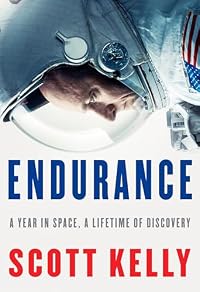
Endurance: A Year in Space, A Lifetime of Discovery
by Scott Kelly
On This Page
Description
The veteran of four space flights and the American record holder for consecutive days spent in space, Scott Kelly has experienced things very few have. Now, he takes us inside a sphere utterly inimical to human life. He describes navigating the extreme challenge of long-term spaceflight, both existential and banal: the devastating effects on the body; the isolation from everyone he loves and the comforts of Earth; the pressures of constant close cohabitation; the catastrophic risks of show more depressurization or colliding with space junk, and the still more haunting threat of being unable to help should tragedy strike at home--an agonizing situation Kelly faced when, on another mission, his twin brother's wife, Gabrielle Giffords, was shot while he still had two months in space. Kelly's humanity, compassion, humor, and passion resonate throughout, as he recalls his rough-and-tumble New Jersey childhood and the youthful inspiration that sparked his astounding career, and as he makes clear his belief that Mars will be the next, ultimately challenging step in American spaceflight. A natural storyteller and modern-day hero, Kelly has a message of hope for the future that will inspire for generations to come. Here, in his personal story, we see the triumph of the human imagination, the strength of the human will, and the boundless wonder of the galaxy. show lessTags
Recommendations









Member Recommendations
Member Reviews
Manchmal lese ich zur Abwechslung auch ein Sachbuch. Als ScienceFiction-Fan fällt es mir aber auch schwer, nicht den Schilderungen von realen Personen zu folgen, die tatsächlich im Weltall waren. Astronaut Scott Kelly war von März 2015 bis März 2016 fast ein Jahr im Weltall und beschreibt in seinem Buch Endurance seine Erfahrungen zu dieser Zeit. Dabei wird schnell deutlich, dass die Auswirkungen der Schwerelosigkeit absolut kein Pappenstiel sind und der menschliche Körper so einiges aushalten muss. Dabei faszinierten mich am meisten die Beschreibungen seines Befindens nach der Rückkehr auf die Erde. Kurz gesagt, lange Aufenthalte in der Schwerelosigkeit verlangen dem Körper Immenses ab. Vieles war mir bis dato noch gar nicht so show more bewusst.
Wir folgen Scott Kellys Reise ins All, von den Vorbereitungen auf die Mission bis hin zu seiner Rückkehr. Dabei ist Endurance allerdings auch mehr als nur ein Erfahrungsbericht dieser Mission. An vielen Stellen ähnelt das Buch eher Memoiren. Ich selbst fand die Details aus Scott Kellys Leben sehr bereichernd, zeichneten sie doch das Bild eines Menschen, der im Leben nichts auf dem silbernen Tablett serviert bekam. Auch, dass er kein besonders guter Schüler war und er seine Bildung hart erarbeitete, machen ihn sehr sympathisch. Viele Menschen können von seinem Werdegang inspiriert werden. Scott Kelly bricht mit dem Idealbild des Wissenschaftlers und Astronauten als hochintelligenter Übermensch. Er zeigt deutlich, dass man wirklich vieles erreichen kann, wenn man nur hart dafür arbeitet.
Besonders gefallen hat mir, wie stark er betonte, dass die Weltraumfahrt ein menschliches Projekt ist und die Nationen bei der Zusammenarbeit auf der ISS ihre Herkunft in den Hintergrund rücken. Auch, dass ehemals verfeindete Nationen jetzt zusammenarbeiten. Ich persönliche denke, dass genau diese Einsicht, dass die Erde unser aller Planet ist und wir alle Menschen sind, vielen fehlt. Vielleicht braucht es tatsächlich erst einen Flug ins All, um das zu erkennen.
Fazit:
Endurance ist ein gutes Buch, das nicht nur Scott Kellys Erfahrung als Astronaut darstellt sondern auch den Menschen dahinter, der für viele eine Inspiration sein kann, auch wenn der deutsche Titel hier etwas irreführend sein kann. Es geht einfach um mehr, als nur diese Langzeitmission. Klare Leseempfehlung. show less
Wir folgen Scott Kellys Reise ins All, von den Vorbereitungen auf die Mission bis hin zu seiner Rückkehr. Dabei ist Endurance allerdings auch mehr als nur ein Erfahrungsbericht dieser Mission. An vielen Stellen ähnelt das Buch eher Memoiren. Ich selbst fand die Details aus Scott Kellys Leben sehr bereichernd, zeichneten sie doch das Bild eines Menschen, der im Leben nichts auf dem silbernen Tablett serviert bekam. Auch, dass er kein besonders guter Schüler war und er seine Bildung hart erarbeitete, machen ihn sehr sympathisch. Viele Menschen können von seinem Werdegang inspiriert werden. Scott Kelly bricht mit dem Idealbild des Wissenschaftlers und Astronauten als hochintelligenter Übermensch. Er zeigt deutlich, dass man wirklich vieles erreichen kann, wenn man nur hart dafür arbeitet.
Besonders gefallen hat mir, wie stark er betonte, dass die Weltraumfahrt ein menschliches Projekt ist und die Nationen bei der Zusammenarbeit auf der ISS ihre Herkunft in den Hintergrund rücken. Auch, dass ehemals verfeindete Nationen jetzt zusammenarbeiten. Ich persönliche denke, dass genau diese Einsicht, dass die Erde unser aller Planet ist und wir alle Menschen sind, vielen fehlt. Vielleicht braucht es tatsächlich erst einen Flug ins All, um das zu erkennen.
Fazit:
Endurance ist ein gutes Buch, das nicht nur Scott Kellys Erfahrung als Astronaut darstellt sondern auch den Menschen dahinter, der für viele eine Inspiration sein kann, auch wenn der deutsche Titel hier etwas irreführend sein kann. Es geht einfach um mehr, als nur diese Langzeitmission. Klare Leseempfehlung. show less
Scott Kelly describes the dedication and determination required to become an astronaut. His description of life in space reveals some of the not necessarily obvious nature of the environment, such as the sounds and smells. He also gives a little insight into the psychology of life as an astronaut. A thoroughly fascinating and engrossing read.
Scott Kelly's Endurance: A Year in Space, A Lifetime of Discovery examines not only his role in the One-Year Mission aboard the International Space Station (with Mikhail Korniyenko as his fellow experimental subject on ISS and his brother, Mark Kelly, remaining on Earth as a control subject), but also serves as a memoir in which he examines the paths that led him from work as an EMT to the U.S. Navy and eventually NASA. Kelly discusses how he learned to value a challenge and, while many of his experiences may not have been his first choice, he set about to master them when they presented themselves.
Kelly draws upon Alfred Lansing's Endurance: Shackleton's Incredible Voyage as a parallel to some of the challenges he faced on the remote show more ISS (the title similarity is obvious, but Kelly also brought Lansing's book into space among his personal items). He also references Tom Wolfe's The Right Stuff, both as an inspiration for him to join NASA and for the frankness with which he describes his experiences. The NASA that Wolfe described is long-gone, but Kelly describes a vibrant, flawed, but well-meaning professional organization that can achieve great things if it again received the level of public support (funding) it enjoyed during Project Mercury. Kelly doesn't shy away from pointing out areas for improvement, but he also extends this constructive criticism to himself, and this honesty makes his book all the more compelling. He also relates stories that will make the reader laugh out loud before explaining something that will inspire. A must-read for those interested in human spaceflight. show less
Kelly draws upon Alfred Lansing's Endurance: Shackleton's Incredible Voyage as a parallel to some of the challenges he faced on the remote show more ISS (the title similarity is obvious, but Kelly also brought Lansing's book into space among his personal items). He also references Tom Wolfe's The Right Stuff, both as an inspiration for him to join NASA and for the frankness with which he describes his experiences. The NASA that Wolfe described is long-gone, but Kelly describes a vibrant, flawed, but well-meaning professional organization that can achieve great things if it again received the level of public support (funding) it enjoyed during Project Mercury. Kelly doesn't shy away from pointing out areas for improvement, but he also extends this constructive criticism to himself, and this honesty makes his book all the more compelling. He also relates stories that will make the reader laugh out loud before explaining something that will inspire. A must-read for those interested in human spaceflight. show less
What a fascinating look at life in space! From the mundane aspects of fixing the toilets to the beauty of watching the earth from the international space station, this memoir is incredible. There are slow moments, but the majority is honest to the point of being a PR nightmare. I loved seeing the international cooperation and learning what an astronaut’s life is truly like, struggles and all. Kelly’s time in space is intense and made me appreciate the small things.
I really enjoyed this. Kelly has a great sense of humor, his descriptions were very vivid, and he did a good job illuminating some of the more surreal aspects of space travel. I appreciated how the events earlier in his life were interspersed with his accounts of life on the International Space Station, and that way I got to learn about both instead of just wondering about when he would ever get to talking about space. At times, things seemed a little negative, but overall, it was a good read.
Before reading this, I had never really thought about what a pain life would be without gravity. For example, it had never occurred to me how much more difficult it would be to take a machine apart for repair and then reassemble it would be when show more all the components were floating around. And while I knew they had taken experimental animals up, I hadn’t thought about what would happen if they escaped. But Kelly recounted a time when several experimental mice escaped their lab habitat, and in addition to recovering the floating mice, the astronauts had to be on the lookout for the small brown pellets that were also floating through the lab. I spent years working in an entomology lab for my doctorate, and now I’m beginning to feel fortunate that I was able to do all my experiments with the assistance of Earth’s gravitational pull – so I didn’t have to worry about keeping my test tubes, petri plates, and the samples themselves from randomly drifting off! And I could use liquid buffers and reagents without a second thought; without gravity, water and water-based solutions will form perfect spheres as a result of surface tension, and of course those spheres will float as well. And now I’m imagining a special kind of hell – PCR prep on the space station. Also, while I had heard of the health effects of not having gravity, and how astronauts have special exercise regimens, I didn’t realize their bodies changed so much that they could feel the effect of missing even one exercise session. In addition, they have to do extra exercise closer to the end of their mission to prepare them for their return to full gravity, and even then it’s a difficult transition. It made me think that, at least while they’re in space, we are getting at least as much exercise as astronauts do just by going about our daily lives. I’ve gained a new appreciation for gravity now that I have finished this book.
Reading about all the problems with the carbon dioxide levels in the ISS (and the trouble Kelly had maintaining the Seedra machine) and the problem when the power to the O2 generator went down made me wonder why the space station doesn’t have more plants to help out with this. After all, plants fix carbon dioxide and release oxygen as a waste product. Unless plants somehow don’t work that way in space? Or maybe they take too much water? Or maybe they’re considered too much trouble – although I can’t imagine they’d be any more high-maintenance than the book makes the Seedra machine sound. Or would the scale just not work given the limited area of the space station? I don’t know how many plants of what size it would take to actually make it work – obviously if you need hectares upon hectares of forests like the ones on Earth it wouldn’t work on the space station – but I’m not sure you’d need anything on the scale of hectares for only a few people. I’m guessing that even one or two square meters would help with the carbon dioxide levels, and it’d be a heck of a lot more sustainable than sending up extra oxygen and new parts for the machines. And I might as well admit there were a couple points where I was yelling at the book about plants and how they would help with removing carbon dioxide and generating oxygen and why was there no discussion of this fairly straightforward application of second-grade science?! Okay, I seriously want to know why they don’t grow more plants on the space station, because it seems to me this would help out with yet another problem. Kelly also talked about how he and his crewmates started getting cravings for fresh fruits and vegetables, and even speculating on whether they could get scurvy (given the thought NASA puts into these things, I’d say unlikely). Of course, fresh fruits and vegetables aren’t easy to come by on the space station, because they have to be sent up on special resupply rockets, along with spare parts, fresh water, fresh oxygen, and medical supplies. The fresh fruits and vegetables were so important to the crew that Kelly specifically identifies the ones sent up on the two resupply rockets: apples, pears, and bell peppers on the first rocket and apples and onions on the second. To me, all of this just adds to the case for seriously cultivating plants on the space station. Plants – In Space!
I didn’t realize it was possible to vote from space, but Kelly talked about making special arrangements with his home county so he could cast his ballot from the space station on election day: “I take pride in exercising my constitutional rights from space, and I hope it sends a message that voting is important (and that inconvenience is never a good excuse for failing to vote).” (Page 288). He also talked about following the news from space and shared what surely must be one of the most unique perspectives on the news ever: “Sometimes before going to sleep I look out the windows of the Cupola at the planet below. What the hell is going on down there? I mutter to myself.” (Page 288).
This book also gave a striking illustration of the power of books and reading. Kelly says reading a copy of [b:The Right Stuff|586472|The Right Stuff|Tom Wolfe|https://images.gr-assets.com/books/1393654700s/586472.jpg|907221] as a college student helped him finally get his life on track. And one of the few things from Earth he took with him – and for perspective, his quarters on the space station were about the size of a phone booth, so he had to choose carefully – was another book:
“I open the door to my CQ [crew quarters]. As I push against the back wall to float myself out, I accidentally kick loose a paperback book: [b:Endurance: Shackleton's Incredible Voyage|139069|Endurance Shackleton's Incredible Voyage|Alfred Lansing|https://images.gr-assets.com/books/1391329559s/139069.jpg|900140]by Alfred Lansing. I brought this book with me on my previous flight as well, and sometimes I flip through it after a long day and reflect on what these explorers went through almost exactly a hundred years before…
“When I try to put myself in their place, I think the uncertainty must have been the worst thing. The doubt about their survival would be worse than the hunger and the cold. When I read about their experiences, I think about how much harder they had it than I do. Sometimes I’ll pick up the book specifically for that reason. If I’m inclined to feel sorry for myself because I miss my family or because I had a frustrating day or because the isolation is getting to me, reading a few pages about the Shackleton expedition reminds me that even if I have it hard up here in some ways, I’m certainly not going through what they did.” (Page 77).
This is also interesting:
“It’s hard to explain to people who haven’t lived here how much we start to miss nature. In the future there will be a word for the specific kind of nostalgia we feel for living things. We all like to listen to recordings of nature – rainforests, birdcalls, wind in the trees. (Misha even has a recording of mosquitos, which I think goes a bit too far.) As sterile and lifeless as everything is up here, we do have windows that give us a fantastic view of Earth. It’s hard to describe the experience of looking down on the planet. I feel as though I know the Earth in an intimate way most people don’t – the coastline, terrain, mountains, and rivers. Some parts of the world, especially in Asia, are so blanketed by air pollution that they appear sick, in need of treatment or at least a chance to heal. The line of our atmosphere on the horizon looks as thin as a contact lens over an eye, and its fragility seems to demand our protection.” (Page 73).
Here are a few pictures of the atmosphere from the space station. The first has got to be one of the most spectacular pictures I have ever seen:
And for a closer look:
The atmosphere scatters more blue light than any other wavelength, which is why it always looks blue in the pictures and why Earth appears to have a blue halo from space. Many astronauts have said the thin blue halo is one of the most beautiful things about Earth, and that it makes the planet look stunningly fragile.
I also had no idea the extent to which air pollution was visible from space; the first picture was taken while the space station was over China and the second was taken when it was over India.
Public Domain, Link
The part of the paragraph about missing nature also brings to mind the idea of biophilia. Almost all people have some drive to connect with nature – it’s why we do things like keep houseplants, have pets, and publicly fund and visit a vast array of city, state, and national parks – and why medical studies have proven that being in nature really is therapeutic for a variety of medical disorders. It’s also why there’s such a field as “urban forestry,” which focuses on the care and management of the trees in large cities, not only the ones in parks but also the ones set into the sidewalks and in street medians (which help not only with aesthetics but also air pollution). And I wouldn’t be surprised if it’s also the reason for the large number of fictional urban dystopias where nature has been erased. I would call this “nostalgia for living things” unfulfilled biophilia – or simply what happens when a biophilic organism is suddenly removed from its entire biosphere – and obviously some people can handle it better than others. But even astronauts aren’t immune. One of the botanical studies on the space station involved growing zinnias, which almost died before Kelly convinced NASA to allow him to directly care for them. He succeeded: “When I post the first picture of the healthy zinnias on social media, there is a huge explosion of interest – six million impressions. It’s gratifying to see people respond with enthusiasm to something I’ve come to care about…I care about the flowers much more than I was expecting to, partly because I’ve been missing the beauty and fragility of living things.” (Page 345).
A relatively minor thing that nevertheless ended up bugging me throughout the book was the capitalization of “Earth.” The rule I learned was that it was never supposed to be capitalized if it was preceded by “the,” and to capitalize it if it wasn’t. The more nuanced form of this rule is to see if the sentence would make sense if you substituted “Mars” for “Earth” – if it does, and if you don’t end up with something like “the Mars,” then capitalization is appropriate. But in this book “Earth” was capitalized every single time. Although I could see how, given the unique perspective of an astronaut, the planet could acquire a capital “E” regardless of the rules.
Oh, and we DO NOT need to go to Mars when we’ve already screwed up this planet so badly. Until you learn how to take care of the one you have, you don’t get a new one…
Some fun quotes:
“At four [mmHg carbon dioxide], my eyes burn and I can feel the cognitive effects. If I’m trying to do something complex, I actually start to feel stupid, which is a troubling way to feel on a space station.” (Page 89).
“It drives me nuts that our food specialists insist on giving us the same number of chocolate, vanilla, and butterscotch puddings, when the laws of physics dictate chocolate will disappear much faster. No one gets a vanilla craving in space (or on Earth).” (Page 95).
“The Russians also have something called “the Appetizing Appetizer,” which it is not.” (Page 143).
“Only later, when the Twitter chat is over, do I have the chance to reflect that I just experienced being trolled, in space, by the second man on the moon, while also engaging in a Twitter conversation with the president.” (Page 190).
And a rather poignant one:
“I’ve learned that following the news from space can make Earth seem like a swirl of chaos and conflict, and that seeing the environmental degradation caused by humans is heartbreaking. I’ve also learned that our planet is the most beautiful thing I’ve ever seen and that we’re lucky to have it.” (Page 362). show less
Before reading this, I had never really thought about what a pain life would be without gravity. For example, it had never occurred to me how much more difficult it would be to take a machine apart for repair and then reassemble it would be when show more all the components were floating around. And while I knew they had taken experimental animals up, I hadn’t thought about what would happen if they escaped. But Kelly recounted a time when several experimental mice escaped their lab habitat, and in addition to recovering the floating mice, the astronauts had to be on the lookout for the small brown pellets that were also floating through the lab. I spent years working in an entomology lab for my doctorate, and now I’m beginning to feel fortunate that I was able to do all my experiments with the assistance of Earth’s gravitational pull – so I didn’t have to worry about keeping my test tubes, petri plates, and the samples themselves from randomly drifting off! And I could use liquid buffers and reagents without a second thought; without gravity, water and water-based solutions will form perfect spheres as a result of surface tension, and of course those spheres will float as well. And now I’m imagining a special kind of hell – PCR prep on the space station. Also, while I had heard of the health effects of not having gravity, and how astronauts have special exercise regimens, I didn’t realize their bodies changed so much that they could feel the effect of missing even one exercise session. In addition, they have to do extra exercise closer to the end of their mission to prepare them for their return to full gravity, and even then it’s a difficult transition. It made me think that, at least while they’re in space, we are getting at least as much exercise as astronauts do just by going about our daily lives. I’ve gained a new appreciation for gravity now that I have finished this book.
Reading about all the problems with the carbon dioxide levels in the ISS (and the trouble Kelly had maintaining the Seedra machine) and the problem when the power to the O2 generator went down made me wonder why the space station doesn’t have more plants to help out with this. After all, plants fix carbon dioxide and release oxygen as a waste product. Unless plants somehow don’t work that way in space? Or maybe they take too much water? Or maybe they’re considered too much trouble – although I can’t imagine they’d be any more high-maintenance than the book makes the Seedra machine sound. Or would the scale just not work given the limited area of the space station? I don’t know how many plants of what size it would take to actually make it work – obviously if you need hectares upon hectares of forests like the ones on Earth it wouldn’t work on the space station – but I’m not sure you’d need anything on the scale of hectares for only a few people. I’m guessing that even one or two square meters would help with the carbon dioxide levels, and it’d be a heck of a lot more sustainable than sending up extra oxygen and new parts for the machines. And I might as well admit there were a couple points where I was yelling at the book about plants and how they would help with removing carbon dioxide and generating oxygen and why was there no discussion of this fairly straightforward application of second-grade science?! Okay, I seriously want to know why they don’t grow more plants on the space station, because it seems to me this would help out with yet another problem. Kelly also talked about how he and his crewmates started getting cravings for fresh fruits and vegetables, and even speculating on whether they could get scurvy (given the thought NASA puts into these things, I’d say unlikely). Of course, fresh fruits and vegetables aren’t easy to come by on the space station, because they have to be sent up on special resupply rockets, along with spare parts, fresh water, fresh oxygen, and medical supplies. The fresh fruits and vegetables were so important to the crew that Kelly specifically identifies the ones sent up on the two resupply rockets: apples, pears, and bell peppers on the first rocket and apples and onions on the second. To me, all of this just adds to the case for seriously cultivating plants on the space station. Plants – In Space!
I didn’t realize it was possible to vote from space, but Kelly talked about making special arrangements with his home county so he could cast his ballot from the space station on election day: “I take pride in exercising my constitutional rights from space, and I hope it sends a message that voting is important (and that inconvenience is never a good excuse for failing to vote).” (Page 288). He also talked about following the news from space and shared what surely must be one of the most unique perspectives on the news ever: “Sometimes before going to sleep I look out the windows of the Cupola at the planet below. What the hell is going on down there? I mutter to myself.” (Page 288).
This book also gave a striking illustration of the power of books and reading. Kelly says reading a copy of [b:The Right Stuff|586472|The Right Stuff|Tom Wolfe|https://images.gr-assets.com/books/1393654700s/586472.jpg|907221] as a college student helped him finally get his life on track. And one of the few things from Earth he took with him – and for perspective, his quarters on the space station were about the size of a phone booth, so he had to choose carefully – was another book:
“I open the door to my CQ [crew quarters]. As I push against the back wall to float myself out, I accidentally kick loose a paperback book: [b:Endurance: Shackleton's Incredible Voyage|139069|Endurance Shackleton's Incredible Voyage|Alfred Lansing|https://images.gr-assets.com/books/1391329559s/139069.jpg|900140]by Alfred Lansing. I brought this book with me on my previous flight as well, and sometimes I flip through it after a long day and reflect on what these explorers went through almost exactly a hundred years before…
“When I try to put myself in their place, I think the uncertainty must have been the worst thing. The doubt about their survival would be worse than the hunger and the cold. When I read about their experiences, I think about how much harder they had it than I do. Sometimes I’ll pick up the book specifically for that reason. If I’m inclined to feel sorry for myself because I miss my family or because I had a frustrating day or because the isolation is getting to me, reading a few pages about the Shackleton expedition reminds me that even if I have it hard up here in some ways, I’m certainly not going through what they did.” (Page 77).
This is also interesting:
“It’s hard to explain to people who haven’t lived here how much we start to miss nature. In the future there will be a word for the specific kind of nostalgia we feel for living things. We all like to listen to recordings of nature – rainforests, birdcalls, wind in the trees. (Misha even has a recording of mosquitos, which I think goes a bit too far.) As sterile and lifeless as everything is up here, we do have windows that give us a fantastic view of Earth. It’s hard to describe the experience of looking down on the planet. I feel as though I know the Earth in an intimate way most people don’t – the coastline, terrain, mountains, and rivers. Some parts of the world, especially in Asia, are so blanketed by air pollution that they appear sick, in need of treatment or at least a chance to heal. The line of our atmosphere on the horizon looks as thin as a contact lens over an eye, and its fragility seems to demand our protection.” (Page 73).
Here are a few pictures of the atmosphere from the space station. The first has got to be one of the most spectacular pictures I have ever seen:
And for a closer look:
The atmosphere scatters more blue light than any other wavelength, which is why it always looks blue in the pictures and why Earth appears to have a blue halo from space. Many astronauts have said the thin blue halo is one of the most beautiful things about Earth, and that it makes the planet look stunningly fragile.
I also had no idea the extent to which air pollution was visible from space; the first picture was taken while the space station was over China and the second was taken when it was over India.
Public Domain, Link
The part of the paragraph about missing nature also brings to mind the idea of biophilia. Almost all people have some drive to connect with nature – it’s why we do things like keep houseplants, have pets, and publicly fund and visit a vast array of city, state, and national parks – and why medical studies have proven that being in nature really is therapeutic for a variety of medical disorders. It’s also why there’s such a field as “urban forestry,” which focuses on the care and management of the trees in large cities, not only the ones in parks but also the ones set into the sidewalks and in street medians (which help not only with aesthetics but also air pollution). And I wouldn’t be surprised if it’s also the reason for the large number of fictional urban dystopias where nature has been erased. I would call this “nostalgia for living things” unfulfilled biophilia – or simply what happens when a biophilic organism is suddenly removed from its entire biosphere – and obviously some people can handle it better than others. But even astronauts aren’t immune. One of the botanical studies on the space station involved growing zinnias, which almost died before Kelly convinced NASA to allow him to directly care for them. He succeeded: “When I post the first picture of the healthy zinnias on social media, there is a huge explosion of interest – six million impressions. It’s gratifying to see people respond with enthusiasm to something I’ve come to care about…I care about the flowers much more than I was expecting to, partly because I’ve been missing the beauty and fragility of living things.” (Page 345).
A relatively minor thing that nevertheless ended up bugging me throughout the book was the capitalization of “Earth.” The rule I learned was that it was never supposed to be capitalized if it was preceded by “the,” and to capitalize it if it wasn’t. The more nuanced form of this rule is to see if the sentence would make sense if you substituted “Mars” for “Earth” – if it does, and if you don’t end up with something like “the Mars,” then capitalization is appropriate. But in this book “Earth” was capitalized every single time. Although I could see how, given the unique perspective of an astronaut, the planet could acquire a capital “E” regardless of the rules.
Oh, and we DO NOT need to go to Mars when we’ve already screwed up this planet so badly. Until you learn how to take care of the one you have, you don’t get a new one…
Some fun quotes:
“At four [mmHg carbon dioxide], my eyes burn and I can feel the cognitive effects. If I’m trying to do something complex, I actually start to feel stupid, which is a troubling way to feel on a space station.” (Page 89).
“It drives me nuts that our food specialists insist on giving us the same number of chocolate, vanilla, and butterscotch puddings, when the laws of physics dictate chocolate will disappear much faster. No one gets a vanilla craving in space (or on Earth).” (Page 95).
“The Russians also have something called “the Appetizing Appetizer,” which it is not.” (Page 143).
“Only later, when the Twitter chat is over, do I have the chance to reflect that I just experienced being trolled, in space, by the second man on the moon, while also engaging in a Twitter conversation with the president.” (Page 190).
And a rather poignant one:
“I’ve learned that following the news from space can make Earth seem like a swirl of chaos and conflict, and that seeing the environmental degradation caused by humans is heartbreaking. I’ve also learned that our planet is the most beautiful thing I’ve ever seen and that we’re lucky to have it.” (Page 362). show less
Endurance is a memoir written by astronaut Scott Kelly, the man who has spent more time in space than any other American astronaut. He spent one year on the International Space Station, an experiment conducted so scientists could determine how and if the human body can survive long term in space. Mark Kelly, Scott's twin, was also part of the study but he stayed on earth so that the changes in Scott's body could be measured against his twin's.
In addition to a fascinating record of Kelly's year in space, the book is also about his life before he became a Navy pilot. A poor student, there were two occurrences in his young life that caused Kelly to decide to seek the near impossible goal of becoming an astronaut. The first was his mother's show more success in becoming the first woman police officer in West Orange, NJ in the 1970s. He watched her practice for the physical test day after day on the obstacle course his policeman dad had built in the back yard, and recognized that fierce dedication and determination caused her to meet the goal. Then, as a failing and directionless college student, he casually picked up a copy of Tom Wolff's book The Right Stuff and on reading the last line decided he was going to be an astronaut. Both his life journey and his space journey are incredible.
Written in a straightforward way, the book is easily readable. I do have one quibble and that's with the progression of the story. It seems very popular in fiction now to move back and forth between the past and present. Unfortunately, this was written the same way and I thought it caused the reader to have to sometimes think about what time frame a new chapter was about. Are we on the ISS or are we in flight school twenty years before? Otherwise a winner. show less
In addition to a fascinating record of Kelly's year in space, the book is also about his life before he became a Navy pilot. A poor student, there were two occurrences in his young life that caused Kelly to decide to seek the near impossible goal of becoming an astronaut. The first was his mother's show more success in becoming the first woman police officer in West Orange, NJ in the 1970s. He watched her practice for the physical test day after day on the obstacle course his policeman dad had built in the back yard, and recognized that fierce dedication and determination caused her to meet the goal. Then, as a failing and directionless college student, he casually picked up a copy of Tom Wolff's book The Right Stuff and on reading the last line decided he was going to be an astronaut. Both his life journey and his space journey are incredible.
Written in a straightforward way, the book is easily readable. I do have one quibble and that's with the progression of the story. It seems very popular in fiction now to move back and forth between the past and present. Unfortunately, this was written the same way and I thought it caused the reader to have to sometimes think about what time frame a new chapter was about. Are we on the ISS or are we in flight school twenty years before? Otherwise a winner. show less
"Attempting something difficult was the only way to live. If you were doing something safe, something you already knew could be done, you were wasting time."
Scott Kelly’s memoir Endurance: A Year in Space, A Lifetime of Discovery tells the inspirational and awe-inspiring story of his journey from an unmotivated kid growing up in New Jersey to one of the most recognized astronauts of our day.
Endurance, in my opinion, is the right blend of science and humanity. Scott Kelly’s story was informative and evocatively told, alternating between his year-long stay on the International Space Station and exploring the events in his life that led him to that moment.
I was particularly intrigued by this book because all I knew of Scott Kelly show more was that he was the astronaut who spent a year in space to study the effects it had on the human body, with his twin brother, Mark Edward Kelly, as the control back on Earth. This book was well-worth the read.
Scott Kelly’s story is one of determination and grit. After watching his mother successfully become a police officer during his childhood, he was inspired by her strength and motivation to work hard and achieve her goal to pass both the written and physical tests. However, it wasn’t until it was in college, when he was adrift and didn’t know where he wanted to go in life, that he read Tom Wolfe’s book The Right Stuff about early test pilots and astronauts in America, which made him realize that he could do anything he set his mind to.
He wanted to become a Navy pilot, so he did.
He wanted to fly a fighter jet, so he did.
He wanted to become an astronaut and fly a rocket, so he did.
Concurrent with his upbringing, he also writes about the everyday challenges faced in space, aboard the International Space Station. From living in close-quarters with other astronauts to adapting to live in zero gravity to being hundreds of miles away from loved ones for extended periods of time, being an astronaut is not all glamorous. But it’s so, so important for scientific advancement and even for healing relationships among nations, no matter how temporary.
Although space can be cruel, Kelly’s message is one of hope.
"In a world of compromise and uncertainty, this space station is a triumph of engineering and cooperation. Putting it into orbit – making it work and keeping it working – is the hardest thing that human beings have ever done, and it stands as proof that when we set our minds to something hard, when we work together, we can do anything, including solving our problems here on Earth."
Thank you to BookishFirst and Knopf Publishing Group for a copy of this book in exchange for an honest review!
This review is also on my blog, Allison's Adventures into Wonderlands (link below):
https://allisonsadventuresintowonderlands.wordpress.com/2017/12/12/scott-kellys-... show less
Scott Kelly’s memoir Endurance: A Year in Space, A Lifetime of Discovery tells the inspirational and awe-inspiring story of his journey from an unmotivated kid growing up in New Jersey to one of the most recognized astronauts of our day.
Endurance, in my opinion, is the right blend of science and humanity. Scott Kelly’s story was informative and evocatively told, alternating between his year-long stay on the International Space Station and exploring the events in his life that led him to that moment.
I was particularly intrigued by this book because all I knew of Scott Kelly show more was that he was the astronaut who spent a year in space to study the effects it had on the human body, with his twin brother, Mark Edward Kelly, as the control back on Earth. This book was well-worth the read.
Scott Kelly’s story is one of determination and grit. After watching his mother successfully become a police officer during his childhood, he was inspired by her strength and motivation to work hard and achieve her goal to pass both the written and physical tests. However, it wasn’t until it was in college, when he was adrift and didn’t know where he wanted to go in life, that he read Tom Wolfe’s book The Right Stuff about early test pilots and astronauts in America, which made him realize that he could do anything he set his mind to.
He wanted to become a Navy pilot, so he did.
He wanted to fly a fighter jet, so he did.
He wanted to become an astronaut and fly a rocket, so he did.
Concurrent with his upbringing, he also writes about the everyday challenges faced in space, aboard the International Space Station. From living in close-quarters with other astronauts to adapting to live in zero gravity to being hundreds of miles away from loved ones for extended periods of time, being an astronaut is not all glamorous. But it’s so, so important for scientific advancement and even for healing relationships among nations, no matter how temporary.
Although space can be cruel, Kelly’s message is one of hope.
"In a world of compromise and uncertainty, this space station is a triumph of engineering and cooperation. Putting it into orbit – making it work and keeping it working – is the hardest thing that human beings have ever done, and it stands as proof that when we set our minds to something hard, when we work together, we can do anything, including solving our problems here on Earth."
Thank you to BookishFirst and Knopf Publishing Group for a copy of this book in exchange for an honest review!
This review is also on my blog, Allison's Adventures into Wonderlands (link below):
https://allisonsadventuresintowonderlands.wordpress.com/2017/12/12/scott-kellys-... show less
Members
- Recently Added By
Lists

Recommend the 20 best books you've read in the last five years
2,168 works; 602 members

Penguin Random House
458 works; 4 members
Author Information

8 Works 1,514 Members
Scott Kelly is a former military fighter pilot and test pilot, an engineer, a retired astronaut, and a retired U.S. Navy captain. A veteran of four space flights, Kelly commanded the International Space Station (ISS) on three expeditions and was a member of the yearlong mission to the ISS. During the Year in Space mission, he set records for the show more total accumulated number of days spent in space and for the single longest space mission by an American astronaut. He lives in Houston, Texas. show less
All Editions
Some Editions
Awards and Honors
Common Knowledge
- Canonical title
- Endurance: A Year in Space, A Lifetime of Discovery
- Original title
- Endurance: A Year in Space, A Lifetime of Discovery
- Original publication date
- 2017
- People/Characters
- Scott Kelly; Mike Kelly; Amiko Kauderer; Samantha Kelly; Charlotte Kelly; Mischa (show all 8); Gabrielle Giffords; Mikhail Korniyenko
- Important places
- Houston, Texas, USA; Cape Canaveral, Florida, USA; International Space Station; Russia
- Important events
- Space Shuttle Challenger Disaster
- Epigraph
- A man must shape himself to a new mark directly the old one goes to ground. -- Sir Ernest Shackleton, Antarctic explorer and captain of the Endurance, 1915
- Dedication
- To Amiko, with whom I've shared this journey
- First words
- I'm sitting at the head of my dining room table at home in Houston, finishing dinner with my family: my longtime girlfriend, Amiko; my daughters, Samantha and Charlotte; my twin brother, Mark; his wife, Gabby; his daughter, C... (show all)laudia; our father, Richie; and Amiko's son, Corbin.
- Last words
- (Click to show. Warning: May contain spoilers.)But I know now that if we decide to do it, we can.
- Original language
- English
Classifications
- Genres
- Biography & Memoir, Nonfiction, Science & Nature, General Nonfiction
- DDC/MDS
- 629.450092 — Technology Engineering Other branches of engineering Astronautics Manned space flight General & Biography General & Biography Biographies & History Biography
- LCC
- TL789.85 .K45 .A3 — Technology Motor vehicles. Aeronautics. Astronautics Motor vehicles. Aeronautics. Astronautics Astronautics. Space travel
- BISAC
Statistics
- Members
- 1,055
- Popularity
- 24,222
- Reviews
- 51
- Rating
- (4.17)
- Languages
- 8 — Danish, English, Finnish, German, Italian, Portuguese, Spanish, Swedish
- Media
- Paper, Audiobook, Ebook
- ISBNs
- 42
- ASINs
- 6