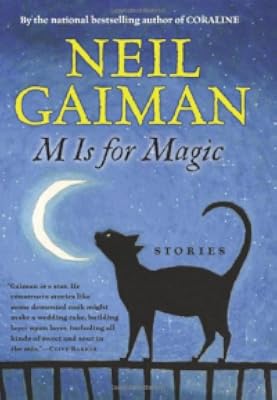
M is for Magic
by Neil Gaiman
On This Page
Description
Eleven stories that involve strange and fantastical events.Tags
Recommendations



Member Reviews
M is always for magic! I've read this collection a few times, and even though the stories are well familiar, they still manage to bring a sense of whimsy and wonder back into my life. From the comedic "Chivalry", which cleverly plays on the trope of thriftshop treasures and Arthurian quests, to the darker tale "Troll Bridge", which explores themes around a life well lived (or not), we are left knowing that there is still magic left in the mundane world. The collection wraps with one of my favourite Gaiman poems/stories: "Instructions", which, though short, is probably one of the most lovely and important pieces that he has ever written. Here we are reminded that every day is a journey, that there are rules and tropes to living (whether show more we understand them or not), and that above all belief is what should drive us. We may be getting just a teaser in this short collection of Gaiman's tales, but it's more than enough to get us hooked and on a quest for more. show less
Neil Gaiman reading his own books aloud to you is its own special magic. To demonstrate, follow this recipe:
Start by being sick in bed with a cold. Best to be past the first day, maybe day 3 or 4, to make sure you are properly bored and irritable.
Get a fresh pair of sheets on the bed. Just a fresh pillowcase will do in a pinch.
Make a hot cup of tea with honey and lemon. This will be the first of dozens, and is integral to success.
Put on this audiobook, loud enough that you can hear fine even with one ear flat on the pillow but not so loud that you are unable to doze.
Settle in and let the stories surround you. By the end of the book the magic will have taken hold, and you will surely feel better than when you started.
Start by being sick in bed with a cold. Best to be past the first day, maybe day 3 or 4, to make sure you are properly bored and irritable.
Get a fresh pair of sheets on the bed. Just a fresh pillowcase will do in a pinch.
Make a hot cup of tea with honey and lemon. This will be the first of dozens, and is integral to success.
Put on this audiobook, loud enough that you can hear fine even with one ear flat on the pillow but not so loud that you are unable to doze.
Settle in and let the stories surround you. By the end of the book the magic will have taken hold, and you will surely feel better than when you started.
A mixed bag collection of short stories, most of which I'd read before.
"The Case of the Four and Twenty Blackbirds", a noir parody in a world populated by nursery rhyme characters, is a cute concept, but I'm not sufficiently familiar with British nursery rhymes to get the most of out of it. I recognise when a reference is being made as I'll usually have heard the rhyme's title, but I don't know the actual lines to it, and so the humour Gaiman is presumably trying to mine is frequently lost on me.
"Troll Bridge" is a dark modern day fairy tale of a boy meeting a troll under a bridge, and then repeatedly as he grows older. It's perhaps not quite my cup of tea, verging too far into horror territory for my tastes, but I do find the writing show more engrossing here.
"Don't Ask Jack", a tale about a Jack-in-the-box which might or might not be haunted, has a similar mood to "Troll Bridge", but I like it a tad more, perhaps because it is shorter and simpler and I feel like I'm wasting less time getting to the point.
"How to Sell the Ponti Bridge" is, if you have a moment, a nesting narrative fantasy crime comedy thriller about a pandimensional club for con artists. It's quite good, I find, until the very end, where the end twist is not much of a twist at all, even though all the characters behave as though it's beyond brilliant. That punctures it a bit for me, but I see this is by far the oldest of the stories in the collection, and having been written much earlier in Gaiman's career, I can partially forgive it the underwhelming ending. If the end twist had been more satisfying, this would easily have been a favourite of mine, as it is otherwise very much up my alley of preferences.
"October in the Chair" is another nesting narrative. In this one personifications of the calendar months tell each other stories. I've read this one before and always feel a bit unsure if I'm missing some kind of essential point -- a couple of very short stories in the beginning aside, there's really just one proper, long tragic story told during the proceedings, and I'm unclear on why that wouldn't have worked just as well on its own, and what the framing device adds to it. While that story is fine (a bit too slow and ponderous for my tastes), the framing narrative is far more memorable, and I kind of feel like the whole of it ends up a bit lesser than the sum of its parts somehow.
"Chivalry" is a fantasy comedy of an old woman buying the Holy Graill on a whim. It's a bit of a delight, and, if you can stomach some low key zaniness, one of the collection's high points by my tastes.
"The Price" is a pseudo-autobiographical (Gaiman seems to have made himself the protagonist) fantasy horror of a black cat that shows up at his house and keeps getting hurt badly during mysterious fights at night. It feels a bit self-indulgant in the set-up, spending a lot of time describing the other cats of the house (though most of them never appear again in the story), but I find it otherwise to be the most memorable and gripping tale included.
"How to Talk to Girls at Parties" is a science fiction mystery drama of two boys attending an all-girl party that is not what it seems to be. Honestly, I didn't get much out of this in its comic book version a few years ago, and I think I now might have gotten even less out of this short story that it was adapted from. The premise is potentially quite fun, but there isn't much of a narrative springing from it.
"Sunbird" is another highlight, a fantasy horror comedy of an Epicurean club wishing to dine on a phoenix, and the story here I've read the most times previously. There's an odd irrationality to some character choices that the book lampshades but never explains that always rub me the wrong way, but I otherwise really like this one. With "Chivalry", it competes for being my second favourite story here, behind "The Price".
"The Witch's Headstone" is sort of an adventure story about a boy raised by ghosts venturing briefly into the mundane world. The story is a chapter from "The Graveyard Book" novel, and while it does work on its own here, it has a lot of references to earlier stories and set-up for later ones that should have been edited out before it was published on its own. It's entertaining, and in the stronger half of the collection for sure, but if you're interested, I'd strongly recommend you just pick up the full novel instead.
"Instructions" is a wonderful poem taking the reader through a fairy tale of evocative tropes and notions. It doesn't quite qualify as a story per se, but if it did, it'd likely edge out "The Price" as my favourite here.
Kristiansen's black and white illustrations are decent, but for me, I can't say they really gave any added value. They're too few and too anonymous to really bring anything to the stories that my imagination hadn't already done by the time they showed up.
All in all, you'd probably be better served buying a different Gaiman short story collection than this one (and as this is one that reprints stories from several other ones, you'll also avoid a lot of overlap if you skip this before buying some of the other ones), but it's definitely varied in both form and style, and should have a little something for most tastes -- assuming your tastes lean towards the supernatural in any way, at least. show less
"The Case of the Four and Twenty Blackbirds", a noir parody in a world populated by nursery rhyme characters, is a cute concept, but I'm not sufficiently familiar with British nursery rhymes to get the most of out of it. I recognise when a reference is being made as I'll usually have heard the rhyme's title, but I don't know the actual lines to it, and so the humour Gaiman is presumably trying to mine is frequently lost on me.
"Troll Bridge" is a dark modern day fairy tale of a boy meeting a troll under a bridge, and then repeatedly as he grows older. It's perhaps not quite my cup of tea, verging too far into horror territory for my tastes, but I do find the writing show more engrossing here.
"Don't Ask Jack", a tale about a Jack-in-the-box which might or might not be haunted, has a similar mood to "Troll Bridge", but I like it a tad more, perhaps because it is shorter and simpler and I feel like I'm wasting less time getting to the point.
"How to Sell the Ponti Bridge" is, if you have a moment, a nesting narrative fantasy crime comedy thriller about a pandimensional club for con artists. It's quite good, I find, until the very end, where the end twist is not much of a twist at all, even though all the characters behave as though it's beyond brilliant. That punctures it a bit for me, but I see this is by far the oldest of the stories in the collection, and having been written much earlier in Gaiman's career, I can partially forgive it the underwhelming ending. If the end twist had been more satisfying, this would easily have been a favourite of mine, as it is otherwise very much up my alley of preferences.
"October in the Chair" is another nesting narrative. In this one personifications of the calendar months tell each other stories. I've read this one before and always feel a bit unsure if I'm missing some kind of essential point -- a couple of very short stories in the beginning aside, there's really just one proper, long tragic story told during the proceedings, and I'm unclear on why that wouldn't have worked just as well on its own, and what the framing device adds to it. While that story is fine (a bit too slow and ponderous for my tastes), the framing narrative is far more memorable, and I kind of feel like the whole of it ends up a bit lesser than the sum of its parts somehow.
"Chivalry" is a fantasy comedy of an old woman buying the Holy Graill on a whim. It's a bit of a delight, and, if you can stomach some low key zaniness, one of the collection's high points by my tastes.
"The Price" is a pseudo-autobiographical (Gaiman seems to have made himself the protagonist) fantasy horror of a black cat that shows up at his house and keeps getting hurt badly during mysterious fights at night. It feels a bit self-indulgant in the set-up, spending a lot of time describing the other cats of the house (though most of them never appear again in the story), but I find it otherwise to be the most memorable and gripping tale included.
"How to Talk to Girls at Parties" is a science fiction mystery drama of two boys attending an all-girl party that is not what it seems to be. Honestly, I didn't get much out of this in its comic book version a few years ago, and I think I now might have gotten even less out of this short story that it was adapted from. The premise is potentially quite fun, but there isn't much of a narrative springing from it.
"Sunbird" is another highlight, a fantasy horror comedy of an Epicurean club wishing to dine on a phoenix, and the story here I've read the most times previously. There's an odd irrationality to some character choices that the book lampshades but never explains that always rub me the wrong way, but I otherwise really like this one. With "Chivalry", it competes for being my second favourite story here, behind "The Price".
"The Witch's Headstone" is sort of an adventure story about a boy raised by ghosts venturing briefly into the mundane world. The story is a chapter from "The Graveyard Book" novel, and while it does work on its own here, it has a lot of references to earlier stories and set-up for later ones that should have been edited out before it was published on its own. It's entertaining, and in the stronger half of the collection for sure, but if you're interested, I'd strongly recommend you just pick up the full novel instead.
"Instructions" is a wonderful poem taking the reader through a fairy tale of evocative tropes and notions. It doesn't quite qualify as a story per se, but if it did, it'd likely edge out "The Price" as my favourite here.
Kristiansen's black and white illustrations are decent, but for me, I can't say they really gave any added value. They're too few and too anonymous to really bring anything to the stories that my imagination hadn't already done by the time they showed up.
All in all, you'd probably be better served buying a different Gaiman short story collection than this one (and as this is one that reprints stories from several other ones, you'll also avoid a lot of overlap if you skip this before buying some of the other ones), but it's definitely varied in both form and style, and should have a little something for most tastes -- assuming your tastes lean towards the supernatural in any way, at least. show less
M is for Magic is a delightfully creepy collection of short stories from Neil Gaiman. These stories are typical Neil Gaiman, and I find that is a phrase that I frequently use about his work, but that's the best way to put it: typical Neil Gaiman. He has a way of writing something that is so fantastical in such a matter-of-fact way that if you were to encounter one of these stories in the real world, you'd feel like it was an everyday occurance, yet special all the same.
The stories are written for a younger audience, so they aren't quite as creepy as they could be, but that isn't saying that these stories aren't creepy and a little dark in their own right. Some of the stories that stuck out the most for me: The Case of the Four and show more Twenty Blackbirds is a perfect example of Mother Goose meets crime pulp fiction; Don't Ask Jack is a little disturbing in it's vagueness and the secrets the Jack in the Box holds; Sunbird tells the tale of the Epicurian Club and their desire to expand their appetites to the extreme; and The Witch's Headstone was later incorporated into The Graveyard Book. The accompanying illustrations by Teddy Kristiansen are dark and creepy, so they fit in with the rest of the stories perfectly.
I enjoyed M is for Magic, but I'm thinking I should have maybe spaced the stories out a little more instead of reading them all at one time. Once finished, I was left wanting a little more, and I think that's because they are short stories, and I really wanted a little more substance from my latest Gaiman selection. Maybe it's time to move onto one of his novels for an 'older' audience, or maybe revisit The Graveyard Book; don't get me wrong, I really enjoyed these stories. Maybe as a bit of advice to other readers, space them out. You'll be able to savour them that much more. show less
The stories are written for a younger audience, so they aren't quite as creepy as they could be, but that isn't saying that these stories aren't creepy and a little dark in their own right. Some of the stories that stuck out the most for me: The Case of the Four and show more Twenty Blackbirds is a perfect example of Mother Goose meets crime pulp fiction; Don't Ask Jack is a little disturbing in it's vagueness and the secrets the Jack in the Box holds; Sunbird tells the tale of the Epicurian Club and their desire to expand their appetites to the extreme; and The Witch's Headstone was later incorporated into The Graveyard Book. The accompanying illustrations by Teddy Kristiansen are dark and creepy, so they fit in with the rest of the stories perfectly.
I enjoyed M is for Magic, but I'm thinking I should have maybe spaced the stories out a little more instead of reading them all at one time. Once finished, I was left wanting a little more, and I think that's because they are short stories, and I really wanted a little more substance from my latest Gaiman selection. Maybe it's time to move onto one of his novels for an 'older' audience, or maybe revisit The Graveyard Book; don't get me wrong, I really enjoyed these stories. Maybe as a bit of advice to other readers, space them out. You'll be able to savour them that much more. show less
Like many reviewers, I find Neil Gaiman's short stories to be hit or miss. I have a sort of love-hate thing with Neil's short stories. Some of them are the best stories I've ever read, and some I find to just be tedious. Gaiman is fine with this. As he admits in his introduction: you don't have to like them all. So instead of focusing on what I don't like. I'll tell you why I think this is my favorite collection of short stories by Gaiman. Sure, they are all recycled from other publications, but that doesn't bother me. You see M Is for Magic collects my favorite four Gaiman short stories in one book, so for me it's a win-win. Chivalry is hands down one of my top three favorite short stories of all time. It's brilliant. It's up there show more with Flannery O'Connor, Bradbury, and Shirley Jackson's short stories. I'm also quite fond of Troll Bridge, The Price, Sunbird, and How To Talk To Girls at Parties. Instructions, a wonderful short poem at the end of this collection, is also an amazing picture book for children that I admire.
Now why isn't this five stars? Well, the other stories in the collection just weren't my cup of tea and I thought they were week entries in what could easily be a greatest hits collection.
The title, while a nod to Ray Bradbury, is a bit misleading as well. You would think this is a story collection for young tikes. I don't think this a book for children per se. However, it is a good middle grade/young adult read. There are some mature themes within this book.
If you haven't read Chivalry yet, do yourself a favor, read it! show less
Now why isn't this five stars? Well, the other stories in the collection just weren't my cup of tea and I thought they were week entries in what could easily be a greatest hits collection.
The title, while a nod to Ray Bradbury, is a bit misleading as well. You would think this is a story collection for young tikes. I don't think this a book for children per se. However, it is a good middle grade/young adult read. There are some mature themes within this book.
If you haven't read Chivalry yet, do yourself a favor, read it! show less
I've decided that I want to be Neil Gaiman when I grow up.
There.
End of review.
Just kidding! God, I crack myself up... M is for Magic is a collection of Gaiman's short stories packaged for children. At first, some of his choices surprised me (eg. the one about the troll where the protagonist grows up and ends up cheating on his wife), but I respect his choices and am the last person to think coddling our children by not letting them read about A-holes is acceptable, so I was soon on board. (Oh and the guy wasn't really an a-hole, although he did become a troll in the end. He was very sad about his divorce...)
Critique:
Once again, another rave fest. I loved his introduction to children, telling them they need not like every story in the show more book. I loved the story about the elderly woman who finds the holy grail in the St. Vincent de Paul and puts it on her mantlepiece. When Galahad comes to fetch it, she drives a hard bargain, fixes him sandwiches and tea , and sends him on his way. The story that started the The Graveyard book is in here, as well as an awesomely hilarious take on a coming of age story about a boy who finally learns to talk to girls at a party and realises too late that the girls are well, not exactly girls...
To conclude, I repeat. I want to be Neil Gaiman when I grow up. show less
There.
End of review.
Just kidding! God, I crack myself up... M is for Magic is a collection of Gaiman's short stories packaged for children. At first, some of his choices surprised me (eg. the one about the troll where the protagonist grows up and ends up cheating on his wife), but I respect his choices and am the last person to think coddling our children by not letting them read about A-holes is acceptable, so I was soon on board. (Oh and the guy wasn't really an a-hole, although he did become a troll in the end. He was very sad about his divorce...)
Critique:
Once again, another rave fest. I loved his introduction to children, telling them they need not like every story in the show more book. I loved the story about the elderly woman who finds the holy grail in the St. Vincent de Paul and puts it on her mantlepiece. When Galahad comes to fetch it, she drives a hard bargain, fixes him sandwiches and tea , and sends him on his way. The story that started the The Graveyard book is in here, as well as an awesomely hilarious take on a coming of age story about a boy who finally learns to talk to girls at a party and realises too late that the girls are well, not exactly girls...
To conclude, I repeat. I want to be Neil Gaiman when I grow up. show less
A lukewarm collection which runs the gamut from outright silly as in the opening "Who Killed Roger Rabbit" rip-off (The Case of the Four and Twenty Blackbirds) to melancholic (Troll Bridge) to a vague Ray Bradbury homage (The Witch's Headstone). An OK read, but I'm sure I would have enjoyed it a lot more back in grade school.
Members
- Recently Added By
Lists

Biggest Disappointments
606 works; 165 members

Books Read in 2016
4,666 works; 199 members
Author Information

848+ Works 450,879 Members
Neil Gaiman was born in Portchester, England on November 10, 1960. He worked as a journalist and freelance writer for a time, before deciding to try his hand at comic books. Some of his work has appeared in publications such as Time Out, The Sunday Times, Punch, and The Observer. His first comic endeavor was the graphic novel series The Sandman. show more The series has won every major industry award including nine Will Eisner Comic Industry Awards, three Harvey Awards, and the 1991 World Fantasy Award for best short story, making it the first comic ever to win a literary award. He writes both children and adult books. His adult books include The Ocean at the End of the Lane, which won a British National Book Awards, and the Locus Award for Best Fantasy Novel for 2014; Stardust, which won the Mythopoeic Award as best novel for adults in 1999; American Gods, which won the Hugo, Nebula, Bram Stoker, SFX, and Locus awards; Anansi Boys; Trigger Warning: Short Fictions and Disturbances; and The View from the Cheap Seats: Selected Nonfiction, which is a New York Times Bestseller. His children's books include The Day I Swapped My Dad for Two Goldfish; Coraline, which won the Elizabeth Burr/Worzalla, the BSFA, the Hugo, the Nebula, and the Bram Stoker awards; The Wolves in the Walls; Odd and the Frost Giants; The Graveyard Book, which won the Newbery Award in 2009 and The Sandman: Overture which won the 2016 Hugo Awards Best Graphic Story. (Bowker Author Biography) show less
All Editions
Awards and Honors
Awards
Work Relationships
Is contained in
Contains
Common Knowledge
- Canonical title
- M is for Magic
- Original title
- M is for Magic
- Original publication date
- 2007-06-27
- People/Characters
- Humpty Dumpty; Jack Horner; Troll; Jack-in-the-Box; October; Galaad (Galahad) (show all 7); Galahad (as Galaad)
- Important places
- Nurseryland
- Dedication
- Writing imaginative tales for the young is like sending coals to Newcastle. For coals.
- First words
- I sat in my office, nursing a glass of hooch and idly cleaning my automatic.
- Last words
- (Click to show. Warning: May contain spoilers.)Or rest.
- Blurbers
- Barker, Clive
- Original language
- English
Classifications
- Genres
- Fiction and Literature, Fantasy, Tween
- DDC/MDS
- 823.914 — Literature & rhetoric English & Old English literatures English fiction 1900- 1901-1999 1945-1999
- LCC
- PZ7 .G1273 .M — Language and Literature Fiction and juvenile belles lettres Fiction and juvenile belles lettres Juvenile belles lettres
- BISAC
Statistics
- Members
- 2,394
- Popularity
- 8,228
- Reviews
- 101
- Rating
- (3.83)
- Languages
- 6 — Chinese, English, Italian, Farsi/Persian, Polish, Spanish
- Media
- Paper, Audiobook, Ebook
- ISBNs
- 28
- UPCs
- 2
- ASINs
- 4