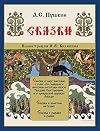
Skazki
by A.S. Pushkin, Boris Aleksandrovich Dekhterev, [from old catalog] (Illustrator)
On This Page
Description
Several generations of readers enjoy the wonderful, fantastic and at the same time very earthly world of Pushkin's fairy tales. They published many times and will be published. This book - a special phenomenon. For the first time, virtually every stanza illustrated works. Heroes of fairy tales come to life with bright colors shone magic world.Tags
Recommendations


















Member Reviews
This is a beautiful edition of Pushkin's fairy tales in verse published for elementary school age children in 1955. The ample illustrations are by B. Dekhterev and are luscious. The pictures look like ink drawings that are detailed and beautifully done in black and white.
Pushkin's skazki (fairy or folk tales) are a joy to read. For the foreign student, this edition is nice because it has stress marks above the words (unusual for Russian books), making reading the verses correctly easier. This is because the edition is designated for "non-Russian" schools -- that is most likely for Russian learners in the non-Russian Soviet republics. There are some short explanatory notes and definitions for some of the words at the bottom of the page, show more but for the most part, one would need a dictionary to parse the reading if one is not a beyond second year of language study. There is also a short essay introducing school-age children to Pushkin and his fairy tales written by the author Konstantin Paustovsky.
Though it is commonly accepted that Pushkin rewrote "Russian" fairytales he heard from his nanny, in fact, several of the tales have elements taken from 1001 arabian nights, Greek mythology and European fairytales, for example "The story of the Dead Princess (tsarevna) and the seven Knights (bogatyry)" is a Russianized version of "Snow White and the Seven Dwarfs". In any case, Pushkin's skazki are delightful.
Contents:
"Skazki Pushkina" by Konstantin Paustovskii
Skazka o tsare Saltane, o syne ego slavnom i moguchem bogatyre kniazt Gvidone Saltanoviche i o prekrasnoi tsarevne Lebedi
Skazka o rybake i rybke
Skazka o pope i o rabotnike ego Balda
Skazka o mertvoi tsarevne i o semi bogatyriakh
Skazka o zolotom petushke show less
Pushkin's skazki (fairy or folk tales) are a joy to read. For the foreign student, this edition is nice because it has stress marks above the words (unusual for Russian books), making reading the verses correctly easier. This is because the edition is designated for "non-Russian" schools -- that is most likely for Russian learners in the non-Russian Soviet republics. There are some short explanatory notes and definitions for some of the words at the bottom of the page, show more but for the most part, one would need a dictionary to parse the reading if one is not a beyond second year of language study. There is also a short essay introducing school-age children to Pushkin and his fairy tales written by the author Konstantin Paustovsky.
Though it is commonly accepted that Pushkin rewrote "Russian" fairytales he heard from his nanny, in fact, several of the tales have elements taken from 1001 arabian nights, Greek mythology and European fairytales, for example "The story of the Dead Princess (tsarevna) and the seven Knights (bogatyry)" is a Russianized version of "Snow White and the Seven Dwarfs". In any case, Pushkin's skazki are delightful.
Contents:
"Skazki Pushkina" by Konstantin Paustovskii
Skazka o tsare Saltane, o syne ego slavnom i moguchem bogatyre kniazt Gvidone Saltanoviche i o prekrasnoi tsarevne Lebedi
Skazka o rybake i rybke
Skazka o pope i o rabotnike ego Balda
Skazka o mertvoi tsarevne i o semi bogatyriakh
Skazka o zolotom petushke show less
Text in Russian. Appears to be collection of four children's stories in verse. Originally from the collection of Stanley Marcus. Stanley Marcus bookplate.
Ratings
Members
- Recently Added By
Author Information

1,144+ Works 17,379 Members
Aleksandr Sergeyevich Pushkin, one of Russian's greatest poets, was born in Moscow on June 6, 1799. He studied Latin and French literature at the Lyceum. Pushkin was often in conflict with the government and was kept under surveillance for much of his later life. He was also exiled for a period of time. His works include Eugene Onegin and Ruslan show more and Ludmila. Pushkin died on February 10, 1837 in St. Petersburg of a wound received during a duel protecting the honor of his wife. (Bowker Author Biography) show less

Alexander Pushkin has a Legacy Library. Legacy libraries are the personal libraries of famous readers, entered by LibraryThing members from the Legacy Libraries group.
Classifications
- Genres
- Fiction and Literature, Children's Books, Poetry
- DDC/MDS
- 398.2 — Society, Government, and Culture Customs, etiquette & folklore Folklore & Folktales Folk literature
- LCC
- PG3343 .S5 — Language and Literature Slavic languages and literatures. Baltic languages. Albanian language Slavic. Baltic. Albanian Russian literature Individual authors and works 1800-1870 Pushkin
- BISAC
Statistics
- Members
- 50
- Popularity
- 602,023
- Reviews
- 2
- Rating
- (4.13)
- Languages
- English, Greek, Hindi, Russian
- Media
- Paper, Ebook
- ISBNs
- 47
- ASINs
- 4