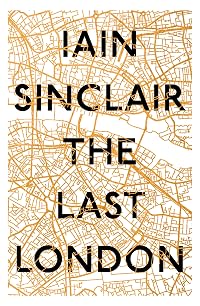
The Last London: True Fictions from an Unreal City
by Iain Sinclair
On This Page
Description
Iain Sinclair has been documenting the peculiar magic of the river city that absorbs and obsesses him for most of his adult life. In 'The Last London', Sinclair strikes out on a series of solitary walks and collaborative expeditions to make a final reckoning with a capital stretched beyond recognition.Tags
Recommendations














Member Reviews
I know I once read, and I suppose it may still be true, that London is the most surveilled city in the world, based on the number of CCTV cameras per person. An awareness of this reality is one of many that hovers in the margins of Iain Sinclair's Last London, but the lines of the pages are Sinclair's own indefatigable observation, overhearing, trailing, tailing, and cultural auditing, as he orbits through Olympicopolis, "Shardenfreude," and a variety of other psychogeographical states and locales. The text combines his own stream-of-consciousness flâneur experiences with kledomancy, graffiti transcription and exegesis, literary anecdote and gossip, and historical research.
In the 1925 story "He," H.P. Lovecraft wrote of New York City show more "the unwhisperable secret of secrets—the fact that this city of stone and stridor is not a sentient perpetuation of Old New York as London is of Old London and Paris of Old Paris, but that it is in fact quite dead, its sprawling body imperfectly embalmed and infested with queer animate things which have nothing to do with it as it was in life." In the twenty-first century New York's unlife has since spread to cities throughout the United States, and through the neoliberal metastases of capital it now spans the world, infecting even the London and Paris that Lovecraft used to supply a contrasting sense of durable urban vitality. (Not that HPL himself ever visited either city.) Arriving at this conclusion independently, Sinclair seeks in this book to preserve his observations of the "last London" as it succumbs to the virus.
The press of gentrification, speculative property redevelopment, and globalized real estate investment all contribute to the sense of expiration here. It's the sterility and expropriation that are so fatal, not the decay and mutation. The book's not sad, though. "I love it," Sinclair writes of the "panoramic edgeland vista" he encounters in his effort to walk to Barking, under the spectre of the US Presidential election of Donald Trump (241). The final chapter is festive in a manner that might take less artistic people 20 to 40 micrograms to achieve. Also notable throughout is Sinclair's network of fellow creatives, who accompany him and serve as rests, termini, and haunters of his walks.
Many allusions to contemporary literature, politics, commerce, and so on are made at a rapid pace with little assistance to the reader's comprehension. I guess that's what search engines are for, when it seems important. The book is longish for its style, but Sinclair's elliptical rants and musings all add up to a worthwhile read. He's an author I've been curious about for many years, and I'm glad to have finally gotten around to reading this very current work. show less
In the 1925 story "He," H.P. Lovecraft wrote of New York City show more "the unwhisperable secret of secrets—the fact that this city of stone and stridor is not a sentient perpetuation of Old New York as London is of Old London and Paris of Old Paris, but that it is in fact quite dead, its sprawling body imperfectly embalmed and infested with queer animate things which have nothing to do with it as it was in life." In the twenty-first century New York's unlife has since spread to cities throughout the United States, and through the neoliberal metastases of capital it now spans the world, infecting even the London and Paris that Lovecraft used to supply a contrasting sense of durable urban vitality. (Not that HPL himself ever visited either city.) Arriving at this conclusion independently, Sinclair seeks in this book to preserve his observations of the "last London" as it succumbs to the virus.
The press of gentrification, speculative property redevelopment, and globalized real estate investment all contribute to the sense of expiration here. It's the sterility and expropriation that are so fatal, not the decay and mutation. The book's not sad, though. "I love it," Sinclair writes of the "panoramic edgeland vista" he encounters in his effort to walk to Barking, under the spectre of the US Presidential election of Donald Trump (241). The final chapter is festive in a manner that might take less artistic people 20 to 40 micrograms to achieve. Also notable throughout is Sinclair's network of fellow creatives, who accompany him and serve as rests, termini, and haunters of his walks.
Many allusions to contemporary literature, politics, commerce, and so on are made at a rapid pace with little assistance to the reader's comprehension. I guess that's what search engines are for, when it seems important. The book is longish for its style, but Sinclair's elliptical rants and musings all add up to a worthwhile read. He's an author I've been curious about for many years, and I'm glad to have finally gotten around to reading this very current work. show less
 This review was written for LibraryThing Early Reviewers.
I've read Sinclair once before--his novel Downriver which I struggled fairly hard to get through. I liked The Last London a lot better. I kind of look at it as somewhat like a travel book---one that takes you around London and its satellite towns but not by way of the usual tourist traps. It's a lot more eclectic than that. But anyway when I go somewhere I'm usually happier when I'm not in the middle of the thing to see or the thing to do. More of a wanderer type and this book wanders. Some probably won't like that as much but I don't mind at all. And with all the eclectic hotspots we find a cast of eclectic fellow wanderer friends of Sinclairs many of whom are writers--artists--lesser known sometimes but..... and then there's the ghost show more of W.G. Sebald that seems to permeate throughout the pages from chapter to chapter. In fact the book quite reminds me a lot of Sebald's work.
The prose can be difficult for an American ear/eye but generally speaking I thought the book very worthwhile reading so I'm giving it 4 stars. show less
The prose can be difficult for an American ear/eye but generally speaking I thought the book very worthwhile reading so I'm giving it 4 stars. show less
This review was written for LibraryThing Early Reviewers.There are so many reasons I’m unqualified to review this book:
- I haven’t been to London in almost 20 years
- I’m an American
- I haven’t read any of Sinclair’s previous books
- I’m intelligent, but certainly not the kind of intellectual bent that powers Sinclair and his circle
On the other hand, I am a faithful reader of The Economist (which I suspect Sinclair despises), so here goes.
This book mostly concerns a series of journeys the author took from his base in Hackney in the company of various friends or colleagues to the outer reaches of London, places with great names like Sheerness and Barking. The name may be the best part of some of these places to go by Sinclair’s takes on them. No matter the location, a number of show more consistent themes recur:
- The constant construction in all parts of Greater London, whether for the Olympics or Crossrail, that screw up transit routes, and the resulting new development that pushes out the lower class and leads to a surplus of coffee shops and bicycle lanes full of impolite cyclists
- The hopeless plight of refugees up against the British bureaucracy
- The loss of a sense of place as everything is turned into monstrous shopping malls or other developments that drive out old businesses such as used book dealers, who find themselves outbid for new space by fancy beard trimmers
- The presence of violence, whether remembered in the form of long-ago gangsters such as the Kray Twins, notorious serial killers, or present-day bicyclists being crushed beneath the wheels of buses (or transports for London’s public bike scheme!)
- The utter failure of politicians of any party to do anything about any of the aforementioned items
By now, you may have correctly guessed that this is probably not a book the London Tourism Bureau will be recommending to prospective tourists. But the book’s tone, despite the negativity, is not angry. Perhaps “resigned” is the best description. The title, “The Last London”, takes on more meaning if taken to mean a last look at a London that is increasingly unrecognizable and rushing headlong toward further irrevocable, dehumanizing changes.
Sinclair’s sympathies are with the inscrutable homeless man he sees every day in Haggerston Park, the ever-present refugees, or the urban explorers who illegally scale the not-yet-open Shard, the monolithic skyscraper that seems to now dominate London. His friends are writers, often poets, artists, or photographers, such as the one who takes a series of photographs of chewing gum that has been ground into the pavements of London.
There are other presences throughout the book, the writer Alan Moore, for one, who receives several mentions. The German writer W.G. Sebald’s book Austerlitz is referred to throughout the book, as well.
There is a bit of inconsistency at times. Despite the author’s love of repeating tales of sensational violence and horrific accidents, he and his merry band have no fear of death or danger as they set out on an all-night walk through London, including one or two dicey parts. There is nothing inconsistent, however, about the author’s common view of Margaret Thatcher, whose funeral day features on one of the book’s walks, as the root of all the ills of present-day Britain. The end of the book takes place under the prevailing gloom of the election of Donald Trump, whose malign shadow is not diminished by the separation of Britain and America by the Atlantic Ocean.
The book’s prose will engross you, although you may not always have a clear idea of what the author is talking about. That would require a firm grasp of British history that most of us lack. A few trips to Wikipedia were a big help in learning more about subjects such as King Harold. And Google Maps can help bring some more perspective on the places visited. The book itself has no maps, and the black and white photographs are mostly of people involved in the story. Mostly, however, the photographs seem to be designed to set a mood rather than convey concrete information.
Along the journey with Sinclair, you’ll be drawn into lots of byways, such as discussions of probably forgotten books such as “The Land Under England” in which a dystopian society descended from Roman Legions lives under Britain, or the seedy London world of Hangover Square and other novels by Patrick Hamilton.
If, after all of this, you still want to visit London, you are likely to see it with new eyes. Rather than marveling at the history presented in those ubiquitous blue plaques, you’ll find yourself looking for unobtrusive shelters for the homeless, surreptitiously placed to blend in with the construction huts and sheds that seem to be everywhere. And maybe you’ll be looking more at the pavement than usual. Mostly, however, you are likely to be looking around you for what is being lost, rather than admiring what is new. show less
- I haven’t been to London in almost 20 years
- I’m an American
- I haven’t read any of Sinclair’s previous books
- I’m intelligent, but certainly not the kind of intellectual bent that powers Sinclair and his circle
On the other hand, I am a faithful reader of The Economist (which I suspect Sinclair despises), so here goes.
This book mostly concerns a series of journeys the author took from his base in Hackney in the company of various friends or colleagues to the outer reaches of London, places with great names like Sheerness and Barking. The name may be the best part of some of these places to go by Sinclair’s takes on them. No matter the location, a number of show more consistent themes recur:
- The constant construction in all parts of Greater London, whether for the Olympics or Crossrail, that screw up transit routes, and the resulting new development that pushes out the lower class and leads to a surplus of coffee shops and bicycle lanes full of impolite cyclists
- The hopeless plight of refugees up against the British bureaucracy
- The loss of a sense of place as everything is turned into monstrous shopping malls or other developments that drive out old businesses such as used book dealers, who find themselves outbid for new space by fancy beard trimmers
- The presence of violence, whether remembered in the form of long-ago gangsters such as the Kray Twins, notorious serial killers, or present-day bicyclists being crushed beneath the wheels of buses (or transports for London’s public bike scheme!)
- The utter failure of politicians of any party to do anything about any of the aforementioned items
By now, you may have correctly guessed that this is probably not a book the London Tourism Bureau will be recommending to prospective tourists. But the book’s tone, despite the negativity, is not angry. Perhaps “resigned” is the best description. The title, “The Last London”, takes on more meaning if taken to mean a last look at a London that is increasingly unrecognizable and rushing headlong toward further irrevocable, dehumanizing changes.
Sinclair’s sympathies are with the inscrutable homeless man he sees every day in Haggerston Park, the ever-present refugees, or the urban explorers who illegally scale the not-yet-open Shard, the monolithic skyscraper that seems to now dominate London. His friends are writers, often poets, artists, or photographers, such as the one who takes a series of photographs of chewing gum that has been ground into the pavements of London.
There are other presences throughout the book, the writer Alan Moore, for one, who receives several mentions. The German writer W.G. Sebald’s book Austerlitz is referred to throughout the book, as well.
There is a bit of inconsistency at times. Despite the author’s love of repeating tales of sensational violence and horrific accidents, he and his merry band have no fear of death or danger as they set out on an all-night walk through London, including one or two dicey parts. There is nothing inconsistent, however, about the author’s common view of Margaret Thatcher, whose funeral day features on one of the book’s walks, as the root of all the ills of present-day Britain. The end of the book takes place under the prevailing gloom of the election of Donald Trump, whose malign shadow is not diminished by the separation of Britain and America by the Atlantic Ocean.
The book’s prose will engross you, although you may not always have a clear idea of what the author is talking about. That would require a firm grasp of British history that most of us lack. A few trips to Wikipedia were a big help in learning more about subjects such as King Harold. And Google Maps can help bring some more perspective on the places visited. The book itself has no maps, and the black and white photographs are mostly of people involved in the story. Mostly, however, the photographs seem to be designed to set a mood rather than convey concrete information.
Along the journey with Sinclair, you’ll be drawn into lots of byways, such as discussions of probably forgotten books such as “The Land Under England” in which a dystopian society descended from Roman Legions lives under Britain, or the seedy London world of Hangover Square and other novels by Patrick Hamilton.
If, after all of this, you still want to visit London, you are likely to see it with new eyes. Rather than marveling at the history presented in those ubiquitous blue plaques, you’ll find yourself looking for unobtrusive shelters for the homeless, surreptitiously placed to blend in with the construction huts and sheds that seem to be everywhere. And maybe you’ll be looking more at the pavement than usual. Mostly, however, you are likely to be looking around you for what is being lost, rather than admiring what is new. show less
This review was written for LibraryThing Early Reviewers.I’ll be visiting London this fall for the first time since my honeymoon 23 years ago. In anticipation of all the changes that await me, I decided to check out Iain Sinclair’s The Last London. Although he’s a well-known novelist in the UK, I’m only familiar with him through his appearances in filmmaker John Roger’s YouTube videos of his walks around literary London.
Based on the description, I was expecting a melancholy tract lamenting the relentless modernization and homogenization of the ancient city, and that’s certainly plays a big part, but on the whole this book is much more nuanced and multi-faceted than that. First and foremost, this is a challenging read. Sinclair has a very unique way of coming at things and, as a show more result, his writing is often unnecessarily complex and circuitous. I frequently found myself unsure of the point he was trying to make. There are also many references to art – literature and literary figures, in particular – much of which was not familiar to me. But the reward for toughing it out are moments of undeniable brilliance and humor.
To the younger crowd, he might come off as curmudgeonly, particularly when he carps about the dangers of bike traffic or obsessive cell phone dependency, but that’s also when he’s at his most hilarious. Two of the book’s funniest passages are simply snippets of overheard phone conversations and a list of slogans taken off posters pasted up in his beloved neighborhood of Hackney. It seems that Sinclair sees globalization as blurring the edges of London (and, by extension, all cities), as it bleeds into the rest of the world, losing what makes it unique and making it indistinguishable from any city, anywhere.
For all its dry humor, keen observation, sardonic wit and obvious affection, The Last London makes me a bit heartsick for all that’s been lost in the two decades since last I saw that amazing city. show less
Based on the description, I was expecting a melancholy tract lamenting the relentless modernization and homogenization of the ancient city, and that’s certainly plays a big part, but on the whole this book is much more nuanced and multi-faceted than that. First and foremost, this is a challenging read. Sinclair has a very unique way of coming at things and, as a show more result, his writing is often unnecessarily complex and circuitous. I frequently found myself unsure of the point he was trying to make. There are also many references to art – literature and literary figures, in particular – much of which was not familiar to me. But the reward for toughing it out are moments of undeniable brilliance and humor.
To the younger crowd, he might come off as curmudgeonly, particularly when he carps about the dangers of bike traffic or obsessive cell phone dependency, but that’s also when he’s at his most hilarious. Two of the book’s funniest passages are simply snippets of overheard phone conversations and a list of slogans taken off posters pasted up in his beloved neighborhood of Hackney. It seems that Sinclair sees globalization as blurring the edges of London (and, by extension, all cities), as it bleeds into the rest of the world, losing what makes it unique and making it indistinguishable from any city, anywhere.
For all its dry humor, keen observation, sardonic wit and obvious affection, The Last London makes me a bit heartsick for all that’s been lost in the two decades since last I saw that amazing city. show less
This review was written for LibraryThing Early Reviewers.Iain Sinclair must be an acquired taste. I don't think I want it often on my mental palette, but I will likely look for another of his London books someday. His premise in The Last London is that what has made London distinctive is disappearing rapidly. This is a book in which Sinclair walks his London, sees the changes, and says good-by. I don't know enough about the contemporary city to follow a lot of what he says, but what I did get was always pointed and often hilarious or poignant. This is a perfect corrective for romantic Anglophiles, whose idea of London is stuck somewhere between the late 18th century and early 20th century Bloomsbury - mostly white, English-speaking, antiseptic as it never was.
Sinclair's London is often that show more of W. G. Sebald's Austerlitz (which I wish I had read before opening this book). He walks Hackney, Haggerston, Bethnal Green, often in the company of Sebald's friend, the poet Stephen Watt. He walks at night. He walks and praises the photography of Effie Paleologou. He walks and harks back to the Vegetative Buddha of Haggerston Park, who sits, an anchor, in the same place on the same bench every day, no matter what the weather. He attempts use Santander/Boris bicycles and fails. He spends a night with his wife in the Shard, symbol for him of the sterile new build which is replacing his London.
Margaret Thatcher, Donald Trump, and Teresa May are anathema. Here he is on May: "Teresa May (or May Not), whose rise was as subtle as John Major in drag, is giving nothing away; as slowly as she can....She staggers into a booby-trapped future on unsuitable heels, trying to keep the political agenda to serious topics: expensive leather trousers (her own) versus the designer handbags (of her critics)."
I got that. Here's Sinclair in mainly incomprehensible (to me) mode: "THE ALBION SAILS ON COURSE. Black script on white wall. The spill-zone around Corbridge Crescent, the painted devil heads and hybrid monsters, the bare-breasted pin-ups from naughtier times mouthing Situationist slogans, are captured and made fit for purpose by film crews and television set-dressers, lighting technicians and catering caravans, responding to dissent as: exploitable edge" That choice does not reflect his penchant for sentence fragments that I cannot love. I do, however, get a general picture for which I'm grateful, and I'll hope to try again someday.
Thank you, ER, for the opportunity to expand my reading experience! show less
Sinclair's London is often that show more of W. G. Sebald's Austerlitz (which I wish I had read before opening this book). He walks Hackney, Haggerston, Bethnal Green, often in the company of Sebald's friend, the poet Stephen Watt. He walks at night. He walks and praises the photography of Effie Paleologou. He walks and harks back to the Vegetative Buddha of Haggerston Park, who sits, an anchor, in the same place on the same bench every day, no matter what the weather. He attempts use Santander/Boris bicycles and fails. He spends a night with his wife in the Shard, symbol for him of the sterile new build which is replacing his London.
Margaret Thatcher, Donald Trump, and Teresa May are anathema. Here he is on May: "Teresa May (or May Not), whose rise was as subtle as John Major in drag, is giving nothing away; as slowly as she can....She staggers into a booby-trapped future on unsuitable heels, trying to keep the political agenda to serious topics: expensive leather trousers (her own) versus the designer handbags (of her critics)."
I got that. Here's Sinclair in mainly incomprehensible (to me) mode: "THE ALBION SAILS ON COURSE. Black script on white wall. The spill-zone around Corbridge Crescent, the painted devil heads and hybrid monsters, the bare-breasted pin-ups from naughtier times mouthing Situationist slogans, are captured and made fit for purpose by film crews and television set-dressers, lighting technicians and catering caravans, responding to dissent as: exploitable edge" That choice does not reflect his penchant for sentence fragments that I cannot love. I do, however, get a general picture for which I'm grateful, and I'll hope to try again someday.
Thank you, ER, for the opportunity to expand my reading experience! show less
This review was written for LibraryThing Early Reviewers.Blurbs indicate The Last London is Sinclair's coda to a lifetime's commentary on London's devolution. It's unclear to me now whether I inferred that myself before cracking the book, or applied it unconsciously after reading that and perhaps other promotional material. The title contains an implied judgment, but the subtitle adds ambiguous nuance to that last (and I suspect editors supplied the subtitle if not the title).
Now I've read it, I have neither the impression The Last London attempts to summarise nor to exemplify Sinclair's position, and the only emblematic passages I noted are less memorable encapsulations of what I'd read in Ghost Milk. True, individual essays can be read as a summary: for example, "Brexit" ends with dates show more like a tombstone, "1975-2016", but are those dates for London or for Sinclair's walkabouts? Other essays on the excavation trend --London's expansion down rather than up or outward into suburbs-- or urban archaeology are the most interesting, but these I found additive more than providing any sigma summation.
The rest I found interesting but not for any insights into London, particularly.
The last London is a lost London, a city of fracture and disappearance. [162]
Perhaps a more instructive view is of Sinclair's essays comprising his literary leave-taking, and not an argument that London has reached a culmination. Sinclair departs the London he knows even as he resides in Hackney, the city around him dissolving to a point he's left it without having gone anywhere.
I wouldn't think this a suitable place to begin reading Sinclair, even within his professed docunovel ouvre. It is pleasingly free of plot or strongly-drawn characters, allowing significance to arise from the interaction of the text and the reader's own musings. This gauzy character suits the subject, I think, though perhaps others will only find reason for complaint. I brought recollections of cultural critique from prior Sinclair, asked what this new narrative would say about urban development and about London character, and the result was satisfying. Still, I anticipate stronger impressions and more lasting meaning from prior London docunovels. show less
Now I've read it, I have neither the impression The Last London attempts to summarise nor to exemplify Sinclair's position, and the only emblematic passages I noted are less memorable encapsulations of what I'd read in Ghost Milk. True, individual essays can be read as a summary: for example, "Brexit" ends with dates show more like a tombstone, "1975-2016", but are those dates for London or for Sinclair's walkabouts? Other essays on the excavation trend --London's expansion down rather than up or outward into suburbs-- or urban archaeology are the most interesting, but these I found additive more than providing any sigma summation.
The rest I found interesting but not for any insights into London, particularly.
The last London is a lost London, a city of fracture and disappearance. [162]
Perhaps a more instructive view is of Sinclair's essays comprising his literary leave-taking, and not an argument that London has reached a culmination. Sinclair departs the London he knows even as he resides in Hackney, the city around him dissolving to a point he's left it without having gone anywhere.
I wouldn't think this a suitable place to begin reading Sinclair, even within his professed docunovel ouvre. It is pleasingly free of plot or strongly-drawn characters, allowing significance to arise from the interaction of the text and the reader's own musings. This gauzy character suits the subject, I think, though perhaps others will only find reason for complaint. I brought recollections of cultural critique from prior Sinclair, asked what this new narrative would say about urban development and about London character, and the result was satisfying. Still, I anticipate stronger impressions and more lasting meaning from prior London docunovels. show less
This review was written for LibraryThing Early Reviewers.This book about Sinclair's wanderings around he City of London has almost fictional feel to it. An almost novelistic encounter with peoples and places: the Vegetative Buddha. I found his story of the Society of St. Mrgaret interesting as a fellow Anglican being sympathetic to Anglo-Catholic causes. He treks the Overground Railway, an unheralded aspect of London Transport. Then there is Shangri-la and the Haggerston Baths - not really sure they are findable. He makes it down to Croydon to establish a link with Sebald. He explores the Thames estuary beyond Gravesend and very much an edge place. He ends with Brexit and what can that mean for London. Unfortunately, this review book did not contain the index, which mkes it problematic for show more checking things out. show less
This review was written for LibraryThing Early Reviewers.Members
- Recently Added By
Lists

Publishers Weekly Best Books of the Week / Starred Reviews 2018
78 works; 2 members
Author Information

87+ Works 4,603 Members
Iain Sinclair is a professional theatre director and dramaturge based in Sydney, Australia. He is a graduate of both The Royal Academy of Dramatic Art (RADA) and King's College London. His works includes Our Town and Blood Wedding for the Sydney Theatre Company, as well as The Seed for Company B. Belvoir.
Some Editions
Awards and Honors
Notable Lists
Common Knowledge
- Canonical title
- The Last London: True Fictions from an Unreal City
- Original publication date
- 2017
- Important places
- London, England, UK
- Quotations
- Provision of swimming pools [and public baths] made a very real difference to the quality of life in impoverished inner city and industrial areas. But utopianism went out of fashion ... by the Realpolitik of Thatcher a... (show all)nd the millenial boosterism of Blair and the New Labour spinners. [148]
- Original language
- English
Classifications
Statistics
- Members
- 146
- Popularity
- 223,593
- Reviews
- 10
- Rating
- (3.73)
- Languages
- English, French, Italian
- Media
- Paper, Audiobook, Ebook
- ISBNs
- 6
- ASINs
- 6