
Stephen Smith (1) (1961–)
Author of Underground London: Travels Beneath the City Streets
For other authors named Stephen Smith, see the disambiguation page.
About the Author
Stephen Smith works for Channel 4 News and writes regularly for the London Review of Books
Works by Stephen Smith
Tagged
Common Knowledge
- Birthdate
- 1961
- Gender
- male
- Education
- University of Reading (BA|Politics & economics)
- Occupations
- journalist
broadcaster
writer
television presenter
podcaster - Organizations
- Channel 4 News
BBC Newsnight - Places of residence
- London, England, UK
- Associated Place (for map)
- England, UK
Members
Reviews
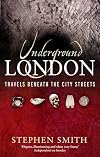
Of course this book was interesting: fascinating even. Who could not be interested in tales of the construction of the London underground, the Post Office's now defunct private underground service for moving mail around, plague pits, war-time bunkers and so on? Despite the thorough research, Stephen Smith has a light touch and it's easy enough to gallop through the book. However, I did find his jokes against the many people with whom he shared his underground voyages, and to whom he was show more indebted for much of his information a bit on the cheap side, and it slightly took the gloss off the stories he told. Overall however, quite compelling reading, whether or not you know your way round overground London. show less
A fascinating tour around all kinds of things to be found under London: sewers, tube tunnels, Roman remains, wine cellars, flood defences, to name but a few. Of course the author's really after the truth about secret government tunnels and the like as well. All really interesting - there were a few chapters I cracked open thinking "hmm, not very exciting" but even if the locations weren't great the author got some decent stories out of them.

A wealth of information here--there are many times where I felt (and methinks rightfully so) that I was being treated to some deeply-buried gems, secrets of which only a select few could know the true nature. Some chapters are as surprisingly naughty and funny as what Smith is unearthing for readers in a particular strata. One or two are extremely dry--an agonizingly detailed and technical chapter on a dam system is a violent break in pace and interest. It seemed a well-meaning tribute not show more to readers or the subject matter but to a guide who had done Smith a big favor in letting him tour a normally off-limits area, nevermind that it didn't turn out to be as worthwhile as rumored. The rumor-mongers are a community of London Underground enthusiasts and the chapter might have been dedicated to the purpose of appeasing/impressing them as well, a testy issue Smith does mention several times in the text (in more amusing chapters). Despite this major mistake and some minor detours of the blander kind, Underground London is a rich feast of an adventure, presenting wonderful stories and spaces and journeys in an entertaining, intimate manner studded with important historical moments and fabulous little anecdotes. I will definitely be revisiting this. show less
I bought this on my last trip to London (years ago, sadly) and didn't finish it on the plane ride home - and somehow it got set aside. Suddenly now seems the time to remedy that. (I left my bookmark in the book too - I was using a ticket stub from the Tower Bridge Exhibition, dated 8 May 2007.]
...I'm now on the part about London's hidden rivers and remembering how much learning about them delighted me. Multiple, entire rivers vanished from sight, but still flowing under the city and other show more built over areas. It sounds completely unreal.
...Ok, I don't remember this bit, and though I've read about bear baiting and dog and cock fighting, this scenario is new:
...I think I'm jealous of the author's childhood field trips:
...Another quote, this time about a London ceremony at All Hallows:
...I'm going to have to make a list now of obscure places the book mentions because I know eventually I'm going to want to refer to them.
[And because that tangent went on a bit too long - I tucked it away over here.]
...So far my favorite chapter is Lifting People which combines the stories of clearing the bodies in the crypt of Saint Andrew's (Holborn), the team of "lifters" moving the bodies, and local history of the plague. The lifters have some great stories:
...It's always likely that I'm going to enjoy almost anything having to do with cemetery history, and so the chapter Going Out With a Bang, which involves both history and a guided tour of a crypt, is another favorite. In the following, Kevin is the tour guide at the catacombs of the General Cemetery of All Souls at Kensal Green
The chapter on the Underground (Euston, We Have a Problem), forgotten/closed stations, and use of Tube stations during the bombings of World War II makes me think I need to dig up a book specifically on the Underground and the war. Holding back on quoting because I've probably thrown out quite enough quotes at this point. Oh and there are two ghost stories related in that chapter.
...In the chapter Post Restante about the Post Office and its miniature railroad system to transport mail - and this comes up about Mount Pleasant:
...Summing up!
Smith hops a bit from topic to topic, and while his facts all are relevant to the point he's making or the area he's visiting, some may not like this style of telling history. He also cited English authors that you may not have heard of, but those are usually in either the index or the bibliography. He'll often tell more than one story at the same time - hopping from a present day tour he's taking to the distant past and the history of the area. Smith's writing style is very much that of a long magazine article in each chapter, which is nice if you want to pick up the book, read a few chapters, then set it aside for a bit.
Depending on what subject you're researching this could be a problematic source because Smith doesn't footnote anything, though you can track down most of his sources via the bibliography. show less
...I'm now on the part about London's hidden rivers and remembering how much learning about them delighted me. Multiple, entire rivers vanished from sight, but still flowing under the city and other show more built over areas. It sounds completely unreal.
p. 31 "...But shipping still preferred to steer clear and the river continued to fill with waste. As London has grown, so the Fleet has disappeared. It has been landscaped out of sight. This trend, affecting not only the Fleet but other lost rivers too, has had very little to do with sanitation and everything to do with the demand for land in central London. Broadly speaking, the covering of the Fleet has proceeded in the opposite direction to the flow of the river, beginning close to the point where it discharges into the Thames and retracing its route back towards its source."Obviously I'm really enjoying rereading this part.
p. 32 "...As London expanded, so did the demands on its sewers. In 1846, the pressure of trapped gases became too much for the Fleet and a section of it spectacularly blew up. Traffic couldn't move for effluent at King's Cross, three poorhouses in Clerkenwell were swept away in a tidal stream of sewage, and a Thames steamboat rammed into Blackfriars Bridge on a bow wave of crap.
If you've been leafing through this book in the hope that subterranean London will be a respite from the vulgarity of the world above, I'm afraid I can only apologise. Dear reader, it gets worse."
...Ok, I don't remember this bit, and though I've read about bear baiting and dog and cock fighting, this scenario is new:
p. 51 "...A landlord called Jimmy Shaw claimed to buy 26,000 rats a year, at 3d each, from farm labourers in Enfield and Essex. Never likely to attract the Marquess of Queensberry's seal of approval, these bouts were bloodbaths involving dogs and scores of rats at a time."And that's all there is on that point - I'm not being coy and withholding any more from that story. But then this is the sort of detail that I'm always going to glom onto and wish for more, when there probably aren't more details provided in the original sources anyway. Still, rats vs dog fights are going to sink into that part of my brain that likes to ponder the nasty bits of history.
...I think I'm jealous of the author's childhood field trips:
p. 77 "...I had vivid childhood memories of visiting the Guildhall. ...School outings were always to one or other of London's celebrated institutions: St. Paul's, the Monument, the Stock Exchange. These excursions were referred to as city visits and they always culminated in the ritual of tea with the Lord Mayor in Guildhall crypt."From the Guildhall website: East and West Crypt, and from Flicker: 1, 2, 3 (stained glass of the hall on fire).
...Another quote, this time about a London ceremony at All Hallows:
p. 85 "...In a few minutes, one of their peers, by tradition the smallest boy among them, would be dangled upside down over the river from a barge linked to no less a London personage than the Lord Mayor. The child would be lowered so that his head was within a foot or two of the water. From this precarious and tortuous position, he would then batter the river with a bamboo pole. This spectacle was a curtain-raiser to the annual rite of beating the bounds, the marking out of parish boundaries on Ascension Day."Imagine wandering by that scene and having no idea what was going on.
...I'm going to have to make a list now of obscure places the book mentions because I know eventually I'm going to want to refer to them.
[And because that tangent went on a bit too long - I tucked it away over here.]
...So far my favorite chapter is Lifting People which combines the stories of clearing the bodies in the crypt of Saint Andrew's (Holborn), the team of "lifters" moving the bodies, and local history of the plague. The lifters have some great stories:
p. 197-198 "...They recalled a previous job, in which they had been engaged to lift bodies from beneath the car park of Guy's Hospital near London Bridge. 'We found loads of arms and legs,' Mark told me.There's also lots of great pondering about the fact that stirring up the bodies potentially means stirring up the plague itself and fun things like smallpox.
'By themselves?'
'By themselves. People used to get paid to donate their limbs. The doctors would practice amputations on them and then get rid of them.'
...It's always likely that I'm going to enjoy almost anything having to do with cemetery history, and so the chapter Going Out With a Bang, which involves both history and a guided tour of a crypt, is another favorite. In the following, Kevin is the tour guide at the catacombs of the General Cemetery of All Souls at Kensal Green
p. 248-249 "...If the embalming was not carried out correctly, Kevin continued, watching our faces, there was a risk that the coffin could explode. There were gasps and giggles. Kevin went on quickly that the blasts were caused by a build-up of waste gasses in the caskets. Exploding coffins! We were all thinking the same thing. What noise would it make? What would it look like?...
...Kevin said that old fashioned clay pipes were used to forestall detonations...
...'Down here we only really make use of the pipe stems,' said Kevin. These were thin enough but also sufficiently hardy and discreet to be slotted into apertures in the caskets. Tin plates were slid aside like peepholes, and the clay pipes were put into the narrow punctures behind them. The decomposition gases were burnt off. I imagined Kensal Green flaring at night like an oilfield."
The chapter on the Underground (Euston, We Have a Problem), forgotten/closed stations, and use of Tube stations during the bombings of World War II makes me think I need to dig up a book specifically on the Underground and the war. Holding back on quoting because I've probably thrown out quite enough quotes at this point. Oh and there are two ghost stories related in that chapter.
...In the chapter Post Restante about the Post Office and its miniature railroad system to transport mail - and this comes up about Mount Pleasant:
p. 296 "...Mount Pleasant was where I had paused in my walk along the route of the buried Fleet [river] and learned from Jane the guide that the locale had been named ironically, after a high-smelling rubbish dump."One of my favorite Noel Coward plays is Present Laughter, and in the play Gary (an Actor) tells his secretary to put a letter he doesn't want to answer "in Mount Pleasant." And only now do I get the joke. (Stage directions earlier had specifically noted that at the secretary's feet is a waste basket.)
...Summing up!
Smith hops a bit from topic to topic, and while his facts all are relevant to the point he's making or the area he's visiting, some may not like this style of telling history. He also cited English authors that you may not have heard of, but those are usually in either the index or the bibliography. He'll often tell more than one story at the same time - hopping from a present day tour he's taking to the distant past and the history of the area. Smith's writing style is very much that of a long magazine article in each chapter, which is nice if you want to pick up the book, read a few chapters, then set it aside for a bit.
Depending on what subject you're researching this could be a problematic source because Smith doesn't footnote anything, though you can track down most of his sources via the bibliography. show less
You May Also Like


Statistics
- Works
- 4
- Members
- 601
- Popularity
- #41,821
- Rating
- 3.5
- Reviews
- 17
- ISBNs
- 97
- Languages
- 5