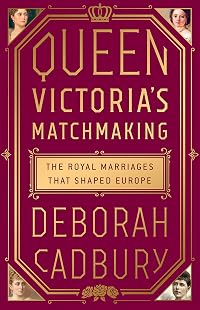
Queen Victoria's Matchmaking: The Royal Marriages that Shaped Europe
by Deborah Cadbury
On This Page
Description
An exploration of Queen Victoria's matchmaking exploits details how she used her grandchildren to further the influence of the British Empire, despite their own plans and the turmoil that rocked Europe starting in the nineteenth century.Tags
Recommendations









Member Recommendations
Member Reviews
I came to this book first having read Victoria, historical fiction by Daisy Goodwin, followed by watching the 2009 feature film, The Young Victoria starring Emily Blunt. And then this caught my eye. Victoria and Albert had 9 children and 42 grandchildren, and Albert had a grand vision of uniting Europe in eternal peace through marriages of their offspring with other royal families. After his untimely death, Victoria forged ahead with Albert’s dream, ultimately connecting most of European royalty in Europe in one way or another (often multiple ways!). It was eye-opening to learn just how closely related major players in WWI were (e.g., George V and Kaiser Wilhelm, who were at war, were 1st cousins, as were Kaiser Wilhelm and Tsar show more Nicholas II, who were also at war) and the frequency to which first cousins were encouraged to marry was rather disturbing viewed through a 21st-century lens. Spoiler alert: making everyone related didn’t prevent conflict, but it sure did result in a lot of hemophilia! There were lots of family members to keep track of, and many shared given names so it can get confusing, but overall I found it interesting and learned quite a bit. show less
This book provides some fascinating insight to the royal families of Europe by seeing them as real people with flaws and intimate relationships beyond the duty of the crowns they wear. It's so easy to simply define historical figures by the roles they play instead of considering them as fully developed human beings. In this book, we get a glimpse of Victoria not as queen but as grandmother with the same desire to keep her children and grandchildren safe while still seeing them lead productive lives as any parent or grandparent might--it just so happens that in this case "productive" means controlling a couple continents. The book may be titled Queen Victoria's Matchmaking, but the two primary relationships it explores in detail were not show more Victoria's doing and, in fact, Victoria demanded on several occasions that they not happen. Instead the book is really about presenting the idea that WWI and the Russian Revolution was all a rather tragic family affair, and in many ways it was. While the beginning of the book can be a bit dull, things get much more engaging when you realize that Franz is *that* Franz and Nicholas is *that* Nicholas and you realize you already know how these stories end. However, there are several interesting tidbits of information that I didn't know previously, and focusing on the individuals involved in these major historical events really shines a new light on just how tragic is all really was.
Having said that, I had to discount a few stars because of how difficult it was to follow the author's discussion in some places. It was difficult at times to keep up with some of the family relationships primarily because of Cadbury's liberal use of indefinite pronouns despite having mentioned three different people in a sentence. Which "he" was she referring to? It took me three times reading a sentence and considering the context of the paragraph before I could figure it out sometimes. Also, and I know this is nitpicking, but the dates were wrong on at least three occasions. I don't mean she said something happened in 1891 and it was really 1892; I am not the kind of reader who would catch an error like that. I am, however, the kind of reader who would notice that the book says Eddy was writing a letter to someone in 1990 or that Victoria had tea with Alix in 1996. Just a simple matter of transposing a number, and the right year is obvious, but it was still a smudge on Cadbury's professionalism in my opinion. That and her need to dramatize and use archaic or unusual adjectives seemingly to impress the reader. The events themselves are dramatic enough without that kind of embellishment.
All in all, I enjoyed the perspective and there are even a few things that can be gleaned about current events, but I think a slightly more aggressive editor might be a good idea for her next book. show less
Having said that, I had to discount a few stars because of how difficult it was to follow the author's discussion in some places. It was difficult at times to keep up with some of the family relationships primarily because of Cadbury's liberal use of indefinite pronouns despite having mentioned three different people in a sentence. Which "he" was she referring to? It took me three times reading a sentence and considering the context of the paragraph before I could figure it out sometimes. Also, and I know this is nitpicking, but the dates were wrong on at least three occasions. I don't mean she said something happened in 1891 and it was really 1892; I am not the kind of reader who would catch an error like that. I am, however, the kind of reader who would notice that the book says Eddy was writing a letter to someone in 1990 or that Victoria had tea with Alix in 1996. Just a simple matter of transposing a number, and the right year is obvious, but it was still a smudge on Cadbury's professionalism in my opinion. That and her need to dramatize and use archaic or unusual adjectives seemingly to impress the reader. The events themselves are dramatic enough without that kind of embellishment.
All in all, I enjoyed the perspective and there are even a few things that can be gleaned about current events, but I think a slightly more aggressive editor might be a good idea for her next book. show less
From their birth, the children, grandchildren, and great grandchildren of Queen Victoria had a role to play as the countries approached the new century.
I'd never realized just how many descendants of the queen became the ruler of a country. Though several either married for love or came to love their life companion after marriage, I couldn't help but pity them all. On every side, their family and friends, well-meaning though they were, manipulated the young people for their own benefit.
Knowing of the family relationships that connected the leaders of the countries, makes the first world war that much more heartbreaking as each one had to take sides in a ruthless and merciless situation. Family bonds were shattered.
I found the narrative show more to be fascinating and informative on a subject I knew very little. For readers who have an interest in the family of Queen Victoria or the history of the late 19th century will enjoy this book.
I received a copy through NetGalley for reviewing purposes. show less
I'd never realized just how many descendants of the queen became the ruler of a country. Though several either married for love or came to love their life companion after marriage, I couldn't help but pity them all. On every side, their family and friends, well-meaning though they were, manipulated the young people for their own benefit.
Knowing of the family relationships that connected the leaders of the countries, makes the first world war that much more heartbreaking as each one had to take sides in a ruthless and merciless situation. Family bonds were shattered.
I found the narrative show more to be fascinating and informative on a subject I knew very little. For readers who have an interest in the family of Queen Victoria or the history of the late 19th century will enjoy this book.
I received a copy through NetGalley for reviewing purposes. show less
This work of narrative history doesn't really say much new but focuses in particular on the activities of QV (and some of her many relations) in their attempt to construct a series of marriages which would reinforce through 'soft power' the agenda of liberal government - or at least what passed for liberal government at the end of the 19th century. Many of the attempts were unsuccessful, either in achieving a wedding, or if they did, in making successful marriages. But there is a good deal of human interest in the stories. Although the book is divided into chapters named after two people, the intersecting stories cannot be divided up so neatly and so each chapter actually has more than one part of the jigsaw.
It is written in a readable show more style, although those unfamiliar with the relationships involved might need to refer often to the family tree which is included in the endpapers. There are some good illustrations, but it is a pity that there is no picture of one of the main players, Princess Helene of Orleans. I only found a couple of factual errors (in one place describing Wilhelm II's eldest sister as his older sister, which she was not since he was the first child of his parents; and in another place, stating that queens consort are heads of state). There are certain assumptions made which are not backed by evidence, since as the nature of George V's marriage, and there is a very one-sided view of Tsarina Alexandra after her marriage. At the end of the book the assignation of blame for WWI is simplistic. But overall, still worth reading. show less
It is written in a readable show more style, although those unfamiliar with the relationships involved might need to refer often to the family tree which is included in the endpapers. There are some good illustrations, but it is a pity that there is no picture of one of the main players, Princess Helene of Orleans. I only found a couple of factual errors (in one place describing Wilhelm II's eldest sister as his older sister, which she was not since he was the first child of his parents; and in another place, stating that queens consort are heads of state). There are certain assumptions made which are not backed by evidence, since as the nature of George V's marriage, and there is a very one-sided view of Tsarina Alexandra after her marriage. At the end of the book the assignation of blame for WWI is simplistic. But overall, still worth reading. show less
Ratings
Members
- Recently Added By
Author Information

14 Works 2,862 Members
Deborah Cadbury is an award-winning TV science producer for the BBC. She is also the author of "The Feminization of Nature". She lives in London. (Bowker Author Biography)
Awards and Honors
Distinctions
The Guardian Book of the Day (2017-09-11)
Common Knowledge
- Original publication date
- 2017-11-14
- People/Characters
- Victoria, Queen of the United Kingdom; George V, King of the United Kingdom; Mary of Teck; Tsar Nicholas II; Wilhelm II, German Kaiser and King of Prussia; Alexandra Feodorovna, Empress of Russia (show all 13); Victoria, German Empress and Queen of Prussia; Edward VII, King of the United Kingdom; Alexandra of Denmark, Queen Consort of the United Kingdom; Alfred, Duke of Saxe-Coburg and Gotha; Marie, Duchess of Saxe-Coburg and Gotha; Princess Alice, Grand Duchess of Hesse and by Rhine; Albert, Prince Consort
- Important places
- Europe; England, UK; Russia (as Russian Empire)
- Dedication
- To Pete, Jo and Julia, with love
- First words
- It was early afternoon on Sunday 13 March 1881.
- Last words
- (Click to show. Warning: May contain spoilers.)I see thy face so dear to me
Shades of the future I do not see. - Publisher's editor
- Fishwick, Michael
- Blurbers
- Jane Ridley
- Original language
- English
Classifications
- Genres
- History, Nonfiction, General Nonfiction, Biography & Memoir
- DDC/MDS
- 941.081092 — History & geography History of Europe British Isles Historical periods of British Isles 1837- Period of Victoria and House of Windsor Victoria 1837-1901
- LCC
- DA554 .C25 — History of Europe, Asia, Africa and Oceania Great Britain History of Great Britain England History By period Modern, 1485- Victorian era, 1837-1901
- BISAC
Statistics
- Members
- 267
- Popularity
- 120,943
- Reviews
- 5
- Rating
- (3.95)
- Languages
- Dutch, English
- Media
- Paper, Audiobook, Ebook
- ISBNs
- 15
- ASINs
- 4