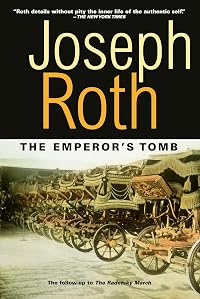
The Emperor's Tomb
by Joseph Roth
On This Page
Description
A continuation of the saga of the von Trotta family from The Radetzky March, it is both a powerful and moving look at a decaying society and its journey through the War and its devastating aftermath, and the story of the erosion of one man's desperate faith in the virtues of a simple life.Tags
Recommendations

















Member Recommendations

Member Reviews
This is one of Roth's last books, and decidedly not an optimistic one. The narrator, Franz Ferdinand Trotta (a distant cousin of the Trottas from Radetzkymarsch) watches with a jaundiced eye as the Dual Monarchy falls apart in the First World War and then the Alpentrottel (Roth's not very flattering term for German Austrians) collude with the Saupreußen from over the border to smash up what's left, culminating in March 1938 with the Nazi takeover. All that Trotta can think of to do as the swastika flags go up and Jewish businesses close down is to go and pay his respects to the late Franz Joseph, the last decent Austrian.
As usual with Roth, there are layers and layers of irony to get through, and this is also obviously a book that was show more written in a hurry and in a bad temper, so it isn't always clear which message we're supposed to be taking from the book, but the general thrust seems to be that however flawed it was in detail, the Hapsburg monarchy provided peace, stability and order for the people at its periphery, a world in which Trotta's chestnut-roasting cousin Joseph Branco could travel to sell his wares wherever he chose in Bohemia, Moravia, Silesia or Galicia without a visa, in which a Jewish cab-driver from Galicia could send his son to the Conservatorium in Vienna (if he happened to know the right aristocrat to pull strings for him) and in which Trotta could enter a café anywhere in the empire and know exactly what to expect. The small-minded cult of nationalism has missed the point, Roth seems to be arguing, by ignoring the huge benefits of living in a world without borders. And that's obviously a point we would do well to remember today as well.
On the other hand, it's sometimes difficult to know when we're supposed to sympathise with Trotta's defeatist conservatism and when we should be laughing at him. A large part of his disenchantment with the post-war world comes as a result of his impetuous marriage, on the eve of mobilisation, to a girlfriend who, when he returns to her after four years absence as a PoW in Russia, turns out to be both in love with another woman and determined to earn her own living as an avant-garde designer (it's hard to say which of these things horrifies him more...). What's more, although he and his mother can no longer live on their inheritance, Trotta makes no effort at all to change his life and find a job. What's the point, when the world is only going to end anyway?
Interesting, provocative, but a bit unsatisfying. A great writer caught at a moment in his life when he obviously wasn't at his best and couldn't see any way out for the world. show less
As usual with Roth, there are layers and layers of irony to get through, and this is also obviously a book that was show more written in a hurry and in a bad temper, so it isn't always clear which message we're supposed to be taking from the book, but the general thrust seems to be that however flawed it was in detail, the Hapsburg monarchy provided peace, stability and order for the people at its periphery, a world in which Trotta's chestnut-roasting cousin Joseph Branco could travel to sell his wares wherever he chose in Bohemia, Moravia, Silesia or Galicia without a visa, in which a Jewish cab-driver from Galicia could send his son to the Conservatorium in Vienna (if he happened to know the right aristocrat to pull strings for him) and in which Trotta could enter a café anywhere in the empire and know exactly what to expect. The small-minded cult of nationalism has missed the point, Roth seems to be arguing, by ignoring the huge benefits of living in a world without borders. And that's obviously a point we would do well to remember today as well.
On the other hand, it's sometimes difficult to know when we're supposed to sympathise with Trotta's defeatist conservatism and when we should be laughing at him. A large part of his disenchantment with the post-war world comes as a result of his impetuous marriage, on the eve of mobilisation, to a girlfriend who, when he returns to her after four years absence as a PoW in Russia, turns out to be both in love with another woman and determined to earn her own living as an avant-garde designer (it's hard to say which of these things horrifies him more...). What's more, although he and his mother can no longer live on their inheritance, Trotta makes no effort at all to change his life and find a job. What's the point, when the world is only going to end anyway?
Interesting, provocative, but a bit unsatisfying. A great writer caught at a moment in his life when he obviously wasn't at his best and couldn't see any way out for the world. show less
Spanning the First World War, this short novel outlines the fall from grace of a minor Austro-Hungarian Noble, a scion of a once proud and heroic family.
It is quite a bleak book in many ways - and reminds me of the world Beckett creates in Waiting for Godot. There is an inevitability in the fall and no action could have prevented it.
The language used (at least in this translation) is minimal and strips to the bone images - making those that remain quite haunting. One which has remained with me for several days is the image of violets blooming from the bones of dead men.
Certainly a great, if troubling, book.
It is quite a bleak book in many ways - and reminds me of the world Beckett creates in Waiting for Godot. There is an inevitability in the fall and no action could have prevented it.
The language used (at least in this translation) is minimal and strips to the bone images - making those that remain quite haunting. One which has remained with me for several days is the image of violets blooming from the bones of dead men.
Certainly a great, if troubling, book.
One of my favorite authors. It’s been quite a while since I revisited Roth and I am embarrassed that this one took so long. Like so much of his work, a masterpiece of nostalgia for the hinterlands of the Hapsburg empire. A wonderful writer with a knack for the telling detail and for evoking a lost world. The story line is engaging and involved (if you’ve read Roth before, you’re likely familiar with the Trotta family) but, to my mind, as good as it is, the story takes second-place to Roth’s superb evocation of time and place and the decay of the empire. It was the last novel of his published in his lifetime and it ends, pregnantly, with the arrival of the Nazis in Vienna.
This book surprised me, as I'm not typically interested in World War I history or politics. The narrative, however, is incredible.
The narrator, Von Trotta, has a very apt perspective on Austro-Hungarian post-war situation, and much of the book is essentially a narrative foreshadowing of the upcoming 2nd World War. Everything in the book seems to be afloat in one kind of desolation or another. Trotta's wife grows to hate him, and all of the people revolving around him are either bogged down with apathy or vainly seeking some new-found wealth.
The ambition we see from the likes of Trotta's wife's people is scorned by the 'old money', and that scorn turns prophetic when Roth boils their entrepreneurial efforts down to failure, speculation, show more and fraud.
This is a dark, honest story, and beautifully told. show less
The narrator, Von Trotta, has a very apt perspective on Austro-Hungarian post-war situation, and much of the book is essentially a narrative foreshadowing of the upcoming 2nd World War. Everything in the book seems to be afloat in one kind of desolation or another. Trotta's wife grows to hate him, and all of the people revolving around him are either bogged down with apathy or vainly seeking some new-found wealth.
The ambition we see from the likes of Trotta's wife's people is scorned by the 'old money', and that scorn turns prophetic when Roth boils their entrepreneurial efforts down to failure, speculation, show more and fraud.
This is a dark, honest story, and beautifully told. show less
Una storia apparentemente semplice racchiude la tragedia, quella con la T maiuscola, quella della Grande guerra, della guerra mondiale che ha distrutto un mondo, una concezione della vita, della politica, della nazionalità, aprendo la strada agli orrori del nazismo e a questo, sciagurato, mondo moderno.
Disperato e struggente.
Disperato e struggente.
A friend told me I must drop what I was reading and take up Joseph Roth’s The Radetsky March. Words like tremendous, a masterpiece, and unbelievably beautiful were tossed around like confetti. I hate to be cynical about my friends, so I concealed all but the tiniest bit of skepticism. Then I read the first page and any doubt I had evaporated in an instant.
In 2009, I wrote, “[The Radetsky March details] three generations, who revered and served Emperor Franz Joseph, [it] encompasses not only the politics of the era but the relationships among fathers, sons, and even the memory of a deceased grandfather. The prose sparkles, and I am hard pressed to recall more than a few novels with prose so consistently beautiful, lyrical, and show more engrossing.” Truly this is one of the finest, most beautiful novels I have ever read.
According to the cover notes, Joseph Roth was born in 1894 in a small town on the Eastern border of the Habsburg Empire. After serving in Austro-Hungarian army from 1916 to 1918, he worked as a journalist in Vienna and in Berlin. He died in Paris in 1939. He authored 13 novels as well as numerous stories and essays. I see a large collection on Roth’s works in my future.
It took some time to get to the sequel, The Emperor’s Tomb, because I feared a sophomore jinx.
The young Trotta makes connections with members of his ancestral village. He reacquaints himself with some of the customs and habits of his grand uncle’s family. Then, Emperor Franz Joseph is assassinated, and World War I begins. He receives a commission and joins a unit headed to the Russian front. He becomes separated from his unit, and is quickly captured and sent to Siberia, where he lives on a farm and works the land. When the war is over, he begins the trek home. By the time he arrives, he finds the Austro-Hungarian Empire has collapsed, and many of the wealthy families have been stripped of their fortunes.
The interesting aspect of this wonderfully written novel is the in-depth character studies Roth provides of the nobles and the peasants, men and women. Young Trotta falls in love with Elizabeth, they marry, and he takes off for the Russian front without a wedding night. Trotta circle of friends are particularly interesting in their views on the war, the empire, and their lives. All are changed from their experiences in the military.
Roth’s prose lulls the reader into a world foreign and difficult to imagine. He writes:
“In midsummer of 1914 I … set off for Zlotogrod. I put up at a the Hotel zum Goldenen Bären, the only hotel in the little town, I was told, which was acceptable to a European.
“The railway station was tiny, like the station at Sipolje, of which I had retained a certain memory. All little stations in all little provincial towns looked alike throughout the old Austro-Hungarian Empire. Small and painted yellow, they were like lazy cats lying in the snow in winter and in the sun in summer, protected by the glass roof over the platform, and watched by the black double eagle on its yellow background. The porter was the same everywhere, in Sipolje as in Zlotogrod, his paunch stuffed into his in offensive dark blue uniform, and across his chest the black belt into which was tucked his bell, whose prescribed treble peal announced the departure of a train” (35).
I find it most easy to imagine standing on the platform watching the ebb and flow of passengers! Joseph Roth has also captured the voice of the period. All this makes The Emperor’s Tomb a thoroughly enjoyable read. 5 stars
--Jim, 6/17/13 show less
In 2009, I wrote, “[The Radetsky March details] three generations, who revered and served Emperor Franz Joseph, [it] encompasses not only the politics of the era but the relationships among fathers, sons, and even the memory of a deceased grandfather. The prose sparkles, and I am hard pressed to recall more than a few novels with prose so consistently beautiful, lyrical, and show more engrossing.” Truly this is one of the finest, most beautiful novels I have ever read.
According to the cover notes, Joseph Roth was born in 1894 in a small town on the Eastern border of the Habsburg Empire. After serving in Austro-Hungarian army from 1916 to 1918, he worked as a journalist in Vienna and in Berlin. He died in Paris in 1939. He authored 13 novels as well as numerous stories and essays. I see a large collection on Roth’s works in my future.
It took some time to get to the sequel, The Emperor’s Tomb, because I feared a sophomore jinx.
The young Trotta makes connections with members of his ancestral village. He reacquaints himself with some of the customs and habits of his grand uncle’s family. Then, Emperor Franz Joseph is assassinated, and World War I begins. He receives a commission and joins a unit headed to the Russian front. He becomes separated from his unit, and is quickly captured and sent to Siberia, where he lives on a farm and works the land. When the war is over, he begins the trek home. By the time he arrives, he finds the Austro-Hungarian Empire has collapsed, and many of the wealthy families have been stripped of their fortunes.
The interesting aspect of this wonderfully written novel is the in-depth character studies Roth provides of the nobles and the peasants, men and women. Young Trotta falls in love with Elizabeth, they marry, and he takes off for the Russian front without a wedding night. Trotta circle of friends are particularly interesting in their views on the war, the empire, and their lives. All are changed from their experiences in the military.
Roth’s prose lulls the reader into a world foreign and difficult to imagine. He writes:
“In midsummer of 1914 I … set off for Zlotogrod. I put up at a the Hotel zum Goldenen Bären, the only hotel in the little town, I was told, which was acceptable to a European.
“The railway station was tiny, like the station at Sipolje, of which I had retained a certain memory. All little stations in all little provincial towns looked alike throughout the old Austro-Hungarian Empire. Small and painted yellow, they were like lazy cats lying in the snow in winter and in the sun in summer, protected by the glass roof over the platform, and watched by the black double eagle on its yellow background. The porter was the same everywhere, in Sipolje as in Zlotogrod, his paunch stuffed into his in offensive dark blue uniform, and across his chest the black belt into which was tucked his bell, whose prescribed treble peal announced the departure of a train” (35).
I find it most easy to imagine standing on the platform watching the ebb and flow of passengers! Joseph Roth has also captured the voice of the period. All this makes The Emperor’s Tomb a thoroughly enjoyable read. 5 stars
--Jim, 6/17/13 show less
This is Roth's work that followed The Radetzky March. It does not have to be read sequentially, but it makes sense to do so. The following quote sums up the book succinctly: "We all had lost our position, our rank, our house, our home, our money, our worth, our past, our present and our future. Each morning when we got up, each night when we went to bed, we cursed death who had invited us in vain to her grand party. " This book picks up post WWI until the Anschluss. This book is narrated by Franz Trotta in first person narrative in which he bares his soul. Franz is trying to stay afloat, one day at a time. He is not equipped to survive in the new post war world. Of course, Trotta is just a symbol for Austria, too focused on what was show more lost instead of looking forward. 208 pages show less
Members
- Recently Added By
Lists

German Literature
518 works; 55 members

Books Read in 2022
5,168 works; 114 members

Books Read in 2019
4,052 works; 108 members
Bibliografia essenziale
86 works; 2 members

Liste Otto
107 works; 1 member
Author Information

233+ Works 13,184 Members
Author and journalist Joseph Roth was born on September 2, 1894. During World War I, he served in the Austro-Hungarian army from 1916 to 1918. Afterwards, he worked as a journalist in Vienna and in Berlin. His best-known works are The Radetzky March and Job. He died in Paris on May 27, 1939 and is buried in Thiais Cemetery. (Bowker Author show more Biography) Joseph Roth is the author of such classics as The Radetzky March and The Emperor's Tomb. He died in Paris in 1939. (Publisher Provided) show less
Some Editions
Awards and Honors
Awards
Series
Belongs to Publisher Series
Work Relationships
Common Knowledge
- Canonical title
- The Emperor's Tomb
- Original title
- Die Kapuzinergruft
- Original publication date
- 1938
- People/Characters*
- fam. Trotta
- Important places*
- Oostenrijk
- Important events*
- "Der Anschluß" van Oostenrijk aan Duitsland (1938); Eerste Wereldoorlog (1914-1918)
- Related movies
- Trotta (1971 | IMDb)
- First words*
- Wij heten Trotta.
- Quotations
- Veel later pas, lang na de grote oorlog die de 'wereldoorlog' wordt genoemd, terecht naar mijn mening, niet omdat de hele wereld deze oorlog voerde, maar omdat wij allen als gevolg van de oorlog een wereld, onze wereld, verlo... (show all)ren, veel later pas zou ik beseffen dat zelfs landschappen, akkers, naties, rassen, krotten en koffiehuizen van de meest uiteenlopende aard en herkomst moeten moeten gehoorzamen aan de volkomen natuurlijke wet van een sterke geest, die in staat is naderbij te brengen wat ver weg is, verwant te laten worden wat vreemd is en te verenigen wat schijnbaar uit elkaar groeit
- Last words*
- (Click to show. Warning: May contain spoilers.)...De Kapucijner crypte, waar mijn keizers begraven liggen in stenen zerken, was gesloten. De kapucijnerbroeder kwam naar me toe en vroeg "Waarmee kan ik u van dienst zijn?"
"Ik wil de zerk van mijn keizer Franz Joseph bezoeken" antwoordde ik.
"God zegene u!" zei de broeder en hij sloeg een kruis boven mijn hoofd.
"God behoede...!" riep ik.
"St!" zei de broeder.
Waar moet ik nu heen, ik, een Trotta?... - Original language
- Tedesco
*Some information comes from Common Knowledge in other languages. Click "Edit" for more information.
Classifications
- Genres
- General Fiction, Fiction and Literature
- DDC/MDS
- 833.912 — Literature & rhetoric German & related literatures German fiction 1900- 1900-1990 1900-1945
- LCC
- PT2635 .O84 .K32 — Language and Literature German, Dutch and Scandinavian literatures German literature Individual authors or works 1860/70-1960
- BISAC
Statistics
- Members
- 1,002
- Popularity
- 26,055
- Reviews
- 25
- Rating
- (3.84)
- Languages
- 15 — Catalan, Dutch, English, Estonian, Finnish, French, German, Greek, Hebrew, Italian, Polish, Portuguese, Spanish, Swedish, Turkish
- Media
- Paper, Audiobook, Ebook
- ISBNs
- 68
- UPCs
- 1
- ASINs
- 30