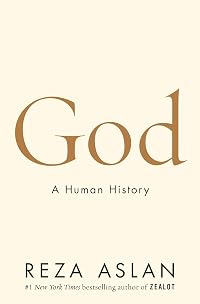
God: A Human History
by Reza Aslan
On This Page
Description
Explores humanity's attempts to comprehend the divine by giving it human traits and emotions, and calls for a more expansive understanding of God to develop a more universal spirituality.Tags
Recommendations








































Member Reviews
Reza Ashlan, author of the controversial Zealot, provides a well-referenced history of religion, especially man's apparently innate desire to humanize our perceptions of God. He explores early man's belief in animism and spiritual evolution into polytheism, henotheism (a High God in a pantheon of lower Gods, and monotheism. Initially, I thought this book was simply a survey of man's search for a greater external power; it actually became an apology for the author's current belief in pantheism, e.g., "All is One, One is All." As I indicated his argument is well referenced; the bibliography and notes comprised half the book's pages. The book is a good read; however, Ashlan does have an agenda.
The title of God: A Human History is quite correct. While at the end of the book, religious scholar Reza Aslan speculates on the nature of God. Instead, this book is more about how humans may have perceived divinity from their earliest days.
In examining evidence from prehistoric cultures, we see how ideas of divinity may have first developed and how they shaped cultures for hundreds of thousands of years. But, surprisingly, scholars now believe it was religion that caused the Agricultural Revolution. Aslan explains how findings at Göbekli Tepe led to that startling conclusion.
While he touches on the Hindu, Buddhist, and Taoist beliefs, the book focuses on how our concept of one God--the monotheistic deity of Judaism, Christianity, and show more Islam, developed. He shows, step-by-step, how these lines of thought developed. Rather than being a natural outcome of revelation, many decisions that shape our current conception of God were of political origin.
I was surprised to learn how the minor Canaanite God Yahweh became the one God of the Hebrew people. It was interesting to see how a concept from a small and relatively insignificant tribe grew to influence many people’s conception of God today.
The book was an enjoyable foray into the religious thought of these past half a million years. I’ve always wanted to know what motivated our ancestors and how they lived. While this book doesn’t provide concrete answers because they don’t exist, it does give a sweeping view of the possibilities. show less
In examining evidence from prehistoric cultures, we see how ideas of divinity may have first developed and how they shaped cultures for hundreds of thousands of years. But, surprisingly, scholars now believe it was religion that caused the Agricultural Revolution. Aslan explains how findings at Göbekli Tepe led to that startling conclusion.
While he touches on the Hindu, Buddhist, and Taoist beliefs, the book focuses on how our concept of one God--the monotheistic deity of Judaism, Christianity, and show more Islam, developed. He shows, step-by-step, how these lines of thought developed. Rather than being a natural outcome of revelation, many decisions that shape our current conception of God were of political origin.
I was surprised to learn how the minor Canaanite God Yahweh became the one God of the Hebrew people. It was interesting to see how a concept from a small and relatively insignificant tribe grew to influence many people’s conception of God today.
The book was an enjoyable foray into the religious thought of these past half a million years. I’ve always wanted to know what motivated our ancestors and how they lived. While this book doesn’t provide concrete answers because they don’t exist, it does give a sweeping view of the possibilities. show less
Great Scholarship that Doesn't Support Conclusion
Reza Aslan's "God: A Human History" does a good job summarizing some aspects of prehistoric religion, Zoroastrianism, Judaism, Christianity, and Islam. However, those summaries do not support Aslan's proselytizing conclusion that God is everything and everything is God. If the conclusion were removed, the book would stand as an actual history, albeit one with problems.
After a wonderful one or two chapters about prehistoric religion, most of it logical suppositions from archaeological finds, Aslan launches into a comprehensive but brief discussion of the Gods that arose from Southwest Asia and Northeast Africa (today's Middle East). We learn tribal Gods and the national Gods of emerging show more civilizations, then Ahura Mazda, Elohim, Yahweh, and the synthesis of all of them, which Aslan says the early Jewish thinkers devised after the Babylonian Exile.
Aslan identifies Meso-American Gods once, and only mentions non-Middle Eastern Gods in passing lists. There is no explanation for why the Middle East is home to all these Gods or as to why the Gods of other regions are so different. The absence of evidence or discussion of these other religious systems is the glaring weakness. How can a book be a "human history" when it only talks about the Gods of a small slice of humanity?
Aslan claims to know God because he himself is God and we are all God. This is the ultimate conclusion he reaches at the end of the book. Throughout the book, religion is presented in evolutionary terms. When prior religions are unfit to explain events, they are changed and supplanted by new religions. Animism begets tribalism begets polytheism begets dualism begets monotheism begets pantheism. Buddhism, Confucian philosophy, and Hinduism, major branches of thought, are given no place in Aslan's evolutionary timeline.
I greatly appreciated the clarity this book gave me as it regards the origins of Judaism. I also appreciated the treatment of prehistoric religions. However, the conclusion that all this history leads to a unification of all religion falls flat. show less
Reza Aslan's "God: A Human History" does a good job summarizing some aspects of prehistoric religion, Zoroastrianism, Judaism, Christianity, and Islam. However, those summaries do not support Aslan's proselytizing conclusion that God is everything and everything is God. If the conclusion were removed, the book would stand as an actual history, albeit one with problems.
After a wonderful one or two chapters about prehistoric religion, most of it logical suppositions from archaeological finds, Aslan launches into a comprehensive but brief discussion of the Gods that arose from Southwest Asia and Northeast Africa (today's Middle East). We learn tribal Gods and the national Gods of emerging show more civilizations, then Ahura Mazda, Elohim, Yahweh, and the synthesis of all of them, which Aslan says the early Jewish thinkers devised after the Babylonian Exile.
Aslan identifies Meso-American Gods once, and only mentions non-Middle Eastern Gods in passing lists. There is no explanation for why the Middle East is home to all these Gods or as to why the Gods of other regions are so different. The absence of evidence or discussion of these other religious systems is the glaring weakness. How can a book be a "human history" when it only talks about the Gods of a small slice of humanity?
Aslan claims to know God because he himself is God and we are all God. This is the ultimate conclusion he reaches at the end of the book. Throughout the book, religion is presented in evolutionary terms. When prior religions are unfit to explain events, they are changed and supplanted by new religions. Animism begets tribalism begets polytheism begets dualism begets monotheism begets pantheism. Buddhism, Confucian philosophy, and Hinduism, major branches of thought, are given no place in Aslan's evolutionary timeline.
I greatly appreciated the clarity this book gave me as it regards the origins of Judaism. I also appreciated the treatment of prehistoric religions. However, the conclusion that all this history leads to a unification of all religion falls flat. show less
This is a superficial look at religious history setting up an analysis of monotheism from a lens Aslan prefers, to reach an ultimate conclusion of pantheism, which is his own position. It's not bad per se, but it's certainly massaging history and religion to fit the idea there's a gradual development of monotheism as well as some coherent reason it happened, and how it was later developed, as if the road from Akhenaten's monotheism through Zoroastrianism's dualism under a single creator led to the Abrahamitic religions that then evolved out of each other trying to define how the godhood works. It's too much of a just so story trying to pave over actual history and theological developments to reach that ultimate goal of deciding the show more problems with a personal God is the problem inherent in monotheism itself, and the reason we should follow Aslan's example.
It's not wholly original ground he's treading, and it's questionable if you should read this treatment over some other book making the case for pantheism from another angle, since this line of argumentation works more as a memoir of Aslan's own religious developments and justifications. show less
It's not wholly original ground he's treading, and it's questionable if you should read this treatment over some other book making the case for pantheism from another angle, since this line of argumentation works more as a memoir of Aslan's own religious developments and justifications. show less
The journey Aslan takes us on is fascinating, and I admire his writing and his storytelling. But at the end we see that he has basically been setting up the dominoes to explain his personal faith. If I had known that going in. I might have read it differently. Overall a good book for people interested in the subject.
Reza Aslan is one of my favorite writers on religion, right up there with Karen Armstrong (whom I've interviewed twice). I loved Aslan's Zealot: The Life and Times of Jesus of Nazareth and looked forward to this book. I was not disappointed.
Aslan presents a well-documented sociological history of how humans made god(s) in their image and the evolution of religious thinking that see-saws through history: the disinterested god as essence, creative force, divine substance vs. the personal god as super-being with human attributes who can be appealed to through prayer and appeased with offerings and rituals. His writing mirrors his own spiritual journey. We get the benefit of his years of searching and research in this well-written, easy to show more follow book. I highly recommend it for folks who are interested in religious history or are exploring their own spirituality. show less
Aslan presents a well-documented sociological history of how humans made god(s) in their image and the evolution of religious thinking that see-saws through history: the disinterested god as essence, creative force, divine substance vs. the personal god as super-being with human attributes who can be appealed to through prayer and appeased with offerings and rituals. His writing mirrors his own spiritual journey. We get the benefit of his years of searching and research in this well-written, easy to show more follow book. I highly recommend it for folks who are interested in religious history or are exploring their own spirituality. show less
Reza Alsan’s God: A Human History is an impressive interdisciplinary examination of our effort to relate to God via religion. Among the questions Aslan addresses are these: What can we learn from the earliest (pre-literate) attempts to depict God? How do we explain and how should we regard our persistent efforts to invest God with human traits? Does the evolution toward monotheism represent progress? How has earth-bound politics influenced our understanding of the divine? Aslan brings to these questions insights from history, anthropology, cognitive science, evolutionary biology, and many of the sub-disciplines that constitute disciplinary theology, including hermeneutics, Christology, soteriology, and eschatology.
The first section of show more the book (there are three sections, each constituted of three chapters, and a conclusion), titled “The Embodied Soul,” traces the earliest attempts to image God—in the primitive cave paintings in Australia and Indonesia and especially, the Cave of Trois-Freres in southwestern France. The images, which merge human and non-human traits into single figures, imply animism, a belief that all creation shares a common spiritual quality, and does not prioritize the human. This is a belief that Aslan (as is seen throughout the book) cherishes. That the images at Trois-Freres (for example) were, scholars speculate, placed in places of worship and intended as inspirations for prayer, suggests that the religious impulse manifest in the Paleolithic age, at least 40,000 years. Aslan makes the interesting point that these early religious representations are not anthropomorphic. Nor are early gods imagined as moral. They were to be worshipped and respected not imitated. If the reader approaches Aslan’s book with the hope of probing the question of evil and pain in a world under the power of an omnipotent god, these ancient ideas suggest that we think of God as more interested in our attention and worship than our wellbeing.
In the second section of God: A Human History, “The Humanized God,” Aslan probes our human all-too human predilection to create gods in our own likeness. The earliest religious temple—the so-called Temple of Eden at Potbelly Hill (Göbekli Tepe) in Urfa Turkey, depicts abstract humanoid figures. This humanizing predilection, Aslan argues, will have its apogee when Christianity invest Jesus with divinity. It also is manifest as politicomorphism, projecting a political system onto the gods, motivated, he argues, by an interest in investings earth-bound politics with heavenly paradigms—one God, one monarch, one bishop of Rome. At times, Aslan expresses dismay at the humanizing tendency. But he seems conflicted, finding in its ubiquity a consolation for the seeker: that we are in fact evolutionarily directed to project religious beliefs in divine beings, which may be biological counter evidence to the dismissal of belief in God as an illusion.
God: A Human History became more compelling for me when it moved away from anthropology and toward history and comparative religion. I was particularly interested in Persian Zoroastrianism for its probing of the way to understand evil and pain. Zarathustra posited evil was a necessary complement to good—that we cannot know good without the experience of evil. And while he speculated that the monotheistic god Ahura Mazda was the ultimate source of both good and evil, he envisioned a dualistic cosmology that placed the universe under the control of dueling forces—the positive and true spirit Spenta Mainyu and evil and false Angra Mainyu. Thus, a monotheistic system with a dualistic cosmology. This may be similar to the Christian cosmology but is valuable as prior to it and for its greater philosophical sophistication. This section also reviews the documentary theory as the basis for the creation of what we know as the definitive Pentateuch. Aslan brings to our attention modern scholarship that casts doubt on much that is conventionally believe: that Judaism may have been a form of Atenism (Egyptian god of the 14th century BCE), that the Israelites may never have been captive in Egypt, that Abraham, Isaac and Jacob worshipped the Canaanite God Elohim, and the monotheistic history we know is relatively late narrative developed by a priestly sources responding to a political and cultural need for monotheism following their defeat at the hands of the Babylonians.
Aslan’s treatment of the early history of Christianity stresses the evolution of the Church’s understanding of Jesus of Nazareth from a second Moses (in Matthew’s Gospel especially) to a divinity coeternal and coexistent with God (in John’s logos made flesh). This evolution involved Christianity decisively separating from its Jewish origin. He traces the struggle to reconcile theologically a belief in monotheism, while simultaneously embracing both a vengeful Yahweh and a loving Christ. Emperor Constantine would not tolerate such dualism. The doctrine of the Trinity at the Councils of Nicaea and Chalcedon was the solution.
Aslan speculates that Islam may have originated as a Jewish sect. He is embraces Islam’s resistance to capturing Allah in any image. He is impatient, however, with orthodox Islam’s emphasis on law over theology. His own religion is Sufism, the more mystical practice of Islam that seeks an unmediated access to God. When the Persian mystic Bāyazīd Bisṭāmī in the late eighth century announced that there is no distinction between God and his creation, for Alsan, he discovered a profound truth, represented in the title to the penultimate chapter of this book: “God is All.”
Reviews of God: A Human History by snarky academicians in the mainstream press have faulted the book as superficial, a result of its breadth and multi-disciplinarity. These charges miss the point of Aslan’s work. The book is not intended for specialists but for intellectuals with an interest in religion. Readability is especially important for these non-specialist readers. Aslan is a very talented writer, with the ability to capture crucial issues in the morass of the scholarship, to summarize views pointedly, and to mediate controversy with a fair-minded authorial voice. Nor have reviewers always noted that Aslan has supplemented the text with 80 pages of notes. Many of these notes are mini-essays on the topic that identify from the mountain of scholarship a very few key sources, making it easy for the inquisitive reader to pursue leads. I highly recommend God: A Human History for the general reader who wants to probe historically our effort to understand God. show less
The first section of show more the book (there are three sections, each constituted of three chapters, and a conclusion), titled “The Embodied Soul,” traces the earliest attempts to image God—in the primitive cave paintings in Australia and Indonesia and especially, the Cave of Trois-Freres in southwestern France. The images, which merge human and non-human traits into single figures, imply animism, a belief that all creation shares a common spiritual quality, and does not prioritize the human. This is a belief that Aslan (as is seen throughout the book) cherishes. That the images at Trois-Freres (for example) were, scholars speculate, placed in places of worship and intended as inspirations for prayer, suggests that the religious impulse manifest in the Paleolithic age, at least 40,000 years. Aslan makes the interesting point that these early religious representations are not anthropomorphic. Nor are early gods imagined as moral. They were to be worshipped and respected not imitated. If the reader approaches Aslan’s book with the hope of probing the question of evil and pain in a world under the power of an omnipotent god, these ancient ideas suggest that we think of God as more interested in our attention and worship than our wellbeing.
In the second section of God: A Human History, “The Humanized God,” Aslan probes our human all-too human predilection to create gods in our own likeness. The earliest religious temple—the so-called Temple of Eden at Potbelly Hill (Göbekli Tepe) in Urfa Turkey, depicts abstract humanoid figures. This humanizing predilection, Aslan argues, will have its apogee when Christianity invest Jesus with divinity. It also is manifest as politicomorphism, projecting a political system onto the gods, motivated, he argues, by an interest in investings earth-bound politics with heavenly paradigms—one God, one monarch, one bishop of Rome. At times, Aslan expresses dismay at the humanizing tendency. But he seems conflicted, finding in its ubiquity a consolation for the seeker: that we are in fact evolutionarily directed to project religious beliefs in divine beings, which may be biological counter evidence to the dismissal of belief in God as an illusion.
God: A Human History became more compelling for me when it moved away from anthropology and toward history and comparative religion. I was particularly interested in Persian Zoroastrianism for its probing of the way to understand evil and pain. Zarathustra posited evil was a necessary complement to good—that we cannot know good without the experience of evil. And while he speculated that the monotheistic god Ahura Mazda was the ultimate source of both good and evil, he envisioned a dualistic cosmology that placed the universe under the control of dueling forces—the positive and true spirit Spenta Mainyu and evil and false Angra Mainyu. Thus, a monotheistic system with a dualistic cosmology. This may be similar to the Christian cosmology but is valuable as prior to it and for its greater philosophical sophistication. This section also reviews the documentary theory as the basis for the creation of what we know as the definitive Pentateuch. Aslan brings to our attention modern scholarship that casts doubt on much that is conventionally believe: that Judaism may have been a form of Atenism (Egyptian god of the 14th century BCE), that the Israelites may never have been captive in Egypt, that Abraham, Isaac and Jacob worshipped the Canaanite God Elohim, and the monotheistic history we know is relatively late narrative developed by a priestly sources responding to a political and cultural need for monotheism following their defeat at the hands of the Babylonians.
Aslan’s treatment of the early history of Christianity stresses the evolution of the Church’s understanding of Jesus of Nazareth from a second Moses (in Matthew’s Gospel especially) to a divinity coeternal and coexistent with God (in John’s logos made flesh). This evolution involved Christianity decisively separating from its Jewish origin. He traces the struggle to reconcile theologically a belief in monotheism, while simultaneously embracing both a vengeful Yahweh and a loving Christ. Emperor Constantine would not tolerate such dualism. The doctrine of the Trinity at the Councils of Nicaea and Chalcedon was the solution.
Aslan speculates that Islam may have originated as a Jewish sect. He is embraces Islam’s resistance to capturing Allah in any image. He is impatient, however, with orthodox Islam’s emphasis on law over theology. His own religion is Sufism, the more mystical practice of Islam that seeks an unmediated access to God. When the Persian mystic Bāyazīd Bisṭāmī in the late eighth century announced that there is no distinction between God and his creation, for Alsan, he discovered a profound truth, represented in the title to the penultimate chapter of this book: “God is All.”
Reviews of God: A Human History by snarky academicians in the mainstream press have faulted the book as superficial, a result of its breadth and multi-disciplinarity. These charges miss the point of Aslan’s work. The book is not intended for specialists but for intellectuals with an interest in religion. Readability is especially important for these non-specialist readers. Aslan is a very talented writer, with the ability to capture crucial issues in the morass of the scholarship, to summarize views pointedly, and to mediate controversy with a fair-minded authorial voice. Nor have reviewers always noted that Aslan has supplemented the text with 80 pages of notes. Many of these notes are mini-essays on the topic that identify from the mountain of scholarship a very few key sources, making it easy for the inquisitive reader to pursue leads. I highly recommend God: A Human History for the general reader who wants to probe historically our effort to understand God. show less
Members
- Recently Added By
Lists

Books Read in 2025
4,091 works; 97 members
Author Information

13+ Works 7,192 Members
Born in Iran, Dr. Reza Aslan is a writer and scholar of religion. He is also President and CEO of Aslan Media Inc. Dr. Aslan has degrees in Religions from Santa Clara University, Harvard University, and the University of California, Santa Barbara, as well as a Master of Fine Arts from the University of Iowa. He is a member of the Council on show more Foreign Relations, the Los Angeles Institute for the Humanities, and the Pacific Council on International Policy. Dr. Aslan also serves on the national advisory board of the Levantine Cultural Center, building bridges between Americans and the Arab/Muslim world. Aslan's first book, the International Bestseller, No god but God: The Origins, Evolution, and Future of Islam (Heinemann 2005), has been translated into thirteen languages, and named one of the 100 most important books of the last decade. He is also the editor of the anthology Tablet & Pen: Literary Landscapes from the Modern Middle East: A Words Without Borders Anthology (WW Norton 2010). His latest work is entitled Zealot: The Life and Times of Jesus of Nazareth (Random House 2013). Dr. Aslan lives in Los Angeles where he is Associate Professor of Creative Writing at the University of California, Riverside. (Bowker Author Biography) show less
Some Editions
Awards and Honors
Common Knowledge
Classifications
- Genres
- Religion & Spirituality, Nonfiction, History, General Nonfiction, Philosophy
- DDC/MDS
- 211 — Religion Philosophy & theory of religion Concepts of God
- LCC
- BL473 — Philosophy, Psychology and Religion Religions. Mythology. Rationalism Religions. Mythology. Rationalism Religious doctrines (General) Other
- BISAC
Statistics
- Members
- 709
- Popularity
- 40,069
- Reviews
- 28
- Rating
- (3.85)
- Languages
- 8 — English, German, Italian, Korean, Polish, Portuguese (Portugal), Romanian, Spanish
- Media
- Paper, Audiobook, Ebook
- ISBNs
- 31
- ASINs
- 3