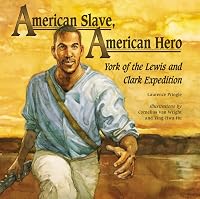
American Slave, American Hero: York of the Lewis and Clark Expedition
by Laurence Pringle
On This Page
Description
A biography of William Clark's personal slave, who provided invaluable assistance to the Lewis and Clark Expedition.Tags
Recommendations




Member Reviews
The main issue with the book is that of tone and perspective. We know that, unfortunately, York left nothing in his own words for us to dissect; one of the many tragedies of slavery. (The same is true for Sally Hemings.) Just as unfortunate is the fact that much of the information we do have about York comes from the very people who initiated and benefited from the system that silenced his voice in the first place. I've always been fascinated by York, and because I had never read this book before, I was hoping for something different that the usual fare about him. But that was not the case, and I was disappointed as a result, particularly since this is a book for children. I don't think that the book emphasized just how horrible slavery show more was, even for those who may not have faced especially harsh treatment (but even saying that is problematic.) And the reader still doesn't get anything new or learn at least a sliver of information about York that doesn't fall into familiar patterns. The same is true for other groups. For example, referring to different Native American tribes as "friendly" versus "not friendly" has always been a pet peeve of mine. As a side note, I still find it hilarious that Clark didn't know how to spell. show less
This picture book was an informative way to learn more about a lesser-known individual on the Corps of Discovery- otherwise known as the Lewis and Clark Expedition. York, the slave of William Clark, accompanied him on the expedition. He was an invaluable member of the team and regarded as "big medicine" by the Indians, which meant something unexplainable and awe-inspiring. His strength-both physical and mental-were a great asset at all times. The author incorporated primary source documents into his story, and acknowledges that little is known about parts of York's life, so the word "probably" was written to show that conjecture was used to fill in those gaps. He writes the story with York as the main character and focuses on his show more contributions to the life of Clark and eventually the Corps of Discovery. Most pages contain a large amount of text, so the book does not seem babyish. The illustrations are detailed and complement the text. The story follows the entire life of York, including a sometimes fractuous relationship with his master, Clark. Treated as a biography, this book would supply a good deal of information about its subject, York. High school appropriate. show less
This award winning book gives the probable biography of an African American slave named York. York was a slave to William Clark of the Lewis and Clark expedition. York assisted Clark in every aspect of the journey from getting leaves for eatting to dancing at a New Year's party for entertainment. Clark eventually freed York. Years after York's death, he was promoted to the rank of honorary sergeant, Regular Army, by Bill Clinton.
I truely enjoyed this book because it told the Lewis and Clark story from a different perspective. Most people forget that there were other people involved since they are not talked about in the history books. The illustrations helped tell the story and showed that York was a happy person. I also enjoyed this show more book because it shows that York, an African American slave, was a true hero. We never hear about the goodness of slaves in history books.
I would use this story in a unit of heros. A good activity would be to act out the story so the children would get a feeling of what the Lewis and Clark expedition may have been like. An exploration activity would be to go to the playground or somewhere the children have not been and have them write about what they see and feel. show less
I truely enjoyed this book because it told the Lewis and Clark story from a different perspective. Most people forget that there were other people involved since they are not talked about in the history books. The illustrations helped tell the story and showed that York was a happy person. I also enjoyed this show more book because it shows that York, an African American slave, was a true hero. We never hear about the goodness of slaves in history books.
I would use this story in a unit of heros. A good activity would be to act out the story so the children would get a feeling of what the Lewis and Clark expedition may have been like. An exploration activity would be to go to the playground or somewhere the children have not been and have them write about what they see and feel. show less
3) Nonfiction
Pringle, Laurence. Cornelius Van Wright and Ying-Hwa Hu illus. (2006). American Slave, American Hero: York of the Lewis and Clark Expedition. Calkins Creek Books.
This book is about a slave named York who grew up with William Clark, in fact being his personal servant from childhood. It chronicles a different side of the story of the Lewis & Clark Expedition. From information taken from journals, we know York actually greatly contributed to the success and survival of both the expedition and its members. The book introduces terms that we don’t use today like Keelboat, as well as gives an historical overview on daily life in the early 19th century. York is highlighted as someone who was revered because of his skill at show more hunting, as well as his differences (being of color). The Native Americans think he is “great medicine” because of his size and color.
We need more books like this. It really gives a much richer historical overview than many books on the expedition called “The Corps of Discovery”. The book chronicles the daily journey and struggle the explorers faced. The illustrations give such an extension to those daily struggles. We don’t know what York looked like because they did not paint slaves back then. With the illustrator’s eye, we get an image of York and the time he and the others lived in. The blending of colors, an almost spotting effect, lends to the antiquity and almost otherworldliness of the story. Each page shows the action before it is read.
I would recommend this book for ages 9-12 because it is useful in studying social studies units, not to mention the importance of African Americans in history. I would compare the cultural diversity differences of then and now. show less
Pringle, Laurence. Cornelius Van Wright and Ying-Hwa Hu illus. (2006). American Slave, American Hero: York of the Lewis and Clark Expedition. Calkins Creek Books.
This book is about a slave named York who grew up with William Clark, in fact being his personal servant from childhood. It chronicles a different side of the story of the Lewis & Clark Expedition. From information taken from journals, we know York actually greatly contributed to the success and survival of both the expedition and its members. The book introduces terms that we don’t use today like Keelboat, as well as gives an historical overview on daily life in the early 19th century. York is highlighted as someone who was revered because of his skill at show more hunting, as well as his differences (being of color). The Native Americans think he is “great medicine” because of his size and color.
We need more books like this. It really gives a much richer historical overview than many books on the expedition called “The Corps of Discovery”. The book chronicles the daily journey and struggle the explorers faced. The illustrations give such an extension to those daily struggles. We don’t know what York looked like because they did not paint slaves back then. With the illustrator’s eye, we get an image of York and the time he and the others lived in. The blending of colors, an almost spotting effect, lends to the antiquity and almost otherworldliness of the story. Each page shows the action before it is read.
I would recommend this book for ages 9-12 because it is useful in studying social studies units, not to mention the importance of African Americans in history. I would compare the cultural diversity differences of then and now. show less
This Sequoyah award book told the story of the Lewis and Clark expedition from a slightly different slant than others I've read. This one told the story of a private slave to William Clark named York. The author did a very authenticating the information. The illustrations were very well done and matched the story line. I felt very involved with the story all along the way.
I really enjoyed this side of the Lewis and Clark expedition story. A lot is written about those two and Sacagawea, but not about the other people who went on the trip and their involvement with getting supplies, etc. Most people had not seen a black man so were interested in him.
I think it would be fun for the kids in the class to take paper and pencil and go outside show more and make their own map. They could make a key to explain different elements that they put on their map.
This would be a good book to have the children act out as a play. show less
I really enjoyed this side of the Lewis and Clark expedition story. A lot is written about those two and Sacagawea, but not about the other people who went on the trip and their involvement with getting supplies, etc. Most people had not seen a black man so were interested in him.
I think it would be fun for the kids in the class to take paper and pencil and go outside show more and make their own map. They could make a key to explain different elements that they put on their map.
This would be a good book to have the children act out as a play. show less
This book is about York, William Clark's personal slave. York was with Clark on his expedition and helped him a great deal. The two boys grew up together, journeyed together, and struggled together. York's story is heart wrenching and triumphant.
This book was interesting because it was an important time in history the Lewis and Clark Expedition. During the expedition thier was and important man named York who was a black slave and somewhat a lifelong partner to Clark. He grew up with him and became a friend and a confident. It is interesting because there are probably a lot of stories from the past that involve blacks and whites being closer than what they appear to be. This was interesting because I love history.
Members
- Recently Added By
Author Information

132+ Works 4,372 Members
Laurence Pringle was raised on an isolated farm in western New York. He studied wildlife biology at Cornell University and the University of Massachusetts at Amherst, and had begun to seek a doctorate in that field. But for several reasons, including trouble with some subjects, Pringle decided to switch to journalism. In 1962, he was looking for a show more job as an editor and writer with an outdoor or science magazine. He found an opening with Nature and Science, a children's magazine published by The American Museum of Natural History. Pringle joined that magazine in early 1963 and during the seven years of that magazine's life, learned a lot about writing for young readers. His friend and editor at the magazine encouraged Pringle to write a book for children. His first manuscript was rejected by several publishers but was finally accepted and published in 1968. When Nature and Science was disbanded in the spring of 1970, Pringle had two choices: look for another editing job or try to survive as a freelance writer. He chose to become a writer and is now the highly acclaimed author of over a hundred books. He writes mainly biographical and environmental stories for children and young adults. Pringle is the recipient of two major awards for his body of writing; the Eva L. Gordon Award for Children's Science Literature and the Washington Post/Children's Book Guild Nonfiction Award in 1999. He has won national awards from the American Nature Study Society and the National Wildlife Federation. Many of his books, including Everybody Has a Bellybutton, have been cited by the National Science Teacher's Association/Children's Book Council as "Outstanding Science Trade Book for Children." In 1998, the National Council of Teachers of English selected his book An Extraordinary Life: The Story of a Monarch Butterfly for the Orbis Pictus Award for Outstanding Nonfiction for Children. (Bowker Author Biography) show less
All Editions
Awards and Honors
Awards
Classifications
Statistics
- Members
- 79
- Popularity
- 392,292
- Reviews
- 9
- Rating
- (3.89)
- Languages
- English
- Media
- Paper, Audiobook
- ISBNs
- 4