
On This Page
Description
Generations of cinema fans and fantasy readers have been charmed by the altruism and sage advice of Glinda the Good Witch in L. Frank Baum's Oz series. This novel, the fourteenth in the series and the last penned by Baum himself, depicts Dorothy's efforts to calm strife and avert war in a section of Oz by calling on Glinda's magical powers.Tags
Recommendations













Member Reviews
With this, my three-year-old son and I came to the end of L. Frank Baum's contributions to the Oz mythos. This was his fourteenth and final Oz novel, which we read about eleven months after we started back with Wonderful Wizard (though as we've taken a couple detours on the way, this was our eighteenth Oz book together).
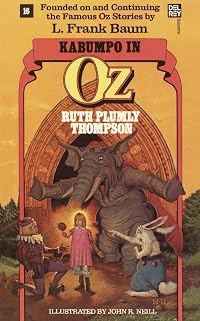
Like many of the late novels, I remembered little of it, but I did remember the Flatheads and the Skeezers. These are two warring tribes in the Gillikin Country: the Flatheads' heads stop at their brows, so they have to carry their brains around in cans, while the Skeezers live in a great domed city that can be submerged in a lake. Beyond this and a scene that appears on the cover of the Del Rey edition, though, I show more remembered little of it.
Like a lot of the later Baum books, I don't think it's a favorite, but I did enjoy it. It's distinctly a novel of two halves. The first half could actually be called Ozma of Oz, except that we already had that book, for it's the book that focuses on the princess of Oz more than any other of the original fourteen. Ozma isn't really the protagonist of any of the Oz books after her transformation from Tip, not even the one called Ozma of Oz, but here she's the co-protagonist with Dorothy. Emerald City established Ozma's pacifist ethos, and this novel explores that in detail, along with what it means for Ozma to be a fairy. (I think Scarecrow was the first book to call Ozma a fairy, something not very consistent with the backstory she received in Marvelous Land or Dorothy and the Wizard.)
Anyway, when Ozma hears about the war between the Skeezers and the Flatheads, she's determined to stop it—but to stop it by showing the Skeezers and the Flatheads a better way to behave, not by using force or anything. We also get an explanation from Ozma of how her fairy magic differs from the sorecery of Glinda and the wizardry of the Wizard: fairy magic is innate and doesn't need tools (though Ozma's magic wand seems to help), while sorcery and wizardry are more powerful but require learning and tools to implement. There's some good problem-solving by Ozma and Dorothy, too. Ozma is ultimately ineffectual in stopping the war, though, despite her pleas; and she and Dorothy ends up trapped in the underwater city of the Skeezers.
The second half of the book, then, shifts focus to Glinda, along with a subplot about a Skeezer named Ervic trying to disenchant some fish. Glinda makes a rescue party: she needs to raise the submerged city, and we see her and the Wizard trying various means of doing this, and we see how their magic is more mechanical than that of Ozma. Though Glinda is well-organized, she's actually not very effectual, either; Scraps has the key idea that enables them to get into the city, Ervic cleverly tricks a Yookoohoo into disenchanting the fish (revealing them to be Adepts at Magic), and Dorothy figures out the magic word that operates the city. It's not a very high-stakes novel; another writer might impose some kind of deadline on raising the city, but Baum goes to great pains to establish that no one is in any danger! It actually has the feel of some Golden Age science fiction to me, a group of competent people working together to reason their way through a problem. So like Magic of Oz, I enjoyed read it on a chapter to chapter basis even if ultimately it kind of doesn't add up to much as you feel it might.
A large number of characters go with Glinda to help raise the Skeezer city, but unlike in some of his other books, Baum is less effective at giving them all something to do. Button-Bright has a nice scene of getting lost and told off by Glinda, but the Scarecrow, the Tin Woodman, the Cowardly Lion, Tik-Tok, Jack Pumpkinhead, Professor Woggle-Bug, the Shaggy Man, Uncle Henry, Cap'n Bill and Trot, the Glass Cat, and Betsy Bobbin are all there too, and most of them just fill out crowd scenes. It's nice for Baum to get so many favorite characters into his last novel, but I wish some of them had even got just one scene where they did something.
Like Magic, this felt influenced by the Great War then recently concluded: Ozma has to stop a war between two nations who have been usurped by dictators, a war their citizens don't want. Because of this, I used German accents for most of the Flatheads, and French for most of the Skeezers.
My son seemed to enjoy this one, though he was a bit worried that the submerged city wouldn't be raised. He even drew his own picture of the Skeezer and Flathead cities, but unfortunately I can't find it to scan it. I do have this picture of Ozma's palace in the Emerald City that he drew.
More on what he drew, what he thought, and the experience of reading the Baum books overall on my blog. show less
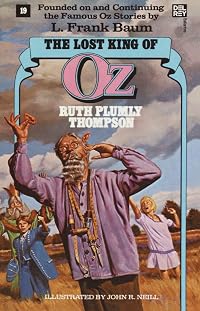
Like many of the late novels, I remembered little of it, but I did remember the Flatheads and the Skeezers. These are two warring tribes in the Gillikin Country: the Flatheads' heads stop at their brows, so they have to carry their brains around in cans, while the Skeezers live in a great domed city that can be submerged in a lake. Beyond this and a scene that appears on the cover of the Del Rey edition, though, I show more remembered little of it.
Like a lot of the later Baum books, I don't think it's a favorite, but I did enjoy it. It's distinctly a novel of two halves. The first half could actually be called Ozma of Oz, except that we already had that book, for it's the book that focuses on the princess of Oz more than any other of the original fourteen. Ozma isn't really the protagonist of any of the Oz books after her transformation from Tip, not even the one called Ozma of Oz, but here she's the co-protagonist with Dorothy. Emerald City established Ozma's pacifist ethos, and this novel explores that in detail, along with what it means for Ozma to be a fairy. (I think Scarecrow was the first book to call Ozma a fairy, something not very consistent with the backstory she received in Marvelous Land or Dorothy and the Wizard.)
Anyway, when Ozma hears about the war between the Skeezers and the Flatheads, she's determined to stop it—but to stop it by showing the Skeezers and the Flatheads a better way to behave, not by using force or anything. We also get an explanation from Ozma of how her fairy magic differs from the sorecery of Glinda and the wizardry of the Wizard: fairy magic is innate and doesn't need tools (though Ozma's magic wand seems to help), while sorcery and wizardry are more powerful but require learning and tools to implement. There's some good problem-solving by Ozma and Dorothy, too. Ozma is ultimately ineffectual in stopping the war, though, despite her pleas; and she and Dorothy ends up trapped in the underwater city of the Skeezers.
The second half of the book, then, shifts focus to Glinda, along with a subplot about a Skeezer named Ervic trying to disenchant some fish. Glinda makes a rescue party: she needs to raise the submerged city, and we see her and the Wizard trying various means of doing this, and we see how their magic is more mechanical than that of Ozma. Though Glinda is well-organized, she's actually not very effectual, either; Scraps has the key idea that enables them to get into the city, Ervic cleverly tricks a Yookoohoo into disenchanting the fish (revealing them to be Adepts at Magic), and Dorothy figures out the magic word that operates the city. It's not a very high-stakes novel; another writer might impose some kind of deadline on raising the city, but Baum goes to great pains to establish that no one is in any danger! It actually has the feel of some Golden Age science fiction to me, a group of competent people working together to reason their way through a problem. So like Magic of Oz, I enjoyed read it on a chapter to chapter basis even if ultimately it kind of doesn't add up to much as you feel it might.
A large number of characters go with Glinda to help raise the Skeezer city, but unlike in some of his other books, Baum is less effective at giving them all something to do. Button-Bright has a nice scene of getting lost and told off by Glinda, but the Scarecrow, the Tin Woodman, the Cowardly Lion, Tik-Tok, Jack Pumpkinhead, Professor Woggle-Bug, the Shaggy Man, Uncle Henry, Cap'n Bill and Trot, the Glass Cat, and Betsy Bobbin are all there too, and most of them just fill out crowd scenes. It's nice for Baum to get so many favorite characters into his last novel, but I wish some of them had even got just one scene where they did something.
Like Magic, this felt influenced by the Great War then recently concluded: Ozma has to stop a war between two nations who have been usurped by dictators, a war their citizens don't want. Because of this, I used German accents for most of the Flatheads, and French for most of the Skeezers.
My son seemed to enjoy this one, though he was a bit worried that the submerged city wouldn't be raised. He even drew his own picture of the Skeezer and Flathead cities, but unfortunately I can't find it to scan it. I do have this picture of Ozma's palace in the Emerald City that he drew.
More on what he drew, what he thought, and the experience of reading the Baum books overall on my blog. show less
This was a pretty good final entry in the Oz books. I set out to read the entire collection and, although I really enjoyed most of the early books, I found the later books to be a mixed bag and I am glad to have finished with them. This one was apparently published posthumously and follows Ozma and Dorothy to the far ends of the kingdom to prevent a war between the Skeezers and the Flatheads. Ozma's magic isn't sufficient to keep them out of trouble so Glinda and the rest of the gang to the rescue! I really enjoyed the side story of Ervic and Reera the Red. Overall, a very enjoyable read.
Here it is, the final book in the original Baum series. He wrote 14 of these novels over twenty years, the last couple being published posthumously. After this the series was handed over to a few randoms who instead of digging down and focusing on the many, many established characters seem to have gone about making up their own characters and not sticking to the established continuity so I have no wish to read those. Which is a shame, because I am sure there are writers out there who could do good work with all Baum's imaginative ideas and interesting characters, instead of constantly moving on to the next shiny object like our official authors (including Baum).
Since I doubt Baum knew this was to be the last book, it is not some great show more satisfying finale but it does at least address the issue that Ozma really doesn't know much about her own land and there are loads of pockets of Oz in which the people don't even know they live in Oz or are ruled by Ozma. I get the impression that she intends to fix this in the future. Here Dorothy reads in the book of records that two such tiny countries are going to war so Ozma and Dorothy pop over there to introduce themselves and solve their issues peacefully. They immediately get trapped.
So Glinda gets together all of Ozma's advisors and an expedition sets out to save the princesses. All your favourites are here. The Scarecrow, the Tin Woodman, the Cowardly Lion, Jack Pumpkinhead, H.M. Wogglebug T.E., Tik-Tok, the Wizard of Oz, the Shaggy Man, Uncle Henry, Scraps the Patchwork Girl, the Glass Cat, Ojo the Lucky, Betsy Bobbin, Cap'n Bill, Trot and the Frogman. Also Button Bright is there, but he's NO ONE's favourite. And guess, go on, how many of these characters are relevant to the plot and get anything to do? That's right! Almost none of them. Most of them aren't even mentioned again after we are told they are part of the expedition. Would it have been so hard to come up with a scene where each character's unique abilities adds a step to solving their issues? In fact, the most useful scene in the book, which reads like a mini fairy tale, involves none of the established characters at all.
I had hoped that some of the characters introduced in books 2 and 3 might finally get to be the focus of another adventure. I consider these characters to be as main as those introduced in book 1, since the first three books all contribute to establishing the lore of the series, but they have been hardly used since. I particularly missed Dorothy spending any time with Tik-Tok. She only left him behind in Ozma of Oz because his mechanics would not work in Kansas, but when she returned to live permanently in Oz in book 6 they were never reunited. Baum had a vast imagination but rarely added any depth to his characters or stories. What do I know about these characters that I didn't learn in their introductory stories? It is a massive missed opportunity. I do like the morality of the Oz stories generally, most of the heroic characters in power are women, and there are often themes of being kind to animals, the importance of consent and not disliking someone's home or beliefs just because they don't fit with yours. Of course, he also has Dorothy whipping her kitten so with Baum you never really know. show less
Since I doubt Baum knew this was to be the last book, it is not some great show more satisfying finale but it does at least address the issue that Ozma really doesn't know much about her own land and there are loads of pockets of Oz in which the people don't even know they live in Oz or are ruled by Ozma. I get the impression that she intends to fix this in the future. Here Dorothy reads in the book of records that two such tiny countries are going to war so Ozma and Dorothy pop over there to introduce themselves and solve their issues peacefully. They immediately get trapped.
So Glinda gets together all of Ozma's advisors and an expedition sets out to save the princesses. All your favourites are here. The Scarecrow, the Tin Woodman, the Cowardly Lion, Jack Pumpkinhead, H.M. Wogglebug T.E., Tik-Tok, the Wizard of Oz, the Shaggy Man, Uncle Henry, Scraps the Patchwork Girl, the Glass Cat, Ojo the Lucky, Betsy Bobbin, Cap'n Bill, Trot and the Frogman. Also Button Bright is there, but he's NO ONE's favourite. And guess, go on, how many of these characters are relevant to the plot and get anything to do? That's right! Almost none of them. Most of them aren't even mentioned again after we are told they are part of the expedition. Would it have been so hard to come up with a scene where each character's unique abilities adds a step to solving their issues? In fact, the most useful scene in the book, which reads like a mini fairy tale, involves none of the established characters at all.
I had hoped that some of the characters introduced in books 2 and 3 might finally get to be the focus of another adventure. I consider these characters to be as main as those introduced in book 1, since the first three books all contribute to establishing the lore of the series, but they have been hardly used since. I particularly missed Dorothy spending any time with Tik-Tok. She only left him behind in Ozma of Oz because his mechanics would not work in Kansas, but when she returned to live permanently in Oz in book 6 they were never reunited. Baum had a vast imagination but rarely added any depth to his characters or stories. What do I know about these characters that I didn't learn in their introductory stories? It is a massive missed opportunity. I do like the morality of the Oz stories generally, most of the heroic characters in power are women, and there are often themes of being kind to animals, the importance of consent and not disliking someone's home or beliefs just because they don't fit with yours. Of course, he also has Dorothy whipping her kitten so with Baum you never really know. show less
One of the better Oz books. It actually has a plot - not just traveling along meeting strange people.
Ozma travels to prevent a war between the Flatheads and the Skeezer. She ends up trapped. I really enjoyed it.
Part I like about magic:
And Dorothy wished in her kindly, innocent heart, that all men and women could be fairies with silver wands, and satisfy all their needs without so much work and worry, for then, she imagined, they would have all their working hours to be happy in. But Ozma, looking into her friend's face and reading those thoughts, gave a laugh and said:
"No, no, Dorothy, that wouldn't do at all. Instead of happiness your plan would bring weariness to the world. If every one could wave a wand and have his wants fulfilled show more there would be little to wish for. There would be no eager striving to obtain the difficult, for nothing would then be difficult, and the pleasure of earning something longed for, and only to be secured by hard work and careful thought, would be utterly lost. There would be nothing to do you see, and no interest in life and in our fellow creatures. That is all that makes life worth our while -- to do good deeds and to help those less fortunate than ourselves show less
Ozma travels to prevent a war between the Flatheads and the Skeezer. She ends up trapped. I really enjoyed it.
Part I like about magic:
And Dorothy wished in her kindly, innocent heart, that all men and women could be fairies with silver wands, and satisfy all their needs without so much work and worry, for then, she imagined, they would have all their working hours to be happy in. But Ozma, looking into her friend's face and reading those thoughts, gave a laugh and said:
"No, no, Dorothy, that wouldn't do at all. Instead of happiness your plan would bring weariness to the world. If every one could wave a wand and have his wants fulfilled show more there would be little to wish for. There would be no eager striving to obtain the difficult, for nothing would then be difficult, and the pleasure of earning something longed for, and only to be secured by hard work and careful thought, would be utterly lost. There would be nothing to do you see, and no interest in life and in our fellow creatures. That is all that makes life worth our while -- to do good deeds and to help those less fortunate than ourselves show less
Peace, prosperity, and happiness are the rule in the marvelous Land of Oz, but in a faraway corner of this magical domain dwell two tribes--the Flatheads and the Skeezers--who have declared war on each other. Determined to keep her subjects from fighting, the Ruler of Oz, Princess Ozma, along with her dearest friend, Princess Dorothy Gale (formerly of Kansas), embarks on a quest to restore peace.When the Supreme Dictator of the Flatheads refuses to cooperate with Ozma, she and Dorothy seek out Queen Coo-ee-oh of the Skeezers, hoping she will be more reasonable. But the queen imprisons Ozma and Dorothy in her grand city and then traps them by submerging the whole city under water. Now it is up to Glinda the Good to save the day. She show more assembles all of Ozma's counsellors--including such beloved Oz friends as the Scarecrow, Tin Woodman, Cowardly Lion, Patchwork Girl, Shaggy Man, Tik-Tok, and Wizard of Oz--and they set out to rescue their friends. Will the magic powers of Glinda and the Wizard combined be enough to free Ozma and Dorothy? show less
_Glinda of Oz_, Baum's fourteenth and last Oz book, finds Dorothy and Ozma captive in the sunken city of the Skeezers, whose contentious relationship with the militant Flatheads has lead to imminent war. In order to rescue the two young girls, as well as bring peace to the Flatheads and the Skeezers, Glinda, the ruler of Quadling Country and the most powerful sorceress in Oz, creates an army consisting of most of Oz's singular inhabitants.
_Glinda of Oz_ is dominated by two qualities: it is consistent and logical. Scenes follow one another by a thread. A great deal of the story is devoted to an almost pseudo-scientific exploration of the different kinds of magic in Oz. Unfortunately, this sets it apart from most of the previous novels, show more which often presented a story that meandered from beginning to end and from encounter to encounter. Although encounters often possessed their own weird and fantastic logic, and individual characters tended to follow their own, sometimes exclusive, rules, they didn't require what might be considered "adult" realism--Oz demanded the suspension of disbelief that children find so natural.
The story also brings together a swath of characters from previous stories, but most of them get short shrift--cameo appearances.
Of course, there is still some of that magic that Baum was so good at crafting, but I didn't find enough of it to truly bring me to Oz. Three stars. show less
_Glinda of Oz_ is dominated by two qualities: it is consistent and logical. Scenes follow one another by a thread. A great deal of the story is devoted to an almost pseudo-scientific exploration of the different kinds of magic in Oz. Unfortunately, this sets it apart from most of the previous novels, show more which often presented a story that meandered from beginning to end and from encounter to encounter. Although encounters often possessed their own weird and fantastic logic, and individual characters tended to follow their own, sometimes exclusive, rules, they didn't require what might be considered "adult" realism--Oz demanded the suspension of disbelief that children find so natural.
The story also brings together a swath of characters from previous stories, but most of them get short shrift--cameo appearances.
Of course, there is still some of that magic that Baum was so good at crafting, but I didn't find enough of it to truly bring me to Oz. Three stars. show less
I didn’t enjoy this as much as some of the other Oz books. Perhaps because there were so many characters and this split the narrative too much. But I’m still sad that I’ve reached the end of Baum’s Oz books.
Members
- Recently Added By
Lists

NPRs Ultimate Backseat Bookshelf: 100 Must-Reads for kids 9-14
222 works; 30 members

Childhood Favorites
427 works; 24 members

Books Read in 2012
816 works; 34 members

Carole's List
445 works; 13 members

Geek Dad Read to Your Kids Additions List
66 works; 4 members

Books Read in 2020
4,379 works; 124 members

Books Read in 2019
4,052 works; 110 members

Books Read in 2025
4,128 works; 98 members
Author Information

605+ Works 72,852 Members
Best known as the author of the Wizard of Oz series, Lyman Frank Baum was born on May 15, 1856, in New York. When Baum was a young man, his father, who had made a fortune in oil, gave him several theaters in New York and Pennsylvania to manage. Eventually, Baum had his first taste of success as a writer when he staged The Maid of Arran, a show more melodrama he had written and scored. Married in 1882 to Maud Gage, whose mother was an influential suffragette, the two had four sons. Baum often entertained his children with nursery rhymes and in 1897 published a compilation titled Mother Goose in Prose, which was illustrated by Maxfield Parrish. The project was followed by three other picture books of rhymes, illustrated by William Wallace Denslow. The success of the nursery rhymes persuaded Baum to craft a novel out of one of the stories, which he titled The Wonderful Wizard of Oz. Some critics have suggested that Baum modeled the character of the Wizard on himself. Other books for children followed the original Oz book, and Baum continued to produce the popular Oz books until his death in 1919. The series was so popular that after Baum's death and by special arrangement, Oz books continued to be written for the series by other authors. Glinda of Oz, the last Oz book that Baum wrote, was published in 1920. (Bowker Author Biography) show less
Some Editions
Series


Belongs to Publisher Series
Work Relationships
Is contained in
Common Knowledge
- Canonical title
- Glinda of Oz
- Original title
- Glinda of Oz
- Original publication date
- 1920
- People/Characters
- Coo-ee-oh; Dorothy Gale; Glinda; Wizard of Oz; Ozma of Oz; Bungle the Glass Cat (show all 13); Tin Woodman; Scarecrow [Oz]; Lady Aurex; Patchwork Girl; Tik-Tok; Cowardly Lion; Adepts at Magic
- Important places
- Oz
- Dedication
- This book is dedicated to my son Robert Stanton Baum.
- First words
- Glinda, the good Sorceress of Oz, sat in the grand court of her palace, surrounded by her maids of honor- a hundred of the most beautiful girls of the Fairyland of Oz.
- Last words
- (Click to show. Warning: May contain spoilers.)"I'm very glad I went to see these peoples," said Princess Ozma,"for I not only prevented any further warfare between them, but they have been freed from the rule of the Su-dic and Coo-ee-oh and are now happy and loyal subjects of the Land of Oz. Which proves that it is always wise to do one's duty, however unpleasant that duty may seem to be."
Classifications
Statistics
- Members
- 1,527
- Popularity
- 15,166
- Reviews
- 21
- Rating
- (3.84)
- Languages
- English, German, Swedish, Ukrainian
- Media
- Paper, Audiobook, Ebook
- ISBNs
- 140
- UPCs
- 1
- ASINs
- 37