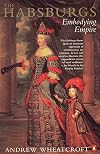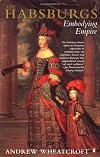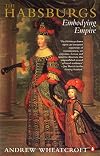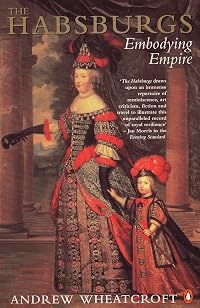
The Habsburgs: Embodying Empire
by Andrew Wheatcroft
On This Page
Description
"For a Habsburg, there was no limit to possibility: Maximilian I could dream of being both Pope and Holy Roman Emperor; Ferdinand II could imagine turning back the tide of Protestantism, and cheerfully risk drowning Europe in blood to achieve that miracle; and Francis I would fashion a cosy Biedermeier world, in which all children had rosy cheeks and all milkmaids were pretty and demure. Like saints - or madmen - they denied reality and constructed the world as they wanted it to be." "For show more generations, the Habsburgs have resisted the interrogation of history, but in this book, covering the whole sweep of Habsburg history from the Middle Ages to the present, Andrew Wheatcroft utilizes a new approach. There is less about the lands and peoples that were ruled, and more about the rulers themselves, both as individuals and collectively. Andrew Wheatcroft uses the techniques of the archaeologist, scraping through the strata of past lives to rediscover the Habsburgs' own scale of values, their concerns, their totems and their fetishes. He explores how and why the Habsburgs have survived and how they are now moving confidently towards a new century, as ever imbued with their own curious and convoluted version of eternal life."--BOOK JACKET.Title Summary field provided by Blackwell North America, Inc. All Rights Reserved show lessTags
Recommendations















Member Reviews
This is actually not the history of the Habsburgs, the rulers of Austria, Spain, The Netherlands, and other chunks of the world. It is more a description in what various ways the Habsburgs tried to legitimize their rule over their vast territories and their claim to the title as Emperors of the Holy Roman Empire. The Habsburgs are usually seen as being conservative, aloof rulers that gained power over almost the whole of Europe by marriage, and then loosing it by being inept military leaders and poor organizers. In many ways this description is correct, although somewhat exaggerated (especially when it comes to being catastrophic military leaders, since Austria fought of the Ottomans in numerous wars). But what we tend to miss, is that show more this, for us, not so flattering image was deliberate, and part of a successful propaganda. By ridiculous claims of being the heir Charlemagne, Frederick Barbarossa, Roman emperors and various Biblical personalities, the Habsburgs created a notion that they had always ruled, even though their roots were as rather middle rank nobles. This propaganda was certainly reinforced by their sanguine and cool appearance to the masses that they are known for. Further, by building churches, cathedrals, monasteries, and sarcophagus for their dead, they created an image as the protectors of (catholic) Christianity, which was reinforced by fighting of heresy with the Inquisition and as being the bulwark against the Islamic Turks. But in what way would that be different of any other king or emperor? Well the Habsburgs ruled as collective. Most kings tried to legitimize themselves and their rule, but the Habsburg propaganda didn’t stop there. They wanted to legitimize their whole linage, their whole family. They also reinforced this by a kind of morbid tendency of marrying relatives. In the long run this created problems in finding healthy male successors to the throne.
Lost expectations can be such a drag. I was hoping to read a book about the Habsburgs as rulers, but instead found myself going threw pages after pages describing churches and monasteries into every miniscule detail. This has certainly influenced my outlook on this book, and thereby maybe giving it a lower score than it is worth. But at the same time, the background in general history the author gives is extremely sketchy, often not chronological, and at many times important historical events are not even mentioned. Thereby this book demands a lot from the reader. Also the numerous descriptions of churches, castles etc., could have been accompanied by more pictures of the same, if now that is such a central part of what the author tries to tell us. In many occasions the author cites in a rather lengthy manner other writers. This is sad, since Mr Weathcroft writes excellent himself, and the book would have been much more fluent if he himself chose the wording. It seems like a lost opportunity since parts of the book are excellent, interesting and perfectly written, and the history of the Habsburgs is certainly as interesting, funny, and at the same time horrifying as past times can be. Two out of five… show less
Lost expectations can be such a drag. I was hoping to read a book about the Habsburgs as rulers, but instead found myself going threw pages after pages describing churches and monasteries into every miniscule detail. This has certainly influenced my outlook on this book, and thereby maybe giving it a lower score than it is worth. But at the same time, the background in general history the author gives is extremely sketchy, often not chronological, and at many times important historical events are not even mentioned. Thereby this book demands a lot from the reader. Also the numerous descriptions of churches, castles etc., could have been accompanied by more pictures of the same, if now that is such a central part of what the author tries to tell us. In many occasions the author cites in a rather lengthy manner other writers. This is sad, since Mr Weathcroft writes excellent himself, and the book would have been much more fluent if he himself chose the wording. It seems like a lost opportunity since parts of the book are excellent, interesting and perfectly written, and the history of the Habsburgs is certainly as interesting, funny, and at the same time horrifying as past times can be. Two out of five… show less
Nice easy-reading overview of the history of the Hapsburgs
I was personally somewhat disappointed with this book. I found it difficult to follow at times as chronological order was only loosely followed, and at times I found the lack of detail frustrating. An interesting read, but hardly the most engaging of history books I have read.
For a Habsburg, there was no limit to possibility: Maximilian I could dream of being both Pope and Holy Roman Emperor; Ferdinand II could imagine turning back the tide of Protestantism, and cheerfully risk drowning Europe in blood to achieve that miracle; and Francis I would fashion a cosy Biedermeier world, in which all children had rosy cheeks and all milkmaids were pretty and demure. Like saints—or madmen—they denied reality and constructed the...
Ratings
Members
- Recently Added By
Author Information

17+ Works 1,880 Members
Andrew Wheatcroft is the author of many books One of the first scholars to use photography in writing the history of the Middle East, he has made art and images a central focus of his work. He is director of the international postgraduate Centre for Publishing Studies at the University of Stirling in Scotland
Common Knowledge
- Canonical title
- The Habsburgs: Embodying Empire
- Original publication date
- 1995
- People/Characters
- Charles V, Holy Roman Emperor; Margaret of Austria; Margaret of Parma; Maria of Hungary, Regent of the Netherlands; Maximilian I von Habsburg, Emperor; Ferdinand I, Holy Roman Emperor
- Important places
- Austria-Hungary; Austria; Spain; The Netherlands; Germany; Hungary
- Dedication
- For my grandmother
Bertha Regina Ware, who gave me a sense of my past, and who lives in my memory
and for her brothers
Otto Veit
Paul Veit
Robert Veit
Hugo Veit
Ernst Veit
the last of their line - First words
- Introduction to the Penguin edition -- The Habsburgs have not, over the centuries, had a good press.
Preface -- In a famous passage in his Autobiography, Edward Gibbon pinpoints the moment at which the germ of The Decline and Fall of the Roman Empire came into his mind.
Classifications
- Genres
- History, Nonfiction, General Nonfiction, Biography & Memoir
- DDC/MDS
- 929.736 — History & geography Biographies, Genealogy, Heraldry Genealogy, Flags, Heraldry, Civil Records Peerage, precedence, titles of honor; Royal houses Germany
- LCC
- DB36 .W43 — History of Europe, Asia, Africa and Oceania Austria – Liechtenstein – Hungary – Czechoslovakia History of Austria. Liechtenstein. Hungary. Czechoslovakia History General
- BISAC
Statistics
- Members
- 652
- Popularity
- 44,583
- Reviews
- 4
- Rating
- (3.50)
- Languages
- English, Italian, Polish, Spanish
- Media
- Paper
- ISBNs
- 6
- ASINs
- 11