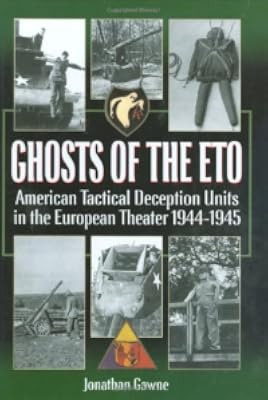
Ghosts of the ETO: American Tactical Deception Units in the European Theater, 1944 - 1945
by Jonathan Gawne
On This Page
Description
No history of the war in Europe has ever taken into account the actions of the men of the US 23rd Special Troops. These men took part in over 22 deception operations against the German Army. Some of these operations had tremendous impact upon how the battles in Europe were fought. The men who participated in these actions were sworn to secrecy for 50 years, and are only now willing to talk about their role. The 23rd was composed of four main units. A signal deception unit to broadcast fake show more radio signals, an engineer camouflage unit to set up rubber dummies of tanks and trucks, a combat engineer unit to construct emplacements and provide local security, and a sonic deception company. The sonic unit was developed to fool German listening posts by playing audio recordings of various sounds, such as tanks moving up or bridges being built. The 23rd was the only tactical deception unit of the American Army in World War ll combining all aspects of deception. This book also covers the birthplace of sonic deception: the Army Experimental Station at Pine Camp; and their smaller sister unit, the 3133rd Sonic Deception company that saw action for 14 days in Italy. Jonathan Gawne is a leading military historian and is the author of the best selling Spearheading D Day and The US Army Photo Album (both published by Histoire & Collections and available from Casemate) as well as books in the Greenhill Books "GI Series". He has contributed articles to numerous military magazines. He lives in Framingham, MA. show lessTags
Recommendations








































Member Reviews
Ghosts is one of interesting books that reveal a lesser know side of World War 2, in this case tactical deception. Tactical deception is the art of deceiving the enemy as to the strength, location, or intent of a combat unit, as opposed to strategic deception which can be considered to be misleading the enemy as to actions that might affect an entire theater of war, for instance fooling the enemy into thinking that you are going to land at the Pas de Calais rather than Normandy.
Ghosts primarily deals with a single unit, the US 23rd Special Troops. This unit, or parts of it, was assigned to various commands of the US Army in Europe in 1944-45. It's role was to deceive the enemy into thinking that a real combat unit was someplace it show more wasn't, or to mask the movement of a combat unit by misleading the enemy into thinking it had gone to somewhere else. There were also other tasks undertaken by the unit. These deceptions were accomplished by using explosives and speakers to mimic artillery fire, phantom radios to simulate the normal wireless traffic of a real combat unit, trucks or half-tracks mounting large speakers to replicate the sound of a large unit moving, and many others.
The book contains a wealth of information concerning these deception techniques and their employment, but sadly the author spends many chapters covering operations that are repetitious to ones previously described. He does carefully include maps to cover the operations, but they aren't all that useful to illuminate the hows and whys of the operations, just where and whens. As I read the book I found myself skimming over chapters once I had determined that it contained nothing new of interest to me. As a unit history this book has much to commend it, but as a study of tactical deception it does tend to get boring after a while. show less
Ghosts primarily deals with a single unit, the US 23rd Special Troops. This unit, or parts of it, was assigned to various commands of the US Army in Europe in 1944-45. It's role was to deceive the enemy into thinking that a real combat unit was someplace it show more wasn't, or to mask the movement of a combat unit by misleading the enemy into thinking it had gone to somewhere else. There were also other tasks undertaken by the unit. These deceptions were accomplished by using explosives and speakers to mimic artillery fire, phantom radios to simulate the normal wireless traffic of a real combat unit, trucks or half-tracks mounting large speakers to replicate the sound of a large unit moving, and many others.
The book contains a wealth of information concerning these deception techniques and their employment, but sadly the author spends many chapters covering operations that are repetitious to ones previously described. He does carefully include maps to cover the operations, but they aren't all that useful to illuminate the hows and whys of the operations, just where and whens. As I read the book I found myself skimming over chapters once I had determined that it contained nothing new of interest to me. As a unit history this book has much to commend it, but as a study of tactical deception it does tend to get boring after a while. show less
Members
- Recently Added By
Author Information
9 Works 381 Members
Classifications
Statistics
- Members
- 39
- Popularity
- 718,664
- Reviews
- 1
- Rating
- (3.00)
- Languages
- English
- Media
- Paper, Ebook
- ISBNs
- 4
- ASINs
- 1