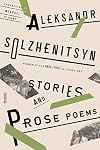
Stories and Prose Poems
by Aleksandr Solzhenitsyn
On This Page
Description
A new edition of the Russian Nobelist's collection of novellas, short stories, and prose poemsStories and Prose Poemscollects twenty-two works of wide-ranging style and character from the Nobel Prize-winner Aleksandr Solzhenitsyn, whose shorter pieces showcase the extraordinary mastery of language that places him among the greatest Russian prose writers of the twentieth century. When the two superb stories "Matryona's House" and "An Incident at Krechetovka Station" were first published in show more Russia in 1963, the Moscow Literary Gazette, the mouthpiece of the Soviet literary establishment, wrote: "His talent is so individual and so striking that from now on nothing that comes from his pen can fail to excite the liveliest interest." The novella For the Good of the Cause and the short story "Zakhar-the-Pouch" in particular--both published in the Soviet Union before Solzhenitsyn's exile--fearlessly address the deadening stranglehold of Soviet bureaucracy and the scandalous neglect of Russia's cultural heritage. But readers who best know Solzhenitsyn through his novels will be delighted to discover the astonishing group of sixteen "prose poems." In these works of varying lengths--some as short as an aphorism--Solzhenitsyn distills the joy and bitterness of Russia's fate into language of unrivaled lyrical purity. show lessTags
Recommendations

























Member Reviews
There are six short stories (including Matryona’s House, For the Good of the Cause, The Easter Procession, Zakhar-the-Pouch, The Right Hand, and An Incident at Krechetovka Station) and sixteen prose poems in this collection. Some of the major themes that run throughout the book are Russian participation in wars and military activities, the inefficiency of the Russian bureaucracy, and individual people’s personal quests to make life better for themselves.
One of the things I really like Solzhenitsyn for is his masterful ability to describe the seemingly unimportant details that affect people’s daily lives and make them who they are. He’s really good at portraying Russia on a grand scale by focusing on the very smallest details. show more He does do this well in the short stories, but I didn’t think they were as good as some of his longer works because they were shorter and therefore less developed. However, the prose poems were the gems of this book. The main theme of them was freedom, and they each really made a strong impression with their vivid imagery. Here’s my favorite:
The Bonfire and the Ants
I threw a rotten log onto the fire without noticing that it was alive with ants.
The log began to crackle, the ants came tumbling out and scurried around in desperation. They ran along the top and writhed as they were scorched by the flames. I gripped the log and rolled it to one side. Many of the ants then managed to escape onto the sand or the pine needles.
But, strangely enough, they did not run away from the fire.
They had no sooner overcome their terror than they turned, circled, and some kind of force drew them back to their forsaken homeland. There were many who climbed back onto the burning log, ran about on it, and perished there.
I think this poem is a good analogy of humanity in general. Overall, this wasn’t my favorite of Solzhenitsyn’s works, but it was well worth reading, especially for the poetry. show less
One of the things I really like Solzhenitsyn for is his masterful ability to describe the seemingly unimportant details that affect people’s daily lives and make them who they are. He’s really good at portraying Russia on a grand scale by focusing on the very smallest details. show more He does do this well in the short stories, but I didn’t think they were as good as some of his longer works because they were shorter and therefore less developed. However, the prose poems were the gems of this book. The main theme of them was freedom, and they each really made a strong impression with their vivid imagery. Here’s my favorite:
The Bonfire and the Ants
I threw a rotten log onto the fire without noticing that it was alive with ants.
The log began to crackle, the ants came tumbling out and scurried around in desperation. They ran along the top and writhed as they were scorched by the flames. I gripped the log and rolled it to one side. Many of the ants then managed to escape onto the sand or the pine needles.
But, strangely enough, they did not run away from the fire.
They had no sooner overcome their terror than they turned, circled, and some kind of force drew them back to their forsaken homeland. There were many who climbed back onto the burning log, ran about on it, and perished there.
I think this poem is a good analogy of humanity in general. Overall, this wasn’t my favorite of Solzhenitsyn’s works, but it was well worth reading, especially for the poetry. show less
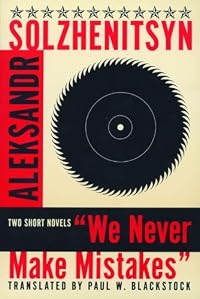
Two of these stories are the novellas in We Never Make Mistakes, which I had just finished reading. The remaining stories were good, although not as developed as the novellas. "For the Good of the Cause" is a critique of corruption and bureaucracy within Russian communism at the regional and local levels. "Zakhar-the-Pouch" is a story of one stop during a cycling trip at a rural battleground monument guarded by an odd caretaker. It reads very much like a personal recollection. "The Right Hand" relates a short tale of a prisoner recovering from illness at an urban hospital. Once again, this story takes a stab at the depersonalization inherent in the practical functions of Russian communism. If you read about Solzhenitsyn's life you find show more that much of his fiction mirrors his own experiences quite closely. The horrific depth of experience he gained during the Stalinist era adds a deeply personal component to his writing. The final section of this volume collects a batch of prose poems. Prior to finding this book at the Book Thing (possibly the best thing in Baltimore, and not far from my house!), I was unaware that Solzhenitsyn had written poetry. So I was excited to read these, and they did not disappoint. Most of them read as reflections on nature or contemporary issues in Russian society that Solzhenitsyn seemed to feel sorrow over. He was a Christian, and his beliefs come through stronger in these poems than I've noticed in the majority of his fiction that I have read. They are not overtly religious in tone, but you can certainly feel where he is coming from. Overall, this collection is a bargain, since you get the two novellas bundled with additional stories and the prose poems. It's a good snapshot of Solzhenitsyn's shorter work and I'm glad I found it. show less
A collection of Solzhenitsyn's short stories, with several shorter works he calls "prose poems". The conventional stories are more effective, some of them quite poignant. Solzhenitsyn is one who understands the brutality of life under a totalitarian state, and has earned many times over the right to storm against it.
This collection of stories and prose poems by Alexander Solzhenitsyn came out in 1970. A couple of the stories are very well known, but most are probably unfamiliar to most people. In several stories, Solzhenitsyn the former political prisoner and school teacher, is the 1st person narrator and his backstory is, while not forefront, understood to be part of the larger background for the story he is telling. Many of these writings are not even stories, they are pictures, described by a harsh critic of the society he is observing. His rancor and disgust at how the Soviet regime had destroyed or debased Russia's cultural history is palpable.
Stories:
Matryona's Home; For the Good of the Cause; The Easter Procession; Zakhar-the-Pouch; The show more Right Hand; An Incident at Krechetovka Station.
Prose Poems:
Freedom to Breathe; Lake Segden; The Duckling; The Ashes of a Poet; The Elm Log; Reflections; The City on the Neva; The Puppy; The Old Bucket; In Yesenin Country; The Kolkhoz Rucksack; The Bonfire and the Ants; A storm in the Mountains; A Journey along the Oka; At the Start of the Day; We Will Never Die. show less
Stories:
Matryona's Home; For the Good of the Cause; The Easter Procession; Zakhar-the-Pouch; The show more Right Hand; An Incident at Krechetovka Station.
Prose Poems:
Freedom to Breathe; Lake Segden; The Duckling; The Ashes of a Poet; The Elm Log; Reflections; The City on the Neva; The Puppy; The Old Bucket; In Yesenin Country; The Kolkhoz Rucksack; The Bonfire and the Ants; A storm in the Mountains; A Journey along the Oka; At the Start of the Day; We Will Never Die. show less
Very good condition. Dust jacket has very minor wear along top edge and very slight discoloration spots in one place on back. Inside all is clean, bright, and tight. Inscribed in ink inside front cover.
Ratings
Members
- Recently Added By
Lists

All Things Russia
459 works; 11 members
Author Information

351+ Works 44,555 Members
Aleksandr Solzhenitsyn was born on December 11, 1918 in Kislovodsk in the northern Caucusus Mountains. He received a degree in physics and math from Rostov University in 1941. He served in the Russian army during World War II but was arrested in 1945 for writing a letter criticizing Stalin. He spent the next decade in prisons and labor camps and, show more later, exile, before being allowed to return to central Russia, where he worked as a high school science teacher. His first novel, One Day in the Life of Ivan Denisovich, was published in 1962. In 1970, he was awarded the Nobel Prize for Literature. In 1974, he was arrested for treason and exiled following the publication of The Gulag Archipelago. He moved to Switzerland and later the U. S. where he continued to write fiction and history. When the Soviet Union collapsed, he returned to his homeland. His other works include The First Circle and The Cancer Ward. He died due to a heart ailment on August 3, 2008 at the age of 89. (Bowker Author Biography) show less
Some Editions
Series
Belongs to Publisher Series
La intrusa (10)
Work Relationships
Is contained in
Common Knowledge
- Canonical title
- Stories and Prose Poems
- Original title
- Матрёнин двор
- Original publication date
- 1963
- Disambiguation notice
- Matryona's House
- For the Good of the Cause
- The Easter Procession
- Zakhar-the-Pouch
- The Right Hand
- An Incident at Krechetovka Station
- Prose Poems
- Freedom to Breathe... (show all)
- Lake Segden
- The Duckling
- The Ashes of a Poet
- The Elm Log
- Reflections
- The City on the Neva
- The Puppy
- The Old Bucket
- In Yesenin Country
- The Kolkhoz Rucksack
- The Bonfire and the Ants
- A Storm in the Mountains
- A Journey Along the Oka
- At the Start of the Day
- We Will Never Die
Classifications
- Genres
- Fiction and Literature, Poetry
- DDC/MDS
- 891.7 — Literature & rhetoric Asian Literature East Indo-European and Celtic literatures Russian and East Slavic languages
- LCC
- PG3488 .O4 .S — Language and Literature Slavic languages and literatures. Baltic languages. Albanian language Slavic. Baltic. Albanian Russian literature Individual authors and works 1961-2000
- BISAC
Statistics
- Members
- 532
- Popularity
- 55,848
- Reviews
- 5
- Rating
- (3.85)
- Languages
- Catalan, English
- Media
- Paper, Ebook
- ISBNs
- 8
- ASINs
- 11