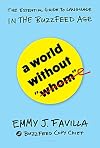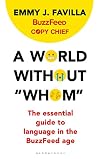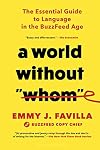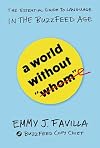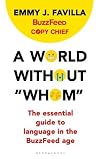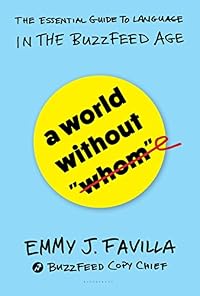
A World Without "Whom": The Essential Guide to Language in the BuzzFeed Age
by Emmy J. Favilla
On This Page
Description
As language evolves faster than ever before, what is the future of "correct" writing? Favilla was tasked with creating a style guide for BuzzFeed, and opted for spelling, grammar, and punctuation guidelines that would reflect not only the site's lighthearted tone, but also how readers actually use language IRL. Now she makes a case for breaking the rules laid out by Strunk and White: she offers a world with more room for writing that's clear, timely, pleasurable, and politically aware.--Tags
Recommendations




Member Reviews
This originally appeared at The Irresponsible Reader.
---
World peace Is a noble ideal, but I’d like to step that goal up a notch: A world with peace and without whom is the place I’d like to spend my golden years, basking in the sun, nary a subjunctive mood in sight, figurative literallys and comma splices frolicking about.
This is a book about feelings, mostly—not about rules, because how can anyone in good conscience create blanket rules for something as fluid, as personal, and as alive as language? Something that is used to communicate literally (literally) every thought, every emotion humans are capable of experiencing, via every medium in existence, from speech to print to Twitter to Snapchat? We can’t. Nearly everything show more about the way words are strung together is open to interpretation, and so boldly declaring a sentence structure “right” or “wrong” is a move that’s often subjective, and we'd be remiss not to acknowledge that most of the guidelines that govern our language are too. Communication is an art, not a science or a machine, and artistic license is especially constructive when the internet is the medium.
WHAT'S A WORLD WITHOUT "WHOM" ABOUT?
This could easily—very easily—be a book I take 10 paragraphs to describe, so I'm going to have mercy on you and me and borrow the description from the Publisher.
A World Without "Whom" is Eats, Shoots & Leaves for the internet age, and BuzzFeed global copy chief Emmy Favilla is the witty go-to style guru of webspeak.
As language evolves faster than ever before, what is the future of "correct" writing? When Favilla was tasked with creating a style guide for BuzzFeed, she opted for spelling, grammar, and punctuation guidelines that would reflect not only the site's lighthearted tone, but also how readers actually use language IRL.
With wry cleverness and an uncanny intuition for the possibilities of internet-age expression, Favilla makes a case for breaking the rules laid out by Strunk and White: A world without "whom," she argues, is a world with more room for writing that's clear, timely, pleasurable, and politically aware. Featuring priceless emoji strings, sidebars, quizzes, and style debates among the most lovable word nerds in the digital media world—of which Favilla is queen—A World Without "Whom" is essential for readers and writers of virtually everything: news articles, blog posts, tweets, texts, emails, and whatever comes next . . . so basically everyone.
At one point, Favilla cites a book, Internet Linguistics: A Student Guide, noting that it "was published in 2011, aka eons ago in internet time." This book was published in 2017, making it eons-old by that standard, and a tad dated. But it still works and may even trigger a pleasant memory or two with a then-topical joke/reference.
THE OVERALL TONE/VOICE
This is a funny book. Favilla writes with a lot of passion, which helps in addressing what most would consider a dry and arid topic. But even better than the intensity of some of her thoughts, it's the humor. I don't know if I made it 3 pages without coming across a solid laugh line—and generally, it was fewer.
Granted, it may take a particular and peculiar sense of humor to find joes about conjunction use fodder for laughter, but if that's your poison...
Even when she's not going for the big laugh, but simply explaining something her style is fun. You can't not have a good time reading this (even when she encourages something like "verbifying with abandon." Just quoting those three words makes me want to scrub my hands like Adrian Monk.
A COUPLE OF NICE BONUSES
As one should expect from a book that invokes BuzzFeed twice on the cover, the book is filled with graphics and lists—and even a couple of quizzes.
My favorite lists are "Standard Punctuation Marks, Ranked from Worst to Best," (I'd literally have a poster of this hanging next to my desk if there was room for anything but bookshelves there) and "Old-Timey Words You Need to Start Using Again" (there's a version on BuzzFeed)
SO, WHAT DID I THINK ABOUT A WORLD WITHOUT "WHOM"?
Hey, remember Latin and its roughly 18,239,721 conjugations for every word? (If you don’t, your high school days were much brighter and probably filled with many more cool parties than mine.) We survived the evolution away from declensions, and we will survive this free-for-all era unscathed as well. Simpler doesn’t necessarily equate to a loss of impact or clarity. It just means fewer strict guidelines to follow. And that’s okay. Have you read the news lately? We have enough utterly horrifying, faith-in-humanity—destroying stuff going on in our day-today to worry about.
The fear that our language is deteriorating because we're making calculated decisions to nix periods or because more people are pretending that whom doesn’t exist or they’re swapping emojis for words is as irritating as the performance that die-hard carnivores often put on of a paralyzing fear of trying vegan food. Pull yourself together. It’s not going to kill you, and it might actually make you a more well-rounded person with a new perspective.
This is not a book for the die-hard prescriptivist when it comes to language use. Favilla bases her positions and stylistic choices on feelings (and literally tells you that on page 1—which is not to say that there's no thought involved) and what she thinks will communicate more clearly. But she'll say time after time, that her rules are subjective and writers should make up their own minds. Especially when it comes to the internet—she will draw a line between print and online writing and doesn't seem to have a problem with more formal writing being done for traditional/print publications—as long as the internet can be the Wild West.
I'm reflexively a prescriptivist and will tend toward that kind of usage/take/book. But anyone who's read this particular site for any length of time (even if this post is your first!), will know I'm clearly not a strict practitioner of the rules Mrs. Hammer and Mr. Nelson pounded into me in Middle School. She didn't convince me on some points, and I'd still side with Strunk, White, and Dreyer at any point they disagreed with her. But I had so much fun reading this—and learning from it, I have to admit—that I don't mind her somewhat anarchical approach.*
*I halfway expect that in 2053, if someone reads this book they'll find that this is a straightjacket in terms of free expression.
And since this is supposed to be what I thought about the reading experience, not if I agree with her on every jot and tittle, I have no problem recommending it. If you're the kind of person who gets worked up about getting your phrasing juuuuuust right or are bothered when someone doesn't. If you think reading tributes to commas and em dashes is a good time. Or if you're curious about why someone would want to eliminate whom or is fine with letting the English subjunctive mood die...this is the book for you. I'm very glad that Jodi recommended this one to me.
And, I think I came away from this with an idea for my next tattoo. So, right there, this was worth the time for me. show less
---
World peace Is a noble ideal, but I’d like to step that goal up a notch: A world with peace and without whom is the place I’d like to spend my golden years, basking in the sun, nary a subjunctive mood in sight, figurative literallys and comma splices frolicking about.
This is a book about feelings, mostly—not about rules, because how can anyone in good conscience create blanket rules for something as fluid, as personal, and as alive as language? Something that is used to communicate literally (literally) every thought, every emotion humans are capable of experiencing, via every medium in existence, from speech to print to Twitter to Snapchat? We can’t. Nearly everything show more about the way words are strung together is open to interpretation, and so boldly declaring a sentence structure “right” or “wrong” is a move that’s often subjective, and we'd be remiss not to acknowledge that most of the guidelines that govern our language are too. Communication is an art, not a science or a machine, and artistic license is especially constructive when the internet is the medium.
WHAT'S A WORLD WITHOUT "WHOM" ABOUT?
This could easily—very easily—be a book I take 10 paragraphs to describe, so I'm going to have mercy on you and me and borrow the description from the Publisher.
A World Without "Whom" is Eats, Shoots & Leaves for the internet age, and BuzzFeed global copy chief Emmy Favilla is the witty go-to style guru of webspeak.
As language evolves faster than ever before, what is the future of "correct" writing? When Favilla was tasked with creating a style guide for BuzzFeed, she opted for spelling, grammar, and punctuation guidelines that would reflect not only the site's lighthearted tone, but also how readers actually use language IRL.
With wry cleverness and an uncanny intuition for the possibilities of internet-age expression, Favilla makes a case for breaking the rules laid out by Strunk and White: A world without "whom," she argues, is a world with more room for writing that's clear, timely, pleasurable, and politically aware. Featuring priceless emoji strings, sidebars, quizzes, and style debates among the most lovable word nerds in the digital media world—of which Favilla is queen—A World Without "Whom" is essential for readers and writers of virtually everything: news articles, blog posts, tweets, texts, emails, and whatever comes next . . . so basically everyone.
At one point, Favilla cites a book, Internet Linguistics: A Student Guide, noting that it "was published in 2011, aka eons ago in internet time." This book was published in 2017, making it eons-old by that standard, and a tad dated. But it still works and may even trigger a pleasant memory or two with a then-topical joke/reference.
THE OVERALL TONE/VOICE
This is a funny book. Favilla writes with a lot of passion, which helps in addressing what most would consider a dry and arid topic. But even better than the intensity of some of her thoughts, it's the humor. I don't know if I made it 3 pages without coming across a solid laugh line—and generally, it was fewer.
Granted, it may take a particular and peculiar sense of humor to find joes about conjunction use fodder for laughter, but if that's your poison...
Even when she's not going for the big laugh, but simply explaining something her style is fun. You can't not have a good time reading this (even when she encourages something like "verbifying with abandon." Just quoting those three words makes me want to scrub my hands like Adrian Monk.
A COUPLE OF NICE BONUSES
As one should expect from a book that invokes BuzzFeed twice on the cover, the book is filled with graphics and lists—and even a couple of quizzes.
My favorite lists are "Standard Punctuation Marks, Ranked from Worst to Best," (I'd literally have a poster of this hanging next to my desk if there was room for anything but bookshelves there) and "Old-Timey Words You Need to Start Using Again" (there's a version on BuzzFeed)
SO, WHAT DID I THINK ABOUT A WORLD WITHOUT "WHOM"?
Hey, remember Latin and its roughly 18,239,721 conjugations for every word? (If you don’t, your high school days were much brighter and probably filled with many more cool parties than mine.) We survived the evolution away from declensions, and we will survive this free-for-all era unscathed as well. Simpler doesn’t necessarily equate to a loss of impact or clarity. It just means fewer strict guidelines to follow. And that’s okay. Have you read the news lately? We have enough utterly horrifying, faith-in-humanity—destroying stuff going on in our day-today to worry about.
The fear that our language is deteriorating because we're making calculated decisions to nix periods or because more people are pretending that whom doesn’t exist or they’re swapping emojis for words is as irritating as the performance that die-hard carnivores often put on of a paralyzing fear of trying vegan food. Pull yourself together. It’s not going to kill you, and it might actually make you a more well-rounded person with a new perspective.
This is not a book for the die-hard prescriptivist when it comes to language use. Favilla bases her positions and stylistic choices on feelings (and literally tells you that on page 1—which is not to say that there's no thought involved) and what she thinks will communicate more clearly. But she'll say time after time, that her rules are subjective and writers should make up their own minds. Especially when it comes to the internet—she will draw a line between print and online writing and doesn't seem to have a problem with more formal writing being done for traditional/print publications—as long as the internet can be the Wild West.
I'm reflexively a prescriptivist and will tend toward that kind of usage/take/book. But anyone who's read this particular site for any length of time (even if this post is your first!), will know I'm clearly not a strict practitioner of the rules Mrs. Hammer and Mr. Nelson pounded into me in Middle School. She didn't convince me on some points, and I'd still side with Strunk, White, and Dreyer at any point they disagreed with her. But I had so much fun reading this—and learning from it, I have to admit—that I don't mind her somewhat anarchical approach.*
*I halfway expect that in 2053, if someone reads this book they'll find that this is a straightjacket in terms of free expression.
And since this is supposed to be what I thought about the reading experience, not if I agree with her on every jot and tittle, I have no problem recommending it. If you're the kind of person who gets worked up about getting your phrasing juuuuuust right or are bothered when someone doesn't. If you think reading tributes to commas and em dashes is a good time. Or if you're curious about why someone would want to eliminate whom or is fine with letting the English subjunctive mood die...this is the book for you. I'm very glad that Jodi recommended this one to me.
And, I think I came away from this with an idea for my next tattoo. So, right there, this was worth the time for me. show less
Sometimes I start a title because I'm intrigued, if not entirely convinced, that the topic merits a book-length narrative to do it justice. This was one of those, which I grabbed mostly on a whim during my last trip to the library before the coronavirus closure. Glad I did! Favilla did an admirable job of turning what could have been a mundane story of creating the first BuzzFeed style guide into a compelling story of how journalism is changing, and being changed by, our online lives and other trends. She also has some pretty coincidental timing for new jobs, noting that she started at BF during Hurricane Sandy and (on Twitter, not in the book) just jumped to CNN as the coronavirus outbreak got to the US.
Not to be mistaken for an English-usage manual on par with The Chicago Manual of Style, A World Without "Whom" is all about BuzzFeed's unique usage guide--how it came to be and why it was needed in the first place. Favilla and her fellow copy editors, as part of an online publication that has its finger on the pulse of what's current, found that the traditional Associated Press Stylebook (APS) didn't fully meet their needs. Favilla initiated the creation of BuzzFeed's usage guide and was so successful that online publications similar to BuzzFeed adopted it.
APS is typically used by journalists but is ideal for those journalists who write for serious, formal publications such as The Washington Post. Lighthearted BuzzFeed is concerned show more first and foremost with connecting with its young readership. That means employing the most up-to-date, if stupid, slang and internet abbreviations, but also bending standard rules of grammar, punctuation, spelling, and syntax when they don't truly need to be bent; spaces surrounding an em dash (long "hyphen," for the unversed) make no difference whatsoever in whether or not the young readership will relate to the content.
This book doesn't seem to know what it is exactly. Certain pieces of Favilla's laid-back advice and an entire section explaining each punctuation mark seem aimed at everyone who writes. On the other hand, A World Without "Whom" seems suitable only for editors as other pieces of advice are irrelevant to all but them. She also discusses the nitty-gritty of traditional grammar, punctuation, and syntax in a way that would bore the average reader. However, Favilla is unable to hide her scorn toward those who value traditional rules. At best, she tosses out “stodgy” and “curmudgeon.” At worst, she rudely mocks those who insert a comma after "Hi" in e-mail salutations and labels those who like to diagram sentences "losers," to cite a few examples. (By her own admission, she has trouble with diagramming.) If she was trying to persuade other editors, those “curmudgeons” who are more likely than most to like diagramming and to use commas in salutations, she sure lacked good sense here.
The majority of Favilla's arguments are unconvincing, and her overall tone and flippant attitude toward English-language standards is irritating. In her world, almost everything is debatable, from comma splices to spelling. Her constant argument is that language is “alive” and evolves, which is fair, but there's accepting natural language evolution, and then there's forcing it. In the most extreme example of Favilla trying to force a change--an example that made me embarrassed for her--she relays how she tried to get her team to adopt a ridiculous word she coined: "faceful." Her team disliked the word, and they instead opted for "face full," the (existing) choice that made sense from the beginning.
To further bolster her core argument, she cites famous writers such as Shakespeare and Mark Twain as those who used incorrect forms of words centuries ago (Shakespeare) or more than 100 years ago (Twain). Twain in particular she cites as proof that "alright" is acceptable (rather than "all right," the correct form according to every reputable usage manual). Her sole reasoning is that he used this word more than 100 years ago. She never considers that perhaps Twain was simply wrong. If a long-dead famous writer used a word incorrectly, to Favilla, that makes that word either the correct form or an acceptable alternative form.
A World Without "Whom" has format and readability going for it. Though it doesn't quite know its identity, the book at least holds reader interest enough, and even those bored by the nitty-gritty aspects may really enjoy the integration of screenshots showing discussions between Favilla and her team; memes; and the results of usage polls (presumably from BuzzFeed's usage guide Twitter page). The most bored can skim A World Without "Whom" and glean some interesting information.
This book is interesting as a curiosity. It's hard to take seriously an editor who employs internet abbreviations (IDK, JK, FWIW, etc.) throughout her book and says “ . . . my test for determining the “right” capitalization, punctuation, or spelling of something I’m editing is this: I ask myself, How would I write this in an email to a friend, or in a Facebook status? If the answer is that I would not, under any circumstance, capitalize the word laundromat--even though many dictionaries (and apparently Microsoft Word) suggest I do--or spell goosebumps as goose bumps, then, well, that settles it.” The few rules Favilla respects can be counted on one hand, and strangely, she gripes about the overuse, to the point of meaninglessness, of "lol" while arguing in favor of things that are just as worth griping about.
Favilla is trying to convince the English-speaking world to throw out 99% of rules and "follow your heart" (a mantra she lives by), without considering that before one can break the rules, one must first know the rules inside and out. She does say it, at the beginning: "It's fine to flout 'the rules' when you have a solid understanding of what the rules are and a calculated reason for doing so . . . " but then...she wrote this book for all and seems to want all to take her advice. It's unwise, and confused.
A World Without "Whom" has to be taken with a grain of salt. I understood Favilla’s every (over-intellectualized) point but rejected them all because they were so ludicrous and because she sounds like she has a generous amount of air between the ears. Anyone serious about writing like an educated person should study the The Chicago Manual of Style or A Writer's Reference by Diana Hacker, at the least. show less
APS is typically used by journalists but is ideal for those journalists who write for serious, formal publications such as The Washington Post. Lighthearted BuzzFeed is concerned show more first and foremost with connecting with its young readership. That means employing the most up-to-date, if stupid, slang and internet abbreviations, but also bending standard rules of grammar, punctuation, spelling, and syntax when they don't truly need to be bent; spaces surrounding an em dash (long "hyphen," for the unversed) make no difference whatsoever in whether or not the young readership will relate to the content.
This book doesn't seem to know what it is exactly. Certain pieces of Favilla's laid-back advice and an entire section explaining each punctuation mark seem aimed at everyone who writes. On the other hand, A World Without "Whom" seems suitable only for editors as other pieces of advice are irrelevant to all but them. She also discusses the nitty-gritty of traditional grammar, punctuation, and syntax in a way that would bore the average reader. However, Favilla is unable to hide her scorn toward those who value traditional rules. At best, she tosses out “stodgy” and “curmudgeon.” At worst, she rudely mocks those who insert a comma after "Hi" in e-mail salutations and labels those who like to diagram sentences "losers," to cite a few examples. (By her own admission, she has trouble with diagramming.) If she was trying to persuade other editors, those “curmudgeons” who are more likely than most to like diagramming and to use commas in salutations, she sure lacked good sense here.
The majority of Favilla's arguments are unconvincing, and her overall tone and flippant attitude toward English-language standards is irritating. In her world, almost everything is debatable, from comma splices to spelling. Her constant argument is that language is “alive” and evolves, which is fair, but there's accepting natural language evolution, and then there's forcing it. In the most extreme example of Favilla trying to force a change--an example that made me embarrassed for her--she relays how she tried to get her team to adopt a ridiculous word she coined: "faceful." Her team disliked the word, and they instead opted for "face full," the (existing) choice that made sense from the beginning.
To further bolster her core argument, she cites famous writers such as Shakespeare and Mark Twain as those who used incorrect forms of words centuries ago (Shakespeare) or more than 100 years ago (Twain). Twain in particular she cites as proof that "alright" is acceptable (rather than "all right," the correct form according to every reputable usage manual). Her sole reasoning is that he used this word more than 100 years ago. She never considers that perhaps Twain was simply wrong. If a long-dead famous writer used a word incorrectly, to Favilla, that makes that word either the correct form or an acceptable alternative form.
A World Without "Whom" has format and readability going for it. Though it doesn't quite know its identity, the book at least holds reader interest enough, and even those bored by the nitty-gritty aspects may really enjoy the integration of screenshots showing discussions between Favilla and her team; memes; and the results of usage polls (presumably from BuzzFeed's usage guide Twitter page). The most bored can skim A World Without "Whom" and glean some interesting information.
This book is interesting as a curiosity. It's hard to take seriously an editor who employs internet abbreviations (IDK, JK, FWIW, etc.) throughout her book and says “ . . . my test for determining the “right” capitalization, punctuation, or spelling of something I’m editing is this: I ask myself, How would I write this in an email to a friend, or in a Facebook status? If the answer is that I would not, under any circumstance, capitalize the word laundromat--even though many dictionaries (and apparently Microsoft Word) suggest I do--or spell goosebumps as goose bumps, then, well, that settles it.” The few rules Favilla respects can be counted on one hand, and strangely, she gripes about the overuse, to the point of meaninglessness, of "lol" while arguing in favor of things that are just as worth griping about.
Favilla is trying to convince the English-speaking world to throw out 99% of rules and "follow your heart" (a mantra she lives by), without considering that before one can break the rules, one must first know the rules inside and out. She does say it, at the beginning: "It's fine to flout 'the rules' when you have a solid understanding of what the rules are and a calculated reason for doing so . . . " but then...she wrote this book for all and seems to want all to take her advice. It's unwise, and confused.
A World Without "Whom" has to be taken with a grain of salt. I understood Favilla’s every (over-intellectualized) point but rejected them all because they were so ludicrous and because she sounds like she has a generous amount of air between the ears. Anyone serious about writing like an educated person should study the The Chicago Manual of Style or A Writer's Reference by Diana Hacker, at the least. show less
Best for: People who enjoy words. People interested in how language use has changed since the internet.
In a nutshell: Buzzfeed Copy Chief shares her perspective on language use for online writing.
Line that sticks with me: “Shakespeare used the singular they, as did a gaggle of other writers, including Jane Austen and Geoffrey Chaucer, as long ago as the 1300s. This is not a new trend, people!” (p 219)
Why I chose it: I love words and writing.
Review: A couple of years ago you might recall seeing stories about the “style guide for the internet.” Ms. Favilla was responsible for that, as she compiles and updates the BuzzFeed style guide. And while it only technically covers copy written for BuzzFeed, what it includes has likely been show more adopted by many writers of online content.
Ms. Favilla is a fun, talented writer. She makes topics that might be dry in less talented hand interesting and lively. Her perspective is that language is alive, and that to better communicate with each other we should be adapting to those changes. Some such changes will be obvious to you, but others might not be as apparent until you think about them. She has a great section on writing about sensitive topics “How to Not Be a Jerk,” which only has one area that I would disagree with - she says one should say “people with disabilities,” and I know there is disagreement in disability communities about whether that or “disabled person” is preferable.
The book doesn’t just cover traditional language; it also discusses emoticons, emojis, and words that may or may not be ‘real.’ You know, the things that make up the internet.
While Ms. Favilla and I disagree strongly on the pronunciation of .gif (PEANUT BUTTER VERSION FOR THE WIN), I’m hard pressed to find anything else of major contention. While the book is long and not quite a quick read, it’s definitely worth it. It will be on my shelf as a reference for years to come. show less
In a nutshell: Buzzfeed Copy Chief shares her perspective on language use for online writing.
Line that sticks with me: “Shakespeare used the singular they, as did a gaggle of other writers, including Jane Austen and Geoffrey Chaucer, as long ago as the 1300s. This is not a new trend, people!” (p 219)
Why I chose it: I love words and writing.
Review: A couple of years ago you might recall seeing stories about the “style guide for the internet.” Ms. Favilla was responsible for that, as she compiles and updates the BuzzFeed style guide. And while it only technically covers copy written for BuzzFeed, what it includes has likely been show more adopted by many writers of online content.
Ms. Favilla is a fun, talented writer. She makes topics that might be dry in less talented hand interesting and lively. Her perspective is that language is alive, and that to better communicate with each other we should be adapting to those changes. Some such changes will be obvious to you, but others might not be as apparent until you think about them. She has a great section on writing about sensitive topics “How to Not Be a Jerk,” which only has one area that I would disagree with - she says one should say “people with disabilities,” and I know there is disagreement in disability communities about whether that or “disabled person” is preferable.
The book doesn’t just cover traditional language; it also discusses emoticons, emojis, and words that may or may not be ‘real.’ You know, the things that make up the internet.
While Ms. Favilla and I disagree strongly on the pronunciation of .gif (PEANUT BUTTER VERSION FOR THE WIN), I’m hard pressed to find anything else of major contention. While the book is long and not quite a quick read, it’s definitely worth it. It will be on my shelf as a reference for years to come. show less
*Sigh*. Linguistic nonfiction is my literary security blanket. I've read pretty much every pop linguistics nonfiction book out there and enjoyed them all. But not this one!
Emmy Favilla seems to have no sense of who her audience is: she veers wildly between offering highly specific advice for those developing a style guide for heavily perused blogs and pedantically defining "prescriptivism." No sooner does she tell people to follow their own instincts than she derides those whose instincts include "whom." She comes off as pretentious, self-important and judgey. My biggest problem with the book is that I didn't like her. But I didn't like the book either: without much central structure, it wanders through half-hearted odes to show more descriptivist language use, punctuated with screenshots of the author's slack chats and buzzfeed articles.
Because Internet covered many of the same topics more comprehensively and was much more fun to read. show less
Emmy Favilla seems to have no sense of who her audience is: she veers wildly between offering highly specific advice for those developing a style guide for heavily perused blogs and pedantically defining "prescriptivism." No sooner does she tell people to follow their own instincts than she derides those whose instincts include "whom." She comes off as pretentious, self-important and judgey. My biggest problem with the book is that I didn't like her. But I didn't like the book either: without much central structure, it wanders through half-hearted odes to show more descriptivist language use, punctuated with screenshots of the author's slack chats and buzzfeed articles.
Because Internet covered many of the same topics more comprehensively and was much more fun to read. show less
I do not own this, but might someday. Fun book!
Ratings
Members
- Recently Added By
Lists

Writing
81 works; 1 member
Author Information
2 Works 152 Members
Classifications
- Genres
- Reference, Technology, Fiction and Literature
- DDC/MDS
- 808.02 — Literature & rhetoric Literature, rhetoric & criticism Rhetoric and collections of literary texts from more than two literatures Rhetoric and anthologies Authorship techniques, plagiarism, editorial techniques
- LCC
- PN147 .F38 — Language and Literature Literature (General) Literature (General) Authorship
- BISAC
Statistics
- Members
- 120
- Popularity
- 270,307
- Reviews
- 6
- Rating
- (3.56)
- Languages
- English
- Media
- Paper, Audiobook, Ebook
- ISBNs
- 6
- ASINs
- 2