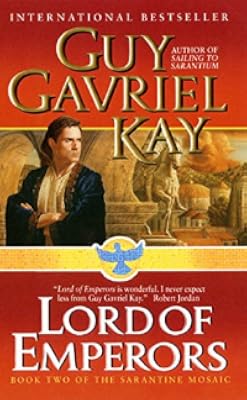
On This Page
Description
In this conclusion to the sequence begun with"Sailing to Sarantium, " Crispin, the mosaicist, has achieved his journey to fabled Sarantium and only wants to confront the challenges of his art high on the scaffolding of destiny. But in Sarantium no human may easily withdraw from the turmoils of court and city, or forget that the presence of the half-world is always close at hand.Tags
Recommendations



Member Recommendations
Busifer Reading this book makes you realize how much of what Kay wrote in The Sarantine Mosaic was lifted from 'real' history, but it also deepens your knowledge of the era and what it has meant to modern society.
20
Member Reviews
Lord of Emperors - Kay
4 stars
“People see different things, remember different things, though all might be looking in the same direction.”
So many people and so many different perspectives in this final book of Kay’s Sarantine Mosaic. The first book begins with the death of an Emperor, an assassination, and the crowning of a new emperor.
This book ends with another assassination, several executions, and the crowning of a different emperor. There’s a spider web of political machinations against the vibrant and dangerous city of Sarantium.
“Crispin looked up at the statue rising before him. A man on a horse, a martial sword, image of power and majesty, a dominant figure. But it was the women, he thought, who had shaped the show more story here, not the men with their armies and blades.”
I’ve always enjoyed the female characters in Kay’s books. Despite the historical settings of his fantasies, he gives women prominent roles and positions of influence, if not power. This book was no exception. There were three women vying for power in this book. Clearly, it could not end well for two out of three of those women. That much was predictable, but I found at least one of the outcomes far from believable. Kay also gives each of these characters a strong sexual appeal (and appetite) while making it clear that each of them knows how to use that attraction as a weapon. As a plot device, and with the addition of several minor female characters, it became tediously repetitious.
I also found the chariot racing to be tedious, although the people of Sarantium obviously do not. I sympathized with the Emperor Valerius who regarded the races as an annoying interruption to the work of the day. I suspect that the author loved the races as much as the citizens. The suspense of the culminating race was so richly described. It was riveting entertainment for the masses while the true epoch changing event was taking place quietly off stage. Kay is a master of metaphor.
Of course, the overriding metaphor is the mosaics. The mosaics are emblems of impermanence. Kay refers to the deterioration of this art form in his later books. Having read the other books first, I know that most of the artwork mentioned in this book doesn’t survive the ages. But, poor Cais Crispus knows his masterpiece will be destroyed even before it is completed. I wanted to cry for him.
The religious landscape of this book is complicated. The old pagan beliefs are retreating. There are factions and schisms within the ruling Jadite beliefs. A new prophet is about to emerge from the desert. Kay may have built a fantasy world with a fantasy map, but it is well grounded in the history of our real world. As he foreshadowed the destruction of the mosaics in the Dome of Sarantium, I kept thinking of the Buddhas of Bamiyan. show less
4 stars
“People see different things, remember different things, though all might be looking in the same direction.”
So many people and so many different perspectives in this final book of Kay’s Sarantine Mosaic. The first book begins with the death of an Emperor, an assassination, and the crowning of a new emperor.
This book ends with another assassination, several executions, and the crowning of a different emperor. There’s a spider web of political machinations against the vibrant and dangerous city of Sarantium.
“Crispin looked up at the statue rising before him. A man on a horse, a martial sword, image of power and majesty, a dominant figure. But it was the women, he thought, who had shaped the show more story here, not the men with their armies and blades.”
I’ve always enjoyed the female characters in Kay’s books. Despite the historical settings of his fantasies, he gives women prominent roles and positions of influence, if not power. This book was no exception. There were three women vying for power in this book. Clearly, it could not end well for two out of three of those women. That much was predictable, but I found at least one of the outcomes far from believable. Kay also gives each of these characters a strong sexual appeal (and appetite) while making it clear that each of them knows how to use that attraction as a weapon. As a plot device, and with the addition of several minor female characters, it became tediously repetitious.
I also found the chariot racing to be tedious, although the people of Sarantium obviously do not. I sympathized with the Emperor Valerius who regarded the races as an annoying interruption to the work of the day. I suspect that the author loved the races as much as the citizens. The suspense of the culminating race was so richly described. It was riveting entertainment for the masses while the true epoch changing event was taking place quietly off stage. Kay is a master of metaphor.
Of course, the overriding metaphor is the mosaics. The mosaics are emblems of impermanence. Kay refers to the deterioration of this art form in his later books. Having read the other books first, I know that most of the artwork mentioned in this book doesn’t survive the ages. But, poor Cais Crispus knows his masterpiece will be destroyed even before it is completed. I wanted to cry for him.
The religious landscape of this book is complicated. The old pagan beliefs are retreating. There are factions and schisms within the ruling Jadite beliefs. A new prophet is about to emerge from the desert. Kay may have built a fantasy world with a fantasy map, but it is well grounded in the history of our real world. As he foreshadowed the destruction of the mosaics in the Dome of Sarantium, I kept thinking of the Buddhas of Bamiyan. show less
This is simply a masterful, beautifully written story and is one of my favourites tales ever, so don’t expect a balanced review
It is a sharp contrast to the first book, where that was a slow burner of a book this one is the frenetic pay off. Without the 1st book this would be a lesser experience but the reader has invested time now and the hook is there.
GGK takes a horde of fully realised characters, complex political manoeuvrings and dramatic action and makes it utterly gripping but not overwhelming. As always with GGK there is nothing black and white about this tale, the tragedy of characters, good or bad, are their failures. Their human frailties that even the emperor has.
The weaving of characters and events into the rhythm of the show more story is joyful. Take the early event of the wedding drawing all characters together then adding new ones and all with their own thoughts and motives that enhance, enrich and underline the story and then he drives them separately into the night and we follow them through the darkness and their passions. There are so many different ways to love here and GGK has much fun exploring them.
The overarching plot, even though signposted (in fact because certain things are hinted at), is one of the most gripping I have ever read. Ok I might be basking in rabid fandom but I can assure you, if you have lasted this long, it will hold your attention. For there are some beautifully written pieces, from the action of the chariot race(s) to the dazzling political, empire changing, manoeuvring. Towards the latter half the pace is frenetic.
Ok there are problems with it.. some of the ways he ties up the story irritate me beyond belief, some off the characters from the first book are awkwardly forgotten and everyone is a shade too beautiful, especially the women and for a story that tries to mirror a whole world, plain women are a noticeable absence.
However none of these faults matter to me for in the end it is a great story, well told. I recommend this ‘duology’ to fantasy and historical fiction fans and to lovers of drama, political intrigue and romance. Of course if the investment in two books puts you off and you have never read GGK I would recommend Lions of Al-Rassan. show less
It is a sharp contrast to the first book, where that was a slow burner of a book this one is the frenetic pay off. Without the 1st book this would be a lesser experience but the reader has invested time now and the hook is there.
GGK takes a horde of fully realised characters, complex political manoeuvrings and dramatic action and makes it utterly gripping but not overwhelming. As always with GGK there is nothing black and white about this tale, the tragedy of characters, good or bad, are their failures. Their human frailties that even the emperor has.
The weaving of characters and events into the rhythm of the show more story is joyful. Take the early event of the wedding drawing all characters together then adding new ones and all with their own thoughts and motives that enhance, enrich and underline the story and then he drives them separately into the night and we follow them through the darkness and their passions. There are so many different ways to love here and GGK has much fun exploring them.
The overarching plot, even though signposted (in fact because certain things are hinted at), is one of the most gripping I have ever read. Ok I might be basking in rabid fandom but I can assure you, if you have lasted this long, it will hold your attention. For there are some beautifully written pieces, from the action of the chariot race(s) to the dazzling political, empire changing, manoeuvring. Towards the latter half the pace is frenetic.
Ok there are problems with it.. some of the ways he ties up the story irritate me beyond belief, some off the characters from the first book are awkwardly forgotten and everyone is a shade too beautiful, especially the women and for a story that tries to mirror a whole world, plain women are a noticeable absence.
However none of these faults matter to me for in the end it is a great story, well told. I recommend this ‘duology’ to fantasy and historical fiction fans and to lovers of drama, political intrigue and romance. Of course if the investment in two books puts you off and you have never read GGK I would recommend Lions of Al-Rassan. show less
I was recommended the Sarantine Mosaic by a friend before I "sailed to Sarantium" myself. It was my first Guy Gavriel Kay's.
I've been swept away by the sheer mastery of Kay's writing. There is nothing cheap about his work. It is a demanding read, especially in the case of the first chapters of the first volume, but in every way a rewarding one. The pace of the books is interesting: events take their time to unravel (the first book really sets the stage for the second one), seeds are planted here and there, but everything comes to its proper end, nothing is left either hanging (with the impression that the author overlooked something or didn't know how to resolve his own plot devices) or concluded in a manner that feels rushed or too show more easy.
Kay knows how to play -- though not cruelly, always with cleverness -- with the expectations of his readers. The shifts in time and in point of views are used to the best effects, giving the reader pause, perspective, or the urge to turn the pages as quickly as possible. He gives hues and shades to every of his character, something generous which I always admire in a writer. As a historian in training, thanks to Kay's choice to reinvent Byzantium as he wished it, I was relieved of the terrible professional trait to gauge the quality of a historical novel by the accuracy of its historicity -- though there is absolutely no doubt that Kay did enormous research to arrive at such historicity in his fiction -- and simply enjoyed every twist and turn of the ride.
A must-read! show less
I've been swept away by the sheer mastery of Kay's writing. There is nothing cheap about his work. It is a demanding read, especially in the case of the first chapters of the first volume, but in every way a rewarding one. The pace of the books is interesting: events take their time to unravel (the first book really sets the stage for the second one), seeds are planted here and there, but everything comes to its proper end, nothing is left either hanging (with the impression that the author overlooked something or didn't know how to resolve his own plot devices) or concluded in a manner that feels rushed or too show more easy.
Kay knows how to play -- though not cruelly, always with cleverness -- with the expectations of his readers. The shifts in time and in point of views are used to the best effects, giving the reader pause, perspective, or the urge to turn the pages as quickly as possible. He gives hues and shades to every of his character, something generous which I always admire in a writer. As a historian in training, thanks to Kay's choice to reinvent Byzantium as he wished it, I was relieved of the terrible professional trait to gauge the quality of a historical novel by the accuracy of its historicity -- though there is absolutely no doubt that Kay did enormous research to arrive at such historicity in his fiction -- and simply enjoyed every twist and turn of the ride.
A must-read! show less
Guy Gavriel Kay might write the must fundamentally human fantasy there is. His stories are steeped in all the love, loss, ambition, and confusion that fills even the most mundane life, yet writ large on lives that echo through the history of this faux-Europe he draws with such deft strokes.
Lord of Emperors finishes the Sarantine Mosaic duology with all the inevitability of history, with triumph and defeat and pain and joy. It is not an easy end, nor one without tears, but it is a grand ending and one I could not stop reading.
One of the most compelling parts of any Kay book, and this one is no different, is how he cuts to the heart of those who do extraordinary things to find why and how they can accomplish such. The genius racer, the show more great artist, the emperor: all are still simply human, mortal and fallible, but some part of them transcends those limits, and this is what Kay so deftly examines.
In Lord of Emperors, we are shown the kind of will and drive that allows a man, a racer, to ignore near mortal injury and even his own chance at winning to create a perfect race for his team. The artist, Crispin, faced with a loss nearly as great as when plague took his family from him, can do nothing but what he has done, and creates. The emperor... Well, I will not spoil that.
Every book of Kay's I reads becomes another favorite. This is no exception. show less
Lord of Emperors finishes the Sarantine Mosaic duology with all the inevitability of history, with triumph and defeat and pain and joy. It is not an easy end, nor one without tears, but it is a grand ending and one I could not stop reading.
One of the most compelling parts of any Kay book, and this one is no different, is how he cuts to the heart of those who do extraordinary things to find why and how they can accomplish such. The genius racer, the show more great artist, the emperor: all are still simply human, mortal and fallible, but some part of them transcends those limits, and this is what Kay so deftly examines.
In Lord of Emperors, we are shown the kind of will and drive that allows a man, a racer, to ignore near mortal injury and even his own chance at winning to create a perfect race for his team. The artist, Crispin, faced with a loss nearly as great as when plague took his family from him, can do nothing but what he has done, and creates. The emperor... Well, I will not spoil that.
Every book of Kay's I reads becomes another favorite. This is no exception. show less
http://nhw.livejournal.com/945115.html
My write-up of the first of these two books, Sailing to Sarantium, ended by wishing that I had bought the sequel at the same time. I repeat that wish now. The two books are so closely intertwined that it's a shame to let the memory of one fade before you start the other. Anyway, like its predecessor, this book is simply a triumph.
But with a difference. Where Sailing to Sarantium stuck fairly closely to the history of our world, in particular the story of Justinian, Theodora, Belisarius and the Hagia Sophia, Lord of Emperors starts by nibbling away at the edges, and then abruptly and brutally swerves into its own timeline a bit over half way through. Suddenly, it all is up for grabs. Viewpoint show more characters die horribly. Any certainty we had is lost. I think that even if you don't know anything about Byzantium, it's a dramatic development on a par with George R.R. Martin's A Game of Thrones. But if you do know what is 'supposed' to happen, the impact is incredible.
But the historical knowingness is not what makes this a great book. (And I add to that historical knowingness the accelerated appearance of Kay's versions of the rise of Islam and a specific spoilerish Christian controversy, brought into the novel for justifiable plot reasons respectively about a century and about two centuries too early.) The overall title of the series is The Sarantine Mosaic, and this is not only a reference to the grand work of art which Caius Crispius is brought to Sarantium to construct, but also surely a reference to the way the books are built up from little pieces - a progression of tight-third-person narratives (some crucial characters to the plot, some purely incidental) - within the overall structure of a framing plot, most of which in Lord of Emperors takes place in the course of two intricately and intimately described 24-hour periods, two days which illuminate the book's structure like the mosaics on either side of an orthodox church.
And apart from fantastic characters, desperate sex, Machiavellian politics, and an unforgettable chariot race, the book - indeed both books - are a deep reflection on the place of art in life, and how some are called to it, some respond to it, and some reject it. A couple of people said they felt the ending of Lord of Emperors was a bit of a let-down. I agree that the emotional place where the key characters end up has been signalled too far in advance to retain the dramatic momentum which Kay probably intended. But read it again, and look at what he is saying about art and the artist. And then look at the work that inspired him. I don't think you will remain unmoved. show less
My write-up of the first of these two books, Sailing to Sarantium, ended by wishing that I had bought the sequel at the same time. I repeat that wish now. The two books are so closely intertwined that it's a shame to let the memory of one fade before you start the other. Anyway, like its predecessor, this book is simply a triumph.
But with a difference. Where Sailing to Sarantium stuck fairly closely to the history of our world, in particular the story of Justinian, Theodora, Belisarius and the Hagia Sophia, Lord of Emperors starts by nibbling away at the edges, and then abruptly and brutally swerves into its own timeline a bit over half way through. Suddenly, it all is up for grabs. Viewpoint show more characters die horribly. Any certainty we had is lost. I think that even if you don't know anything about Byzantium, it's a dramatic development on a par with George R.R. Martin's A Game of Thrones. But if you do know what is 'supposed' to happen, the impact is incredible.
But the historical knowingness is not what makes this a great book. (And I add to that historical knowingness the accelerated appearance of Kay's versions of the rise of Islam and a specific spoilerish Christian controversy, brought into the novel for justifiable plot reasons respectively about a century and about two centuries too early.) The overall title of the series is The Sarantine Mosaic, and this is not only a reference to the grand work of art which Caius Crispius is brought to Sarantium to construct, but also surely a reference to the way the books are built up from little pieces - a progression of tight-third-person narratives (some crucial characters to the plot, some purely incidental) - within the overall structure of a framing plot, most of which in Lord of Emperors takes place in the course of two intricately and intimately described 24-hour periods, two days which illuminate the book's structure like the mosaics on either side of an orthodox church.
And apart from fantastic characters, desperate sex, Machiavellian politics, and an unforgettable chariot race, the book - indeed both books - are a deep reflection on the place of art in life, and how some are called to it, some respond to it, and some reject it. A couple of people said they felt the ending of Lord of Emperors was a bit of a let-down. I agree that the emotional place where the key characters end up has been signalled too far in advance to retain the dramatic momentum which Kay probably intended. But read it again, and look at what he is saying about art and the artist. And then look at the work that inspired him. I don't think you will remain unmoved. show less
Guy Gavriel Kay is one of my favourite authors, for the way he crafts minimalistically, building sparse scenes that are weighted down with deftly placed emotion. For the way he uses repetition to create resonance and force contemplative space in the narrative. For his love of warrior poets and other amazing figures.
This re-read, I was particularly struck by the broad difference between male motivations (to leave something behind - Crispin's mosaics, the Emperor's plans, the Doctor's son, the charioteer's statues, the chef's apprentice) and the female motivations (to survive... or possibly revenge).
This re-read, I was particularly struck by the broad difference between male motivations (to leave something behind - Crispin's mosaics, the Emperor's plans, the Doctor's son, the charioteer's statues, the chef's apprentice) and the female motivations (to survive... or possibly revenge).
Summary: Crispin the mosaicist has come, under imperial summons, to the capital city of Sarantium, and there has been given charge of creating a mosaic larger and grander than anything he could ever have aspired to. Much as he would like to, however, he cannot simply retreat up his scaffolding to his work; the city swirls around him, rife with depths and complexities, currents both personal and political and frequently both. A time of change is coming - rumors of a war being planned against Crispin's homeland, his exiled queen friendless and alone in the great city, violence in the streets and in the stands of the Hippodrome, a pagan doctor and spy arriving from the lands to the east, and above and below it all, the smooth and show more treacherous subtleties of the most powerful imperial court on earth.
Review: I can understand why, from a publisher's point of view, the Sarantine Mosaic was split up into two books - a reader is more likely to take a chance on two 550-page books than on one giant 1100-page one. Yet, from the point of view of a reader, I wonder if that was a mistake. I read these books relatively close together - about a month apart - but I can instantly tell that they would have been better, and I would have been more involved, had I read them sequentially. That's part - but not all - of the reason why I think I didn't connect with this book as much as I have with much of Kay's other writing. The other part is that I never really connected with any of the characters. This book felt a little more distant to me than some of Kay's others... it concerns itself with broad, cataclysmic, history-making changes rather than with the more personal revolutions of many of his other books, and I felt the difference. At least for me, the personal is more powerful than the political, even when the political is built out of the personal, as it is in Lord of Emperors.
The format is all in short sections from a wide variety of viewpoints. This style isn't unfamiliar territory for Kay - he uses it to some extent in all his books - but it's employed here to much more dramatic effect. There is a reason this duology is called The Sarantine Mosaic, and it's to do with the writing as much as with the profession of the main character. Little glittering chips of scenes, some of which are nearly incomphrensible on their own (several would have gone straight over my head had I not already read The Lions of Al-Rassan), but put together form a shining, detailed whole. There's a definite flair to the writing, but the mosaic-style approach and the lack of a strong main character to get attached to (Crispin's around, but his viewpoint does not command a majority of the scenes) led to my having a harder time getting emotionally invested in the book.
The writing, though.... Oh, the writing! Kay's a phenomenal writer, of fantasy and of literature and of fantastic literature, able to conjure mature, complex, multi-layered characters, intricate plots, and vivid environments with an elegance that's difficult to describe. There is a touch more supernatural presence and magic in this one than in several of Kay's other works (Lions and A Song for Arbonne had very little, if any), although less than in Tigana or even in this novel's predecessor, Sailing to Sarantium. The result is something that's not quite historical fiction, not quite fantasy, but some amalgam of the two, driven by a powerful narrative voice and a joy to read. 4 out of 5 stars.
Recommendation: Not my personal favorite of Kay's work, but an excellent book nonetheless. If you're going to read this series, though (and if you enjoy fantasy, or any well-written, mature fiction, I highly recommend you do), buy both and read them together - too much of the power of the story gets lost, otherwise. show less
Review: I can understand why, from a publisher's point of view, the Sarantine Mosaic was split up into two books - a reader is more likely to take a chance on two 550-page books than on one giant 1100-page one. Yet, from the point of view of a reader, I wonder if that was a mistake. I read these books relatively close together - about a month apart - but I can instantly tell that they would have been better, and I would have been more involved, had I read them sequentially. That's part - but not all - of the reason why I think I didn't connect with this book as much as I have with much of Kay's other writing. The other part is that I never really connected with any of the characters. This book felt a little more distant to me than some of Kay's others... it concerns itself with broad, cataclysmic, history-making changes rather than with the more personal revolutions of many of his other books, and I felt the difference. At least for me, the personal is more powerful than the political, even when the political is built out of the personal, as it is in Lord of Emperors.
The format is all in short sections from a wide variety of viewpoints. This style isn't unfamiliar territory for Kay - he uses it to some extent in all his books - but it's employed here to much more dramatic effect. There is a reason this duology is called The Sarantine Mosaic, and it's to do with the writing as much as with the profession of the main character. Little glittering chips of scenes, some of which are nearly incomphrensible on their own (several would have gone straight over my head had I not already read The Lions of Al-Rassan), but put together form a shining, detailed whole. There's a definite flair to the writing, but the mosaic-style approach and the lack of a strong main character to get attached to (Crispin's around, but his viewpoint does not command a majority of the scenes) led to my having a harder time getting emotionally invested in the book.
The writing, though.... Oh, the writing! Kay's a phenomenal writer, of fantasy and of literature and of fantastic literature, able to conjure mature, complex, multi-layered characters, intricate plots, and vivid environments with an elegance that's difficult to describe. There is a touch more supernatural presence and magic in this one than in several of Kay's other works (Lions and A Song for Arbonne had very little, if any), although less than in Tigana or even in this novel's predecessor, Sailing to Sarantium. The result is something that's not quite historical fiction, not quite fantasy, but some amalgam of the two, driven by a powerful narrative voice and a joy to read. 4 out of 5 stars.
Recommendation: Not my personal favorite of Kay's work, but an excellent book nonetheless. If you're going to read this series, though (and if you enjoy fantasy, or any well-written, mature fiction, I highly recommend you do), buy both and read them together - too much of the power of the story gets lost, otherwise. show less
Members
- Recently Added By
Lists

Favorite Long Books
330 works; 42 members

Slipstream or Interstitial Fiction
160 works; 19 members

Top Five Books of 2018
802 works; 265 members
Books with Noble Titles
179 works; 11 members
Speculative Fiction to Read
706 works; 31 members

Books Read in 2016
4,666 works; 199 members

Alphabetical Books
211 works; 3 members

Books Read in 2019
4,052 works; 110 members

Books Read in 2021
5,361 works; 114 members

Books Read in 2018
4,360 works; 110 members

Canadian Jurist-Novelists
316 works; 1 member
Author Information

35+ Works 38,861 Members
Guy Gavriel Kay was born on November 7, 1954 in Weyburn, Saskatchewan, Canada. He became interested in fantasy fiction while working as an assistant to Christopher Tolkien. He assisted him with the editing of J. R. R. Tolkien's The Silmarillion. After receiving a law degree from the University of Toronto, he became principal writer and associate show more producer for the CBC radio series, The Scales of Justice. He also wrote several episodes when the series moved to television. He has written social and political commentary for several publications including the National Post, The Globe and Mail, and The Guardian. His first fantasy novels were The Summer Tree, The Wandering Fire, and The Darkest Road, which make up the Fionavar Tapestry Trilogy. His other works include A Song for Arbonne, The Lions of Al-Rassan, Beyond This Dark House, The Last Light of the Sun, and Under Heaven. He has received numerous awards including and the Aurora Award for Tigana and The Wandering Fire, the 2008 World Fantasy Award for Best Novel for Ysabel, and the International Goliardos Award for his work in the fantasy field. (Bowker Author Biography) show less
Some Editions
Awards and Honors
Awards
Distinctions
Notable Lists
Series

Belongs to Publisher Series
Work Relationships
Is contained in
Common Knowledge
- Canonical title
- Lord of Emperors
- Original title
- Lord of Emperors
- Original publication date
- 2000-02
- People/Characters
- Caius Crispus
- Important places
- Sarantium
- Epigraph
- Timing and turning in a widening gyre . . .
Aut lux hic est, aut capta hic libera regnat.
Light was either born here or, held captive, here reigns free.
---Inscription in Ravenna, among the mosaics
I think that if I cold be given a month of Antiquity and leave top spend it where I chose, I would spend it in Byzantium a little before Justinian opened St. Sophia and closed the Academy of Plato. I think I could find in ... (show all)some little wine-shop some philosophical worker in mosaic who could answer all my questions, the supernatural descending nearer to him . . .
W.B. Yeats, A Vision - Dedication
- For Sam and Matthew,
'the singing-masters of my soul.'
This belongs to them, beginning and end. - First words
- Amid the first hard winds of winter, the King of Kings of Bassania, Shirvan the Great, Brother to the Sun and Moons, Sword of Perun, Scourge of Black Azal, left his walled city of Kabadh and journeyed south and west with much... (show all) of his court to examine the state of his fortifications in that part of the lands he ruled, to sacrifice at the ancient Holy Fire of the priestly caste, and to hunt lions in the desert.
- Last words
- (Click to show. Warning: May contain spoilers.)He draws a breath and steps down off the scaffolding. She smiles.
- Original language
- English
Classifications
- Genres
- Fantasy, Fiction and Literature, General Fiction, Historical Fiction
- DDC/MDS
- 813.54 — Literature & rhetoric American literature in English American fiction in English 1900-1999 1945-1999
- LCC
- PR9199.3 .K39 .L67 — Language and Literature English English Literature English literature: Provincial, local, etc.
- BISAC
Statistics
- Members
- 2,103
- Popularity
- 9,856
- Reviews
- 45
- Rating
- (4.16)
- Languages
- 6 — Czech, English, French, German, Polish, Spanish
- Media
- Paper, Audiobook, Ebook
- ISBNs
- 26
- ASINs
- 6