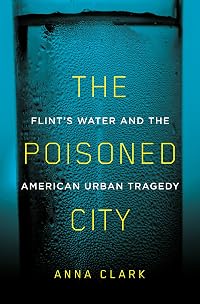
The Poisoned City: Flint's Water and the American Urban Tragedy
by Anna Clark
On This Page
Description
When the people of Flint, Michigan, turned on their faucets in April 2014, the water pouring out was poisoned with lead and other toxins.Through a series of disastrous decisions, the state government had switched the city's water supply to a source that corroded Flint's aging lead pipes. Complaints about the foul-smelling water were dismissed: the residents of Flint, mostly poor and African American, were not seen as credible, even in matters of their own lives.
It took eighteen months of show more activism by city residents and a band of dogged outsiders to force the state to admit that the water was poisonous. By that time, twelve people had died and Flint's children had suffered irreparable harm. The long battle for accountability and a humane response to this man-made disaster has only just begun.
In Anna Clark's full account of this American tragedy, The Poisoned City recounts the gripping story of Flint's poisoned water through the people who caused it, suffered from it, and exposed it. It is a chronicle of one town, but could also be about any American city, all made precarious by the neglect of infrastructure and the erosion of democratic decision making.
Places like Flint are set up to fail—and for the people who live and work in them, the consequences can be fatal.
. show less
Tags
Recommendations


























Member Recommendations


Member Reviews
Spoiler alert: It was BRILLIANT. Anna Clark gives readers an in-depth look at the water crisis in Flint, Michigan that resulted from a breakdown in infrastructure as well as many years of disinvestment from the rest of the state (one could argue the country). I appreciated how much history Clark gave on the creation of the town from a trading post to an industrial powerhouse (General Motors was a big deal there). She also explained how the infrastructure of pipelines across the country has severe flaws like being lead lined and poorly documented so that if they were to be replaced it would be nearly impossible to locate them. However, the biggest impediment to upgrades is the cost and time it would take to make these large-scale show more changes. Towns like Flint (which was already under emergency management due to debt) found themselves facing a public threat for which they seemingly had no recourse. Of course, the most infuriating and heartbreaking thing about Flint's case is that the townspeople were being thwarted at every turn by the very people that were tasked with their welfare and safety. When the water coming out of their taps was brown, oily, and smelly they complained. When people started to develop rashes and their hair started falling out they complained. But the government agencies tasked with monitoring environmental issues (in this case an absolute emergency) insisted that the water was safe for drinking, cooking, and bathing. When some of the residents had independent water tests conducted at their own expense they were pooh-poohed. This went on for over a year.
I cannot begin to express the outrage that I felt while reading this book. I had of course heard about the Flint Water Crisis but I wasn't fully aware of the duplicitousness of the local and state authorities or of the steady decline and disinvestment of the city. (And learning about water infrastructure is a lot more interesting than I'm probably making it sound. Trust me, it's fascinating.) Learning about how certain laws, statues, and ordinances have been finagled so that decisions that have far-reaching ramifications and consequences get made and justified...y'all it had me livid. But it serves as a powerful reminder that citizen scientists like the ones in Flint (who got almost no credit) are willing and perfectly able to advocate for their town. So this book serves as a warning and a testament to the strength of Flint's people. I'll never take my water for granted again. 10/10 show less
I cannot begin to express the outrage that I felt while reading this book. I had of course heard about the Flint Water Crisis but I wasn't fully aware of the duplicitousness of the local and state authorities or of the steady decline and disinvestment of the city. (And learning about water infrastructure is a lot more interesting than I'm probably making it sound. Trust me, it's fascinating.) Learning about how certain laws, statues, and ordinances have been finagled so that decisions that have far-reaching ramifications and consequences get made and justified...y'all it had me livid. But it serves as a powerful reminder that citizen scientists like the ones in Flint (who got almost no credit) are willing and perfectly able to advocate for their town. So this book serves as a warning and a testament to the strength of Flint's people. I'll never take my water for granted again. 10/10 show less
I knew nothing about Flint, Michigan and its water crisis, save a couple of television and journalistic accounts of outraged citizens and dirty water. It truly was national disgrace that an entire American city had to live like this in these terrible conditions. In The Poisoned City, journalist Anna Clark, a native of Michigan, gives an account of the crisis, in which she covers the history of Flint and its rise and fall as a model city. She emphasizes the importance of race and class to this story. I was struck by how much the situation in Flint mirrors the Love Canal crisis in western New York state in the late 1970s and early 1980s. Both crises were decades in the making, both involved state officials who ignored local populations show more and insisted that everything was ok, both communities relied on independent experts to come to their aid, both states altered and abused scientific evidence to stifle discussion, and, in both cases, the states had to backtrack, recognize the problem, and offer remediation. You will come away understanding how long and complex the Flint water crisis has been, and you will come away very angry that this happened in America. show less
Anna Clark's reportorial account of the Flint Water Crisis is a reminder that some of the biggest problems we face in America - systemic racism, self-serving politicians, ineffectual government agencies less interested in serving the public need then in performing CYA - are not just confined to Washington D.C. Her emphasis on the importance of community organizing in overcoming these pressures to force the crisis into the light so it could be resolved is very timely. A short(ish) book and a quick read, and one well worth your time.
I briefly knew Anna Clark when I used to volunteer at the Haley House in Boston and she was a member of the intentional community that lived there. Ever since she moved to Michigan I've followed her journalism career from afar. She seems the perfect person to bring together a passion for social justice and the skills of journalism to documenting the water crisis in Flint, Michigan.
Clark tells the story from the perspective of the local activists who brought the problems with the water to light and the health and science experts who verified that the water was dangerous. So much of the Flint water crisis is rooted in greed and indifference. The decision was made by the city's emergency manager who was appointed by the governor to "run show more the city like a business" (a practice carried out in many Michigan cities leading to 53% of Michigan's African American population living under non-elected local government). The switch from Lake Huron water via Detroit to the backup system of the Flint River was purportedly to save money until a new regional water authority came online, although it is questionable if money was saved at all considering the costs of updating the local treatment plant.
While it's often reported that the Flint River water is unhealthy, it turns out that water in the river and when it left the treatment plant was in fact clean. But the different chemistry of the river water compared to lake water had a corrosive effect that leeched lead from the city's ancient pipes and also promoted growth of infectious diseases. The water authority failed to use the proper anti-corrosives to help prevent this from happening. But the real scandal is that when residents complained of discolored and odoriferous water and the bad health effects, especially among children, the city and state officials refused to help and continued to claim there was no ill effects from the water.
In addition to thoroughly documenting the crisis, Clark also provides the historical background that shows why the water crisis inordinately affected Flint's poorer residents, especially black and brown people. The prosperous Flint of the mid-20th century was heavily segregated, with the effects of redlining and housing segregation still felt today. The movement of prosperous white families and corporations out of Flint was funded by disinvestment in the city itself. And while medical experts have been aware of the poisonous nature of lead for centuries, that did not stop industry from making efforts to use lead - whether it be in gasoline or water pipes - and promote it as safe.
Poison City is a well-written book, and a very important book to read as Flint's crisis is one that is happening or could happen in various ways in cities across the country. It's hard not to read this book without feeling rage, yet Clark finds hope in the community activists who fought to bring this issue to international attention, and continue to fight for clean water in Flint. show less
Clark tells the story from the perspective of the local activists who brought the problems with the water to light and the health and science experts who verified that the water was dangerous. So much of the Flint water crisis is rooted in greed and indifference. The decision was made by the city's emergency manager who was appointed by the governor to "run show more the city like a business" (a practice carried out in many Michigan cities leading to 53% of Michigan's African American population living under non-elected local government). The switch from Lake Huron water via Detroit to the backup system of the Flint River was purportedly to save money until a new regional water authority came online, although it is questionable if money was saved at all considering the costs of updating the local treatment plant.
While it's often reported that the Flint River water is unhealthy, it turns out that water in the river and when it left the treatment plant was in fact clean. But the different chemistry of the river water compared to lake water had a corrosive effect that leeched lead from the city's ancient pipes and also promoted growth of infectious diseases. The water authority failed to use the proper anti-corrosives to help prevent this from happening. But the real scandal is that when residents complained of discolored and odoriferous water and the bad health effects, especially among children, the city and state officials refused to help and continued to claim there was no ill effects from the water.
In addition to thoroughly documenting the crisis, Clark also provides the historical background that shows why the water crisis inordinately affected Flint's poorer residents, especially black and brown people. The prosperous Flint of the mid-20th century was heavily segregated, with the effects of redlining and housing segregation still felt today. The movement of prosperous white families and corporations out of Flint was funded by disinvestment in the city itself. And while medical experts have been aware of the poisonous nature of lead for centuries, that did not stop industry from making efforts to use lead - whether it be in gasoline or water pipes - and promote it as safe.
Poison City is a well-written book, and a very important book to read as Flint's crisis is one that is happening or could happen in various ways in cities across the country. It's hard not to read this book without feeling rage, yet Clark finds hope in the community activists who fought to bring this issue to international attention, and continue to fight for clean water in Flint. show less
“The Flint water crisis illustrates how the challenges in America's shrinking cities are not a crisis of local leadership - or, at least, not solely that - but a crisis of systems. Paternalism, even if it is well meaning, cannot transcend the political, economic, and social obstacles that relegate places such as Flint to the bottom. The chronic under funding of American cities imperils the health of citizens. It also stunts their ability to become full participants in a democratic society, and it shatters their trust in the public realm. Communities that are poor and communities of color - and especially those that are both - are hurt worst of all.”
― Anna Clark, The Poisoned City: Flint's Water and the American Urban Tragedy
I show more remember when I first heard about the Flint water crisis. There was this feeling..and it has never really left me..that this couldn't have happened. Not in the United States. Not in this wonderful country where we look out for each other. And love each other. It was incomprehensible to me that an entire city in America could be poisoned, just like that.
Anna Clark takes us on the journey through the Flint water crisis and she does it amazingly. It is almost impossible to read this book and not be angry. An entire city was lied to, patronized, talked down to, ignored and made to feel like they were nothing.
This is not the first time we, as a nation, have screwed up. I remember reading about Enron and feeling anger. Of coarse there was the "Weapons of Mass destruction" lie, The Trayvon Martin case..I mean I could go on and on. So maybe it should not be such a shock..but it is.
This is a dense book and I will freely admit there were some parts I skimmed a bit but with that, I will also say, Anna Clark is a damn good writer. No, a great one. The research that went into telling this story must have been just..very deep. I applaud her for writing this.
There is an expression, "If you cannot imagine it, you can't believe it". I wish I could remember who that quote is by. The bottom line is..I could not imagine it..then. I remember listening to the coverage and just feeling incredulous. And angry. Sometimes evil knows no limits. I truly do not understand how some of these people can sleep at night.
So the book goes back and forth in time. Anna tells the reader so much about Flint's history, how successful they once were before urban blight came their way. She gets into the weeds on some of the people who were most affected in this shitstorm as well as introducing us to many good people who went all out to stop it. There are so many players in this story. Flint was let down by so many people.
I am a cynic. I wasn't always this way but as the years go by, don't we all become a bit more jaded? I still however, see some things through rose colored glasses. I know there was a time I would not have been able to comprehend this.
And not only is it a story of betrayal..at the highest levels..it is also a story of fear..if we cannot trust our elected officials, both at the local and national level..and .The EPA..who, for crying out loud can we trust? Can everything be bought, even death? Even the lead poisoning of little children?
I also cannot help thinking about the country's present circumstances, which came in to sharp focus as I read this. Right now, we as a country, are virtually locked in our houses trying to keep ourselves and the ones we love..safe..but we are also at the mercy of a Government, impatient to reopen, to get the economy on track, TO PROFIT..and it scares me..how far will they go? How many deaths will be acceptable? What corners will they cut, what rules will they break..in the name of money? And lawlessness.
I am not a conspiracy theorist. I do not believe that Elvis and Jim Morison are alive and secretly lounging around somewhere, (although it would be nice if they were). I do not believe 9/11 was an inside job. I am not a conspiracy theory person but I have come to believe in utter and complete ruthlessness and that some people ..for whatever a reason..lack of a soul, addiction to power, simply not having an ounce of humanity..I have come to believe in those things over the years and you will find much of that in this book.
I think this is an important book. I cannot say it's a fun read. My only negative is how dense it is and the constant back and forth in time. But I do not happen to like that format. It also made the book a bit confusing for me but regardless, I would strongly recommend this book and believe me, it is full of bravery, fearlessness and love as well. And God Bless Rachel Maddow. We need more journalists like her.
I hope this writer thinks seriously about getting in to the weeds of the Corona Virus and maybe writing a book on it. I thin k she would be the perfect person to do so. Highly, Highly recommended. show less
― Anna Clark, The Poisoned City: Flint's Water and the American Urban Tragedy
I show more remember when I first heard about the Flint water crisis. There was this feeling..and it has never really left me..that this couldn't have happened. Not in the United States. Not in this wonderful country where we look out for each other. And love each other. It was incomprehensible to me that an entire city in America could be poisoned, just like that.
Anna Clark takes us on the journey through the Flint water crisis and she does it amazingly. It is almost impossible to read this book and not be angry. An entire city was lied to, patronized, talked down to, ignored and made to feel like they were nothing.
This is not the first time we, as a nation, have screwed up. I remember reading about Enron and feeling anger. Of coarse there was the "Weapons of Mass destruction" lie, The Trayvon Martin case..I mean I could go on and on. So maybe it should not be such a shock..but it is.
This is a dense book and I will freely admit there were some parts I skimmed a bit but with that, I will also say, Anna Clark is a damn good writer. No, a great one. The research that went into telling this story must have been just..very deep. I applaud her for writing this.
There is an expression, "If you cannot imagine it, you can't believe it". I wish I could remember who that quote is by. The bottom line is..I could not imagine it..then. I remember listening to the coverage and just feeling incredulous. And angry. Sometimes evil knows no limits. I truly do not understand how some of these people can sleep at night.
So the book goes back and forth in time. Anna tells the reader so much about Flint's history, how successful they once were before urban blight came their way. She gets into the weeds on some of the people who were most affected in this shitstorm as well as introducing us to many good people who went all out to stop it. There are so many players in this story. Flint was let down by so many people.
I am a cynic. I wasn't always this way but as the years go by, don't we all become a bit more jaded? I still however, see some things through rose colored glasses. I know there was a time I would not have been able to comprehend this.
And not only is it a story of betrayal..at the highest levels..it is also a story of fear..if we cannot trust our elected officials, both at the local and national level..and .The EPA..who, for crying out loud can we trust? Can everything be bought, even death? Even the lead poisoning of little children?
I also cannot help thinking about the country's present circumstances, which came in to sharp focus as I read this. Right now, we as a country, are virtually locked in our houses trying to keep ourselves and the ones we love..safe..but we are also at the mercy of a Government, impatient to reopen, to get the economy on track, TO PROFIT..and it scares me..how far will they go? How many deaths will be acceptable? What corners will they cut, what rules will they break..in the name of money? And lawlessness.
I am not a conspiracy theorist. I do not believe that Elvis and Jim Morison are alive and secretly lounging around somewhere, (although it would be nice if they were). I do not believe 9/11 was an inside job. I am not a conspiracy theory person but I have come to believe in utter and complete ruthlessness and that some people ..for whatever a reason..lack of a soul, addiction to power, simply not having an ounce of humanity..I have come to believe in those things over the years and you will find much of that in this book.
I think this is an important book. I cannot say it's a fun read. My only negative is how dense it is and the constant back and forth in time. But I do not happen to like that format. It also made the book a bit confusing for me but regardless, I would strongly recommend this book and believe me, it is full of bravery, fearlessness and love as well. And God Bless Rachel Maddow. We need more journalists like her.
I hope this writer thinks seriously about getting in to the weeds of the Corona Virus and maybe writing a book on it. I thin k she would be the perfect person to do so. Highly, Highly recommended. show less
Disclaimer: I received this book from GoodReads First Reads program.
This is the story of how mismanagement and cover ups led to the deadly water crisis in Flint Michigan. The author traces the problem from the very beginning, explaining how white flight after GM's plant closings had resulted in pockets of poor people, interspersed with small pockets of financially better off families. The city's tax base had fallen dramatically, the city had been placed under a management that had no accountability to the people, and choices were made based on fiscal policy rather than what was best for the populace. The people were told by their elected officials and by those in charge of the water distribution, that the water was safe to drink, so show more they drank it, bathed in it, made baby formula with it. Then their pets started to die, their children got sick and people were getting rashes. Those responsible tested the water using methods that were guaranteed to test with lower levels of pollutants, and assured everyone it wasn't the water. Only when independent tests were administered did they find out how how the lead levels in the water were - often exceeding levels used to indicate toxic waste. The author also gives a good history lesson on lead and it's use for pipes. Also a sobering look at how racism was applied to neighborhoods in Flint (and, I'm sure, many other cities in America).
This is a very interesting story, and one that everyone who lives in an urban environment should pay attention to. It's very likely your town also has lead pipes, and uses testing methods that will insure the water tests cleaner than it really is. I recommend this book highly. show less
This is the story of how mismanagement and cover ups led to the deadly water crisis in Flint Michigan. The author traces the problem from the very beginning, explaining how white flight after GM's plant closings had resulted in pockets of poor people, interspersed with small pockets of financially better off families. The city's tax base had fallen dramatically, the city had been placed under a management that had no accountability to the people, and choices were made based on fiscal policy rather than what was best for the populace. The people were told by their elected officials and by those in charge of the water distribution, that the water was safe to drink, so show more they drank it, bathed in it, made baby formula with it. Then their pets started to die, their children got sick and people were getting rashes. Those responsible tested the water using methods that were guaranteed to test with lower levels of pollutants, and assured everyone it wasn't the water. Only when independent tests were administered did they find out how how the lead levels in the water were - often exceeding levels used to indicate toxic waste. The author also gives a good history lesson on lead and it's use for pipes. Also a sobering look at how racism was applied to neighborhoods in Flint (and, I'm sure, many other cities in America).
This is a very interesting story, and one that everyone who lives in an urban environment should pay attention to. It's very likely your town also has lead pipes, and uses testing methods that will insure the water tests cleaner than it really is. I recommend this book highly. show less
Anna Clark with the city of Flint, Michigan, presents us with how racism and a stressed environment can together go disastrously bad. Other large issues present themselves. When faced with a large problem is American society and its politics, as they are constructed, able to react effectively? The multitude of agencies and governmental jurisdictions not working together certainly hurt Flint when it was so needy, Clark points out the citizens were at the bottom of the pecking order when bad action followed bad action. Flint is shown to be a warning signal that this certainly will happen again if basic changes in attitude and problem solving mechanics are not made.
Quotes: (page 87) “Kettering wanted to avoid the word 'lead' in the show more commercial market, so the fuel was sold under the brand name Ethyl, eventually through a company that was developed as a partnership of the Dayton Lab, DuPont, and Standard Oil. But skeptics still slowed the march of progress. In response to queries from the surgeon general about the impact of TEL on public health, a DuPont executive said that while 'no actual experimental data was taken,' the makers felt confident it was safe. To support their case, the industrialists funded a study that would be conducted by the Bureau of Mines, the federal agency for scientific research at the time. The industrialists demanded---and the bureau largely accepted---extreme control over the results. The contract gave the makers of TEL not only the right to view and comment on the bureau's analysis, but also the right of final approval. As the historians David Rosner and Gerald Markowitz have pointed out, the people who profited from leaded gasoline therefore had ' veto power over the research of the United States government.'”
(page 126) “Even in its new guise, Michigan's emergency manager law remained focused on finances. 'That's the problem.' The goal is 'to balance the books, and if you can try to get something else done, I guess you can try that. But that's not what you go there for. And then the state's idea is to get out as soon as possible,' said Michael Stampfer, a former emergency manager for the City of Pontiac. It was a short- term strategy for long-term problems. Emergency managers might make real improvements by cutting costs, but they are not necessarily ones that endure.”
(page 185) “The governor did not compel others to release their emails, and there was no independent way to ensure that what was posted included all of the relevant communications. And it was striking that Snyder did not initially include messages from 2013, the year when the KWA's contract was signed. Openness was still an at-will gesture for which Michigan residents and newspaper editorial boards had to plead.”
(page 208) “In Flint, 37percent of the residents are white. But as researcher Laura Pelido points out, 'they suffer a fate similar to their Black neighbors insofar as the entire city is racialized as Black.' (To say nothing of other communities in Flint, particularly the sizeable Hispanic population.) That's an echo of the days of redlining and racially restrictive covenants, when a neighborhood could be back or it could be white, but never both.
The more the cities are divided by race and class, the more that environmental racism becomes likely.”
(page 211) “While positive action is imperative, it needs to come with great intention and care, mindful of the boundless mistakes of the past. Pain cannot be papered over with public-relations spin or erased by shinny new programs or buildings, any more than our lead problems were solved when we stopped laying lead pipes but did nothing to extract the ones that were already in the ground. Just and sustainable change requires reckoning with the past even while cultivating a transformational future.” show less
Quotes: (page 87) “Kettering wanted to avoid the word 'lead' in the show more commercial market, so the fuel was sold under the brand name Ethyl, eventually through a company that was developed as a partnership of the Dayton Lab, DuPont, and Standard Oil. But skeptics still slowed the march of progress. In response to queries from the surgeon general about the impact of TEL on public health, a DuPont executive said that while 'no actual experimental data was taken,' the makers felt confident it was safe. To support their case, the industrialists funded a study that would be conducted by the Bureau of Mines, the federal agency for scientific research at the time. The industrialists demanded---and the bureau largely accepted---extreme control over the results. The contract gave the makers of TEL not only the right to view and comment on the bureau's analysis, but also the right of final approval. As the historians David Rosner and Gerald Markowitz have pointed out, the people who profited from leaded gasoline therefore had ' veto power over the research of the United States government.'”
(page 126) “Even in its new guise, Michigan's emergency manager law remained focused on finances. 'That's the problem.' The goal is 'to balance the books, and if you can try to get something else done, I guess you can try that. But that's not what you go there for. And then the state's idea is to get out as soon as possible,' said Michael Stampfer, a former emergency manager for the City of Pontiac. It was a short- term strategy for long-term problems. Emergency managers might make real improvements by cutting costs, but they are not necessarily ones that endure.”
(page 185) “The governor did not compel others to release their emails, and there was no independent way to ensure that what was posted included all of the relevant communications. And it was striking that Snyder did not initially include messages from 2013, the year when the KWA's contract was signed. Openness was still an at-will gesture for which Michigan residents and newspaper editorial boards had to plead.”
(page 208) “In Flint, 37percent of the residents are white. But as researcher Laura Pelido points out, 'they suffer a fate similar to their Black neighbors insofar as the entire city is racialized as Black.' (To say nothing of other communities in Flint, particularly the sizeable Hispanic population.) That's an echo of the days of redlining and racially restrictive covenants, when a neighborhood could be back or it could be white, but never both.
The more the cities are divided by race and class, the more that environmental racism becomes likely.”
(page 211) “While positive action is imperative, it needs to come with great intention and care, mindful of the boundless mistakes of the past. Pain cannot be papered over with public-relations spin or erased by shinny new programs or buildings, any more than our lead problems were solved when we stopped laying lead pipes but did nothing to extract the ones that were already in the ground. Just and sustainable change requires reckoning with the past even while cultivating a transformational future.” show less
Members
- Recently Added By
Lists

Books Read in College
80 works; 5 members

Books Read in 2025
4,128 works; 98 members
Author Information

3 Works 290 Members
Awards and Honors
Awards
Distinctions
Notable Lists
Common Knowledge
- Original publication date
- 2018
- Important places
- Flint, Michigan, USA
- Original language
- English
- Canonical DDC/MDS
- 363.610977437
- Canonical LCC
- RA591
Classifications
- Genres
- Nonfiction, General Nonfiction, Politics and Government, History, Science & Nature
- DDC/MDS
- 363.610977437 — Society, government, & culture Social problems and social services Public Safety - Police, Crime Investigation Public utilities and related services Water supply
- LCC
- RA591 — Medicine Public aspects of medicine Public aspects of medicine Public health. Hygiene. Preventive medicine Environmental health
- BISAC
Statistics
- Members
- 259
- Popularity
- 125,448
- Reviews
- 15
- Rating
- (4.11)
- Languages
- English, Italian
- Media
- Paper, Audiobook, Ebook
- ISBNs
- 6
- ASINs
- 2