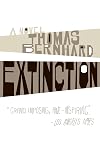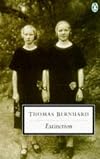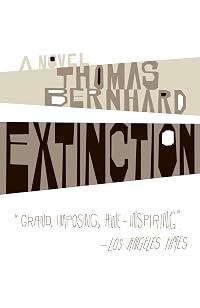
Extinction
by Thomas Bernhard
On This Page
Description
From the late Thomas Bernhard, arguably Austria's most influential novelist of the postwar period, and one of the greatest artists in all twentieth-century literature in the German language, his magnum opus. Extinction, Bernhard's last work of fiction, takes the form of the autobiographical testimony of Franz-Josef Murau, the intellectual black sheep of a powerful Austrian land-owning family. Murau lives in Rome in self-imposed exile from his family, surrounded by a coterie of artistic and show more intellectual friends. On returning from his sister's wedding to the "wine-cork manufacturer" on the family estate of Wolfsegg, having resolved never to go home again, Murau receives a telegram informing him of the death of his parents and brother in a car crash. Not only must he now go back, he must do so as the master of Wolfsegg. And he must decide its fate. Divided into two halves, Extinction explores Murau's rush of memories of Wolfsegg as he stands at his Roman window considering the fateful telegram, in counterpoint to his return to Wolfsegg and the preparations for the funeral itself. Written in the seamless style for which Bernhard became famous, Extinction is the ultimate proof of his extraordinary literary genius. It is his summing-up against Austria's treacherous past and -- in unprecedented fashion -- a revelation of his own incredibly complex personality, of his relationship with the world in which he lived, and the one he left behind. A literary event of the first magnitude. show lessTags
Recommendations







Member Recommendations
Member Reviews
This is an extinction in progress. This is the slow methodical annihilation of every comfortable reading habit you've ever had, every expectation about what a novel should do or be, all of it swept away by this Austrian voice that won't shut up, that can't shut up, that circles and circles around its own rage and intelligence until you realize the circling itself is the point. Bernhard has created not a story but a kind of magnificent textual suicide, and you'll either throw the book across the room or find yourself completely destroyed by it and transformed by it which amounts to the same thing in the end.
Bernhard's narrator in this novel, Franz-Josef Murau, Austrian exile in Rome, shares a lot of attributes with his creator. He's given to long, and often hilarious and self-contradictory diatribes, in particular against the "Catholic-National-Socialist" culture of Austria, against his family, against many aspects of the modern world, against aristocrats, against the ill-bred, against philistines, and against people who have an exaggerated devotion to "culture". He receives an urgent telegram on the opening page of the novel and doesn't start thinking about what to do in response until about 300 pages in, at the very end of the first part. In the second half of the book he also has one fundamental problem to resolve, and he deals with it show more in a couple of lines on the last page, after another 300 pages or so of talking about other things. As always in a Thomas Bernhard novel, it's not about the plot.
What it is about, as the title suggests, is a Schopenhauer-inspired project to deal with — extinguish — the bad stuff in Murau's head by expressing it all. This is a novel that will aims for self-destruction, or at least the annihilation of the narrator. Murau is out to free himself from the shadow of his unloving, aristocratic parents (killed, together with Murau's elder brother, in a car accident just before the opening of the novel) with their unpleasant Nazi and Catholic connections, from the philistine, money-centred atmosphere at Wolfsegg Castle, from his outdoorsy brother, from his snooty sisters, one of whom has just married a Weinflaschenstöpselfabrikant (wine bottle stopper manufacturer — Bernhard clearly loves this superb German word, and uses it with increasing degrees of irony every time the unfortunate brother-in-law is mentioned) from Baden, and from Austria in general.
Of course, Bernhard doesn't want us to take it all completely at face value: we are shown that Murau has picked up much more of his family's snobbish attitudes than he is aware of, and particularly when he starts to realise that he has inherited Wolfsegg, he starts to act in some very country-landowner-like ways towards his sisters and the estate workers. We also have to decide for ourselves whether Murau's mother was really having an affair with the super-suave Vatican diplomat Archbishop Spadolini, or whether this is another bit of paranoia on his part.
As usual with Bernhard, there's at least a suspicion that he's put some of his friends and enemies into the book. Murau's Rome friend and critic, the eccentric poet Maria, is obviously based on Ingeborg Bachmann (who died some ten years before this was written); I'm sure there are some more characters who would be recognisable to readers in the know. And of course the whole topic of the Austrian upper classes closing ranks to protect former Nazis was very current in 1985-86 because of the Kurt Waldheim scandal.
Basically, this is six hundred pages of top-quality sardonic Bernhard prose. We don't have to like anyone in the book, or even take a particular interest in the fate of Wolfsegg, but we can sit back and enjoy it all from a safe distance.
(My 2000th LT review) show less
What it is about, as the title suggests, is a Schopenhauer-inspired project to deal with — extinguish — the bad stuff in Murau's head by expressing it all. This is a novel that will aims for self-destruction, or at least the annihilation of the narrator. Murau is out to free himself from the shadow of his unloving, aristocratic parents (killed, together with Murau's elder brother, in a car accident just before the opening of the novel) with their unpleasant Nazi and Catholic connections, from the philistine, money-centred atmosphere at Wolfsegg Castle, from his outdoorsy brother, from his snooty sisters, one of whom has just married a Weinflaschenstöpselfabrikant (wine bottle stopper manufacturer — Bernhard clearly loves this superb German word, and uses it with increasing degrees of irony every time the unfortunate brother-in-law is mentioned) from Baden, and from Austria in general.
Of course, Bernhard doesn't want us to take it all completely at face value: we are shown that Murau has picked up much more of his family's snobbish attitudes than he is aware of, and particularly when he starts to realise that he has inherited Wolfsegg, he starts to act in some very country-landowner-like ways towards his sisters and the estate workers. We also have to decide for ourselves whether Murau's mother was really having an affair with the super-suave Vatican diplomat Archbishop Spadolini, or whether this is another bit of paranoia on his part.
As usual with Bernhard, there's at least a suspicion that he's put some of his friends and enemies into the book. Murau's Rome friend and critic, the eccentric poet Maria, is obviously based on Ingeborg Bachmann (who died some ten years before this was written); I'm sure there are some more characters who would be recognisable to readers in the know. And of course the whole topic of the Austrian upper classes closing ranks to protect former Nazis was very current in 1985-86 because of the Kurt Waldheim scandal.
Basically, this is six hundred pages of top-quality sardonic Bernhard prose. We don't have to like anyone in the book, or even take a particular interest in the fate of Wolfsegg, but we can sit back and enjoy it all from a safe distance.
(My 2000th LT review) show less
What he does here is hard to explain, alongside his everything-austrian loathing, he includes healthful doses of the protagonist's self-loathing. The novel seems more fleshed, and how amazing that on his last book he was still artistically peaking. And worth noting, 1986, the year of publication, Kurt Waldheim, a nazi, became president of Austria.
"We all succumb to megalomania, I told Gambetti, in order to avoid having to pay the price for our constant ineffectuality."
One of the most difficult things to learn about appreciating fiction is that when an author (or director, playwright, etc.) shows you something, it doesn't necessarily mean that they're advocating or endorsing it. You would think that this would be obvious, but I catch myself all the time wanting to write something off, only to think about it for a while and deciding that something I thought was disagreeable or infuriating or loathsome was written that way deliberately in order to get me to think about something in a different way. A good author frequently makes a character with negative attributes in order to show more highlight some aspect of human nature in a way that they couldn't do by making a "normal" character, because all of us are, to some extent, at times disagreeable or infuriating or loathsome, and it's often the case that when we dislike something it's because it reminds us all too much of ourselves. The only quality I don't think it's possible to successfully capture artistically is boredom - while real people and real situations are of course frequently extremely boring, there's no way I'm sitting through a book as dull as real life, because there's simply nothing to say about boredom. Try reading a Jonathan Franzen novel if you don't believe me.
Extinction is very hard to like at first because it seems dangerously boring. It consists of a single monologue by the protagonist Franz-Josef Murau, interrupted only by the division between the two halves of the book, without even any paragraph breaks. Murau is a blowhard soi-disant tutor of philosophy, a rich-kid dilettante in love with the sound of his own voice, prone to droning on in long, relentless, repetitious rants about anything that pops into his head. Sometimes he mentions his handful of friends or recalls talking to his uncle or his pupil Gambetti, but mostly he mentally unleashes vitriol on his estranged family and their crypto-Nazi associates, his home country of Austria, and random other things he doesn't like. Especially in the first half of the book, the effect of being essentially trapped in this character's head is a little much.
What eventually sold me on this book is that his nearly intolerable blathering is actually quite funny over its course. Here's part of one of his better rants about photography, a few pages into the novel. The setup is that he's holding some pictures of his recently deceased family members and trying to remember them as they actually were:
"Photography is a vulgar addiction that is gradually taking hold of the whole of humanity, which is not only enamored of such distortion and perversion but completely sold on them, and will in due course, given the proliferation of photography, take the distorted and perverted world of the photograph to be the only real one. Practitioners of photography are guilty of one of the worst crimes it is possible to commit - of turning nature into a grotesque. The people in their photographs are nothing but pathetic dolls, disfigured beyond recognition, staring in alarm into the pitiless lens, brainless and repellent. Photography is a base passion that has taken hold of every continent and every section of the population, a sickness that afflicts the whole of humanity and is no longer curable. The inventor of the photographic art was the inventor of the most inhumane of all arts. To him we owe the ultimate distortion of nature and the human beings who form part of it, the reduction of human beings to perverse caricatures - his and theirs. I have yet to see a photograph that shows a normal person, a true and genuine person, just as I have yet to see one that gives a true and genuine representation of nature. Photography is the greatest disaster of the twentieth century."
That last sentence, a technique frequently repeated over the book's course, deftly turns the indistinct hum of this tirade from just another interminable bellyache into a great example of the silly conclusions you can talk yourself into when you get carried away with the love of your own complaints. Complaining is one of the greatest human pastimes, as universal in its conduct as it is insipid in its content and arbitrary in its targets. Yet when you read something as ludicrous as this rant about the act of taking a picture, all you can do is smile, because no doubt you yourself have uttered something nearly as fatuous just the other day. I certainly have. If you liked Ignatius P. Reilly's invincible egotism in A Confederacy of Dunces, you will find his direct literary ancestor here. And, curiously, Murau's overwhelming self-absorption somehow makes his occasional insights seem stronger, the currents and eddies of his thoughts washing up unexpected pearls with a surprising luster of sentiment. Unlike Reilly, Murau's isolation from much of the world makes his love of the few things he likes all the stronger, and it's hard not to identify at least a bit with his mental and emotional refuges.
Another literary connection that popped into my head was The Stranger, and not merely because I happen to have read it recently. The first page begins with the main character receiving word that his parents and brother have died in language and sentiment nearly identical to Camus' famous opening "Mother died today. Or maybe yesterday; I can't be sure." But Bernhard's protagonist is very different than Camus', and in fact nearly his opposite in many ways. For all his emotionless thinking, Mersault is a fairly active guy, with a job, girls he hooks up with, and of course the wherewithal to commit murder. Murau, on the other hand, for all his vivid passions, gripes, and distastes, seems to live a nearly monkish existence. Sure, he recalls occasionally seeing a few friends in his self-imposed exile in Rome, talking at his long-suffering pupil Gambetti, reading books he often doesn't like or understand, and re-re-re-remembering an infinite catalogue of slights from his parents and siblings, but he strikes me as more of a shut-in hikikomori-type than the merely anhedonic Mersault, especially in his avoidance of responsibility for his parent's estate. Also, in contrast to the sparse, logical quality of Mersault's dialogue and thought, Murau is addicted to extended, looping Montaigne-ish digressions (it's notable that the book's epigraph is a Montaigne quote). I doubt that Bernhard was intentionally setting this up as a sort of commentary on absurdism, but the parallels I noticed seemed notable.
Anyway, is the book any good? Murau's almost pathological avoidance of the mantle of adulthood - the death of his parents gives him what seems like the first real set of decisions he's ever been forced to make - may or may not resonate with you, though hopefully you'll find his ultimate decision as interesting as I did. Your tolerance for uninterrupted, unadulterated verbosity will also be a factor. There's a meta-fictional frame element that I'm not sure adds much (we learn on the final page that this is the book Murau has been wanting to write). But even if not all of this stuff is worth saying, it's worth reading, because even if this guy isn't exactly likable, I think he's more like us than we might like to admit, and the final effect of this word-torrent is both a renewed appreciation for the pleasures of escape that human contact gives us, and a healthy capacity for amusement at how silly our own negative thoughts can be, no matter how recurrent or compelling. show less
One of the most difficult things to learn about appreciating fiction is that when an author (or director, playwright, etc.) shows you something, it doesn't necessarily mean that they're advocating or endorsing it. You would think that this would be obvious, but I catch myself all the time wanting to write something off, only to think about it for a while and deciding that something I thought was disagreeable or infuriating or loathsome was written that way deliberately in order to get me to think about something in a different way. A good author frequently makes a character with negative attributes in order to show more highlight some aspect of human nature in a way that they couldn't do by making a "normal" character, because all of us are, to some extent, at times disagreeable or infuriating or loathsome, and it's often the case that when we dislike something it's because it reminds us all too much of ourselves. The only quality I don't think it's possible to successfully capture artistically is boredom - while real people and real situations are of course frequently extremely boring, there's no way I'm sitting through a book as dull as real life, because there's simply nothing to say about boredom. Try reading a Jonathan Franzen novel if you don't believe me.
Extinction is very hard to like at first because it seems dangerously boring. It consists of a single monologue by the protagonist Franz-Josef Murau, interrupted only by the division between the two halves of the book, without even any paragraph breaks. Murau is a blowhard soi-disant tutor of philosophy, a rich-kid dilettante in love with the sound of his own voice, prone to droning on in long, relentless, repetitious rants about anything that pops into his head. Sometimes he mentions his handful of friends or recalls talking to his uncle or his pupil Gambetti, but mostly he mentally unleashes vitriol on his estranged family and their crypto-Nazi associates, his home country of Austria, and random other things he doesn't like. Especially in the first half of the book, the effect of being essentially trapped in this character's head is a little much.
What eventually sold me on this book is that his nearly intolerable blathering is actually quite funny over its course. Here's part of one of his better rants about photography, a few pages into the novel. The setup is that he's holding some pictures of his recently deceased family members and trying to remember them as they actually were:
"Photography is a vulgar addiction that is gradually taking hold of the whole of humanity, which is not only enamored of such distortion and perversion but completely sold on them, and will in due course, given the proliferation of photography, take the distorted and perverted world of the photograph to be the only real one. Practitioners of photography are guilty of one of the worst crimes it is possible to commit - of turning nature into a grotesque. The people in their photographs are nothing but pathetic dolls, disfigured beyond recognition, staring in alarm into the pitiless lens, brainless and repellent. Photography is a base passion that has taken hold of every continent and every section of the population, a sickness that afflicts the whole of humanity and is no longer curable. The inventor of the photographic art was the inventor of the most inhumane of all arts. To him we owe the ultimate distortion of nature and the human beings who form part of it, the reduction of human beings to perverse caricatures - his and theirs. I have yet to see a photograph that shows a normal person, a true and genuine person, just as I have yet to see one that gives a true and genuine representation of nature. Photography is the greatest disaster of the twentieth century."
That last sentence, a technique frequently repeated over the book's course, deftly turns the indistinct hum of this tirade from just another interminable bellyache into a great example of the silly conclusions you can talk yourself into when you get carried away with the love of your own complaints. Complaining is one of the greatest human pastimes, as universal in its conduct as it is insipid in its content and arbitrary in its targets. Yet when you read something as ludicrous as this rant about the act of taking a picture, all you can do is smile, because no doubt you yourself have uttered something nearly as fatuous just the other day. I certainly have. If you liked Ignatius P. Reilly's invincible egotism in A Confederacy of Dunces, you will find his direct literary ancestor here. And, curiously, Murau's overwhelming self-absorption somehow makes his occasional insights seem stronger, the currents and eddies of his thoughts washing up unexpected pearls with a surprising luster of sentiment. Unlike Reilly, Murau's isolation from much of the world makes his love of the few things he likes all the stronger, and it's hard not to identify at least a bit with his mental and emotional refuges.
Another literary connection that popped into my head was The Stranger, and not merely because I happen to have read it recently. The first page begins with the main character receiving word that his parents and brother have died in language and sentiment nearly identical to Camus' famous opening "Mother died today. Or maybe yesterday; I can't be sure." But Bernhard's protagonist is very different than Camus', and in fact nearly his opposite in many ways. For all his emotionless thinking, Mersault is a fairly active guy, with a job, girls he hooks up with, and of course the wherewithal to commit murder. Murau, on the other hand, for all his vivid passions, gripes, and distastes, seems to live a nearly monkish existence. Sure, he recalls occasionally seeing a few friends in his self-imposed exile in Rome, talking at his long-suffering pupil Gambetti, reading books he often doesn't like or understand, and re-re-re-remembering an infinite catalogue of slights from his parents and siblings, but he strikes me as more of a shut-in hikikomori-type than the merely anhedonic Mersault, especially in his avoidance of responsibility for his parent's estate. Also, in contrast to the sparse, logical quality of Mersault's dialogue and thought, Murau is addicted to extended, looping Montaigne-ish digressions (it's notable that the book's epigraph is a Montaigne quote). I doubt that Bernhard was intentionally setting this up as a sort of commentary on absurdism, but the parallels I noticed seemed notable.
Anyway, is the book any good? Murau's almost pathological avoidance of the mantle of adulthood - the death of his parents gives him what seems like the first real set of decisions he's ever been forced to make - may or may not resonate with you, though hopefully you'll find his ultimate decision as interesting as I did. Your tolerance for uninterrupted, unadulterated verbosity will also be a factor. There's a meta-fictional frame element that I'm not sure adds much (we learn on the final page that this is the book Murau has been wanting to write). But even if not all of this stuff is worth saying, it's worth reading, because even if this guy isn't exactly likable, I think he's more like us than we might like to admit, and the final effect of this word-torrent is both a renewed appreciation for the pleasures of escape that human contact gives us, and a healthy capacity for amusement at how silly our own negative thoughts can be, no matter how recurrent or compelling. show less
Until I bought a clutch of Thomas Bernhard books for next to nothing in an Oxfam bookshop, I was always put off by the `seamless' style by which I mean there are no paragraphs. It's just a mass of text. Well, now I have read Lime Works, Concrete, Wittgenstein's nephew and Extinction and they are just roller coasters, the text and style rushing the reader along in Bernhard's idiosyncratic, negative but sometimes very funny world. Extinction I just could not put down.
This was my introduction to Bernhard, and what a powerful introduction it was. I became obsessed with his obsessive, discursive writing style, the way his sentences loop back on themselves to describe something several different ways. You have to give yourself to it and stop expecting the usual plot or character mechanics of most conventional fiction, but once you do, it's an exhilarating ride.
If the fire in the spirit of Bernhard's Murau syncs up to the embers of one's own burning unease with the world, I think "Extinction" can be pure catharsis. Having previously been crushed by "The Loser" and its neurotic musings on impostor-syndrome, I can say firmly say that this book solidifies Bernhard as a voice of reassurance for the distraught inner-monologue of the jaded, hungry mind.
Members
- Recently Added By
Lists

The Guardian's 1000 Novels Everyone Must Read
1,005 works; 550 members

1001 Books You Must Read Before You Die
1,448 works; 1,133 members

German Literature
518 works; 55 members

Recommend the 20 best books you've read in the last five years
2,168 works; 601 members
20th Century Literature
1,161 works; 55 members

1980s
356 works; 23 members

1,001 BYMRBYD Concensus
723 works; 27 members

A Good Read (Radio 4)
151 works; 1 member

Books Set in Rome
98 works; 2 members

My TBR
371 works; 3 members

Books Read in 2024
4,623 works; 124 members

Día del libro 2025. Lecturas (no) obligatorias (Juan Jiménez García)
12 works; 1 member
Author Information

282+ Works 16,429 Members
Thomas Bernhard was born to Austrian parents in Holland and reared by his mother in the vicinity of Salzburg. His temperament and erratic health created difficulties for him as he grew up in a society governed by National Socialists. Bernhard found the alpine landscapes of his native Austria far more harsh than lyrical. The isolation of the show more characters in his novels is only slightly mitigated by friendship, generally only between men, and never by love. Yet many readers feel this lack of sentimentality gives Bernhard's work an epic power. (Bowker Author Biography) show less
Some Editions
Awards and Honors
Awards
Notable Lists
Series
Belongs to Publisher Series
Work Relationships
Is contained in
Common Knowledge
- Canonical title
- Extinction
- Original title
- Auslöschung : ein Zerfall
- Original publication date
- 1986
- Important places
- Austria; Rome, Italy
- Original language
- German
Classifications
- Genres
- General Fiction, Fiction and Literature
- DDC/MDS
- 833.914 — Literature & rhetoric German & related literatures German fiction 1900- 1900-1990 1945-1990
- LCC
- PT2662 .E7 .A9513 — Language and Literature German, Dutch and Scandinavian literatures German literature Individual authors or works 1961-2000
- BISAC
Statistics
- Members
- 993
- Popularity
- 26,327
- Reviews
- 19
- Rating
- (4.27)
- Languages
- 14 — Danish, English, Finnish, French, German, Italian, Norwegian (Bokmål), Polish, Portuguese, Romanian, Serbian, Spanish, Swedish, Turkish
- Media
- Paper, Ebook
- ISBNs
- 40
- ASINs
- 9