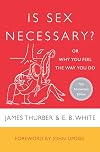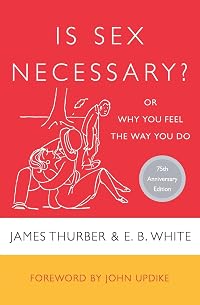
Is Sex Necessary?: Or Why You Feel the Way You Do
by James Thurber, E. B. White
On This Page
Description
The first book of prose published by either James Thurber or E. B. White, Is Sex Necessary? combines the humor and genius of both authors to examine those great mysteries of life -- romance, love, and marriage. A masterpiece of drollery, this 75th Anniversary Edition stands the test of time with its sidesplitting spoof of men, women, and psychologists; more than fifty funny illustrations by Thurber; and a new foreword by John Updike.Tags
Recommendations





















Member Reviews
I borrowed this one from a friend after seeing it on his shelf and immediately being intrigued by E.B. White's name on the cover. I mean, it was a little unexpected to see the creator of Charlotte's Web and Stuart Little included in a book about sex.
A brilliant spoof of the multitude of professional sex study books that were released at the time (and are really still being published today), Thurber and White turn all the clinical talk into hilarity by discussing relations between men and women in a unique way, their own.
Illustrated by Thurber's unique style, the book goes into the differences between men and women, discusses the confusion of the American male, tries to identify the differences between love and passion, and even explores show more the frigidity of men (which the authors find much more interesting than frigidity in women). There is also a glossary of terms with definitions written by White and Thurber, definitely worth the read.
The one dated bit of information I found was the reference the authors made to men carving swastikas into wood as a way of keeping their minds off sex. Looking at the events of what would come soon after this book was published, it certainly gives one pause. show less
A brilliant spoof of the multitude of professional sex study books that were released at the time (and are really still being published today), Thurber and White turn all the clinical talk into hilarity by discussing relations between men and women in a unique way, their own.
Illustrated by Thurber's unique style, the book goes into the differences between men and women, discusses the confusion of the American male, tries to identify the differences between love and passion, and even explores show more the frigidity of men (which the authors find much more interesting than frigidity in women). There is also a glossary of terms with definitions written by White and Thurber, definitely worth the read.
The one dated bit of information I found was the reference the authors made to men carving swastikas into wood as a way of keeping their minds off sex. Looking at the events of what would come soon after this book was published, it certainly gives one pause. show less
Like many others, I was surprised and intrigued to see a "sex book" written by E.B. White, the author of beloved children's classics like Charlotte's Web. This is a humorous book co-written by White and James Thurber as a parody of clinical writings based on Freudian psychoanalysis. The book consists of eight chapters/essays, which more or less each stand on their own, although they all tie together under the same theme and style of satire. Despite its perhaps rather shocking title (given the time period it was written), the book is neither pornographic nor remotely explicit. At most, it mentions hand holding, knees touching when a couple is sitting next to one another, and an occasional kiss; it is therefore pretty tame and chaste for show more our day and age. (Perhaps ironically, it does devote two chapters to the ridiculousness of how parents and children can't talk openly about sex with one another and instead rely on "the birds and the bees" type talks that benefit no one with their vagueness and discomfort.) Instead, the book is rather more about relationships and how things can go wrong.
The book is clearly dated in some respects, although some amusing observations still ring true. Again, given the time period it was written (the late 1920s), it is not surprising that the book is entirely male-centric and heteronormative in its treatment of the subject of romantic relationships and marriage. A gross number of stereotypes are made (e.g., the nagging wife for one), but I let all these slide in the name of satire -- perhaps these thoughts were how Thurber and White really felt, or perhaps they just made for what the authors perceived as funnier content. (Truth be told, I suspect the former and wouldn't stand for such nonsense in a book written today, but something approaching 90 years in age gets a reprieve from me.)
The edition I had was the "Coming of Age" update, re-released in the 1950s with a new introduction by White. In it, he describes the first chapter "The Nature of the American Male: A Study of Pedestalism" as one of the finest, giving all the credit entirely to Thurber for that contribution. To my taste, this was probably the least funny of all the chapters in the book. Meanwhile, the second chapter "How to Tell Love from Passion" was by far the most amusing and had me chuckling aloud quite a bit. It had so many wonderfully hilarious passages, such as:
- "The medical profession recognizes two distinct types of men: first, the type that believes that to love a woman is not to desire her; second, the type that believes to desire a woman is not to love her. The medical profession rests."
- "I have taken up the question of Man's uncertainty about love and passion in two different circumstances - at the start of a letter, and in the middle of an embrace. It was originally my intention also to show how this uncertainty overcomes one at the end of a day in the country when a man is so tired that he not only can't distinguish love from passion, but has all he can do to distinguish one station on the New Haven railroad from another and often gets out at 125th Street by mistake."
As with most parodies, it helps to have a background understanding of the original works or concepts that are being skewered. While specific titles and authors referenced were lost on me, I've read enough studies from psychoanalysts and behaviorists back when I was a psychology major in college that I definitely appreciated a lot of the little digs and humorous anecdotes told as "case histories." (Of course, my background also meant that sometimes I didn't find certain lines funny because they referenced actual mental illness too glibly.) However, trading on stereotypes of female-male relationships as the authors do helps make the book readily accessible to lay readers as well. Again like many parodies, sometimes it feels like the joke goes on a little too long. Even though this book only clocks in at 190 pages complete with introduction and other ancillary materials, it still felt like it could have been shortened by one chapter and thus been more succinctly humorous.
The book contains 50+ sketch drawings by Thurber (later inked by White) scattered throughout its pages. These are sometimes more related to the written materials than at other times. Apparently Thurber was nicknamed "the Ugly Artist" because his drawings are so simple and seemingly unfinished, but his flowing lines with an almost cartoonish execution fit well with this book's tone. I found myself chuckling a good deal over some of these, especially given their accompanying captions, such as in the example below.
Caption: "Here we have that strange, alert furtiveness which instantly overtakes a man when he beholds a woman doing something which he does not thoroughly understand."
Overall, this book was a fairly entertaining and quick read, and I was glad to see a different side of a beloved children's author as he writes for an adult audience instead. But I'm not sure that I would go out of my way to recommend this title, as I think it may appeal to a small subset of people. show less
The book is clearly dated in some respects, although some amusing observations still ring true. Again, given the time period it was written (the late 1920s), it is not surprising that the book is entirely male-centric and heteronormative in its treatment of the subject of romantic relationships and marriage. A gross number of stereotypes are made (e.g., the nagging wife for one), but I let all these slide in the name of satire -- perhaps these thoughts were how Thurber and White really felt, or perhaps they just made for what the authors perceived as funnier content. (Truth be told, I suspect the former and wouldn't stand for such nonsense in a book written today, but something approaching 90 years in age gets a reprieve from me.)
The edition I had was the "Coming of Age" update, re-released in the 1950s with a new introduction by White. In it, he describes the first chapter "The Nature of the American Male: A Study of Pedestalism" as one of the finest, giving all the credit entirely to Thurber for that contribution. To my taste, this was probably the least funny of all the chapters in the book. Meanwhile, the second chapter "How to Tell Love from Passion" was by far the most amusing and had me chuckling aloud quite a bit. It had so many wonderfully hilarious passages, such as:
- "The medical profession recognizes two distinct types of men: first, the type that believes that to love a woman is not to desire her; second, the type that believes to desire a woman is not to love her. The medical profession rests."
- "I have taken up the question of Man's uncertainty about love and passion in two different circumstances - at the start of a letter, and in the middle of an embrace. It was originally my intention also to show how this uncertainty overcomes one at the end of a day in the country when a man is so tired that he not only can't distinguish love from passion, but has all he can do to distinguish one station on the New Haven railroad from another and often gets out at 125th Street by mistake."
As with most parodies, it helps to have a background understanding of the original works or concepts that are being skewered. While specific titles and authors referenced were lost on me, I've read enough studies from psychoanalysts and behaviorists back when I was a psychology major in college that I definitely appreciated a lot of the little digs and humorous anecdotes told as "case histories." (Of course, my background also meant that sometimes I didn't find certain lines funny because they referenced actual mental illness too glibly.) However, trading on stereotypes of female-male relationships as the authors do helps make the book readily accessible to lay readers as well. Again like many parodies, sometimes it feels like the joke goes on a little too long. Even though this book only clocks in at 190 pages complete with introduction and other ancillary materials, it still felt like it could have been shortened by one chapter and thus been more succinctly humorous.
The book contains 50+ sketch drawings by Thurber (later inked by White) scattered throughout its pages. These are sometimes more related to the written materials than at other times. Apparently Thurber was nicknamed "the Ugly Artist" because his drawings are so simple and seemingly unfinished, but his flowing lines with an almost cartoonish execution fit well with this book's tone. I found myself chuckling a good deal over some of these, especially given their accompanying captions, such as in the example below.
Caption: "Here we have that strange, alert furtiveness which instantly overtakes a man when he beholds a woman doing something which he does not thoroughly understand."
Overall, this book was a fairly entertaining and quick read, and I was glad to see a different side of a beloved children's author as he writes for an adult audience instead. But I'm not sure that I would go out of my way to recommend this title, as I think it may appeal to a small subset of people. show less
As a final word on sex, this book fails. I’m glad I didn’t read this when I was young – it might have put me on the wrong track for years. As it was, I had to compile my perception of sex from tattered fantasy novels and lurid novellas accidentally classified in the young adult section of my local library. The discovery, when I was twelve, of a suitcase stuffed with the most hardcore pornography imaginable - buried, like some hideous treasure, in the damp leaves of the woods - well, that did not help either.
Thurber’s drawings scattered throughout this book are slightly interesting. A surprisingly astute observation comes tucked away in the appendix: White explains the sketches represent the ‘the melancholy of sex’ and ‘the show more implausibility of animals’. White explains most of the men in the drawings look frightened, but I disagree: I think they mostly look angry. This book is supposed to be light reading, but I wouldn’t be surprised if Thurber was secretly (or not so secretly) a misogynist, and a bitter one at that. show less
Thurber’s drawings scattered throughout this book are slightly interesting. A surprisingly astute observation comes tucked away in the appendix: White explains the sketches represent the ‘the melancholy of sex’ and ‘the show more implausibility of animals’. White explains most of the men in the drawings look frightened, but I disagree: I think they mostly look angry. This book is supposed to be light reading, but I wouldn’t be surprised if Thurber was secretly (or not so secretly) a misogynist, and a bitter one at that. show less
The best thing about this book is the Thurber drawings -- it was great to get reacquainted with them. Unfortunately, it hasn't aged very well. It was written as a satire of sex studies of the day, and you kind of need to know them to get the humor. But as with all things by White, it's very well written.
One of Thurber's funniest books, and one he wrote in collaboration with E.B. White (who also co-authored the great writing reference "The Elements of Style"). This book was written in 1929, when both men were just starting out with The New Yorker, and both were young. It shows: the book is a wonderfully psuedo-serious look at men, women, sex, etc etc etc, and it bubbles over with high spirits. The illustrations, Thurber cartoons of course, are as delightful as the rest.
Still hilarious. Dated in some ways, but remember, this was written in the 'Roaring Twenties' and so in other ways it's still relevant. It's both a spoof of the medical manuals of the time and a thoughtful, if sometimes satirical, exploration of the differences between men and women, pre- & post-marital intimacy, love and passion, etc.
A hilarious "study" of men and women and their attitudes towards sex, liberally quoting the studies of Karl Zaner and Walter Tithridge, the "deans of American Sex." Originally written in 1929, and reprinted in 1950, it proves, once again, that there is nothing new under the sun.
Members
- Recently Added By
Author Information

135+ Works 18,250 Members
Born in Columbus, Ohio, Thurber was blinded in one eye in a childhood accident. He attended Ohio State University but left without earning a degree. In 1925 he moved to New York City, where he joined the staff of the New Yorker in 1927 at the urging of his friend E. B. White. For the rest of his lifetime, Thurber contributed to the magazine his show more highly individual pieces and those strange, wry, and disturbing pen-and-ink drawings of "huge, resigned dogs, the determined and sometimes frightening women, the globular men who try so hard to think so unsuccessfully." The period from 1925, when the New Yorker was founded, until the death of its creator-editor, Harold Ross, in 1951, was described by Thurber in delicious and absorbing detail in The Years with Ross (1959). Of his two great talents, Thurber preferred to think of himself primarily as a writer, illustrating his own books. He published "fables" in the style of Aesop (see Vol. 2) and La Fontaine (see Vol. 2)---usually with a "barbed tip of contemporary significance"---children's books, several plays (two Broadway hits, one successful musical revue), and endless satires and parodies in short stories or full-length works. "The Secret Life of Walter Mitty," included in My World---and Welcome to It (1942), is probably his best-known story and continues to be frequently anthologized. T. S. Eliot described Thurber's work as "a form of humor which is also a way of saying something serious." (Bowker Author Biography) show less

92+ Works 111,553 Members
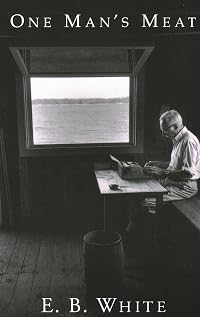
Born in Mount Vernon, New York, E. B. White was educated at Cornell University and served as a private in World War I. After several years as a journalist, he joined the staff of the New Yorker, then in its infancy. For 11 years he wrote most of the "Talk of the Town" columns, and it was White and James Thurber who can be credited with setting the show more style and attitude of the magazine. In 1938 he retired to a saltwater farm in Maine, where he wrote essays regularly for Harper's Magazine under the title "One Man's Meat." Like Thoreau, White preferred the woods; he also resembled Thoreau in his impatience and indignation. White received several prizes: in 1960, the gold medal of the American Academy of Arts and Letters; in 1963, the Presidential Medal of Freedom, the nation's highest civilian award (he was honored along with Thornton Wilder and Edmund Wilson); and in 1978, a special Pulitzer Prize. His verse is original and witty but with serious undertones. His friend James Thurber described him as "a poet who loves to live half-hidden from the eye." Three of his books have become children's classics: Stuart Little (1945), about a mouse born into a human family, Charlotte's Web (1952), about a spider who befriends a lonely pig, and The Trumpet of the Swan (1970). Among his best-known and most widely used books is The Elements of Style (1959), a guide to grammar and rhetoric based on a text written by one of his professors at Cornell, William Strunk, which White revised and expanded. White was married to Katherine Angell, the first fiction editor of the New Yorker. (Bowker Author Biography) Elwyn Brooks White was born on July 11, 1899, in Mt. Vernon, New York. After graduating from Cornell University, he worked briefly for an advertising agency and as a newspaper reporter before joining the staff of The New Yorker magazine in 1927. As a columnist for The New Yorker and a contributor to Harper's Magazine, White established a reputation as a prose stylist of exceptional elegance, clarity and wit. His interests, as reflected in his writing, were numerous and varied; his essays touched on such wide-ranging subjects as politics, farm animals, and life in New York City. White married Katharine S. Angell in 1929. They had one son, and in 1957 the family left New York for a farm in North Brookline, Maine. Writings from The New Yorker, 1927-1976 is a compilation of columns and essays produced during White's long relationship with the magazine. One Man's Meat, published in 1942, is a collection of his writings for Harper's. White adapted a short guide to English grammar and usage, The Elements of Style, from a college text written by one of his professors at Cornell, William Strunk Jr. It has sold millions of copies since it was first published in 1959 and has become a cherished resource for guidance in writing. White also co-authored Is Sex Necessary? with the humorist James Thurber, a fellow staff member at The New Yorker. E.B. White died on October 1, 1985 after succumbing to Alzheimer's. His diverse legacy also includes three children's books: Stuart Little, Charlotte's Web, and The Trumpet of the Swan. In 1970 the American Library Association presented White the Laura Ingalls Wilder Award in recognition of his "substantial and lasting contribution to literature for children." He was also awarded the Presidential Medal of Freedom in 1963 and received a special Pulitzer Prize citation for his body of work in 1970. (Bowker Author Biography) show less
Some Editions
Awards and Honors
Notable Lists
Series
Belongs to Publisher Series
Common Knowledge
- Canonical title*
- ¿Es necesario el sexo?
- Original title
- Is Sex necessary?
- Original publication date
- 1929
- Epigraph
- Things look pretty bad right now'
MAJ. GEN. BRIGGS, AT SHILOH - Dedication
- To Daisy and Jeanie
- First words
- During the past year, two factors in our civilisation have been greatly overemphasized. One is aviation, the other is sex.
- Quotations
- I have mentioned that the question of deciding whether a feeling be love or passion arises at inopportune moments, such as at the start of a letter. Let us say you have sat down to write a letter to your lady. There has been ... (show all)a normal amount of preparation for the ordeal, such as clearing a space on the desk (in doing which you have become momentarily interested in a little article in last month's Scribner's called, "Plumbing the Savage," and have stood for a minute reading the first page and deciding to let it go), and the normal amount of false alarms, such as sitting down and discovering that you have no cigarettes. (Note: if you think you can write the letter without cigarettes, it is not love, it is passion.)
I have seldom met an individual of literary tastes or propensities in whom the writing of love was not directly attributable to the love of writing. A person of this sort falls terribly in love, but in the end it turns out th... (show all)at he is more bemused by a sheet of white paper that a sheet of white bed linen. He would rather leap into print with his lady than leap into bed with her.
The young man, instead of losing himself in the kiss, finds himself in it. What's more, the girl to him loses her identity —she becomes just anyone on whom he is imposing his masculinity. Instead of his soul being full of t... (show all)he ecstasy which is traditionally associated with love's expression, his soul is just fiddling around. The young man is thinking to himself: "Say, this is pretty nice!" Well, that scares him. Up to this point in the affair he has been satisfied that his feeling was that of love. Now he doesn't know what to think. In all his life he has never come across a character in a book or a movie who, embracing his beloved, was heard to say, "This is pretty nice," unless that character was a villain. He becomes a mass of conflicting emotions, and is so thoroughly skeptical and worried about the state of his heart that he will probably take to reading sociological books to find out if it's O.K. to go ahead ...
*Some information comes from Common Knowledge in other languages. Click "Edit" for more information.
Classifications
- Genre
- Fiction and Literature
- DDC/MDS
- 818.5207 — Literature & rhetoric American literature in English American miscellaneous writings in English 20th Century 1900-1945
- LCC
- PN6161 .T56 — Language and Literature Literature (General) Literature (General) Collections of general literature Wit and humor By region or country
- BISAC
Statistics
- Members
- 638
- Popularity
- 45,483
- Reviews
- 13
- Rating
- (3.68)
- Languages
- 6 — Danish, Dutch, English, French, Greek, Spanish
- Media
- Paper, Ebook
- ISBNs
- 14
- ASINs
- 29