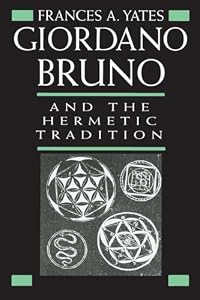
Giordano Bruno and the Hermetic Tradition
by Frances A. Yates
On This Page
Description
In 1600 the renegade philosopher and theologian Giordano Bruno was burnt at the stake in Rome. One of the most notorious figures of his times, his crime was to preach a doctrine of brotherhood, peace and free love. Four centuries later Bruno is known as the Prophet of the New Age and his vision of an infinite universe grounded in science is increasingly celebrated.; One of the main forces behind his rediscovery was the great British historian Frances Yates. It was she who pioneered the study show more of the hugely influential occult and hidden traditions that had previously been ignored in the histories of European thought. In calling attention to Giordono Bruno Yates paved the way for a re-evaluation of the esoteric influences at play during the onset of the modern era. Today, when traditional answers about the universe and our place within it are under increasing scrutiny, "Giordono Bruno and the Hermetic Tradition" might prove itself a true classic for our time. show lessTags
Recommendations






Member Reviews
16. Giordano Bruno and the Hermetic Tradition by Frances A. Yates
published: 1964
format: 461-page paperback
acquired: 2013
read: Dec 15, 2021 – Apr 19, 2022
time reading: 33:01, 4.3 mpp
rating: 5
locations: Bruno lived in Nola, Naples, Paris, London (with a stop in Oxford), Wittenberg, Prague, Helmstadt, Frankfurt, Padua, Venice (where we was arrested) and Rome (where he was imprisoned and executed), 1548-1600.
about the author: English Historian associated with the Warburg Institute, University of London: 1899 –1981
Giordano Bruno is famous for fully embracing Copernicus's uncentering of the earth and taking it one step beyond - arguing for infinite universe, the earth just one object in this vast space; and that there was no center. No show more one else was arguing this. He was arrested in 1592 in Venice, interrogated by the church for 8 years and on February 17, 1600, with his tongue physically muffled, he was hung upside and burned in Rome. Among the intellectually swirling early years of the 17th century and later enlightenment, he was viewed as a martyr to science and as an exemplum of the muffling by the church of free exploration.
Yates book is a targeted correction of the myth. Bruno was no scientist. He was deeply religious and his entire outlook was spiritual. The infinite universe was, to him, kind of a reflection of the infinite thinking-space in our own minds, one which he made an active effort to cram, in memory, everything important (in order to better link in with god). But Yates goes one step further herself, arguing that Giordano Bruno was pursuing a Hermitic religion - that is he took the so called Hermetic writings, roughly discovered by Europe in the mid 15th century, as an ancient source of truth, more ancient than Christianity or its Judaic parent or any known ancient religion. These are very spiritual writings with a striking creation story, and full gnostic ideas related to Egyptian mythology, and full of magic, even providing instructions on how to create magical talismans and statues.
While I can't speak for how original her idea was in 1964, I think she could make her case in a short scholarly article. It's not doubtful. So while this book is thematically all about this argument, it's also a whole lot more: a background, biography and exploration of who Bruno was and what his influence was. The first half is an explanation of these Hermetic writings and what they were. The second half is the life of Bruno and an overview of his constant ferocious writing he continually published until his arrest. Then she ends with a look at how European scientific thought developed after Bruno. The scientific perspective began to dominate the intellectual world a few decades after Bruno's execution, led especially by Rene Descartes. The age of enlightenment did not look back on Bruno's ideas, but marched ahead as if it was always there. And Yates asks, what changed? What allowed the intellectual community to make the shift from religion, and spiritual ideas, and magic and alchemy, to, as Yates put it, "mechanical" sciences? And why is Bruno hanging out in between these two states of mind?
------
The writings of Hermes Trismegistus are a collection of Egyptian-influence Greek religious texts from the 2nd century. They are attributed to Hermes Trismegistus, but the true authors are unknown. In the 1460's they were translated from Greek into Latin by Marsilo Ficino for the Cosimo de' Medici. For roughly 150 years Ficino's Hermetica would heavily influence European religious and intellectual thought. They were considered nearly the oldest and most sacred texts available. They were seen to predict Christianity, and were also used to develop practical magic. Shortly after translation Giovanni Pico Della Mirandola merged the ideas in them with Hebrew Jewish Cabalism creating a religious magic philosophy - something not really at all Christian. But still Pope Alexander VI, of the Borgia family, blessed this work as if it were Christian. And this blessing allowed scholars throughout the western Christian world to openly study it. The text (mixed with some other key texts) formed the foundation of respectable occult thinking in Europe. This lasted until Isaac Casaubon, a scholar of Greek with a chip on his shoulder, attacked its age. The language of the work was not an ancient Greek, but a Greek from early Christian era. He published his attack in 1614, after Bruno's execution, effectively closing the Hermetic tradition (although the ideas would linger).
----
Giordano Bruno was a rejected Domincan. Born in Nola, near Naples, he was very religious but kicked out of his Dominican order. He left Italy looking for an audience for his ideas and some sponsorship. He went to Paris where he got some support from King Henry III, then to England where he lived with the French ambassador in London. He famously travelled to Oxford to lecture in what became a something of fantastic argument. Documents of the time point to English scholars slowly picking up on the Hermetic aspects of his Copernican ideas. (Apparently, they brought out their own copies of Ficino). Oddly Bruno was viewed as a papist by protestant Oxford. From England Bruno continued to wander - back to Paris, to Martin Luther's Wittenberg (where he was welcomed warmly), to Prague, Helmstadt, Frankfort, Switzerland, and fatefully to Venice. He had in mind a Giordanic religion. He was no charlatan. He was a sincere magus. Brunos ideas were all in the mind. He elaborated on the medieval memory systems, developing his own style with the goal that he could memorize all the occult information, hundreds and hundreds of facts, complete texts, and that if he could hold it all in his mind at once, he sort of become one with the universe, an all-knowing master. As Yates put it, "The possessor of this system {memorizing eveything} thus rose above time and reflected the whole universe of nature and of man in his mind." Or, as Bruno put it, "Unless you make yourself equal to God, you cannot understand God…If you embrace in your thought all things at once, times, places, substances, qualities, quantities, you may understand God." It's pretty cool stuff. It's also not Christian. Bruno was fearless. Other hermetic scholars tied the hermetica into Christianty. Bruno saw, correctly, they were independent (they are 2nd-century Egyptian gnostic ideas) and dove in. He always saw himself as Christian, but his ideas were truly heretical. This was why he was executed, not because of his patently non-scientific infinite universe.
In the odd swings of history, the documents from Bruno's trial were later carried to Paris and destroyed. But documents from his interrogation exist. And it seems Bruno stuck to his ideas faithfully to the bitter end.
----
I bought this in 2013 in an occult science phase (inspired a bit by Club Read's Poquette). I started it in December and finished last night. Pages of Hermetic magic, of Latin untranslated, and the writings G Bruno (in Italian and Latin), plus the French commentary, made for very slow reading. But after taking this all in, there is really a rich world to think about. And there is that science thing. The link between the drives of the metaphysical perspectives - those of religion, magic, and science - include a method of structured thinking, but also may be in their origins. Each demands a kind of enlightenment moment to start things off. Even science needs an inspiration. And here at that point of inspiration, Bruno fits all three ideas and makes a nice 3-point intersection. Recommended to anyone excited by these ideas.
2022
https://www.librarything.com/topic/341027#7820245 show less
published: 1964
format: 461-page paperback
acquired: 2013
read: Dec 15, 2021 – Apr 19, 2022
time reading: 33:01, 4.3 mpp
rating: 5
locations: Bruno lived in Nola, Naples, Paris, London (with a stop in Oxford), Wittenberg, Prague, Helmstadt, Frankfurt, Padua, Venice (where we was arrested) and Rome (where he was imprisoned and executed), 1548-1600.
about the author: English Historian associated with the Warburg Institute, University of London: 1899 –1981
Giordano Bruno is famous for fully embracing Copernicus's uncentering of the earth and taking it one step beyond - arguing for infinite universe, the earth just one object in this vast space; and that there was no center. No show more one else was arguing this. He was arrested in 1592 in Venice, interrogated by the church for 8 years and on February 17, 1600, with his tongue physically muffled, he was hung upside and burned in Rome. Among the intellectually swirling early years of the 17th century and later enlightenment, he was viewed as a martyr to science and as an exemplum of the muffling by the church of free exploration.
Yates book is a targeted correction of the myth. Bruno was no scientist. He was deeply religious and his entire outlook was spiritual. The infinite universe was, to him, kind of a reflection of the infinite thinking-space in our own minds, one which he made an active effort to cram, in memory, everything important (in order to better link in with god). But Yates goes one step further herself, arguing that Giordano Bruno was pursuing a Hermitic religion - that is he took the so called Hermetic writings, roughly discovered by Europe in the mid 15th century, as an ancient source of truth, more ancient than Christianity or its Judaic parent or any known ancient religion. These are very spiritual writings with a striking creation story, and full gnostic ideas related to Egyptian mythology, and full of magic, even providing instructions on how to create magical talismans and statues.
While I can't speak for how original her idea was in 1964, I think she could make her case in a short scholarly article. It's not doubtful. So while this book is thematically all about this argument, it's also a whole lot more: a background, biography and exploration of who Bruno was and what his influence was. The first half is an explanation of these Hermetic writings and what they were. The second half is the life of Bruno and an overview of his constant ferocious writing he continually published until his arrest. Then she ends with a look at how European scientific thought developed after Bruno. The scientific perspective began to dominate the intellectual world a few decades after Bruno's execution, led especially by Rene Descartes. The age of enlightenment did not look back on Bruno's ideas, but marched ahead as if it was always there. And Yates asks, what changed? What allowed the intellectual community to make the shift from religion, and spiritual ideas, and magic and alchemy, to, as Yates put it, "mechanical" sciences? And why is Bruno hanging out in between these two states of mind?
------
The writings of Hermes Trismegistus are a collection of Egyptian-influence Greek religious texts from the 2nd century. They are attributed to Hermes Trismegistus, but the true authors are unknown. In the 1460's they were translated from Greek into Latin by Marsilo Ficino for the Cosimo de' Medici. For roughly 150 years Ficino's Hermetica would heavily influence European religious and intellectual thought. They were considered nearly the oldest and most sacred texts available. They were seen to predict Christianity, and were also used to develop practical magic. Shortly after translation Giovanni Pico Della Mirandola merged the ideas in them with Hebrew Jewish Cabalism creating a religious magic philosophy - something not really at all Christian. But still Pope Alexander VI, of the Borgia family, blessed this work as if it were Christian. And this blessing allowed scholars throughout the western Christian world to openly study it. The text (mixed with some other key texts) formed the foundation of respectable occult thinking in Europe. This lasted until Isaac Casaubon, a scholar of Greek with a chip on his shoulder, attacked its age. The language of the work was not an ancient Greek, but a Greek from early Christian era. He published his attack in 1614, after Bruno's execution, effectively closing the Hermetic tradition (although the ideas would linger).
----
Giordano Bruno was a rejected Domincan. Born in Nola, near Naples, he was very religious but kicked out of his Dominican order. He left Italy looking for an audience for his ideas and some sponsorship. He went to Paris where he got some support from King Henry III, then to England where he lived with the French ambassador in London. He famously travelled to Oxford to lecture in what became a something of fantastic argument. Documents of the time point to English scholars slowly picking up on the Hermetic aspects of his Copernican ideas. (Apparently, they brought out their own copies of Ficino). Oddly Bruno was viewed as a papist by protestant Oxford. From England Bruno continued to wander - back to Paris, to Martin Luther's Wittenberg (where he was welcomed warmly), to Prague, Helmstadt, Frankfort, Switzerland, and fatefully to Venice. He had in mind a Giordanic religion. He was no charlatan. He was a sincere magus. Brunos ideas were all in the mind. He elaborated on the medieval memory systems, developing his own style with the goal that he could memorize all the occult information, hundreds and hundreds of facts, complete texts, and that if he could hold it all in his mind at once, he sort of become one with the universe, an all-knowing master. As Yates put it, "The possessor of this system {memorizing eveything} thus rose above time and reflected the whole universe of nature and of man in his mind." Or, as Bruno put it, "Unless you make yourself equal to God, you cannot understand God…If you embrace in your thought all things at once, times, places, substances, qualities, quantities, you may understand God." It's pretty cool stuff. It's also not Christian. Bruno was fearless. Other hermetic scholars tied the hermetica into Christianty. Bruno saw, correctly, they were independent (they are 2nd-century Egyptian gnostic ideas) and dove in. He always saw himself as Christian, but his ideas were truly heretical. This was why he was executed, not because of his patently non-scientific infinite universe.
In the odd swings of history, the documents from Bruno's trial were later carried to Paris and destroyed. But documents from his interrogation exist. And it seems Bruno stuck to his ideas faithfully to the bitter end.
----
I bought this in 2013 in an occult science phase (inspired a bit by Club Read's Poquette). I started it in December and finished last night. Pages of Hermetic magic, of Latin untranslated, and the writings G Bruno (in Italian and Latin), plus the French commentary, made for very slow reading. But after taking this all in, there is really a rich world to think about. And there is that science thing. The link between the drives of the metaphysical perspectives - those of religion, magic, and science - include a method of structured thinking, but also may be in their origins. Each demands a kind of enlightenment moment to start things off. Even science needs an inspiration. And here at that point of inspiration, Bruno fits all three ideas and makes a nice 3-point intersection. Recommended to anyone excited by these ideas.
2022
https://www.librarything.com/topic/341027#7820245 show less
Giordano Bruno and the Hermetic Tradition purports to trace the history of Hermeticism from the time a Greek manuscript of the so-called Corpus Hermeticum was brought to Florence in 1453, at the time of the fall of Constantinople to the Turks. At the behest of Cosimo de Medici it was soon translated into Latin by Marsilio Ficino, one of few Italians who had studied Greek. The Corpus is a collection of mystical tracts in the form of dialogues, hymns, dream visions, prayers, and scripture-like accounts which are now understood to have been written by various persons during the early Middle Ages, but at the time of their introduction into Renaissance Italy, they were believed to be by Hermes Trismegistus who, again according to belief at show more the time had lived contemporaneously with Moses, but was later determined to be a mythical character who possibly had never lived at all.
This little collection of tracts, which had much in common with the Neoplatonic philosophy that was already widely accepted, had an electrifying effect on many of the learned men who fell under its spell, and it set off an amazing train of events which may have indirectly influenced the development of science and mathematics leading up to and during the Enlightenment.
What was the excitement all about? As a supposed contemporary of Moses, Hermes' writings were believed to foretell Christ much as the Hebrew Bible did. This was important to the intellectuals who saw the Church as more a purveyor of corruption and authoritarianism rather than as a fount of morality and spirituality. Since the Church was not a source of spiritual sustenance, those with a spiritual hunger were willing to seek nourishment wherever it lay, and they attempted to reconcile Hermeticism with Christianity in an effort to stay within the good graces of the Church.
The Corpus Hermeticum was a deeply spiritual collection of texts. However, it was not the first Hermetic document known to Renaissance scholars. An earlier medieval Latin manuscript called the Picatrix had been circulating down through the ages. It was largely a text of magical or theurgical procedures. While the Renaissance sages like Ficino were steeped in astrology, they steered clear of outright magic because of the stance of the Church which was burning people at the stake for heresy. Magic definitely fell under the heading of heresy.
Thus there were two kinds of Hermeticism: one gnostic and spiritual in the tradition of the Corpus Hermeticum and the other occult and magical following more in the tradition of the Picatrix.
Frances Yates traces the history of magical Hermeticism from Ficino and Pico della Mirandola to Cornelius Agrippa, Giordano Bruno, Thomas Campanella and Robert Fludd. Each of these individuals put his own individual mark on the theory and practice of Renaissance magic.
The first half of the book provides background on Hermeticism. The second focuses on Bruno and the aftermath of the discovery by philologist Lorenzo Valla that the Corpus Hermeticum did not trace back to the era of Moses after all but was written and compiled somewhere around the second or third century A.D.
After crawling through four hundred pages of history and historiography, the real payoff comes in the final chapter where Yates credits not the practitioners but their critics with hastening the development of science and mathematics. It is Yates' position that the level of analysis achieved prepared the way for more and more rigorous thought processes. For example, Bruno was a believer in the Copernican theory of heliocentricity, but his belief came through a version of Pythagorean numerology. Copernicus and his follower Johann Kepler used actual astronomical observations and pure mathematics to reach their own conclusions. The trend toward pure mathematics led to Descartes and all that followed. The condemnation of Bruno to burn at the stake has been attributed to his belief in Copernican heliocentricity. But there was much more to it than that.
Only the most dedicated reader will want to slog through this entire book. I almost quit halfway through. The more it concentrated on magic, the more my interest waned. But in the end, I would have to give this book the highest marks both for what it explains, for the clarity of the narrative — except for all the irritating untranslated Latin quotations — and for the conclusions it reached, which shed important light on the history of science. show less
This little collection of tracts, which had much in common with the Neoplatonic philosophy that was already widely accepted, had an electrifying effect on many of the learned men who fell under its spell, and it set off an amazing train of events which may have indirectly influenced the development of science and mathematics leading up to and during the Enlightenment.
What was the excitement all about? As a supposed contemporary of Moses, Hermes' writings were believed to foretell Christ much as the Hebrew Bible did. This was important to the intellectuals who saw the Church as more a purveyor of corruption and authoritarianism rather than as a fount of morality and spirituality. Since the Church was not a source of spiritual sustenance, those with a spiritual hunger were willing to seek nourishment wherever it lay, and they attempted to reconcile Hermeticism with Christianity in an effort to stay within the good graces of the Church.
The Corpus Hermeticum was a deeply spiritual collection of texts. However, it was not the first Hermetic document known to Renaissance scholars. An earlier medieval Latin manuscript called the Picatrix had been circulating down through the ages. It was largely a text of magical or theurgical procedures. While the Renaissance sages like Ficino were steeped in astrology, they steered clear of outright magic because of the stance of the Church which was burning people at the stake for heresy. Magic definitely fell under the heading of heresy.
Thus there were two kinds of Hermeticism: one gnostic and spiritual in the tradition of the Corpus Hermeticum and the other occult and magical following more in the tradition of the Picatrix.
Frances Yates traces the history of magical Hermeticism from Ficino and Pico della Mirandola to Cornelius Agrippa, Giordano Bruno, Thomas Campanella and Robert Fludd. Each of these individuals put his own individual mark on the theory and practice of Renaissance magic.
The first half of the book provides background on Hermeticism. The second focuses on Bruno and the aftermath of the discovery by philologist Lorenzo Valla that the Corpus Hermeticum did not trace back to the era of Moses after all but was written and compiled somewhere around the second or third century A.D.
After crawling through four hundred pages of history and historiography, the real payoff comes in the final chapter where Yates credits not the practitioners but their critics with hastening the development of science and mathematics. It is Yates' position that the level of analysis achieved prepared the way for more and more rigorous thought processes. For example, Bruno was a believer in the Copernican theory of heliocentricity, but his belief came through a version of Pythagorean numerology. Copernicus and his follower Johann Kepler used actual astronomical observations and pure mathematics to reach their own conclusions. The trend toward pure mathematics led to Descartes and all that followed. The condemnation of Bruno to burn at the stake has been attributed to his belief in Copernican heliocentricity. But there was much more to it than that.
Only the most dedicated reader will want to slog through this entire book. I almost quit halfway through. The more it concentrated on magic, the more my interest waned. But in the end, I would have to give this book the highest marks both for what it explains, for the clarity of the narrative — except for all the irritating untranslated Latin quotations — and for the conclusions it reached, which shed important light on the history of science. show less
Opera bellissima, appassionata, precisa della Yates sul grande Giordano Bruno. Analizza e ricostruisce il pensiero filosofico del Bruno, simbolo del nostro pensiero libero, riconducendolo alla tradizione magica ci restituisce la splendida figura ed ermetica rinascimentale, al tal punto frainteso da metterlo al rogo.
Frances Yates was a pioneer in recognizing that the occult preoccupations of Renaissance scholars were just as worthy of study as their interests in classical literature and science. Bruno's story is particularly interesting, in that he came to his peculiar view of the world more or less on his own, by accumulating all sorts of knowledge and then forming a world-view that accounted for what he perceived. Yates does an excellent job of accounting for Bruno's sources of information and shows why - far from being a man out of time - he was formed by and representative of the intellectual traditions of his time.
Good but dated (1964), where I started after our Moon landing and after 15pp of B's Latin poem on the Innumerable Worlds (400pp). Also, GB as magus* is only 1/4 the story. You'd never guess from this that 1) GB wrote a hilarious comedy, Candelaio*; and 2) GB laughed aloud after quoting Aristotle, which he mastered, and taught at the U of Toulouse (1579). 3) He also mastered Copernicus (spherical geometry) and wrote five books on math (one anticipating calculus, De minimo). He interviewed for the open Chair of Math (U Padua, 1592) won by a guy who had published only one piece --on art. The winner would not publish on math (and astronomy) for 16 more years when he became a household name, though Kepler said he used Bruno's habitable idea show more unacknowledged: Galileo Galilei.
* GB did write 4 books (of his 26) on magic, but he also satirizes Magi in his comedy, with 4 of 'em of different stripes: Scaramuré (whom men trust to improve love, a Caribbean obeah doctor in my version), Bartolomeo the working chemist-alchemist, Cencio the conman-alchemist, and Consalvo the spice-pharmaceutical agent. show less
* GB did write 4 books (of his 26) on magic, but he also satirizes Magi in his comedy, with 4 of 'em of different stripes: Scaramuré (whom men trust to improve love, a Caribbean obeah doctor in my version), Bartolomeo the working chemist-alchemist, Cencio the conman-alchemist, and Consalvo the spice-pharmaceutical agent. show less
Great book. I actually read it on Spanish.
100 YAT 1
Members
- Recently Added By
Lists

Club Read's Recommended Nonfiction Written by Women
618 works; 30 members

The ESOTERICA Library by Dr. Justin Sledge (Renaissance Magic)
10 works; 1 member
Author Information

29+ Works 4,574 Members
Some Editions
Awards and Honors
Notable Lists
Series
Belongs to Publisher Series
Work Relationships
Is contained in
Common Knowledge
- Canonical title*
- Giordano Bruno en de hermetische traditie
- Original title
- Giordano Bruno and the Hermetic Tradition
- Original publication date
- 1964
- People/Characters
- Giordano Bruno; Hermes Trismegistus
- Important events
- Renaissance; Hermeticism
- First words
- The great forward movements of the Renaissance all derive their vigor, their emotional impulse, from looking backwards.
- Blurbers
- Vasoli, Cesare; Trevor-Roper, Hugh; de Santillana, Giorgio; Bronowski, J.
- Original language
- English, UK
*Some information comes from Common Knowledge in other languages. Click "Edit" for more information.
Classifications
- Genres
- Nonfiction, Religion & Spirituality, Philosophy, History, General Nonfiction, Biography & Memoir
- DDC/MDS
- 190 — Philosophy and Psychology Modern western philosophy Modern western and other noneastern philosophy
- LCC
- B783 .Z7 .Y3 — Philosophy, Psychology and Religion Philosophy (General) By period Renaissance
- BISAC
Statistics
- Members
- 973
- Popularity
- 26,840
- Reviews
- 11
- Rating
- (4.46)
- Languages
- 9 — Czech, Dutch, English, French, Italian, Norwegian (Bokmål), Norwegian, Portuguese, Spanish
- Media
- Paper, Ebook
- ISBNs
- 28
- ASINs
- 6