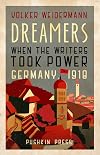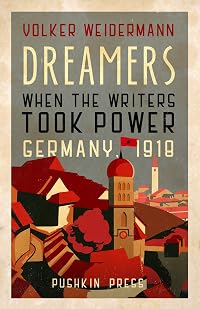
Dreamers: When the Writers Took Power, Germany, 1918
by Volker Weidermann
On This Page
Description
At the end of the First World War in Germany, the journalist and theatre critic Kurt Eisner organised a revolution which overthrew the monarchy, and declared a Free State of Bavaria. In February 1919, he was assassinated, and the revolution failed. But while the dream lived, it was the writers, the poets, the playwrights and the intellectuals who led the way. As well as Eisner, Thomas Mann, Rainer Maria Rilke, and many other prominent figures in German cultural history were involved. In his show more characteristically lucid, sharp prose, Volker Weidermann presents us with a slice of history - November 1918 to April 1919 - and shows how a small group of people could have altered the course of the twentieth century. show lessTags
Recommendations








Member Reviews
An interesting and ambitious attempt to convey a period of history in a novelistic way - which I'm sure will work for some people, but for me there were 2 problems. I had some knowledge of the period but not sure I had enough for the novelistic approach to work. It's certainly a very interesting period but personally, I would've preferred the history delivered in more conventional manner.
Another problem with the novelistic approach is that it tends to encourage expectations that you will be more drawn in than by a more conventional historical account e.g. you will sympathise with certain characters or at least feel sufficiently swept along by the plot and a sense of what is at stake to care what happens. But it didn't do that for me. show more Although it tries hard to sweep you along with a sense of the excitement of the times, ultimately I felt quite distanced from the narrative because most of the personalities covered are not particularly sympathetic and the events often have a slightly absurdist feel to them.
If there is a general lesson here, it is that writers and artists generally make lousy politicians - although even that feels like a massive generalisation e.g. I think Vaclav Havel did reasonably well as President of what was then Czechoslovakia following the Velvet Revolution (perhaps he is just the exception that proves the rule - I don't know). But a comparative analysis of that type was not what the author set out to provide here, so it's unfair to judge it by reference to that. show less
Another problem with the novelistic approach is that it tends to encourage expectations that you will be more drawn in than by a more conventional historical account e.g. you will sympathise with certain characters or at least feel sufficiently swept along by the plot and a sense of what is at stake to care what happens. But it didn't do that for me. show more Although it tries hard to sweep you along with a sense of the excitement of the times, ultimately I felt quite distanced from the narrative because most of the personalities covered are not particularly sympathetic and the events often have a slightly absurdist feel to them.
If there is a general lesson here, it is that writers and artists generally make lousy politicians - although even that feels like a massive generalisation e.g. I think Vaclav Havel did reasonably well as President of what was then Czechoslovakia following the Velvet Revolution (perhaps he is just the exception that proves the rule - I don't know). But a comparative analysis of that type was not what the author set out to provide here, so it's unfair to judge it by reference to that. show less
Dreamers: When the Writers Took Power, Germany 1918 by Volker Weidermann is a narrative history of the often overlooked Bavarian Revolution of 1918. This reads almost like a novel which makes it both an enjoyable read and one that presents the people and ideas as well as the events and outcomes.
Well researched, the information is conveyed to the reader almost casually. Rather than simply quote letters or essays or memoirs, the thoughts from those texts are incorporated into the action so that we experience what is happening at the same time we are learning about what any one of them might have been thinking or expecting.
I was caught up in the narrative itself as much as I was interested in learning about the events. When I say it felt show more like reading a novel, I mean that in a good way. It was like reliving the events rather than just reading about what happened.
Reviewed from a copy made available by the publisher via NetGalley. show less
Well researched, the information is conveyed to the reader almost casually. Rather than simply quote letters or essays or memoirs, the thoughts from those texts are incorporated into the action so that we experience what is happening at the same time we are learning about what any one of them might have been thinking or expecting.
I was caught up in the narrative itself as much as I was interested in learning about the events. When I say it felt show more like reading a novel, I mean that in a good way. It was like reliving the events rather than just reading about what happened.
Reviewed from a copy made available by the publisher via NetGalley. show less
Dieser Roman über die Münchner Räterepublik ist wirklich faszinierend: Toll recherchiert und gut zu lesen. Was für eine Zeit!
Und doch würde ich dazu raten, originale Bücher aus jener Zeit zu lesen, „ Eine Jugend in Deutschland“ von Ernst Toller etwa und „Wir sind Gefangene“ von Oskar Maria Graf.
Und doch würde ich dazu raten, originale Bücher aus jener Zeit zu lesen, „ Eine Jugend in Deutschland“ von Ernst Toller etwa und „Wir sind Gefangene“ von Oskar Maria Graf.
Aug 9, 2022German
Dokumentarroman: Den frie stat Bayern blev udråbt med Kurt Eisner som ny præsident, men allerede i 1919 blev han dræbt ved et attentat, hvilket dog giver ny medvind til idéen om en stat bygget på kunstens og æstetikkens principper.Men mens drømmen stadig levede, var det i en kort periode forfattere, digtere, dramatikere og intellektuelle, som sad på magten og førte folket fremad. Et helt unikt lille vindue i tiden – november 1918 til april 1919 – hvor det ikke var de sædvanlige magtmennesker, som besad de vigtige embeder, men derimod kunstnere, som drømte om et helt nyt samfund.Efter den internationale succes med bogen Oostende 1936 om Stefan Zweig og Joseph Roth har Volker Weidermann nu skrevet endnu et stykke show more dramatiseret tysk litteratur- og kulturhistorie, hvor han viser, hvordan en lille gruppe mennesker kunne have ændret historiens gang, hvis omstændighederne havde været bare en smule anderledes. show less
May 15, 2026Danish
En 1918 un grupo de intelectuales pretendieron en Baviera declarar una república independiente, la revolución duraría tres meses.
Frase: referida a Hitler. “Un hombre ha encontrado su destino. Su talento. Y su enemigo (el enemigo son los judíos)” (página 232).
Frase: referida a Hitler. “Un hombre ha encontrado su destino. Su talento. Y su enemigo (el enemigo son los judíos)” (página 232).
Feb 14, 2024Spanish
Ratings
Members
- Recently Added By
Author Information

Some Editions
Common Knowledge
- Canonical title
- Dreamers: When the Writers Took Power, Germany, 1918
- Original title
- Träumer. Als die Dichter die Macht übernahmen
- Original publication date
- 2017 (original German) (original German); 2018 (English translation) (English translation)
- Important places
- Munich, Bavaria, Germany
- Important events
- World War I
- Original language
- German
Classifications
- Genres
- History, Nonfiction, General Nonfiction, Politics and Government
- DDC/MDS
- 943.3085 — History & geography History of Europe Central Europe: Germany, Austria, Switzerland, Czech, Poland, Hungary Bavaria Historical periods 1866- 1918-1933 Weimar Republic
- LCC
- DD248 — History of Europe, Asia, Africa and Oceania Germany History of Germany History By period Modern, 1519- 19th-20th centuries Revolution and Republic, 1918-
- BISAC
Statistics
- Members
- 138
- Popularity
- 239,283
- Reviews
- 5
- Rating
- (3.72)
- Languages
- 5 — Danish, English, German, Spanish, Swedish
- Media
- Paper, Audiobook, Ebook
- ISBNs
- 11
- ASINs
- 3