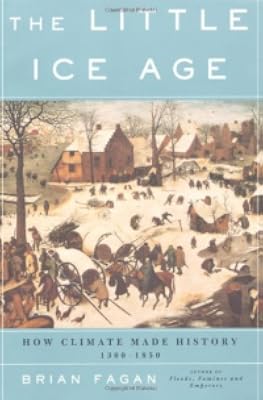
The Little Ice Age: How Climate Made History, 1300–1850
by Brian M. Fagan
On This Page
Description
The Little Ice Age tells the story of the turbulent, unpredictable, and often very cold years of modern European history, how climate altered historical events, and what they mean in the context of today's global warming. Only in the last decade have climatologists developed an accurate picture of yearly climate conditions in historical times. This development confirmed a long-standing suspicion: that the world endured a 500-year cold snap, a little ice age, that lasted roughly from AD 1300 show more until 1850. With its basis in cutting-edge science, The Little Ice Age offers a new perspective on familiar events. Renowned archaeologist Brian Fagan shows how the increasing cold affected Norse exploration; how changing sea temperatures caused English and Basque fishermen to follow vast shoals of cod all the way to the New World; how a generations-long subsistence crisis in France contributed to social disintegration and ultimately revolution; and how English efforts to improve farm productivity in the face of a deteriorating climate helped pave the way for the Industrial Revolution and hence for global warming. This is a fascinating, original book for anyone interested in history, climate, or the new subject of how they interact. show lessTags
Recommendations







Member Reviews
After the amazing warm period of the 13th century, climate change had a profound effect on human behavior and well-being. Brian Fagan takes us step by step through the cold, unsettled, rainy, dry, hot and otherwise completely unpredictable years of the Little Ice Age, when the subsistence farmers of Europe and elsewhere suffered repeated bad harvests and terrible privations. He is blunt, and after the description of life in the 1300s and 1400s, I was consumed with empathy for these people who had to live through such uncertain times.
Starting in the early 1300s, weather became increasingly destructive to farming, with repeated cold spells, drenching rains and unexpected droughts. Fagan takes us all the way through to the 1800s and the show more blistering Irish famine that pushed so many to emigrate or die. In between, he notes the persistent rain in the 14th and 15th centuries that turned farmlands and pasturelands to seas of mud and certainly contributed to the outcomes of battles (for instance, Agincourt) as well as privation. He notes calamity in the New World as well, as early settlers in North America fought to live through one of the coldest winters of the age, the Incan Empire and other indigenous societies were ruined by drought, volcanic eruptions blocked the sun, and the Thames froze solid.
And of course, he ends the age with our own interference in climate. This book, published in 2000, is cautious about laying all the global warming at our feet, citing other contributing possibilities. But his description of one possible outcome is literally chilling, as fresh water melt covers the north end of the Gulf Stream and shuts off the downwelling of that great warm river in the sea. Once we scorch the Earth, another Ice Age may come again. show less
Starting in the early 1300s, weather became increasingly destructive to farming, with repeated cold spells, drenching rains and unexpected droughts. Fagan takes us all the way through to the 1800s and the show more blistering Irish famine that pushed so many to emigrate or die. In between, he notes the persistent rain in the 14th and 15th centuries that turned farmlands and pasturelands to seas of mud and certainly contributed to the outcomes of battles (for instance, Agincourt) as well as privation. He notes calamity in the New World as well, as early settlers in North America fought to live through one of the coldest winters of the age, the Incan Empire and other indigenous societies were ruined by drought, volcanic eruptions blocked the sun, and the Thames froze solid.
And of course, he ends the age with our own interference in climate. This book, published in 2000, is cautious about laying all the global warming at our feet, citing other contributing possibilities. But his description of one possible outcome is literally chilling, as fresh water melt covers the north end of the Gulf Stream and shuts off the downwelling of that great warm river in the sea. Once we scorch the Earth, another Ice Age may come again. show less
This book was a serious disappointment. I assumed I would like this book. The best thing I can say about it is that it is very readable. However it is seriously marred by the author’s inconsistencies and the way he cherry-picks data to fit his thesis, both using and misusing historical data, or hiding data by over-dramatazation of isolated events that blur the big picture. Of course this makes for a readable book. Fagan tells a great story, and there are some truths here, but although I can’t call this fiction, it blurs too many lines. I wish it were better. He is not wrong. But he is not right either.
My wife and I have been ‘radicalized’ over the past decade when it comes to man-made climate change: we hardly use our care anymore, we fly as little as possible, we have extra insulated our homes, invested in solar panels and a home battery, eat mostly vegetarian, and even participate in demonstrations to encourage politicians to adopt a more decisive environmental policy. We believe that, based on the scientific insights of the IPCC, there should be no more discussion about the need for a drastic approach worldwide; the only thing that should be debated is the problematic social repercussions of a climate policy. In other words, we are anything but climate deniers.
However, I can get really angry when the climate case is pleaded show more with wrong or false arguments, and when, from a woke-like reflex, everything is attributed to “global warming”. To me, it’s not done to attribute every heavy storm or flood, drought or heat period to climate change; that’s just not scientific. And I’m particular sensitive to the misuse of the past in the service of the climate cause. Especially the abundant literature of the last decade about the Little Ice Age, is guilty of this. This book, by archaeologist-anthropologist Brian Fagan, is a manifest expression of that. The list of things that irritated me whilst reading is too long to discuss in detail here (I run through some of them in my History account on Goodreads: https://www.goodreads.com/review/show/3677412612). Fagan is a good storyteller, that much is clear, and this book offers interesting reading, I will not dispute that. And neither does his warm plea at the end to take the current climate crisis seriously and to take appropriate measures. But the theme would be better served with a more kosher approach to history. show less
However, I can get really angry when the climate case is pleaded show more with wrong or false arguments, and when, from a woke-like reflex, everything is attributed to “global warming”. To me, it’s not done to attribute every heavy storm or flood, drought or heat period to climate change; that’s just not scientific. And I’m particular sensitive to the misuse of the past in the service of the climate cause. Especially the abundant literature of the last decade about the Little Ice Age, is guilty of this. This book, by archaeologist-anthropologist Brian Fagan, is a manifest expression of that. The list of things that irritated me whilst reading is too long to discuss in detail here (I run through some of them in my History account on Goodreads: https://www.goodreads.com/review/show/3677412612). Fagan is a good storyteller, that much is clear, and this book offers interesting reading, I will not dispute that. And neither does his warm plea at the end to take the current climate crisis seriously and to take appropriate measures. But the theme would be better served with a more kosher approach to history. show less
The book is essentially a very detailed description of the effects of climate change brought about by natural forces such as volcanoes, sunspots, and the North Atlantic Oscillation in Britain and northern Europe. As describe by the author, the Little Ice Age "was an irregular seesaw of rapid climatic shifts, driven by complex and still little understood cycles of intensely cold winters and easterly winds, then switched abruptly to years of heavy spring and early summer rains, mild winter, and frequent Atlantic storms or to periods of droughts, light northeasterlies, and summer heat waves that baked growing crops in an endless zigzag of climatic shifts, few lasting more than a quarter of a century" and lasted 500 years from King Charles show more I to 1918. The author accessed hundreds of written material sources and with his writing skills created an engaging read on how people, communities, and countries were adversely affected. It was a very good read until he segued to man made climate change which would have best been told in another book. show less
Though I often did not follow his technical ideas, I still gave this book 5 stars because, after the many books I've read about history, none of them credited climate for its huge effects. Only individual weather events on occasion, like the Russian winter that defeated Napoleon and Hitler. But not climate. This was the first that went into any depth. It was like a giant puzzle piece finally falling into place.
Of course everyone knows about the potato blight in Ireland, but I'd never read so much detail about it.
Also, in "John Adams," when Abigail joins her husband in Paris and is shocked at all the beggars... this book explains it.
My only suggestion to the author would be to provide a comparison scale for Celsius and Fahrenheit show more temperatures for us U.S. readers. My calculator was never close at hand, so I had to assume that 38C is pretty hot. Now that I've looked it up, the author was shocked at temp's over 38C which is only about 100F -- that temp is pretty common in the summer where I live.
I see this author has written many other books. I will look for them. show less
Of course everyone knows about the potato blight in Ireland, but I'd never read so much detail about it.
Also, in "John Adams," when Abigail joins her husband in Paris and is shocked at all the beggars... this book explains it.
My only suggestion to the author would be to provide a comparison scale for Celsius and Fahrenheit show more temperatures for us U.S. readers. My calculator was never close at hand, so I had to assume that 38C is pretty hot. Now that I've looked it up, the author was shocked at temp's over 38C which is only about 100F -- that temp is pretty common in the summer where I live.
I see this author has written many other books. I will look for them. show less
On several occasions between 1695 and 1728, inhabitants of the Orkney Islands off Northern Scotland were startled to see an Inuit in his kayak paddling off their coasts. On one memorable occasion, a kayaker came as far South as the river Don near Aberdeen. These solitary Arctic hunters had probably spent weeks marooned on large ice floes.
Between the relative stability of the mediaeval and modern warm periods, came hundreds of years of climatic instability. The climate seesawed randomly between hot summers, cold winters, late frosts, cool summers, drought, famines due to excessive rainfall, land lost to encroaching glaciers sea surges or sand, and lots of volcanic activity. A fascinating study of how climate change affected everyday show more life, social change and historical events in Europe and the rest of the world. show less
Between the relative stability of the mediaeval and modern warm periods, came hundreds of years of climatic instability. The climate seesawed randomly between hot summers, cold winters, late frosts, cool summers, drought, famines due to excessive rainfall, land lost to encroaching glaciers sea surges or sand, and lots of volcanic activity. A fascinating study of how climate change affected everyday show more life, social change and historical events in Europe and the rest of the world. show less
The Little Ice Age by Brian Fagan was really interesting. One of the many things he discusses is the influence of weather on art. It's almost a footnote to the book as a whole, but I found it very interesting to posit that you can measure climate changes by changes in art content, such as the number of winter scenes in certain centuries or the types of clouds that are being painted. It's very well written and though I didn't always agree with all of Fagan's conclusions, I did find it difficult to put this one down.
Members
- Recently Added By
Lists

Climate Change
87 works; 7 members

Environmental History
46 works; 8 members

Recommended Books about Climate Change
30 works; 2 members
Author Information

119+ Works 9,586 Members
Brian Fagan is emeritus professor of anthropology at the University of California, Santa Barbara. A former Guggenheim fellow, he has written many internationally acclaimed, popular books about archaeology, including The Little Ice Age, The Great Warming, and The Lang Summer. He lives in Santa Barbara, California.
Awards and Honors
Common Knowledge
- Canonical title
- The Little Ice Age: How Climate Made History, 1300–1850
- Original title
- The complete ice age
- Original publication date
- 2000
- Important places*
- Europe
- Important events
- The Year without a Summer; Irish Potato Famine; climate change
- Dedication
- In memoriam
Professor Glyn Daniel and Ruth Daniel, archaeologists
Professor Hubert Lamb, climatologist - First words
- The fog lies close to the oily, heaving water, swirling gently as a bitterly cold air wafts in from the north.
- Last words
- (Click to show. Warning: May contain spoilers.)In a new climatic era, we would be wise to learn from the climatic lessons of history.
- Original language
- English
*Some information comes from Common Knowledge in other languages. Click "Edit" for more information.
Classifications
Statistics
- Members
- 1,017
- Popularity
- 25,619
- Reviews
- 18
- Rating
- (3.79)
- Languages
- 6 — Czech, English, German, Italian, Portuguese, Spanish
- Media
- Paper, Audiobook, Ebook
- ISBNs
- 19
- ASINs
- 7