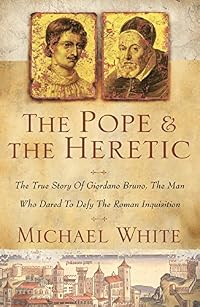
The Pope and the Heretic: The True Story of Giordano Bruno, the Man Who Dared to Defy the Roman Inquisition
by Michael White
On This Page
Description
Giordano Bruno challenged everything in his pursuit of an all-embracing system of thought. This not only brought him patronage from powerful figures of the day but also put him in direct conflict with the Catholic Church. Arrested by the Inquisition and tried as a heretic, Bruno was imprisoned, tortured, and, after eight years, burned at the stake in 1600. The Vatican "regrets" the burning yet refuses to clear him of heresy.But Bruno's philosophy spread: Galileo, Isaac Newton, Christiaan show more Huygens, and Gottfried Leibniz all built upon his ideas; his thought experiments predate the work of such twentieth-century luminaries as Karl Popper; his religious thinking inspired such radicals as Baruch Spinoza; and his work on the art of memory had a profound effect on William Shakespeare.Chronicling a genius whose musings helped bring about the modern world, Michael White pieces together the final years -- the capture, trial, and the threat the Catholic Church felt -- that made Bruno a martyr of free thought. show lessTags
Recommendations







Member Reviews
On February 19, 1600, Giordano Bruno was burned at the stake by the Roman Inquisition. His crime: he deigned to think beyond orthodoxy. Michael White's The Pope and the Heretic is a sad look at the short life of Bruno, his philosophy, his execution, and his legacy. Bruno's notion of the infinite as it pertains to the universe was only slightly ahead of its time, and in the centuries that followed, countless scientists would come to many of the same conclusions that Bruno contemplated in the 16th century. His treatment at the hands of the Vatican was tedious at best and torturous at worst. This book is a quick read, but a vexing one.
While White's portrait of Bruno is interesting, he commits a fundamental fallacy in dealing with history; he evaluates events from a contemporary perspective. In doing so he not only does the Church and society of the 16th century a severe disservice, but in effect, does so to Bruno as well. Bruno has been quasi-canonized by the same anti-church sentiments that make of Galileo a far more colorful martyr than the facts support, and White's work only continues this trend. Bruno had elements of brilliance in his work, certainly, but it was buried amidst a mish-mash of self-aggrandizing, convoluted and almost schizophrenic ramblings. His prosecution by the church resulted less from his ideas in and of themselves, and more from his general show more tendency to cause trouble wherever he went; Catholic, Protestant - he seemed to offend all equally.
White, in addition to his post-enlightenment condemnation of history, also has an unfortunate tendency to over-dramatize. He is not alone in this; there seem to have been a spate of highly novelized histories recently, of which some are impressive and others considerably less so. This is of the latter ilk, the sort which imposes purely speculative dialog and other such details (which are utterly impossible for us to know) onto the facts at hand. It may be that the result is more entertaining than the facts themselves; however, this volume cannot really be called history. I submit that if the author's wish is to entertain, perhaps he would be better advised to stick to fiction writing (at which he seems to have some skill) and leave history in the hands of those who will treat it responsibly. show less
White, in addition to his post-enlightenment condemnation of history, also has an unfortunate tendency to over-dramatize. He is not alone in this; there seem to have been a spate of highly novelized histories recently, of which some are impressive and others considerably less so. This is of the latter ilk, the sort which imposes purely speculative dialog and other such details (which are utterly impossible for us to know) onto the facts at hand. It may be that the result is more entertaining than the facts themselves; however, this volume cannot really be called history. I submit that if the author's wish is to entertain, perhaps he would be better advised to stick to fiction writing (at which he seems to have some skill) and leave history in the hands of those who will treat it responsibly. show less
A fairly engrossing account of the life of this philosopher and occultist who perceived an infinite universe and tried to establish a new religion, a fusion of pre-Christian beliefs and original Christianity, shorn of what he perceived to be the corruption of the official Catholic church. Bruno's persecution and eventual death are described in horrific detail, but also with a certain breathless novelistic embellishment that I found irritating.
Many people might also say the author has rather a simplistic view of the history of Catholicism and the role of the Inquisition, following a resolutely modern viewpoint that cannot adequately be used to understand a 16th century view of religion, with its single minded and exclusivist attitude on show more both sides of the Reformation divide. He frequently refers to Church figures as "evil", for example, which, while it would be very accurate as a description of someone now who carried out such acts of persecution, is somehow inadequate when describing the 16th century.
Bruno emerges as a highly intelligent and imaginative thinker, but also as arrogant and, ironically in view of the vast breadth of his vision, narrow minded and naïve in terms of the sharing and practical application of his views. He does not emerge as a sympathetic and pro-science figure as does Galileo. Some of the author's views on the longer term influence of Bruno on modern computer technology also did not convince me.
Worth a read, but not as good as Dava Sobel's Galileo's Daughter, which I read immediately before this. show less
Many people might also say the author has rather a simplistic view of the history of Catholicism and the role of the Inquisition, following a resolutely modern viewpoint that cannot adequately be used to understand a 16th century view of religion, with its single minded and exclusivist attitude on show more both sides of the Reformation divide. He frequently refers to Church figures as "evil", for example, which, while it would be very accurate as a description of someone now who carried out such acts of persecution, is somehow inadequate when describing the 16th century.
Bruno emerges as a highly intelligent and imaginative thinker, but also as arrogant and, ironically in view of the vast breadth of his vision, narrow minded and naïve in terms of the sharing and practical application of his views. He does not emerge as a sympathetic and pro-science figure as does Galileo. Some of the author's views on the longer term influence of Bruno on modern computer technology also did not convince me.
Worth a read, but not as good as Dava Sobel's Galileo's Daughter, which I read immediately before this. show less
Whereas this does not go into much about detail on Bruno's writings, I found it an informative (and disturbing) account of what the Inquisition did to those who doubted Church dogma. It is an account of his life, not his philosophy. Despite some surprisingly modern sounding ideas, Bruno was not a scientist. He was a philosopher, but, as this biography demonstrates, he was a man of remarkable intelligence and courage. He dared to challenge violently enforced concepts that did not make sense, he did not back down, and he paid for it in 1600 with an ugly death. I recommend this one, in part because it is a well written book, but also because Giordano Bruno was a man history must not forget.
Going to have to DNF this one for now. Got up to page 75. Its a physical book and I just cannot read physical books any more. I may come back to this one later
From Amazon: "Giordano Bruno challenged everything in his pursuit of an all-embracing system of thought. This not only brought him patronage from powerful figures of the day but also put him in direct conflict with the Catholic Church. Arrested by the Inquisition and tried as a heretic, Bruno was imprisoned, tortured, and, after eight years, burned at the stake in 1600. The Vatican "regrets" the burning yet refuses to clear him of heresy. But Bruno's philosophy spread: Galileo, Isaac Newton, Christiaan Huygens, and Gottfried Leibniz all built upon his ideas; his thought experiments predate the work of such twentieth-century luminaries as Karl Popper; his religious thinking inspired such radicals as Baruch Spinoza; and his work on the show more art of memory had a profound effect on William Shakespeare. Chronicling a genius whose musings helped bring about the modern world, Michael White pieces together the final years -- the capture, trial, and the threat the Catholic Church felt -- that made Bruno a martyr of free thought. show less
GIORDANO BRUNO, EL HEREJE IMPENITENTE
Filósofo, científico, erudito y místico, Giordano Bruno (Nola,
Nápoles, 1548-Roma, 1600) siguió los pasos de Leonardo da
Vinci y abrió los senderos del conocimiento que después
recorrería Newton, arrojando la luz de la razón en una época de
oscuridad. Bruno, sediento de saber cuando imperaba la ignorancia,
puso en cuestión los dogmas de la Iglesia pero, sobre todo, lanzó
una hipótesis que despertó la ira de las autoridades eclesiásticas:
la posible existencia de infinitos mundos en los que criaturas
como nosotros vivirían y rendirían culto a su propio dios.
Michael White centra sus investigaciones en los últimos años de
Bruno, cuando éste se enfrenta en una lucha desigual contra show more la
Inquisición y, rebelde, defiende sus teorías aunque ello le cueste
la vida.
«Por una parte la devoción religiosa nos ha dado obras magníficas
que enaltecen y alimentan nuestro espíritu. Por otra, produjo
las cazas de brujas, los horrores de la Inquisición, las guerras
de religión, las bombas de Irlanda del Norte y los niños que
mueren en Palestina. show less
Filósofo, científico, erudito y místico, Giordano Bruno (Nola,
Nápoles, 1548-Roma, 1600) siguió los pasos de Leonardo da
Vinci y abrió los senderos del conocimiento que después
recorrería Newton, arrojando la luz de la razón en una época de
oscuridad. Bruno, sediento de saber cuando imperaba la ignorancia,
puso en cuestión los dogmas de la Iglesia pero, sobre todo, lanzó
una hipótesis que despertó la ira de las autoridades eclesiásticas:
la posible existencia de infinitos mundos en los que criaturas
como nosotros vivirían y rendirían culto a su propio dios.
Michael White centra sus investigaciones en los últimos años de
Bruno, cuando éste se enfrenta en una lucha desigual contra show more la
Inquisición y, rebelde, defiende sus teorías aunque ello le cueste
la vida.
«Por una parte la devoción religiosa nos ha dado obras magníficas
que enaltecen y alimentan nuestro espíritu. Por otra, produjo
las cazas de brujas, los horrores de la Inquisición, las guerras
de religión, las bombas de Irlanda del Norte y los niños que
mueren en Palestina. show less
Apr 16, 2024Spanish
Members
- Recently Added By
Author Information

35 Works 4,971 Members
Michael White is a British writer. He was born in 1959 and studied at King's College London. He has been a science editor of British GQ and a columnist for the Sunday Express in London. From 1984 to 1991, he was a science lecturer at d'Overbroeck's College in Oxford before becoming a full-time writer, of both fiction and non-fiction. Among his show more non-fiction works are: Coffee with Newton, Galileo Antichrist: A Biography, The Fruits of War, Tolkien: A Biography, Leonardo: The First Scientist, and Isaac Newton: The Last Sorcerer. White also collaborated with John Gribbin on 'A Life in Science' Series, featuring biographies of Stephen Hawking, Albert Einstein and Charles Darwin. His novels include: The Art of Murder, The Borgia Ring, The Medici Secret, and Equinox. He has also written numerous novels under pseudonyms, including; the E-Force trilogy as Sam Fisher, and The Titanic Enigma, as Tom west. Most recently, White co-wrote the international bestseller Private down Under, with James Patterson. (Bowker Author Biography) show less
Common Knowledge
- People/Characters
- Giordano Bruno
- Important events
- Roman Inquisition
Classifications
Statistics
- Members
- 254
- Popularity
- 127,117
- Reviews
- 8
- Rating
- (3.74)
- Languages
- English, Portuguese, Spanish
- Media
- Paper, Ebook
- ISBNs
- 8
- ASINs
- 3