On This Page
Description
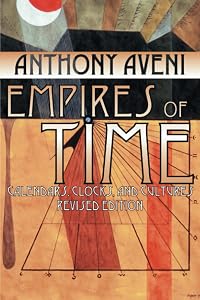
Compares contemporary timekeeping methods and related cultural perspectives to those of seminomadic tribes and classical civilizations, tracing the influence of calendars, datebooks, clocks, and other means of measuring humankind's most valuable commodity.Tags
Recommendations




































Member Reviews
As the subtitle says, this is a book about calendars, clocks, and cultures. Aveni is both an astronomer and an anthropologist and has studied pre-Columbian cultures extensively. The central part of the book explains where our Western European calendars and methods of keeping time came from and then examines the way other cultures such as the Maya developed their calendars and how they experienced time. A good and readable book for those interested in the subject. Well illustrated.
Ratings
Members
- Recently Added By
Published Reviews
ThingScore 25
In this book, Aveni wears two hats: that of the anthropologist describing how various societies have chosen their clocks, and that of the physical scientist concerned with what modem scientific ideas—such as the theory of relativity and the quantum theory—have taught us about the abstract nature of time. It is the anthropological part of this book that I admire. I am afraid, as I shall show more point out, that Aveni has the modem abstract physics part seriously muddled. It would be a miracle if anyone could be equally competent in both domains, and by definition, miracles do not occur often.... As I have tried to indicate, I have nothing but admiration for Aveni's anthropological material and for that part of his book that reflects it. However, when he turns to modern, abstract science, it seems to me that he is clearly in over his head. While Aveni's discussion of relativity is, in my view, simply wrong, some of his other ventures into the arcana of modern physics fall into a category, introduced by the late Wolfgang Pauli, of ideas that are not even wrong—ideas so muddled that the categories "true" or "false" do not apply. In this category I would put Aveni's discussion of what is known as time reversal —a property of deep symmetry in many quantum mechanical systems, but one that was shown to break down in some of them in an experiment carried out in 1964. Although I have taught this subject to two generations of graduate students, I am unable to attach any meaning at all to the sentence "The neutral K meson, or Kaon, a subatomic particle, decays into two separate and distinct particles in a time interval that can be shown to be different if time were reversed." Nor can I attach any meaning to the sentences that follow. I do not have the space, or spacetime, in this review to try to sort this out, but to a reader with some scientific background I highly recommend The Physics of Time Asymmetry, by R C. W. Davies (University of California Press). show less
added by ttiptocs
Author Information

44+ Works 1,580 Members
Anthony Aveni is the Russell Colgate Distinguished University Professor of Astronomy, Anthropology, and Native American Studies at Colgate University. He has researched and written about Maya astronomy for more than four decades. He was named a US National Professor of the year and has been awarded the H. B. Nicholson Medal for Excellence in show more Research in Mesoamerican Studies by Harvard's Peabody Museum. He is the author of several books, including Class Not Dismissed, Uncommon Sense, and Empires of Time. show less
Series

Belongs to Publisher Series
Common Knowledge
- Original publication date
- 1989
- First words
- I was born.
- Last words
- (Click to show. Warning: May contain spoilers.)If anyone in my bend of the river is helped by reading my log, then I am gratified.
Classifications
Statistics
- Members
- 243
- Popularity
- 134,106
- Reviews
- 1
- Rating
- (3.09)
- Languages
- English, Italian, Polish
- Media
- Paper
- ISBNs
- 8
- ASINs
- 3