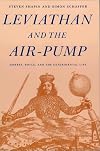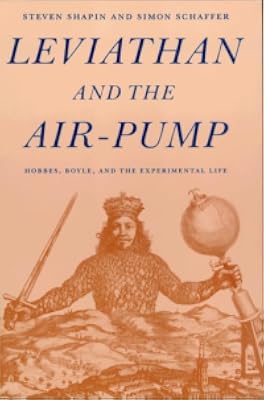
Leviathan & the Air Pump: Hobbes, Boyle and the Experimental Life
by Steven Shapin, Simon Schaffer (Author)
On This Page
Description
"Leviathan and the Air-Pump examines the conflicts over the value and propriety of experimental methods between two major seventeenth-century thinkers: Thomas Hobbes, author of the political treatise Leviathan and vehement critic of systematic experimentation in natural philosophy, and Robert Boyle, mechanical philosopher and owner of the newly invented air-pump. The issues at stake in their disputes ranged from the physical integrity of the air-pump to the intellectual integrity of the show more knowledge it might yield. Both Boyle and Hobbes were looking for ways of establishing knowledge that did not decay into ad hominem attacks and political division. Boyle proposed the experiment as cure. He argued that facts should be manufactured by machines like the air-pump so that gentlemen could witness the experiments and produce knowledge that everyone agreed on. Hobbes, by contrast, looked for natural law and viewed experiments as the artificial, unreliable products of an exclusive guild. The new approaches taken in Leviathan and the Air-Pump have been enormously influential on historical studies of science. Shapin and Schaffer found a moment of scientific revolution and showed how key scientific givens--facts, interpretations, experiment, truth--were fundamental to a new political order. Shapin and Schaffer were also innovative in their ethnographic approach. Attempting to understand the work habits, rituals, and social structures of a remote, unfamiliar group, they argued that politics were tied up in what scientists did, rather than what they said. Steven Shapin and Simon Schaffer use the confrontation between Hobbes and Boyle as a way of understanding what was at stake in the early history of scientific experimentation. They describe the protagonists' divergent views of natural knowledge, and situate the Hobbes-Boyle disputes within contemporary debates over the role of intellectuals in public life and the problems of social order and assent in Restoration England. In a new introduction, the authors describe how science and its social context were understood when this book was first published, and how the study of the history of science has changed since then."--Publisher's website. show lessTags
Recommendations




































Member Recommendations

Member Reviews
Today Boyle is considered the forefather of the experimental method, and Hobbes a titan of political philosophy. This is an artifact of history, as the two were contemporaries and competitors in that strange space called 'Natural Philosophy.' One of the most important books in the history of science and in STS, Leviathan and the Air-Pump looks at the early days of the Royal Society as a constitutional moment. In the controversy over the air experiments, the integrity of the machine, the nature of the substances contained within, and the practices of witnessing used to attest to its results, Shapin and Schaffer find the start of both science and liberalism.
This is an immense and deeply researched work of scholarship, that vividly show more imagines the politics and practices of the time; a very difference world where technological dissension could imply the chaos of civil war, and the idea of perfect philosophical system was still attainable. My only quibbles are that this book is denser than the subject warrants, and despite protestations to the contrary, has just the small whiff of whiggishness, as the authors are descendants of Boyle's cultural tradition rather than Hobbes, and Boyle is described as 'speaking for nature' whereas Hobbes is merely 'social'. show less
This is an immense and deeply researched work of scholarship, that vividly show more imagines the politics and practices of the time; a very difference world where technological dissension could imply the chaos of civil war, and the idea of perfect philosophical system was still attainable. My only quibbles are that this book is denser than the subject warrants, and despite protestations to the contrary, has just the small whiff of whiggishness, as the authors are descendants of Boyle's cultural tradition rather than Hobbes, and Boyle is described as 'speaking for nature' whereas Hobbes is merely 'social'. show less
This is a narrowly focused, dense, scholarly book. It's about Robert Boyle and his air pump, how the air pump was a paradigmatic example for Boyle's goal of establishing an experimental community, a community dedicated to coming to understand nature via laboratory experiments. Of course Boyle was successful - we live today in the world he built.
This book focuses mostly on the challenges to Boyle from Thomas Hobbes, but we hear about a few other challenges too. I must say, this book was a slog for me. I studied physics in college, but there is not much recognizable physics here. This is all before Newton published! The ideas here are pretty strange! It's fascinating really to see how folks struggled with ideas that by now we have worked show more through quite thoroughly... but actually to come at the puzzles freshly through these early modern eyes... it reinvigorates my curiosity!
A key aspect of the time of these debates - these unfolded in the early years of the reign of Charles II, the monarchy restored after the civil war and the republic of Cromwell etc. People were really looking for stability after a time of extreme turmoil. Hobbes advocated a kind of extreme stability, rigidity really, modeled on Euclidean geometry. Physics should be basic on logic and axioms. Boyle advocated a middle way. Folks could agree to disagree on theories about why things happened, but they could agree on what things happened - experimentally observed facts.
How can you tell if your equipment is working? You need to be able to reproduce the results others have observed. But then, how can you independently confirm those observations by others? This is a nice conundrum. This book takes us through the story of hmmm anomalous suspension... darned if I know... it's like water or mercury in a barometer can get stuck at the top of the tube somehow, not pushed up by air pressure but maybe it's the van der Waals force or something. It's really true, experimental equipment tends to be temperamental and real experience tends to be messier than the nice pretty picture that gets presented in the textbooks.
I don't know how politics and science were tangling in 1985 when this book came out. It sure seems a lot more crucial today in the time of the Covid-19 pandemic! Science requires a suitable degree of political support and freedom. Science can in turn support society. This symbiotic relationship grew out of early modern times, especially after the Thirty Years War on the continent and the English Civil War. Can it survive the turbulence of the early 21st Century? show less
This book focuses mostly on the challenges to Boyle from Thomas Hobbes, but we hear about a few other challenges too. I must say, this book was a slog for me. I studied physics in college, but there is not much recognizable physics here. This is all before Newton published! The ideas here are pretty strange! It's fascinating really to see how folks struggled with ideas that by now we have worked show more through quite thoroughly... but actually to come at the puzzles freshly through these early modern eyes... it reinvigorates my curiosity!
A key aspect of the time of these debates - these unfolded in the early years of the reign of Charles II, the monarchy restored after the civil war and the republic of Cromwell etc. People were really looking for stability after a time of extreme turmoil. Hobbes advocated a kind of extreme stability, rigidity really, modeled on Euclidean geometry. Physics should be basic on logic and axioms. Boyle advocated a middle way. Folks could agree to disagree on theories about why things happened, but they could agree on what things happened - experimentally observed facts.
How can you tell if your equipment is working? You need to be able to reproduce the results others have observed. But then, how can you independently confirm those observations by others? This is a nice conundrum. This book takes us through the story of hmmm anomalous suspension... darned if I know... it's like water or mercury in a barometer can get stuck at the top of the tube somehow, not pushed up by air pressure but maybe it's the van der Waals force or something. It's really true, experimental equipment tends to be temperamental and real experience tends to be messier than the nice pretty picture that gets presented in the textbooks.
I don't know how politics and science were tangling in 1985 when this book came out. It sure seems a lot more crucial today in the time of the Covid-19 pandemic! Science requires a suitable degree of political support and freedom. Science can in turn support society. This symbiotic relationship grew out of early modern times, especially after the Thirty Years War on the continent and the English Civil War. Can it survive the turbulence of the early 21st Century? show less
'Leviathan and the Air-Pump: Hobbes, Boyle, and the Experimental Life' by Steven Shapin and Simon Schaffer is often referenced as a seminal work in the history and philosophy of science that explores the clash between Thomas Hobbes and Robert Boyle in the 17th century. The book focuses on their dispute over the role and validity of experimentation, particularly Boyle's use of the air-pump in his experiments, against the backdrop of Hobbes's scepticism about the reliability of experimental knowledge. The book explores the foundational debates about the nature of scientific knowledge, the role of experimentation, and the construction of scientific authority.
Positioned at a crucial intersection in the history of science, "Leviathan and the show more Air-Pump" is not merely a recounting of a scientific disagreement but an analysis of how social, political, and philosophical concerns shape scientific practice and knowledge. It illuminates the 17th century's intellectual landscape, a period when modern science's methodologies and epistemologies were in their nascent stages of development. The book has become a landmark study, influencing not only the history of science but also the fields of sociology, philosophy, and the wider humanities, by showing how scientific knowledge is a product of its social context.
However, "Leviathan and the Air-Pump" is not an easy read. Shapin and Schaffer's work is dense and requires a deep understanding of both the historical context and the philosophical debates it engages with. The authors dissect minutiae of the Hobbes-Boyle debate with a level of detail that necessitates a careful and attentive reading. Their analysis goes beyond the surface of the historical narrative to explore the underlying philosophical, social, and political dimensions that influenced the development of scientific knowledge. As such, this book appeals to a specialized audience interested in the intricate workings of scientific thought and its historical development.
At some stage I put the book down and yet to pick it up again. show less
Positioned at a crucial intersection in the history of science, "Leviathan and the show more Air-Pump" is not merely a recounting of a scientific disagreement but an analysis of how social, political, and philosophical concerns shape scientific practice and knowledge. It illuminates the 17th century's intellectual landscape, a period when modern science's methodologies and epistemologies were in their nascent stages of development. The book has become a landmark study, influencing not only the history of science but also the fields of sociology, philosophy, and the wider humanities, by showing how scientific knowledge is a product of its social context.
However, "Leviathan and the Air-Pump" is not an easy read. Shapin and Schaffer's work is dense and requires a deep understanding of both the historical context and the philosophical debates it engages with. The authors dissect minutiae of the Hobbes-Boyle debate with a level of detail that necessitates a careful and attentive reading. Their analysis goes beyond the surface of the historical narrative to explore the underlying philosophical, social, and political dimensions that influenced the development of scientific knowledge. As such, this book appeals to a specialized audience interested in the intricate workings of scientific thought and its historical development.
At some stage I put the book down and yet to pick it up again. show less
A meticulous and model account unravelling the history, philosophy and sociology of science, ideal for would-be workers in science and technology studies, and indeed all critical observers of science and society.
I'm almost not giving this stars because I'm in no position to do so. Read this in graduate school and all I remember is this takeaway: seemingly "natural" and systemic transmission of knowledge is neither natural nor systemic--and that even the way we think of the inherent "rightness" of the scientific method has many problems.
Ratings
Members
- Recently Added By
Lists

r/AskHistorians' Recommended Books
1,068 works; 19 members

In Our Time books
4,934 works; 2 members
Author Information

12+ Works 1,476 Members
Steven Shapin is the Franklin L. Ford Research Professor of the History of Science at Harvard University. His books include Leviathan and the Air-Pump (with Simon Schaffer), A Social History of Truth: Civility and Science in Seventeenth-Century England, and The Scientific Life: A Moral History of a Late Modern Vocation.

Awards and Honors
Common Knowledge
- Canonical title
- Leviathan & the Air Pump: Hobbes, Boyle and the Experimental Life
- Original publication date
- 1985
- People/Characters
- Thomas Hobbes; Robert Boyle
- First words
- Our subject is experiment.
- Last words
- (Click to show. Warning: May contain spoilers.)Hobbes was right.
Classifications
Statistics
- Members
- 427
- Popularity
- 72,511
- Reviews
- 5
- Rating
- (3.78)
- Languages
- Chinese, English, French
- Media
- Paper, Ebook
- ISBNs
- 7
- ASINs
- 4