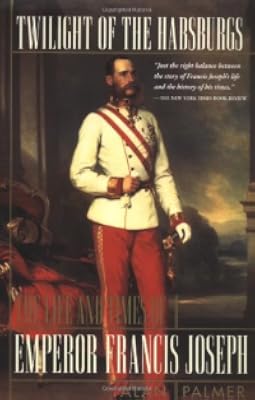
Twilight of the Habsburgs: The Life and Times of Emperor Francis Joseph
by Alan Palmer
On This Page
Description
No ruler in modern times reigned in full sovereignty for as long as Francis Joseph emperor of Austria and king of Hungary, Bohemia, Dalmatia, Croatia, and Slavonia. Titular master of central Europe from 1848 until 1916, he was center stage in Europe throughout the dramatic era in which Italy and Germany emerged as united nation states. His personal decisions were vital both to the outcome of the Crimean War and to the onset of World War l, sixty years later. Although he was an autocrat who show more believed ill the Habsburg dynastic mission to provide eleven distinct nationalities with a cohesive unity, he was also a family man of simple tastes; and in his old age he was revered in his Austrian heartland, much as Queen Victoria was within her empire. Francis Joseph suffered a succession of personal disasters: his brother, Maximilian, was executed by Mexican republicans; his only son, Rudolf, shot himself and his mistress at Mayerling; his empress-queen Elizabeth, died from stab wounds in Geneva; his nephew and heir, Francis Ferdinand, was assassinated at Sarajevo. These episodes are examined anew by Alan Palmer in a biography of revelation, reassessment, and restoration. Too often the emperor is represented as a lonely, humorless bureaucrat, lacking in human warmth, artistic sensitivity, or political perception. Alan Palmer believes that this is a false impression. From a reading of hundreds of the emperor's letters, as well as his mother's diaries and other papers in the Vienna archives, Alan Palmer presents a more rounded and sympathetic portrait of Francis Joseph as the head of an empire and the head of a family. He has also used Elizabeth's curious verse journal, only recently made public, and the extensive writings of the controversial Crown Prince Rudolf in a reappraisal of the conflicting emotions that troubled the oldest of dynasties at a time of immense social, cultural, and political change for European society. Finally, Alan Palmer examines the durability of the Francis Joseph legend and its manifestation in republican Austria today. show lessTags
Recommendations














Member Reviews
Kaiser Franz Josef was one of the most significant of monarchs in European history. His long reign over the diverse Habsburg realms in the 19th and early 20th century came at a time when Europe was changing irreversibly. No longer was Europe in a struggle for survival with neighbouring civilizations, it was the greatest moment in European history and Franz Josef was at the heart of one of the Great Powers that controlled it. With the existential threat from the Ottomans receeding, Josef presided over technological, economic, and social progress despite the pressures from expansionist France and the newly emerging nations of Italy and Germany. Alan Palmer's biography tracks Josef's long life from cradle to grave, describing in the right show more level of detail the conservative administrator who kept his multi-ethnic nation together for over 70 years.
Palmer's biography is authoritative. It leaves out no major area and covers the early years of Josef's development and into power as Josef brings with him the ideals of an earlier age, it covers the politics of dynastic affairs as Josef chooses himself a wife and oversees the marital tribulations of his relatives, the account includes the geopolitics of the day - the ever-changing allegiances between the Great and the new Powers, and it covers the tensions within the Empire that eventually saw it collapse two years after Josef's death.
Within Austria, Franz Josef is remembered as a selfless man who worked extremely hard to do what was best for his people. Given the events in that country over the nearly 100 years since his death it is fashionable to avoid being seen as supporting someone who was an authoritarian leader. Palmer at times falls into this fashionable trap in his biography and where Palmer's own views are forwarded the work seems less strong. In particular, Josef's handling of the Italian question comes under some criticism and there is an allusion that his brother Maximilian was both hard done by and the one who could have reconciled the Habsburg interests in northern Italy with the Risorgimento. There is no evidence that taking a more accomodating line would have done anything to halt the march of irredentism and indeed the collapse of the Empire on ethnic lines after Josef's death suggests his approach brought at least some measure of stability. Equally, Palmer's views on democracy are simply fashionable and Josef's manipulation of Parliamentary structures to ensure stability and continuity should be recognised as genius.
Where Josef can perhaps more fairly be criticised is in his handling of personal relations. Palmer clearly feels for Maximilian who met a violent end in Mexico but as a biography on the life and times of a man, the suicide of his son and heir perhaps merited deeper analysis. Josef's personal relations were clearly difficult - being so in love with a wife so ill-suited to an Imperial role must have been hard when he alone was the sole unifier of the Empire. Josef's drug addict son Rudolf and the Meyerling affair make for romantic tale but the burden of such an event must have weighed heavily on Josef.
Palmer does bring a very thorough and balanced account of Josef's relationship with Katharina Schratt and the story of their comradeship is touching. While Schratt might receive an undue weight of attention from Palmer, it is a series of insights into the man rather than just the actions he took which is enlightening.
The political and military machinations of Josef's many governments are fascinating. The continuing need to balance the claims of Hungarians, Croats, Italians, Czechs, and Germans combined to make Josef's tenure perhaps the most difficult of any of the Great Power leaders. The tensions within SE Europe continue to this day and while they are clearly a legacy of three cultures combining at one spot, Josef's capacity to manage the geopolitics and the day to day administration is an under-admired trait.
It is a shame that Palmer chooses to render the name Franz Josef as Francis Joseph as it jars on every appearance. There are other names and places that are more complex and might have benefited from Anglicisation but having the flow of the narrative interrupted to scan and recognise the correct name of the Emperor takes a lot of getting used to.
Despite some minor quibbles, Twilight of the Habsburgs is a terrific survey of the life and times of the Emperor. A reveared leader, a humble and thoughtful administrator, and a man at the heart of one of the truly Great Powers is given a thorough and enlightening biography by Alan Palmer. It is not exciting populist history, it is an account of the complex and fascinating life of Franz Josef and times in which he participated. show less
Palmer's biography is authoritative. It leaves out no major area and covers the early years of Josef's development and into power as Josef brings with him the ideals of an earlier age, it covers the politics of dynastic affairs as Josef chooses himself a wife and oversees the marital tribulations of his relatives, the account includes the geopolitics of the day - the ever-changing allegiances between the Great and the new Powers, and it covers the tensions within the Empire that eventually saw it collapse two years after Josef's death.
Within Austria, Franz Josef is remembered as a selfless man who worked extremely hard to do what was best for his people. Given the events in that country over the nearly 100 years since his death it is fashionable to avoid being seen as supporting someone who was an authoritarian leader. Palmer at times falls into this fashionable trap in his biography and where Palmer's own views are forwarded the work seems less strong. In particular, Josef's handling of the Italian question comes under some criticism and there is an allusion that his brother Maximilian was both hard done by and the one who could have reconciled the Habsburg interests in northern Italy with the Risorgimento. There is no evidence that taking a more accomodating line would have done anything to halt the march of irredentism and indeed the collapse of the Empire on ethnic lines after Josef's death suggests his approach brought at least some measure of stability. Equally, Palmer's views on democracy are simply fashionable and Josef's manipulation of Parliamentary structures to ensure stability and continuity should be recognised as genius.
Where Josef can perhaps more fairly be criticised is in his handling of personal relations. Palmer clearly feels for Maximilian who met a violent end in Mexico but as a biography on the life and times of a man, the suicide of his son and heir perhaps merited deeper analysis. Josef's personal relations were clearly difficult - being so in love with a wife so ill-suited to an Imperial role must have been hard when he alone was the sole unifier of the Empire. Josef's drug addict son Rudolf and the Meyerling affair make for romantic tale but the burden of such an event must have weighed heavily on Josef.
Palmer does bring a very thorough and balanced account of Josef's relationship with Katharina Schratt and the story of their comradeship is touching. While Schratt might receive an undue weight of attention from Palmer, it is a series of insights into the man rather than just the actions he took which is enlightening.
The political and military machinations of Josef's many governments are fascinating. The continuing need to balance the claims of Hungarians, Croats, Italians, Czechs, and Germans combined to make Josef's tenure perhaps the most difficult of any of the Great Power leaders. The tensions within SE Europe continue to this day and while they are clearly a legacy of three cultures combining at one spot, Josef's capacity to manage the geopolitics and the day to day administration is an under-admired trait.
It is a shame that Palmer chooses to render the name Franz Josef as Francis Joseph as it jars on every appearance. There are other names and places that are more complex and might have benefited from Anglicisation but having the flow of the narrative interrupted to scan and recognise the correct name of the Emperor takes a lot of getting used to.
Despite some minor quibbles, Twilight of the Habsburgs is a terrific survey of the life and times of the Emperor. A reveared leader, a humble and thoughtful administrator, and a man at the heart of one of the truly Great Powers is given a thorough and enlightening biography by Alan Palmer. It is not exciting populist history, it is an account of the complex and fascinating life of Franz Josef and times in which he participated. show less
Thorough biography, both interesting and boring. A lot of Hungarian and Balkan history.
p. 217: "Makart Festzugtag" 27 April 1879
p. 217: "Makart Festzugtag" 27 April 1879
Un ritratto inedito, pubblico e privato, di Francesco Giuseppe I (1830 - 1916), imperatore e re d'Ungheria, signore di Boemia, Dalmazia, Croazia, Slavonia e di molte altre terre, dal Lombardo-Veneto alle frontiere della Russia, che con il suo regno, durato dal 1848 al 1916, segnò uno dei periodi più ricchi di eventi della storia europea, e anche italiana. Spesso rappresentato come un burocrate freddo e misantropo, privo di visione politica, Francesco Giuseppe fu invece una grande figura tragica, che entrò ancora vivente in una leggenda che continua fino ai nostri giorni. Dovette sopportare una serie incredibile di rovesci personali e dinastici: la fucilazione del fratello Massimiliano, imperatore del Messico, il suicidio del figlio show more Rodolfo a Mayerling, l'assassinio della moglie Elisabetta (Sissi) per mano di un anarchico, la morte del nipote ed erede Francesco Ferdinando a Sarajevo, oltre alla perdita dei possedimenti italiani e alla lenta dissoluzione del suo impero multinazionale. Alan Palmer ci offre in questo saggio anche un'immagine nuova del famoso sovrano: dalla sua corrispondenza privata, dai diari della madre e della moglie, dagli scritti del figlio Rodolfo e da moltissimi altri documenti di prima mano emerge il ritratto di un sensibile e solerte padre di famiglia e dei "suoi popoli", che contrastò come potè un destino storico avverso. show less
May 21, 2014 (Edited)Italian
Ratings
Members
- Recently Added By
Lists

r/History Recommended Reading List
603 works; 12 members
Author Information

Some Editions
Series
Belongs to Publisher Series
Common Knowledge
- Canonical title*
- Franz Joseph I., Kaiser von Österreich und König von Ungarn
- Original title
- Twilight of the Habsburgs: The Life and Times of Emperor Francis Joseph
- Original publication date
- 1994; 1997-02-12 (Pbk. Ed.) (Pbk. Ed.)
- People/Characters
- Franz Joseph, Emperor of Austria; Elisabeth, Empress of Austria
- Important places
- Austria-Hungary
- Dedication
- To Anna, László, Judit, György and Eszter, in gratitude and affection.
- First words
- The summer residence of the Habsburgs lies barely three miles from the centre of Vienna.
- Last words
- (Click to show. Warning: May contain spoilers.)Ninety years later, it is the eleven peoples who are fragmented and seek asylum.
- Original language*
- inglese
*Some information comes from Common Knowledge in other languages. Click "Edit" for more information.
Classifications
- Genres
- History, Nonfiction, Biography & Memoir, General Nonfiction
- DDC/MDS
- 943.604092 — History & geography History of Europe Central Europe: Germany, Austria, Switzerland, Czech, Poland, Hungary Austria and Liechtenstein
- LCC
- DB87 .P25 — History of Europe, Asia, Africa and Oceania Austria – Liechtenstein – Hungary – Czechoslovakia History of Austria. Liechtenstein. Hungary. Czechoslovakia History By period 1521- 19th-20th centuries
- BISAC
Statistics
- Members
- 211
- Popularity
- 154,757
- Reviews
- 3
- Rating
- (3.50)
- Languages
- English, German, Italian
- Media
- Paper, Ebook
- ISBNs
- 11
- ASINs
- 3