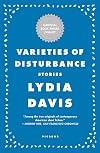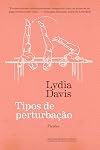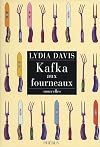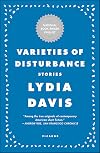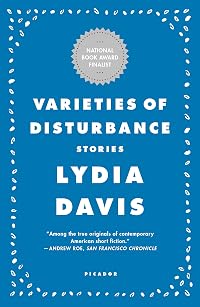
Varieties of Disturbance: Stories
by Lydia Davis
On This Page
Description
Lydia Davis has been called "one of the quiet giants in the world of American fiction" (Los Angeles Times), "an American virtuoso of the short story form" (Salon), an innovator who attempts "to remake the model of the modern short story" (The New York Times Book Review). Her admirers include Grace Paley, Jonathan Franzen, and Zadie Smith; as Time magazine observed, her stories are "moving . . . and somehow inevitable, as if she has written what we were all on the verge of thinking."In show more Varieties of Disturbance, her fourth collection, Davis extends her reach as never before in stories that take every form from sociological studies to concise poems. Her subjects include the five senses, fourth-graders, good taste, and tropical storms. She offers a reinterpretation of insomnia and re-creates the ordeals of Kafka in the kitchen. She questions the lengths to which one should go to save the life of a caterpillar, proposes a clear account of the sexual act, rides the bus, probes the limits of marital fidelity, and unlocks the secret to a long and happy life.No two of these fictions are alike. And yet in each, Davis rearranges our view of the world by looking beyond our preconceptions to a bizarre truth, a source of delight and surprise.Varieties of Disturbance is a 2007 National Book Award Finalist for Fiction. show lessTags
Recommendations







Member Reviews
Remember one of those moments when a friend utters a single word or phrase and it makes you both burst into side-splitting laughter, leaving others around you perplexed. That is kind of how some of Davis's very short stories work, except there is not so much laughter.
Many of her stories are about quirks and absurdities of our daily lives, little moments, our common experiences and absent-minded musings. These may be some little experiences which we vaguely recognize, but can't quite put our finger on. Or those experiences which we consider too trivial to give a thought to. She does not need any words to describe the setting. She does not need any words to describe the characters. Her stories can be so relatable that we can often draw show more the setting from what is around us, and we can substitute ourselves as the characters. Using only a few words, Davis puts a mirror in front of us and brings out an "I know, right?" kind of response.
“[her stories are] moving . . . and somehow inevitable, as if she has written what we were all on the verge of thinking.” - Time Magazine
There is good deal of variety in the stories, both stylistically and content-wise. Some stories are written like academic reports, some play around with language, some deal with imperfect familial ties, some are absurd and funny. There is an undercurrent of loneliness in many of the stories, while some others speak of an unbearable sadness:
"...Soon everything returned to normal: the incident had been no more than a moment of madness during which the people could not bear the frustration of their lives and had given way to a strange impulse."
"I would like to disappear into the earth like that mole. I would like to stuff myself into the drawer of the laundry chest, and open the drawer from time to time to see if I have suffocated yet. It's so much more surprising that one gets up every morning at all."
Despite, the range of emotions Davis's writing deals with, it is never overly-sentimental. She uses a calm, detached voice. She manages to condense the essence to a few innocuous sentences which hit you in just the right place.
_______
The Good Times
“What was happening to them was that every bad time produced a bad feeling that in turn produced several more bad times and several more bad feelings, so that their life together became crowded with bad times and bad feelings, so crowded that almost nothing else could grow in that dark field. But then she had a feeling of peace one morning that lingered from the evening before spent sewing while he sat reading in the next room. And a day or two later, she had a feeling of contentment that lingered in the morning from the evening before when he kept her company in the kitchen while she washed the dinner dishes. If the good times increased, she thought, each good time might produce a good feeling that would in turn produce several more good times that would produce several more good feelings. What she meant was that the good times might multiply perhaps as rapidly as the square of the square, or perhaps more rapidly, like mice, or like mushrooms springing up overnight from the scattered spore of a parent mushroom which in turn had sprung up overnight with a crowd of others from the scattered spore of a parent, until her life with him with be so crowded with good times that the good times might crowd out the bad as the bad times had by now almost crowded out the good.” show less
So now I have read all four. Several of these last stories were a bit different from the other books--more of them were more like exercises in sociological inquiry or "studies" of human behaviour, interesting but . . . are they stories? Well, who cares, why not! What came into my mind was a study of Shakespeare's wife written by Germaine Greer -- the information about who she "really" was has to be gleaned from skimpy records of, say people with licenses to brew beer (she did), who inherited the "best bed" (she didn't) -- a picture does emerge but it is built as much on one's own ideas as the facts presented. The point, in other words! When Davis is at her best she is like a terrier pulling the squeaker out of a toy, intent and show more thorough, she'll take a behaviour apart until you cry uncle -- the best in this collection for me was the piece on what she learned from the baby. I do think even a non-short story reader might find Davis rewarding although I might be mad to think so. One of her stories has inspired me to take my mother's letters (I've kept about fifty) to read through and catalogue aspects of -- as a way to see what emerges, what might come through the whole and reveal more about who she was. I think Davis is extraordinary, original, funny, wise and humble. ***** show less
Of the 57 varieties of disturbance to be found in Lydia Davis’ collection of the same name, the variety itself may not be so various, but the execution of each exemplar is exquisite. These “stories” range from a single line to many pages, though length is no marker of how closely any individual example will resemble whatever you currently consider a story to be. You might wish to think of them as exercises, though the fact that each seems perfectly formed and complete rather belies the unfinished aspect one typically associates with exercises. Some work better than others for some people (I’m guessing) on some days. I have a suspicion that on other days others would work better for me (or other people). So this is really just a show more blanket recommendation—you’ll simply have to see for yourself which of these excursions work for you.
I like many of the very, very short entries. But this type of aphoristic exclamation can seem contrived (at least on some days for some people). If brevity is the soul of wit, it does not follow that wit is always achieved through brevity. At the next level, there a great many entries of about one page in length. In these, Davis seems almost expansive, luxuriously so, where so many writers might have found a one page story to be the limit of their skill with concision. There are a few entries that are much longer and which have the form and technique of psychological studies or treatises in computational linguistics: “We Miss You: A Study of Get-Well Letters from a Class of Fourth-Graders”, “Helen and Vi: A Study in Health and Vitality”. Remarkable achievements, though I don’t entirely know what to do with such perfect simulacra other than to treat them as the very objects they mirror.
For me, the stories that worked best, at least today, were the Kafkaesque “Kafka Cooks Dinner” and the remarkable account of two academics taking a walk around Oxford after having participated in a conference there, “The Walk”. But I’m sure your favourites will vary. Recommended. show less
I like many of the very, very short entries. But this type of aphoristic exclamation can seem contrived (at least on some days for some people). If brevity is the soul of wit, it does not follow that wit is always achieved through brevity. At the next level, there a great many entries of about one page in length. In these, Davis seems almost expansive, luxuriously so, where so many writers might have found a one page story to be the limit of their skill with concision. There are a few entries that are much longer and which have the form and technique of psychological studies or treatises in computational linguistics: “We Miss You: A Study of Get-Well Letters from a Class of Fourth-Graders”, “Helen and Vi: A Study in Health and Vitality”. Remarkable achievements, though I don’t entirely know what to do with such perfect simulacra other than to treat them as the very objects they mirror.
For me, the stories that worked best, at least today, were the Kafkaesque “Kafka Cooks Dinner” and the remarkable account of two academics taking a walk around Oxford after having participated in a conference there, “The Walk”. But I’m sure your favourites will vary. Recommended. show less
Another go at finishing books from the spring semester...
Lydia Davis is like nothing I've ever read before. In the just over 4 months since I began reading excerpts of this collection of her short fictions, I've gone back and forth over whether I love or hate her style, whether I find the brutal economy and utter truth of her prose fantastic or too jarring. She takes the most ordinary moments of life and makes them into the most literary bits of prose. The fascination of her prose is not the characters, who are so very clearly flawed humans, or the plots, which often don't even really exist, but rather the force of her unique project and unique language.
One of the most thought-provoking books I've ever read. Recommend.
Lydia Davis is like nothing I've ever read before. In the just over 4 months since I began reading excerpts of this collection of her short fictions, I've gone back and forth over whether I love or hate her style, whether I find the brutal economy and utter truth of her prose fantastic or too jarring. She takes the most ordinary moments of life and makes them into the most literary bits of prose. The fascination of her prose is not the characters, who are so very clearly flawed humans, or the plots, which often don't even really exist, but rather the force of her unique project and unique language.
One of the most thought-provoking books I've ever read. Recommend.
Another go at finishing books from the spring semester...
Lydia Davis is like nothing I've ever read before. In the just over 4 months since I began reading excerpts of this collection of her short fictions, I've gone back and forth over whether I love or hate her style, whether I find the brutal economy and utter truth of her prose fantastic or too jarring. She takes the most ordinary moments of life and makes them into the most literary bits of prose. The fascination of her prose is not the characters, who are so very clearly flawed humans, or the plots, which often don't even really exist, but rather the force of her unique project and unique language.
One of the most thought-provoking books I've ever read. Recommend.
Lydia Davis is like nothing I've ever read before. In the just over 4 months since I began reading excerpts of this collection of her short fictions, I've gone back and forth over whether I love or hate her style, whether I find the brutal economy and utter truth of her prose fantastic or too jarring. She takes the most ordinary moments of life and makes them into the most literary bits of prose. The fascination of her prose is not the characters, who are so very clearly flawed humans, or the plots, which often don't even really exist, but rather the force of her unique project and unique language.
One of the most thought-provoking books I've ever read. Recommend.
Another go at finishing books from the spring semester...
Lydia Davis is like nothing I've ever read before. In the just over 4 months since I began reading excerpts of this collection of her short fictions, I've gone back and forth over whether I love or hate her style, whether I find the brutal economy and utter truth of her prose fantastic or too jarring. She takes the most ordinary moments of life and makes them into the most literary bits of prose. The fascination of her prose is not the characters, who are so very clearly flawed humans, or the plots, which often don't even really exist, but rather the force of her unique project and unique language.
One of the most thought-provoking books I've ever read. Recommend.
Lydia Davis is like nothing I've ever read before. In the just over 4 months since I began reading excerpts of this collection of her short fictions, I've gone back and forth over whether I love or hate her style, whether I find the brutal economy and utter truth of her prose fantastic or too jarring. She takes the most ordinary moments of life and makes them into the most literary bits of prose. The fascination of her prose is not the characters, who are so very clearly flawed humans, or the plots, which often don't even really exist, but rather the force of her unique project and unique language.
One of the most thought-provoking books I've ever read. Recommend.
Another go at finishing books from the spring semester...
Lydia Davis is like nothing I've ever read before. In the just over 4 months since I began reading excerpts of this collection of her short fictions, I've gone back and forth over whether I love or hate her style, whether I find the brutal economy and utter truth of her prose fantastic or too jarring. She takes the most ordinary moments of life and makes them into the most literary bits of prose. The fascination of her prose is not the characters, who are so very clearly flawed humans, or the plots, which often don't even really exist, but rather the force of her unique project and unique language.
One of the most thought-provoking books I've ever read. Recommend.
Lydia Davis is like nothing I've ever read before. In the just over 4 months since I began reading excerpts of this collection of her short fictions, I've gone back and forth over whether I love or hate her style, whether I find the brutal economy and utter truth of her prose fantastic or too jarring. She takes the most ordinary moments of life and makes them into the most literary bits of prose. The fascination of her prose is not the characters, who are so very clearly flawed humans, or the plots, which often don't even really exist, but rather the force of her unique project and unique language.
One of the most thought-provoking books I've ever read. Recommend.
Members
- Recently Added By
Published Reviews
ThingScore 100
It’s inspiring to watch Davis map out knotty ruminations without devolving into tongue-tied panic. Her stories are also deeply funny, though not in a willful way. Eschewing one-liners, Davis creates humor by making distressing topics collide with matter-of-fact, vaguely fascinated tones. It’s as if her characters were rubbernecking while cruising past the pileups of their own obsessions.
added by paradoxosalpha
Lists

National Book Award Finalists - Fiction
377 works; 12 members

Books Read in 2016
4,666 works; 199 members
Author Information

35+ Works 4,957 Members
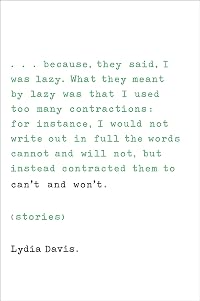
Lydia Davis is the author of several works of fiction. She is also a noted translator. She teaches at Bard College and lives in Port Ewen, New York. (Publisher Provided) Lydia Davis is a writer and translator. She is a professor of creative writing at the University at Albany, SUNY, and was a Lillian Vernon Distinguished Writer-in-Residence at New show more York University in 2012. Davis has published six collections of short stories, including The Thirteenth Woman and Other Stories (1976) and Break It Down (1986), a Finalist for the PEN/Hemingway Award. Her most recent collection was Varieties of Disturbance, published by Farrar, Straus and Giroux in 2007 and a Finalist for the National Book Award. Davis' stories are acclaimed for their brevity and humor. Many are only one or two sentences. Her book Can't and Won't made the New York Times Bestseller List in 2014. She has also translated Proust, Flaubert, Blanchot, Foucault, Michel Leiris, Pierre Jean Jouve and other French writers, as well as the Dutch writer A.L. Snijders. In October 2003 Davis received a MacArthur Fellowship. She was elected a Fellow of the American Academy of Arts and Sciences in 2005. Davis was announced as the winner of the 2013 Man Booker International Prize on 22 May 2013. Davis won £60,000 as part of the biennial award. (Bowker Author Biography) show less
Awards and Honors
Work Relationships
Is contained in
Common Knowledge
- Canonical title
- Varieties of Disturbance: Stories
- Original publication date
- 2007
- Dedication
- for my brother SHD
and for RHD, HHD, and CF,
in loving memory - First words
- I think Mother is flirting with a man from her past who is not Father.
- Last words
- (Click to show. Warning: May contain spoilers.)In the morning, he was a rosy king, gleaming, smooth-cheeked and smooth-chinned, fragrant with perfumed talc, coming out into the sunlight with a royal embrace in his royal red plaid robe...
- Blurbers
- Callanan, Liam; Lennon, Brian; Roe, Andrew; Marcus, Ben; Friedman, Paula; Scott, A. O. (show all 8); Harleman, Ann; Texier, Catherine
Classifications
Statistics
- Members
- 410
- Popularity
- 75,478
- Reviews
- 21
- Rating
- (3.74)
- Languages
- 6 — Dutch, English, French, German, Portuguese, Swedish
- Media
- Paper, Ebook
- ISBNs
- 8
- ASINs
- 2