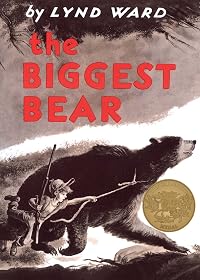
The Biggest Bear
by Lynd Ward
On This Page
Description
Johnny goes hunting for a bearskin to hang on his family's barn and returns with a small bundle of trouble.Tags
Recommendations






Member Reviews
The story was about a middle-schoolish boy, raised in the country and accustomed to hunting (the first page will, um, trigger some people these days). He wants to bag a bear, but instead makes friends with an orphan cub. When the bear gets too big, the boy has a hard choice to make, which would generate some serious discussion once the adults quit clutching their pearls, but all's well that ends well.
Illustrations are greyish-sepia drawings, and appropriate to the story. The bear is delightfully drawn.
Good enough reading by the narrator, but the turn-page whistle was most annoying, especially since there is so little text on each page the turns come rapidly and often; side 2 does not have it.
Illustrations are greyish-sepia drawings, and appropriate to the story. The bear is delightfully drawn.
Good enough reading by the narrator, but the turn-page whistle was most annoying, especially since there is so little text on each page the turns come rapidly and often; side 2 does not have it.
This book was published in 1952 before anyone would think twice about whether it was politically correct to write a book about a boy who sets out to shoot a bear. Despite the intial premise that Johnny Orchard, in order to prove himself a brave boy, sets out to find the biggest bear he can find with the intent of killing him, this book is still a really nice story.
Johnny isn't as cold and heartless as he pretends, especially when he finds a bear cub in the woods and decides to bring him home. As Johnny raises the cub there are all kinds of hijinks that go on around the homestead, and soon Johnny's bear is so big that he can no longer with the family.
The subtle message in the book is what happens to wild animals when they are taken from show more their natural habitat and forced to live the life that humans live. The reader starts to feel sorry for the bear and Johnny as it becomes clear that Johnny has to do something to remove the bear from his home. Taking responsiblity for his actions, Johnny leads the bear to the woods, and in his hands are the rifle that he had hunted with a long time ago when he found the bear. The implication is clear -- because the bear has been domesticated, it won't be able to survive in the wild and Johnny must deal with that.
The suspense of whether Johnny is going to shoot his bear doesn't last but a minute, and animal rights people will have no argument with this book on that level.
The illustrations are line drawings in a sepia tone, and are beautiful. The text and illustrations work very well together, creating a truly beautiful reading experience. This would be a great story for any boy who fancies himself a hunter, or who wants to own a gun. Likewise, it is for children who think they want to adopt exotic pets like lions, tigers, monkeys and bears (oh my!).
The Biggest Bear has endured all these years, and I can't see it ever being out-of-date. show less
Johnny isn't as cold and heartless as he pretends, especially when he finds a bear cub in the woods and decides to bring him home. As Johnny raises the cub there are all kinds of hijinks that go on around the homestead, and soon Johnny's bear is so big that he can no longer with the family.
The subtle message in the book is what happens to wild animals when they are taken from show more their natural habitat and forced to live the life that humans live. The reader starts to feel sorry for the bear and Johnny as it becomes clear that Johnny has to do something to remove the bear from his home. Taking responsiblity for his actions, Johnny leads the bear to the woods, and in his hands are the rifle that he had hunted with a long time ago when he found the bear. The implication is clear -- because the bear has been domesticated, it won't be able to survive in the wild and Johnny must deal with that.
The suspense of whether Johnny is going to shoot his bear doesn't last but a minute, and animal rights people will have no argument with this book on that level.
The illustrations are line drawings in a sepia tone, and are beautiful. The text and illustrations work very well together, creating a truly beautiful reading experience. This would be a great story for any boy who fancies himself a hunter, or who wants to own a gun. Likewise, it is for children who think they want to adopt exotic pets like lions, tigers, monkeys and bears (oh my!).
The Biggest Bear has endured all these years, and I can't see it ever being out-of-date. show less
three stars for the lovely illustrations but otherwise, this Caledcott winner from 1952 is a depressing story that I would never recommend to kids. This story would never be published today. An excellent illustration of how times change. Young Johnny sets out to shoot a bear, as it is embarrassing that his farm is the only one in town without a bearskin tacked up on the wall of the barn. He finds a baby bear and ends up making it a pet, which you would think (being a children's book), would be a charming and happy thing - maybe talking about the importance of loving animals and being gentle. Instead, the townsfolks want Johnny to get rid of the bear, so he sets out to return the bear to the woods and in the process, the bear gets show more captured to be put on display at a zoo.
Absolutely depressing.
Nice illustrations. show less
Absolutely depressing.
Nice illustrations. show less
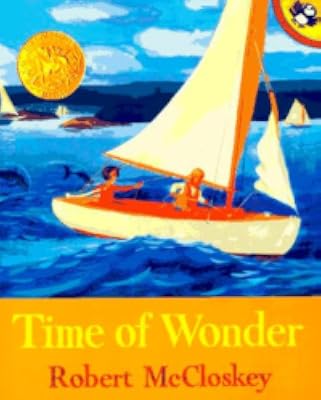
A young boy goes off on a bear hunt, determined to bring home a hide to hang on the side of the barn, but ends up rescuing an orphaned cub instead. As the bear grows larger, so do the problems it causes, until a hard decision must be made. The illustrations are very realistic, somewhat reminiscent of Robert McCloskey's work, but Ward never comes as close to cuteness as McCloskey does. Lynd Ward is sort of the father of the graphic novel, having produced six wordless novels comprised solely of woodcuts, in the 1930's, as well as a "story in pictures" - The Silver Pony for children. He also illustrated many juvenile books including the first edition of Johnny Tremain.
Ward won the Caldecott for the detailed, sepia-toned, drawings that accompany this story.
Johnny Orchard lives on a farm at the far end of the valley, near a big woods. Whenever he walks down the road he notices that other barns have bear skins drying on their walls; he’s embarrassed that his family’s barn doesn’t have a bear skin. So he heads into the woods one day, with his rifle, determined to get the biggest bear.
What he finds, though is an orphaned bear cub, which he befriends with a piece of maple sugar candy. But when he brings the cub home, problems begin; and they only get worse when the bear grows B*I*G.
I think children might be intrigued by the adventure of the story, but I hope they wouldn’t feel encouraged to try show more to tame a wild animal. I was also somewhat dismayed bya scene where Johnny has to take his bear to the woods to kill it because it has become a nuisance. Don’t worry, he doesn’t ever actually do this, but he has every intention of doing so, and I find that disturbing in a children’s book.
The illustrations are wonderfully detailed. I kept looking at them, absorbing the farmhouse, barnyard, woods, etc. If I were rating the illustrations alone, I’d give the book 4****. show less
Johnny Orchard lives on a farm at the far end of the valley, near a big woods. Whenever he walks down the road he notices that other barns have bear skins drying on their walls; he’s embarrassed that his family’s barn doesn’t have a bear skin. So he heads into the woods one day, with his rifle, determined to get the biggest bear.
What he finds, though is an orphaned bear cub, which he befriends with a piece of maple sugar candy. But when he brings the cub home, problems begin; and they only get worse when the bear grows B*I*G.
I think children might be intrigued by the adventure of the story, but I hope they wouldn’t feel encouraged to try show more to tame a wild animal. I was also somewhat dismayed by
The illustrations are wonderfully detailed. I kept looking at them, absorbing the farmhouse, barnyard, woods, etc. If I were rating the illustrations alone, I’d give the book 4****. show less
I really enjoyed this book! First off, I thought the writing was very organized, and easy to read. The other organized the book so the writing was on the left, and the picture was on the right. Each page with writing only had one or two sentences. This allows readers to read the book with ease and not become overwhelm. For, example, there are 82 pages, but the first page only has one sentence, "Johnny Orchard lived on the farm farthest up the valley and closest to the woods." Second, this book pushes readers to think about a tough issue. Johnny is jealous of his neighbors bear skins; however, when given the opportunity to kill a bear he has a hard time doing so. It makes the reader think about what they are jealous of, and if it really show more is all that great. It goes along with the saying, the grass isn't always green on the other side. I thought this was a good lesson for young readers to hear, and it was in an entertaining way. Third, I really liked the illustrations in this book. The other only used black, white, and brown in the pictures. This create a simple, and concrete picture for the readers to focus on. For example, the page's sentence states, "And most especially he like the maple sugar Johnny bought him from the store." This page only has a drawing of the boy and the bear, and no background. This allows the reader to focus on what is important. show less
The Biggest Bear by Lynd Ward
Summary:
This Caldecott Honor-winning picture book is about a young farm boy named Johnny. Johnny is humiliated by the fact that his family's barn is the only one without a bear skin tacked to the side of it. As a result, he sets out on an adventure to find the biggest bear in the woods with the intent to shoot it. As he is deep in the woods, he finds a bear alright; however, the bear is not the biggest bear in the woods like Johnny hoped to find. In fact, the bear was just a small cub. After Johnny realizes that the cub was hungry, he feeds the cub a piece of maple sugar and then takes him home. Johnny takes good care of the cub; however, the cub is always hungry and helps himself to food that is meant for show more the other animals. As the cub grows up, he becomes quite large and destructive as he searches for food. A decision is made to return the bear back to the woods. However, after Johnny makes several attempts to return the bear back to the woods, the bear finds his way back to the farm. Finally, Johnny and his father decide that it is best for Johnny to take the bear back into the woods and shoot him. However, after they venture into the woods further than necessary, Johnny and the bear get caught in a trap. After they were both found by a group of men, the men explain that they are looking for animals to put in their zoo. Johnny's bear is much bigger than they expected. The story ends as Johnny visits his bear in the zoo and brings him a piece of maple sugar.
Personal Reaction:
I enjoyed this book because the story felt real to me. I enjoyed the bond that was shared between the bear and cub, and how the bear kept showing up after he was taken back to the woods several times. Although different, the decisions that were made in the story compare to tough decisions that people are forced to make every day.
Classroom Extension Ideas:
1. As a class, I could encourage the children to share their favorite part of the story and why.
2. In the classroom, I could have the children write their own short story that includes making a tough decision. show less
Summary:
This Caldecott Honor-winning picture book is about a young farm boy named Johnny. Johnny is humiliated by the fact that his family's barn is the only one without a bear skin tacked to the side of it. As a result, he sets out on an adventure to find the biggest bear in the woods with the intent to shoot it. As he is deep in the woods, he finds a bear alright; however, the bear is not the biggest bear in the woods like Johnny hoped to find. In fact, the bear was just a small cub. After Johnny realizes that the cub was hungry, he feeds the cub a piece of maple sugar and then takes him home. Johnny takes good care of the cub; however, the cub is always hungry and helps himself to food that is meant for show more the other animals. As the cub grows up, he becomes quite large and destructive as he searches for food. A decision is made to return the bear back to the woods. However, after Johnny makes several attempts to return the bear back to the woods, the bear finds his way back to the farm. Finally, Johnny and his father decide that it is best for Johnny to take the bear back into the woods and shoot him. However, after they venture into the woods further than necessary, Johnny and the bear get caught in a trap. After they were both found by a group of men, the men explain that they are looking for animals to put in their zoo. Johnny's bear is much bigger than they expected. The story ends as Johnny visits his bear in the zoo and brings him a piece of maple sugar.
Personal Reaction:
I enjoyed this book because the story felt real to me. I enjoyed the bond that was shared between the bear and cub, and how the bear kept showing up after he was taken back to the woods several times. Although different, the decisions that were made in the story compare to tough decisions that people are forced to make every day.
Classroom Extension Ideas:
1. As a class, I could encourage the children to share their favorite part of the story and why.
2. In the classroom, I could have the children write their own short story that includes making a tough decision. show less
Members
- Recently Added By
Lists

Caldecott Medal Books
91 works; 15 members

Honey For a Child's Heart
1,152 works; 25 members

Romalda Spalding's Writing Road To Reading
213 works; 3 members

CCE 1000 Good Books List
1,033 works; 12 members

Literature of Honor for Boys
91 works; 3 members

Books Read in 2023
5,638 works; 147 members

Early Picture Books
467 works; 9 members

Recommended Reading List
219 works; 1 member
Author Information

31+ Works 4,213 Members
Awards and Honors
Series
Belongs to Publisher Series
Vintage Scholastic (TW0531)
Common Knowledge
- Canonical title
- The Biggest Bear
- Original publication date
- 1952
- First words
- Johnny Orchard lived on the farm farthest up the valley and closest to the woods.
- Last words
- (Click to show. Warning: May contain spoilers.)"And I'll always bring him maple sugar," said Johnny.
- Original language
- English
Classifications
Statistics
- Members
- 1,905
- Popularity
- 11,289
- Reviews
- 25
- Rating
- (3.88)
- Languages
- English, French
- Media
- Paper, Audiobook, Ebook
- ISBNs
- 30
- UPCs
- 3
- ASINs
- 19