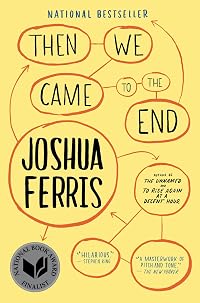
Then We Came to the End
by Joshua Ferris
On This Page
Description
This wickedly funny, big-hearted novel about life in the office signals the arrival of a gloriously talented writer.The characters in Then We Came to the End cope with a business downturn in the time-honored way: through gossip, secret romance, elaborate pranks, and increasingly frequent coffee breaks. By day they compete for the best office furniture left behind and try to make sense of the mysterious pro-bono ad campaign that is their only remaining "work.".
Tags
Recommendations







Member Recommendations
Member Reviews
This meandering tale of a group of co-workers who spend more time gossiping about one another than they do working, even in the face of an economic downturn, makes up in sheer style what it might lack in plot.
Ferris has assembled a cast of characters with the same kind of goofiness that pervaded “The Office” and occasionally even rings with the same tone of “M*A*S*H” or "Catch-22", but without the blood. Even as the reader may be allowed a bit of impatience at the juvenile hijinks of the workplace, anyone who has ever worked in an office will recognize the petty frustrations and the ego-driven conflicts. A continuing thread dealing with the poaching of office equipment from recently-vacated cubicles is probably the funniest show more motif in the book; many of the other situations actually depend on an essential sadness that pervades cubicle-land.
Most of the book is written from an unusual first-person plural viewpoint: “When someone quit, we couldn’t believe it.” “We wanted to die looking stupid in front of Lynn, but we didn’t mind it in front of Joe.” The single exception is a third-person chapter in the midst of all this middle-school nattering in which a character faces the prospect of a looming surgery that is terrifying to her.
“The Thing to Do and the Place to Be” could easily be a stand-alone short story, and one could entertain the notion that the rest of the novel actually sprang up to accompany it. Powerful and frightening, it’s something that will stick with the reader for a long time, particularly if they have ever found themselves at a similar crossroads.
Ferris wraps all this up with a bittersweet coda set at a time when the team has gone their separate ways. Some questions are answered – a few with borderline unbelievable resolutions -- while others are allowed to play out unresolved.
Kind of like life, actually. show less
Ferris has assembled a cast of characters with the same kind of goofiness that pervaded “The Office” and occasionally even rings with the same tone of “M*A*S*H” or "Catch-22", but without the blood. Even as the reader may be allowed a bit of impatience at the juvenile hijinks of the workplace, anyone who has ever worked in an office will recognize the petty frustrations and the ego-driven conflicts. A continuing thread dealing with the poaching of office equipment from recently-vacated cubicles is probably the funniest show more motif in the book; many of the other situations actually depend on an essential sadness that pervades cubicle-land.
Most of the book is written from an unusual first-person plural viewpoint: “When someone quit, we couldn’t believe it.” “We wanted to die looking stupid in front of Lynn, but we didn’t mind it in front of Joe.” The single exception is a third-person chapter in the midst of all this middle-school nattering in which a character faces the prospect of a looming surgery that is terrifying to her.
“The Thing to Do and the Place to Be” could easily be a stand-alone short story, and one could entertain the notion that the rest of the novel actually sprang up to accompany it. Powerful and frightening, it’s something that will stick with the reader for a long time, particularly if they have ever found themselves at a similar crossroads.
Ferris wraps all this up with a bittersweet coda set at a time when the team has gone their separate ways. Some questions are answered – a few with borderline unbelievable resolutions -- while others are allowed to play out unresolved.
Kind of like life, actually. show less
Hysterical office satire played as the modern workplace socially akin to junior high. Insecurity, gossip, miscommunication and stupid swirl amongst the colorful denizens of a Chicago advertising agency in fiscal decline. Famously and effectively written in the first person plural, the book beautifully shifts in perspective and time, a story told in disjointed second-hand accounts of characters' strange rumors and moronic obsessions. Such a funny book that even the tedious workplace humdrum is zany and engaging.
Second reading: I'm feeling that achy-love feeling that comes when you've turned the last page of a really good book. What really struck me this time around was the quality of the writing, how everything is so well said and purposeful and just right. It's something that I notice a lot more as I get older, an author's use of language and style, and I have no tolerance for flabby meandering writing. Reader, this book is sharp and on point. Highly recommend.
First reading: Feels kind of like the movie "Office Space", but better. Seriously.
The book starts off less like a novel and more like a collection of great anecdotes your friend is sharing during happy hour. This was a little unexpected for me, but it only took about a chapter to get show more into the flow. About halfway through the story structure becomes more linear and plot-focused.
I have to share the following passage because my office just went through the exact same thing with our second floor, and the author totally nailed the feeling:
"[Floor:] Fifty-nine was a ghost town. We needed to gather up the payroll staff still occupying a quarter of that floor and find room for them among the rest of us and close down fifty-nine, seal it off like a contamination site. Odds were we were contractually bound to pay rent on that floor through the year, shelling out cash we didn't have for real estate we didn't need. But who knows - maybe we were keeping those abandoned cubicles and offices in hopes of a turnaround. It wasn't always about ledger work at the corporate level. Sometimes, like with real people, it was about faith, hope, and delusion." show less
First reading: Feels kind of like the movie "Office Space", but better. Seriously.
The book starts off less like a novel and more like a collection of great anecdotes your friend is sharing during happy hour. This was a little unexpected for me, but it only took about a chapter to get show more into the flow. About halfway through the story structure becomes more linear and plot-focused.
I have to share the following passage because my office just went through the exact same thing with our second floor, and the author totally nailed the feeling:
"[Floor:] Fifty-nine was a ghost town. We needed to gather up the payroll staff still occupying a quarter of that floor and find room for them among the rest of us and close down fifty-nine, seal it off like a contamination site. Odds were we were contractually bound to pay rent on that floor through the year, shelling out cash we didn't have for real estate we didn't need. But who knows - maybe we were keeping those abandoned cubicles and offices in hopes of a turnaround. It wasn't always about ledger work at the corporate level. Sometimes, like with real people, it was about faith, hope, and delusion." show less
Ok, I’ll admit it: I hated this book from the moment I saw it. The stylised front cover, cluttered with little people in various ‘office poses’, the cursive orange font, the Richard and Judy book club sticker…it all made me shudder. The blurb bored me and I objected to the idea that this was ‘the story of my life’. I quite like my life, usually. And it definitely isn’t because I think it’s a sitcom, which is what this book seemed to think it was. Looking on the bright side, no book could possibly be as irritating as I anticipated this one being. Or could it?
The premise
There’s a bunch of supposedly eccentric yet charmingly ‘typical’ people who happen to work in an office. Stuff happens, particularly redundancies, show more gossip and mental breakdowns. This is all meant to be humorous. The narrative voice talks about ‘we’ rather than ‘me’ for most of the book and this suggests that the members of the office are some strangely consistent entity. It is intended to be a satirical view of the American workplace.
My thoughts or, more accurately, a summary of the irritations I experienced
Due to my lack of interest in the whole concept, it took me a while to begin this book. When I did, I wished I hadn’t. Maybe I’d ‘get it’ more if I had ever worked in an office but I found this extraordinarily dull and not at all humorous. In fact, I failed to complete this in time for the book group session on it (a rarity for me, but I’d never have even picked this up if I wasn’t asked to!) and spent a good couple of months forcing myself to read it all out of sheer stubbornness. I was sure I must be missing something and hoped that perhaps the last 50 pages would reward all my diligence. They didn’t.
My biggest irritation was the lack of a central storyline. Instead, there are several narrative threads which recur throughout the book, such as one worker’s potential cancer, another’s difficult marriage and the struggle of several colleagues to accept being made redundant. Gradually, over nearly 400 pages, events become clearer and fit together a bit more. However, despite a kind of postscript at the end of the book, there is little sense of resolution because there was very little to resolve. Indeed, events are often mentioned right at the beginning of the book, so there is no narrative tension; instead I felt there was narrative confusion caused by the shifts back and forth in time. Initially I had to flick back through the pages fairly frequently to remind myself who a particular character was and what was happening to him. I found this irritating and felt that I couldn’t get involved or interested in the story. Later, when I had a firmer grasp of who was who, I realised I didn’t really care about what happened to them as I didn’t feel like they were convincingly rounded characters.
I also found the lack of a central character problematic. I was irritated by the perpetual ‘we’. I appreciate that co-workers share gossip and often share perspectives on situations that involve them, but the lack of an individual voice grated on me. Bizarrely, there are 20 pages in the middle of the book which are written in the first person. This allowed me an insight into one of the character’s lives for the first time and I thought it was a shame that the rest of the book wasn’t written this way. Personally, I prefer books with a clear focus, even if that focus does shift periodically. This just felt like a mish-mash.
Although there is direct speech and dialogue throughout, it tends to be interspersed with commentary and sometimes takes place in different time periods. Because of this, I felt that the whole narrative was a summary of events rather than an unfolding of them. For me, this meant that events lacked dramatic immediacy and I was uninterested in the summarised events. This wasn’t helped by the shifts in time. The lack of focus could explain the lengthy chapters: the first two take up 96 pages between them. I prefer books with clear chunks and places to digest what I have read. Although there were regular breaks, the ‘story’ itself was so weak that there rarely seemed to be a genuine pause.
Finally, I disliked the world Ferris presented. It is entirely possible that offices are full of barely sane, deeply troubled characters who hate each other. I am definitely willing to believe in office gossip and the tendency to avoid work. Overall though, the bitchiness and pettiness troubled me. In fairness, I suspect that I am deliberately disregarding those aspects which do ring true due to my overall irritation with the book. I think that in some ways this is a very sharp rendering of the daily squabbles which seem so important in the claustrophobic and often fraught world of the modern workplace. This is probably the real strength of the book: the way it exposes our daily struggles to be part of a team and enjoy success while finding some colleagues seriously frustrating. Ferris certainly captures this frustration.
Conclusions
So, I loathed it. Who would I recommend it to? People who work in offices, perhaps. People whose sense of humour is different to mine. People who like books which meander their way to a sort of stop. People who can enjoy a book which describes the antics of a range of characters and don’t need a central, sympathetic character. Someone somewhere likes it: it has won at least two awards in America, including one for ‘best first novel’. It has had very positive reviews in British newspapers. I’m sure there is an audience for this book but my rating reflects my own sincere, heartfelt irritation. show less
The premise
There’s a bunch of supposedly eccentric yet charmingly ‘typical’ people who happen to work in an office. Stuff happens, particularly redundancies, show more gossip and mental breakdowns. This is all meant to be humorous. The narrative voice talks about ‘we’ rather than ‘me’ for most of the book and this suggests that the members of the office are some strangely consistent entity. It is intended to be a satirical view of the American workplace.
My thoughts or, more accurately, a summary of the irritations I experienced
Due to my lack of interest in the whole concept, it took me a while to begin this book. When I did, I wished I hadn’t. Maybe I’d ‘get it’ more if I had ever worked in an office but I found this extraordinarily dull and not at all humorous. In fact, I failed to complete this in time for the book group session on it (a rarity for me, but I’d never have even picked this up if I wasn’t asked to!) and spent a good couple of months forcing myself to read it all out of sheer stubbornness. I was sure I must be missing something and hoped that perhaps the last 50 pages would reward all my diligence. They didn’t.
My biggest irritation was the lack of a central storyline. Instead, there are several narrative threads which recur throughout the book, such as one worker’s potential cancer, another’s difficult marriage and the struggle of several colleagues to accept being made redundant. Gradually, over nearly 400 pages, events become clearer and fit together a bit more. However, despite a kind of postscript at the end of the book, there is little sense of resolution because there was very little to resolve. Indeed, events are often mentioned right at the beginning of the book, so there is no narrative tension; instead I felt there was narrative confusion caused by the shifts back and forth in time. Initially I had to flick back through the pages fairly frequently to remind myself who a particular character was and what was happening to him. I found this irritating and felt that I couldn’t get involved or interested in the story. Later, when I had a firmer grasp of who was who, I realised I didn’t really care about what happened to them as I didn’t feel like they were convincingly rounded characters.
I also found the lack of a central character problematic. I was irritated by the perpetual ‘we’. I appreciate that co-workers share gossip and often share perspectives on situations that involve them, but the lack of an individual voice grated on me. Bizarrely, there are 20 pages in the middle of the book which are written in the first person. This allowed me an insight into one of the character’s lives for the first time and I thought it was a shame that the rest of the book wasn’t written this way. Personally, I prefer books with a clear focus, even if that focus does shift periodically. This just felt like a mish-mash.
Although there is direct speech and dialogue throughout, it tends to be interspersed with commentary and sometimes takes place in different time periods. Because of this, I felt that the whole narrative was a summary of events rather than an unfolding of them. For me, this meant that events lacked dramatic immediacy and I was uninterested in the summarised events. This wasn’t helped by the shifts in time. The lack of focus could explain the lengthy chapters: the first two take up 96 pages between them. I prefer books with clear chunks and places to digest what I have read. Although there were regular breaks, the ‘story’ itself was so weak that there rarely seemed to be a genuine pause.
Finally, I disliked the world Ferris presented. It is entirely possible that offices are full of barely sane, deeply troubled characters who hate each other. I am definitely willing to believe in office gossip and the tendency to avoid work. Overall though, the bitchiness and pettiness troubled me. In fairness, I suspect that I am deliberately disregarding those aspects which do ring true due to my overall irritation with the book. I think that in some ways this is a very sharp rendering of the daily squabbles which seem so important in the claustrophobic and often fraught world of the modern workplace. This is probably the real strength of the book: the way it exposes our daily struggles to be part of a team and enjoy success while finding some colleagues seriously frustrating. Ferris certainly captures this frustration.
Conclusions
So, I loathed it. Who would I recommend it to? People who work in offices, perhaps. People whose sense of humour is different to mine. People who like books which meander their way to a sort of stop. People who can enjoy a book which describes the antics of a range of characters and don’t need a central, sympathetic character. Someone somewhere likes it: it has won at least two awards in America, including one for ‘best first novel’. It has had very positive reviews in British newspapers. I’m sure there is an audience for this book but my rating reflects my own sincere, heartfelt irritation. show less
I've avoided this book for years because of the gimmick--first person plural--but the truth is that for the setting, it works like a charm as it overlays all the office inhabitants relating these stories to each other as part of the story, because at work you gossip, even if you can't stand anybody.
At times so funny I would make my wife listen to me read passages aloud--Yop and the chair saga, Jim Jackers' Uncle--at times the heartbreaking of a lost child, of breast cancer, sometimes the heartbreaking mundanity of: this is what we do. And then we came to the end.
At times so funny I would make my wife listen to me read passages aloud--Yop and the chair saga, Jim Jackers' Uncle--at times the heartbreaking of a lost child, of breast cancer, sometimes the heartbreaking mundanity of: this is what we do. And then we came to the end.
Many readers will probably accuse Joshua Ferris of hitching his debut novel to a cheap gimmick. Narration in the first person plural? C'mon! Part of me wants to argue that this shifting of narrative perspective is merely one step in a natural progression. Narrators who make friends with their audience while they tell them their stories go back at least as far as "The Brothers Karamazov;" what Ferris has done here is move this familiar, ingratiating narrator-friend closer to the center of the story's action. The nameless storyteller is both a convenient vehicle for his (or her) story and a participant in it, although because they are never named, they are denied any particular agency. Our passive, elephant-memoried storyteller expresses show more no real opinions of his or her own and always goes along with the crowd, so, in a sense, using the second-person plural makes perfect sense. It's a testament to Mr. Ferris's skill that "Then We Came to the End" reads so naturally and is so much fun to read.
And it really is funny. There's a lot of workplace humor around lately, from "Dilbert" to "The Office," but Stephen King's mention of "Catch-22" in his blurb is spot-on. Ferris seems to have, like Joseph Heller did, an eagle eye's view for the mechanics of organization-wide ridiculousness. He's also got an easy, shaggy storytelling manner that suits his material. He's not afraid of big words, necessarily, but he never lets them get in the way of a good yarn. Some readers, I think, will question Ferris's decision to include a first-person interlude, written from the perspective of an ad executive battling cancer, in the middle of all the good fun, but I won't second-guess him here. They author may have wanted to prove to readers and critics that he could play it straight, of course, but this section also effectively shows the limitations of gossip, work friendships, and the perspective he uses for the rest of the book. Ferris's anonymous narrator is full of stories, but seldom manages to see the objects of his or her gossip for who they are. Co-workers die, they get fired, they get married, they live mysterious lives on the weekend. When people move on from their workplace, they hardly seem to leave a trace. "Then We Came to the End" isn't exactly a "work sucks" manifesto, but I think that Ferris is slyly arguing that the American obsession with work doesn't really bring us much closer to our workmates in human terms. Indeed, when he introduces a talented, successful author who memorializes a colleague in the novel's last pages, I think he's making a case that fiction might still be the best way to figure out what's inside of others, and of ourselves, too. show less
And it really is funny. There's a lot of workplace humor around lately, from "Dilbert" to "The Office," but Stephen King's mention of "Catch-22" in his blurb is spot-on. Ferris seems to have, like Joseph Heller did, an eagle eye's view for the mechanics of organization-wide ridiculousness. He's also got an easy, shaggy storytelling manner that suits his material. He's not afraid of big words, necessarily, but he never lets them get in the way of a good yarn. Some readers, I think, will question Ferris's decision to include a first-person interlude, written from the perspective of an ad executive battling cancer, in the middle of all the good fun, but I won't second-guess him here. They author may have wanted to prove to readers and critics that he could play it straight, of course, but this section also effectively shows the limitations of gossip, work friendships, and the perspective he uses for the rest of the book. Ferris's anonymous narrator is full of stories, but seldom manages to see the objects of his or her gossip for who they are. Co-workers die, they get fired, they get married, they live mysterious lives on the weekend. When people move on from their workplace, they hardly seem to leave a trace. "Then We Came to the End" isn't exactly a "work sucks" manifesto, but I think that Ferris is slyly arguing that the American obsession with work doesn't really bring us much closer to our workmates in human terms. Indeed, when he introduces a talented, successful author who memorializes a colleague in the novel's last pages, I think he's making a case that fiction might still be the best way to figure out what's inside of others, and of ourselves, too. show less
My first and last impressions are: creepy! It took me a while to figure it out but it all comes to Emerson's quote: to be a faceless unit in the group is to be a disgrace. This is the main theme demonstrated by the use of the "we", the gossip, the mindless behavior and Benny's inability to adapt to any new environment - a hopeless reminder of a brainless mob. From this stand out Lynn and Joe, beacons of hope and courage, each in their own way. A brilliant construction and an incisive look at the workplace dynamics.
Members
- Recently Added By
Published Reviews
ThingScore 100
It is a brave author who embeds the rationale for writing his novel into the novel itself. But 70 pages into Joshua Ferris’s first novel, set in a white-collar office, we meet Hank Neary, an advertising copywriter writing his first novel, set in a white-collar office. Ferris has the good sense to make Neary’s earnest project seem slightly ridiculous. Neary describes his book as “small show more and angry.” His co-workers tactfully suggest more appealing topics. He rejects them. “The fact that we spend most of our lives at work, that interests me,” he says. “A small, angry book about work,” his colleagues think. “There was a fun read on the beach.”
“Then We Came to the End,” it turns out, is neither small nor angry, but expansive, great-hearted and acidly funny. It is set at the turn of the current century, when the implosion of the dot-com economy is claiming collateral victims down the fluorescent-paneled halls of a Chicago advertising firm. Clients are fleeing, projects are drying up and management is chucking human ballast from the listing corporate balloon. The layoffs come piecemeal, without warning and — in keeping with good, brutal, heinie-covering legal practice — with no rationale as to why any person was let go. . . . show less
“Then We Came to the End,” it turns out, is neither small nor angry, but expansive, great-hearted and acidly funny. It is set at the turn of the current century, when the implosion of the dot-com economy is claiming collateral victims down the fluorescent-paneled halls of a Chicago advertising firm. Clients are fleeing, projects are drying up and management is chucking human ballast from the listing corporate balloon. The layoffs come piecemeal, without warning and — in keeping with good, brutal, heinie-covering legal practice — with no rationale as to why any person was let go. . . . show less
added by PLReader
Lists

Best Contemporary Literary Fiction (Around the Last 30 Years)
388 works; 123 members

Best Workplace Fiction
47 works; 18 members

TED 2013 Summer Reading List
190 works; 13 members

Best Psychological Fiction
81 works; 16 members

National Book Award Finalists - Fiction
377 works; 12 members

2000s (the decade, not the century)
184 works; 11 members

Contemporary Fiction
109 works; 7 members

stories at work
43 works; 7 members

2000s decade
85 works; 7 members

Books With Interesting Titles
173 works; 14 members
LibraryThingers' 1001 Books You Must Read Before You Die
442 works; 30 members

Funny Novels Post-1960
11 works; 4 members

Books Read in 2007
326 works; 8 members

Favorite Books from the 2000s
35 works; 3 members
Overdue Podcast
806 works; 9 members

Books To Get From The Library
115 works; 5 members
First Novels
373 works; 17 members

Books Set in Illinois
19 works; 7 members

Books Read in 2008
335 works; 8 members

American Lit for Eng 11 Research Project
368 works; 6 members

Books With Complete Sentence Titles
374 works; 15 members

"We" narration
49 works; 2 members

Unread books
1,063 works; 87 members
Author Information

10+ Works 7,691 Members
Joshua Ferris, is bestselling author best known for his debut 2007 novel, Then We Came to the End. The book is a comedy about the American workplace, told in the first-person plural. He graduated from the University of Iowa with a BA in English and Philosophy 1996. He then moved to Chicago and worked in advertising for several years before show more obtaining an MFA in writing from UC Irvine. His first published story, Mrs. Blue, appeared in the Iowa Review in 1999. Then We Came to the End has been greeted by positive reviews from The New York Times Book Review, The New Yorker, Esquire, and Slate, has been published in twenty-five languages, was a finalist for the National Book Award, and received the 2007 PEN/Hemingway Award. Joshua's other books include The Unnamed and To Rise Again at a Decent Hour, which is New York Times bestseller. (Bowker Author Biography) show less
Some Editions
Awards and Honors
Awards
Distinctions
Common Knowledge
- Canonical title
- Then We Came to the End
- Original title
- Then We Came to the End
- Original publication date
- 2007-03-01
- People/Characters
- Yopandwoo Tribe; Lynn Mason; Tom Mota; Marcia Dwyer; Chris Yop; Hank Neary (show all 19); Karen Woo; Benny Shassberger; Jim Jackers; Frank Brizzioli; Janine Gorjanc; Don Blattner; Amber Ludwig; Larry Novotny; Mike Boroshanksky; Carl Garbedian; Marylynn Garbedian; Genevieve Latko-Devine; Joe Pope
- Important places
- Chicago, Illinois, USA
- Epigraph
- It is not the chief disgrace in the world, not to be a unit;–not to be reckoned one character;–not to yield that particular fruit which each man was created to bear, but to be reckoned in the gross, in the hundred, or the... (show all) thousand, of the party, the section, to which we belong...
-Ralph Waldo Emerson - Dedication
- To Elizabeth
- First words
- We are fractious and overpaid. Our mornings lacked promise.
- Quotations
- "These stupid enduring artifacts–a bar, a song–that stick around after the love has cast his heart into the sea, they are solace and agony both. She is drawn toward them for the promise of renewal, but the main experience... (show all) is a deepening of the woe."
- Last words
- (Click to show. Warning: May contain spoilers.)We were the only two left. Just the two of us, you and me.
- Publisher's editor*
- Back Bay Books
- Blurbers
- Wolff, Geoffrey; Shepard, Jim; Dyer, Geoff; Weber, Katharine; Hornby, Nick
*Some information comes from Common Knowledge in other languages. Click "Edit" for more information.
Classifications
Statistics
- Members
- 4,772
- Popularity
- 2,984
- Reviews
- 228
- Rating
- (3.50)
- Languages
- 13 — Chinese, Danish, Dutch, English, French, German, Hebrew, Hungarian, Italian, Norwegian (Bokmål), Portuguese, Romanian, Swedish
- Media
- Paper, Audiobook, Ebook
- ISBNs
- 44
- UPCs
- 1
- ASINs
- 13