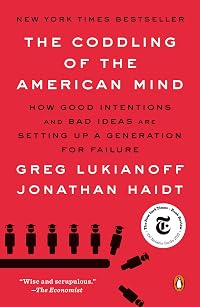
The Coddling of the American Mind: How Good Intentions and Bad Ideas Are Setting Up a Generation for Failure
by Greg Lukianoff, Jonathan Haidt
On This Page
Description
Education. Psychology. Sociology. Nonfiction. HTML:Something has been going wrong on many college campuses in the last few years. Speakers are shouted down. Students and professors say they are walking on eggshells and are afraid to speak honestly. Rates of anxiety, depression, and suicide are rising—on campus as well as nationally. How did this happen?First Amendment expert Greg Lukianoff and social psychologist Jonathan Haidt show how the new problems on campus have their origins in show more three terrible ideas that have become increasingly woven into American childhood and education: What doesn’t kill you makes you weaker; always trust your feelings; and life is a battle between good people and evil people. These three Great Untruths contradict basic psychological principles about well-being and ancient wisdom from many cultures. Embracing these untruths—and the resulting culture of safetyism—interferes with young people’s social, emotional, and intellectual development. It makes it harder for them to become autonomous adults who are able to navigate the bumpy road of life.
Lukianoff and Haidt investigate the many social trends that have intersected to promote the spread of these untruths. They explore changes in childhood such as the rise of fearful parenting, the decline of unsupervised, child-directed play, and the new world of social media that has engulfed teenagers in the last decade. They examine changes on campus, including the corporatization of universities and the emergence of new ideas about identity and justice. They situate the conflicts on campus within the context of America’s rapidly rising political polarization and dysfunction.
This is an audiobook for anyone who is confused by what is happening on college campuses today, or has children, or is concerned about the growing inability of Americans to live, work, and cooperate across party lines. show less
Tags
Recommendations

















Member Reviews
This book started out well. It deals with many of the changes occurring in our society, and especially on campus, as the latest generation grows up to expect an environment where they are never offended or have their beliefs challenged. The authors write well, and detail the problems with excellent insight. It's too bad that, in their discussion of the Great Untruths passed on by adults, that they perpetrate a great untruth themselves: the untruth that no one can hurt us unless we allow them to. A socially acceptable form of victim blaming, they repeat this in close to every chapter. In addition, they are wearing blinders or are somewhat naive. In discussing why young girls have a high suicide attempt rate, they miss the most obvious show more reason, one frequently stated by the young women: the crap that they get every day on social media sites they are afraid to depart for fear of losing all their social life. The level of misogyny and violent threats is barely noted in the book. In addition, they seem to think the best time in the US was the period from FDR to the early 1960s, and since then, things have become too focused on "identity". In short, the best thing of all is when white men rule unchallenged, women remain in the home with few economic, social, or political rights, and people of color are segregated. I suspect this isn't really what they meant from other things they say, but in the end, the message is loud and clear. Especially when they use a couple of Title IX examples to represent poor thinking, when they don't have any data to support their position, and there is a lot of data to support the opposite position - that women are being kept out of many areas of life by misogyny, not by lack of interest. It is a common thing I see in books on critical thinking; they will do a beautiful job until they come to one particular spot, and then it all falls apart. Overall, a worthwhile book, but with significant flaws. show less
Fantastic book which spans trends in parenting, politics, universities, and culture to analyze the forces that were at work for what some call “iGen”, kids born after 1995, as they grew up and then went to college. It also works as a guide to use Cognitive Behavioral Techniques for better mental health, and as a manifesto for free speech and the tolerance of others. I appreciated the book for its balance and careful rationality, at time when things are so polarized and skewed, and for how it avoids pointing fingers or making simplistic claims. I found great wisdom here, and it really made me think.
The books starts by describing three “Great Untruths” the authors believe are harming people and the country at large: (1) What show more doesn’t kill you makes you weaker, (2) Always trust your feelings, and (3) Life is a battle between good and evil people. It then looks at some disturbing behavior on college campuses like Berkeley, Evergreen State, and Reed College, as well as at Charlottesville. Lastly, it examines six confluent and interrelated forces that have emerged in recent times: political polarization, anxiety and depression, paranoid parenting, the decline of free play in children, college campus bureaucracy, and the quest for social justice.
Some of the more hair-raising passages were the description of events at universities, mostly those that are on the east or west coast and liberal. The authors describe various acts of censorship of ideas and a ‘call out’ culture that has many attributes of a mob, one that feeds off of the feeling of being offended and demanding speakers be disinvited, classes be shut down, articles be redacted, and professors be fired over the smallest of things, instead of keeping an open mind and engaging in debate. In one key insight into the behavior, the authors relate it to mental habits seen in people who suffer from anxiety and depression (which have risen dramatically in young people, girls particularly) – namely, exaggeration of danger and other cognitive distortions, and the suggestion solutions take a holistic approach. And, at the same time, they are careful to point out the benefits of pushing for social changes and the horrifying actions of the alt-right, including outright racism and violence.
Great stuff, very thought-provoking, and these quotes will give insight into other points the book makes:
On free speech:
“The notion that a university should protect all of its students from ideas that some of them find offensive is a repudiation of the legacy of Socrates, who described himself as the ‘gladfly’ of the Athenian people. He thought it was his job to sting, to disturb, to question, and thereby to provoke his fellow Athenians to think through their current beliefs, and change the ones they could not defend.”
On good and evil, from Alexander Solzhenitsyn, who after being sentenced to the gulags, reflected that he had nearly joined the NKVD (the forerunner of the KGB), and could just as easily have become the executioner, rather than the condemned man:
“If only it were so simple! If only there were evil people somewhere insidiously committing evil deeds, and it were necessary only to separate them from the rest of us and destroy them. But the line dividing good and evil cuts through the heart of every human being.”
On inclusion, and overcoming ‘us vs. them’ thinking, the words of Pauli Murray in 1945:
“I intend to destroy segregation by positive and embracing methods … When my brothers try to draw a circle to exclude me, I shall draw a larger circle to include them. Where they speak out for the privileges of a puny group, I shall shout for the rights of all mankind.”
On learning, from Chief Justice John Roberts, addressing his son’s middle-school graduating class in 2017:
“From time to time in the years to come, I hope you will be treated unfairly, so that you will come to know the value of justice. I hope that you will suffer betrayal because that will teach you the importance of loyalty. Sorry to say, but I hope you will get lonely from time to time so that you don’t take friends for granted. I wish you bad luck, again, from time to time so that you will be conscious of the role of chance in life and understand that your success is not completely deserved either. And when you lose, as you will from time to time, I hope every now and then, your opponent will gloat over your failure. It is a way for you to understand the importance of sportsmanship. I hope you’ll be ignored so you know the importance of listening to others, and I hope you will have just enough pain to learn compassion. Whether I wish these things or not, they’re going to happen. And whether you benefit from them or not will depend upon your ability to see the message in your misfortunes.”
On parenting, fostering strength in kids, referencing Nassim Nicholas Taleb’s book ‘The Black Swan’:
“Wind extinguishes a candle but energizes a fire. He advises us not to be like candles and not to turn our children into candles: ‘You want to be the fire and wish for the wind.’”
On polarization, from Julia Ebner’s, ‘The Rage: The Vicious Circle of Islamist and Far-Right Extremism’:
“What we have is the far right depicting Islamist extremists as representatives of the whole Muslim community, while Islamist extremists depict the far right as representatives of the entire West. As the extremes [pull more people from] the political center, these ideas become mainstream, and the result is a clash-of-civilizations narrative turning into a self-fulfilling prophecy.”
On safety, from Van Jones:
“There are two ideas about safe spaces: One is a very good idea and one is a terrible idea. The idea of being physically safe on a campus – not being subjected to sexual harassment and physical abuse, or being targeted, specifically, personally, for some kind of hate speech ‘ ‘you are the n-word,’ or whatever – I am perfectly fine with that. But there’s another view that is now I think ascendant, which I think is just a horrible view, which is that ‘I need to be safe ideologically. I need to be safe emotionally. I just need to feel good all the time, and if someone says something I don’t like, that’s a problem for everybody else, including the [university] administration.’ … I don’t want you to be safe ideologically. I don’t want you to be safe emotionally. I want you to be strong. That’s different. I’m not going to pave the jungle for you. Put on some boots, and learn how to deal with adversity. I’m not going to take all the weights out of the gym; that’s the whole point of the gym. This is the gym.”
On truth, and its importance, from Northwestern University professor Alice Dreger’s ‘Galileo’s Middle Finger’:
“Evidence really is an ethical issue, the most important ethical issue in a modern democracy. If you want justice, you must work for truth. And if you want to work for truth, you must do a little more than wish for justice.” show less
The books starts by describing three “Great Untruths” the authors believe are harming people and the country at large: (1) What show more doesn’t kill you makes you weaker, (2) Always trust your feelings, and (3) Life is a battle between good and evil people. It then looks at some disturbing behavior on college campuses like Berkeley, Evergreen State, and Reed College, as well as at Charlottesville. Lastly, it examines six confluent and interrelated forces that have emerged in recent times: political polarization, anxiety and depression, paranoid parenting, the decline of free play in children, college campus bureaucracy, and the quest for social justice.
Some of the more hair-raising passages were the description of events at universities, mostly those that are on the east or west coast and liberal. The authors describe various acts of censorship of ideas and a ‘call out’ culture that has many attributes of a mob, one that feeds off of the feeling of being offended and demanding speakers be disinvited, classes be shut down, articles be redacted, and professors be fired over the smallest of things, instead of keeping an open mind and engaging in debate. In one key insight into the behavior, the authors relate it to mental habits seen in people who suffer from anxiety and depression (which have risen dramatically in young people, girls particularly) – namely, exaggeration of danger and other cognitive distortions, and the suggestion solutions take a holistic approach. And, at the same time, they are careful to point out the benefits of pushing for social changes and the horrifying actions of the alt-right, including outright racism and violence.
Great stuff, very thought-provoking, and these quotes will give insight into other points the book makes:
On free speech:
“The notion that a university should protect all of its students from ideas that some of them find offensive is a repudiation of the legacy of Socrates, who described himself as the ‘gladfly’ of the Athenian people. He thought it was his job to sting, to disturb, to question, and thereby to provoke his fellow Athenians to think through their current beliefs, and change the ones they could not defend.”
On good and evil, from Alexander Solzhenitsyn, who after being sentenced to the gulags, reflected that he had nearly joined the NKVD (the forerunner of the KGB), and could just as easily have become the executioner, rather than the condemned man:
“If only it were so simple! If only there were evil people somewhere insidiously committing evil deeds, and it were necessary only to separate them from the rest of us and destroy them. But the line dividing good and evil cuts through the heart of every human being.”
On inclusion, and overcoming ‘us vs. them’ thinking, the words of Pauli Murray in 1945:
“I intend to destroy segregation by positive and embracing methods … When my brothers try to draw a circle to exclude me, I shall draw a larger circle to include them. Where they speak out for the privileges of a puny group, I shall shout for the rights of all mankind.”
On learning, from Chief Justice John Roberts, addressing his son’s middle-school graduating class in 2017:
“From time to time in the years to come, I hope you will be treated unfairly, so that you will come to know the value of justice. I hope that you will suffer betrayal because that will teach you the importance of loyalty. Sorry to say, but I hope you will get lonely from time to time so that you don’t take friends for granted. I wish you bad luck, again, from time to time so that you will be conscious of the role of chance in life and understand that your success is not completely deserved either. And when you lose, as you will from time to time, I hope every now and then, your opponent will gloat over your failure. It is a way for you to understand the importance of sportsmanship. I hope you’ll be ignored so you know the importance of listening to others, and I hope you will have just enough pain to learn compassion. Whether I wish these things or not, they’re going to happen. And whether you benefit from them or not will depend upon your ability to see the message in your misfortunes.”
On parenting, fostering strength in kids, referencing Nassim Nicholas Taleb’s book ‘The Black Swan’:
“Wind extinguishes a candle but energizes a fire. He advises us not to be like candles and not to turn our children into candles: ‘You want to be the fire and wish for the wind.’”
On polarization, from Julia Ebner’s, ‘The Rage: The Vicious Circle of Islamist and Far-Right Extremism’:
“What we have is the far right depicting Islamist extremists as representatives of the whole Muslim community, while Islamist extremists depict the far right as representatives of the entire West. As the extremes [pull more people from] the political center, these ideas become mainstream, and the result is a clash-of-civilizations narrative turning into a self-fulfilling prophecy.”
On safety, from Van Jones:
“There are two ideas about safe spaces: One is a very good idea and one is a terrible idea. The idea of being physically safe on a campus – not being subjected to sexual harassment and physical abuse, or being targeted, specifically, personally, for some kind of hate speech ‘ ‘you are the n-word,’ or whatever – I am perfectly fine with that. But there’s another view that is now I think ascendant, which I think is just a horrible view, which is that ‘I need to be safe ideologically. I need to be safe emotionally. I just need to feel good all the time, and if someone says something I don’t like, that’s a problem for everybody else, including the [university] administration.’ … I don’t want you to be safe ideologically. I don’t want you to be safe emotionally. I want you to be strong. That’s different. I’m not going to pave the jungle for you. Put on some boots, and learn how to deal with adversity. I’m not going to take all the weights out of the gym; that’s the whole point of the gym. This is the gym.”
On truth, and its importance, from Northwestern University professor Alice Dreger’s ‘Galileo’s Middle Finger’:
“Evidence really is an ethical issue, the most important ethical issue in a modern democracy. If you want justice, you must work for truth. And if you want to work for truth, you must do a little more than wish for justice.” show less
When picking up this book, I had the distinct impression that I MIGHT be getting into a polemical debate with some sort of bias beginning to scream at Lefts or Rights... but that's the funny thing.
This book argues AGAINST triggers. Against going with your knee-jerk reactions. Against Safetyism.
A culture of safety is NOT the same thing as providing a safe physical environment. It should be obvious, but often is not, that having seatbelts in cars is not the same thing as students shouting down speakers on campus, issuing rape and death threats for people speaking of ANYTHING that they don't agree with, or equating social justice with REAL justice.
Stopping the KKK and lynchings is Justice. Making a school administrator fear for their lives show more because they misused a pronoun, or turning the misuse of a specific pronoun into something as nasty as actual physical molestation IS NOT JUSTICE.
And yet, people everywhere (and I mean, EVERYWHERE) are getting more and more scared of doxing, public shaming, and anonymous trolling campaigns. It has become an accepted practice to turn anyone of a different ideology into targets of ridicule and slander until both sides have no idea what the hell is going on.
What is truth? What happened to the search for truth ANYWHERE?
They sum up the book in three main points.
1. We've forgotten the adage of "What doesn't kill you will make you stronger." If someone insults you, you ought to ADAPT. If someone betrays you, ADAPT. And yet, increasingly, we're all climbing into our safe ideological niches, surrounding ourselves with ONLY those things we think we can cope with, until nothing else remains except a narrow, narrow worldview.
Open up your minds. Broaden your horizons. You don't have to agree with everyone or even anyone, but the experience WILL enrich you.
2. Following your feelings is often really, really stupid. We have minds and we must always combat our own biases every single day. Remember when you fussed about a food when you were a kid and then you realized, later, that you loved it? If we always did what our feelings said, (especially for those of us who suffer from depression,) then our suicide rates might jump higher than the death rates of cancer. Oh, and let's not forget... following our feelings when surrounded by a bunch of other fearful and angry people has another term associated with it:
MOBS. And we all know that no one is as stupid as all of us together.
3. Oh, and we must always look for fault in others. We're never wrong. It's always someone else that has done this to us. This way of thinking could NEVER backfire, of course. Unfortunately, the first two points described above are exacerbating everyone's mental health issues. And let's face it... we have TONS. Rates of murder and violence and abductions are as low as they were in the 60's and yet everyone is growing up coddled and fearful and crazy. We've lost natural socialization, not only in the physical sense (scheduled playdates versus running around and getting into and out of trouble), but also in the amount of screentime we're ALL getting. Children are maturing much, much slower than at any other time and they're unable to cope with the real world. Hell, most of us are.
We all need to open up our minds to listen as if we're wrong even while we argue passionately as if we're right.
The point is... TRUTH is getting lost in mob mentality. We all need to wake up and get courageous and stand up for our beliefs while simultaneously RETAINING AN OPEN MIND.
Otherwise, unofficially, our vaunted love of free speech is now DEAD. show less
This book argues AGAINST triggers. Against going with your knee-jerk reactions. Against Safetyism.
A culture of safety is NOT the same thing as providing a safe physical environment. It should be obvious, but often is not, that having seatbelts in cars is not the same thing as students shouting down speakers on campus, issuing rape and death threats for people speaking of ANYTHING that they don't agree with, or equating social justice with REAL justice.
Stopping the KKK and lynchings is Justice. Making a school administrator fear for their lives show more because they misused a pronoun, or turning the misuse of a specific pronoun into something as nasty as actual physical molestation IS NOT JUSTICE.
And yet, people everywhere (and I mean, EVERYWHERE) are getting more and more scared of doxing, public shaming, and anonymous trolling campaigns. It has become an accepted practice to turn anyone of a different ideology into targets of ridicule and slander until both sides have no idea what the hell is going on.
What is truth? What happened to the search for truth ANYWHERE?
They sum up the book in three main points.
1. We've forgotten the adage of "What doesn't kill you will make you stronger." If someone insults you, you ought to ADAPT. If someone betrays you, ADAPT. And yet, increasingly, we're all climbing into our safe ideological niches, surrounding ourselves with ONLY those things we think we can cope with, until nothing else remains except a narrow, narrow worldview.
Open up your minds. Broaden your horizons. You don't have to agree with everyone or even anyone, but the experience WILL enrich you.
2. Following your feelings is often really, really stupid. We have minds and we must always combat our own biases every single day. Remember when you fussed about a food when you were a kid and then you realized, later, that you loved it? If we always did what our feelings said, (especially for those of us who suffer from depression,) then our suicide rates might jump higher than the death rates of cancer. Oh, and let's not forget... following our feelings when surrounded by a bunch of other fearful and angry people has another term associated with it:
MOBS. And we all know that no one is as stupid as all of us together.
3. Oh, and we must always look for fault in others. We're never wrong. It's always someone else that has done this to us. This way of thinking could NEVER backfire, of course. Unfortunately, the first two points described above are exacerbating everyone's mental health issues. And let's face it... we have TONS. Rates of murder and violence and abductions are as low as they were in the 60's and yet everyone is growing up coddled and fearful and crazy. We've lost natural socialization, not only in the physical sense (scheduled playdates versus running around and getting into and out of trouble), but also in the amount of screentime we're ALL getting. Children are maturing much, much slower than at any other time and they're unable to cope with the real world. Hell, most of us are.
We all need to open up our minds to listen as if we're wrong even while we argue passionately as if we're right.
The point is... TRUTH is getting lost in mob mentality. We all need to wake up and get courageous and stand up for our beliefs while simultaneously RETAINING AN OPEN MIND.
Otherwise, unofficially, our vaunted love of free speech is now DEAD. show less
Imagine that you want to start a fitness program to increase your strength and endurance and sign up at the local gym. Upon arrival, you notice that management has removed all of the weights, concerned that heavy weights can cause stress and injury. Instead, you are instructed to perform light body-weight exercises that you can already safely handle. As you go through the motions of exercise, progress is nonexistent and you’ll be entirely unprepared for any activities that might require greater strength and endurance.
Welcome to (some) modern universities, which engage in the intellectual equivalent of removing the weights from the gym by creating safe spaces, disinviting speakers, removing offensive material, and inhibiting free show more speech and inquiry that should be the staple of a college education. Attending a university with these policies to prepare for the challenges of the outside world is like training for a marathon in our weightless gym.
The analogy is apt because the human mind, like the musculoskeletal system, is antifragile. Whereas fragile systems break under pressure and resilient systems can withstand pressure without change, antifragile systems become stronger under pressure. If you want to enhance your physical strength, you have to lift progressively heavier weight; if you want to enhance your intellectual fortitude, you have to expose yourself to different and sometimes controversial or offensive ideas.
This is the topic Greg Lukianoff and Jonathan Haidt tackle in The Coddling of the American Mind. They frame the issue around the “three great untruths” that are promoted on some campuses across the US, which are creating an environment that not only blocks open inquiry and learning but that leads to polarization, emotional immaturity, fragility, violence, and mental illness.
The three untruths are 1) what doesn’t kill you makes you weaker, 2) always trust your feelings, and 3) life is a battle between good people and evil people. These three untruths, taken together, create a student body that is unreceptive to other viewpoints, dogmatic, easily offended, and self-righteous, eager to earn points within the group by calling out and ostracizing those with different views. The great untruths are damaging both socially and psychologically, and run counter to both the principles of cognitive behavioral therapy (used to treat anxiety and depression) and ancient wisdom regarding well-being and happiness.
The great untruths therefore lead to the types of mental habits that our best therapy aims to eradicate, such as catastrophizing, emotional reasoning, overgeneralizing, dichotomous thinking, labeling, blaming, and negative filtering. Universities are encouraging, in other words, the very habits that lead to anxiety and depression and emotional stunting.
The authors dive deeply into these issues in the first two parts of the book and then describe the historical, social, psychological, and political reasons why we find ourselves in this situation. The fourth and final part of the book offers solutions, which I would summarize as follows.
The problems on campus can ultimately be solved by focusing on developing the virtues of intellectual courage, humility, and emotional resilience in our children and students. First, intellectual humility forces one to recognize that humans are fallible and prone to bias and error, both individually and collectively. Since we are often blind to our own errors, the only possibility of correcting our misjudgments is through exposure to competing ideas. As the authors put it, exposure to someone that disagrees with you is a gift. They can either change your mind, thus correcting your errors and biases, or else strengthen your own beliefs in the process of defending them.
The second virtue, intellectual courage, is the habit of pursuing the truth wherever it may lead and embracing the values of free speech and open inquiry. It’s the recognition that you may be wrong, that you may not have all of the answers, and that the development of your intellect depends on defending your ideas against competing views rather than shutting them down through force or violence.
The third virtue, emotional resilience, is the habit of handling adversity appropriately and taking control of your own emotions and reactions. Words are not violence, and being offended does not count as a point or an argument. This reminds me of three quotes by Christopher Hitchens that captures the spirit:
— “If someone tells me that I've hurt their feelings, I say, 'I'm still waiting to hear what your point is.’”
— “In this country, I've been told, 'That's offensive' as if those two words constitute an argument or a comment.”
— “Those who are determined to be ‘offended’ will discover a provocation somewhere. We cannot possibly adjust enough to please the fanatics, and it is degrading to make the attempt.”
The best defense against false or immoral ideas is rigorous intellectual debate and criticism, and the censorship of ideas only makes those ideas more appealing to your opponents and to those who are never exposed to the proper criticisms. Shouting down a speaker is immature and intellectually and emotionally cowardly and has no place within a university. If you want to call yourself a liberal, you should have no problem winning the war of words with religious fundamentalists or racists without having to suppress their speech. Sticking with the Christopher Hitchens theme, can you imagine if, instead of engaging in dozens of debates with religious conservatives, he instead called for their speech to be suppressed? How much weaker and ineffective would his position have been?
As the authors point out, this is not happening at every university, and there is some debate as to whether or not this is as big of problem as it appears. In fact, it might not be; but it’s important to get out in front of the issue before it becomes a bigger problem. The authors cite some fairly egregious examples from a handful of universities, but also note that there are many exceptions. In particular, the University of Chicago remains a leader in free speech and inquiry and published the Chicago Statement on Principles of Free Expression, which every college student and parent should read. Over 40 institutions have adopted this policy, and hopefully more will follow suit. show less
Welcome to (some) modern universities, which engage in the intellectual equivalent of removing the weights from the gym by creating safe spaces, disinviting speakers, removing offensive material, and inhibiting free show more speech and inquiry that should be the staple of a college education. Attending a university with these policies to prepare for the challenges of the outside world is like training for a marathon in our weightless gym.
The analogy is apt because the human mind, like the musculoskeletal system, is antifragile. Whereas fragile systems break under pressure and resilient systems can withstand pressure without change, antifragile systems become stronger under pressure. If you want to enhance your physical strength, you have to lift progressively heavier weight; if you want to enhance your intellectual fortitude, you have to expose yourself to different and sometimes controversial or offensive ideas.
This is the topic Greg Lukianoff and Jonathan Haidt tackle in The Coddling of the American Mind. They frame the issue around the “three great untruths” that are promoted on some campuses across the US, which are creating an environment that not only blocks open inquiry and learning but that leads to polarization, emotional immaturity, fragility, violence, and mental illness.
The three untruths are 1) what doesn’t kill you makes you weaker, 2) always trust your feelings, and 3) life is a battle between good people and evil people. These three untruths, taken together, create a student body that is unreceptive to other viewpoints, dogmatic, easily offended, and self-righteous, eager to earn points within the group by calling out and ostracizing those with different views. The great untruths are damaging both socially and psychologically, and run counter to both the principles of cognitive behavioral therapy (used to treat anxiety and depression) and ancient wisdom regarding well-being and happiness.
The great untruths therefore lead to the types of mental habits that our best therapy aims to eradicate, such as catastrophizing, emotional reasoning, overgeneralizing, dichotomous thinking, labeling, blaming, and negative filtering. Universities are encouraging, in other words, the very habits that lead to anxiety and depression and emotional stunting.
The authors dive deeply into these issues in the first two parts of the book and then describe the historical, social, psychological, and political reasons why we find ourselves in this situation. The fourth and final part of the book offers solutions, which I would summarize as follows.
The problems on campus can ultimately be solved by focusing on developing the virtues of intellectual courage, humility, and emotional resilience in our children and students. First, intellectual humility forces one to recognize that humans are fallible and prone to bias and error, both individually and collectively. Since we are often blind to our own errors, the only possibility of correcting our misjudgments is through exposure to competing ideas. As the authors put it, exposure to someone that disagrees with you is a gift. They can either change your mind, thus correcting your errors and biases, or else strengthen your own beliefs in the process of defending them.
The second virtue, intellectual courage, is the habit of pursuing the truth wherever it may lead and embracing the values of free speech and open inquiry. It’s the recognition that you may be wrong, that you may not have all of the answers, and that the development of your intellect depends on defending your ideas against competing views rather than shutting them down through force or violence.
The third virtue, emotional resilience, is the habit of handling adversity appropriately and taking control of your own emotions and reactions. Words are not violence, and being offended does not count as a point or an argument. This reminds me of three quotes by Christopher Hitchens that captures the spirit:
— “If someone tells me that I've hurt their feelings, I say, 'I'm still waiting to hear what your point is.’”
— “In this country, I've been told, 'That's offensive' as if those two words constitute an argument or a comment.”
— “Those who are determined to be ‘offended’ will discover a provocation somewhere. We cannot possibly adjust enough to please the fanatics, and it is degrading to make the attempt.”
The best defense against false or immoral ideas is rigorous intellectual debate and criticism, and the censorship of ideas only makes those ideas more appealing to your opponents and to those who are never exposed to the proper criticisms. Shouting down a speaker is immature and intellectually and emotionally cowardly and has no place within a university. If you want to call yourself a liberal, you should have no problem winning the war of words with religious fundamentalists or racists without having to suppress their speech. Sticking with the Christopher Hitchens theme, can you imagine if, instead of engaging in dozens of debates with religious conservatives, he instead called for their speech to be suppressed? How much weaker and ineffective would his position have been?
As the authors point out, this is not happening at every university, and there is some debate as to whether or not this is as big of problem as it appears. In fact, it might not be; but it’s important to get out in front of the issue before it becomes a bigger problem. The authors cite some fairly egregious examples from a handful of universities, but also note that there are many exceptions. In particular, the University of Chicago remains a leader in free speech and inquiry and published the Chicago Statement on Principles of Free Expression, which every college student and parent should read. Over 40 institutions have adopted this policy, and hopefully more will follow suit. show less
A safe book with good arguments
The main arguments definitely provide some clarity and understanding of the PC/virtue signaling/SJW culture that is being embodied by the left especially on many college campuses. The authors do a good job of diving deep into specific instances to show motivations and another side of the story. Unfortunately, this is bogged down by their one sided political view of events in the US. They seem to be quite sympathetic to those actually promoting and causing violence and spend a lot of time explaining their actions, sometimes seeming to blame the victims but put no effort into doing the same for the other side. They conveniently leave specific facts out or unaddressed (Trump, Charlottesville) and include show more incorrect facts as supporting arguments (McCarthyism). However, this all aligns with the common narrative and does not seem to detract from the primary arguments of the book. That is what makes this book safe, in the sense that the authors use the word throughout. It goes right along with most of the current beliefs of the people they are discussing many of which are very divisive while suggesting that people stop being so divisive. show less
The main arguments definitely provide some clarity and understanding of the PC/virtue signaling/SJW culture that is being embodied by the left especially on many college campuses. The authors do a good job of diving deep into specific instances to show motivations and another side of the story. Unfortunately, this is bogged down by their one sided political view of events in the US. They seem to be quite sympathetic to those actually promoting and causing violence and spend a lot of time explaining their actions, sometimes seeming to blame the victims but put no effort into doing the same for the other side. They conveniently leave specific facts out or unaddressed (Trump, Charlottesville) and include show more incorrect facts as supporting arguments (McCarthyism). However, this all aligns with the common narrative and does not seem to detract from the primary arguments of the book. That is what makes this book safe, in the sense that the authors use the word throughout. It goes right along with most of the current beliefs of the people they are discussing many of which are very divisive while suggesting that people stop being so divisive. show less
This book does not disappoint a long-time Haidt fan. His arguments continue to be exquisitely measured and explained to appeal to any reasonable person willing to listen. He does not suffer for collaborating with co-author Lukianoff, either, who seems to have the same style.
The title makes it sound like it is going to be a conservative or curmudgeonly rant - "coddle" is such a smug and "when I was your age" kind of verb. But you can trust Haidt. He's very sympathetic, for example, to what even the most strident and intolerant protesters may be trying to achieve; he's just pointing out, clearly and convincingly in my opinion, how they are harming their cause more than helping. That is one major area covered in the book - college protest; show more and although I was familiar with many of the cases described here, such as Charles Murray's appearance in Middlebury in my home state of Vermont, I had no idea of the extent of some of the other things going on in the rest of the country, like the truly anarchic takeover of Evergreen College in Washington state. Again, don't think this is just some conservative outrage-generating listing of cases where those liberal students went too far in their political correctness. There are some eyebrow-raising incidents described here, but the authors aren't out simply to raise ire about them; but to explain where they feel things went wrong.
Another subject covered in the book is the overprotectiveness of parents in our modern culture, and effects of excessive screen time on kids; they authors see these as roots of the excessive fragility of the younger generation of today's adults.
The authors hold up cognitive behavioral therapy (CBT) as a proven successful method of dealing with depression and anxiety, and use its tenets as models of how we SHOULD be raising children and encouraging young people to deal effectively with their feelings of fragility.
Major fault: I don't understand why they felt they had to end every chapter with a summary - and then end the book with an overall summary, as well! For Pete's sake, have a little faith that I know what I just read.
The only other fault was really just a personal disappointment that there was a lot in it about raising children, and the rest was almost all about college students - I guess if I had read the description I would have been more prepared; but I selfishly wanted more things to apply to my own life. show less
The title makes it sound like it is going to be a conservative or curmudgeonly rant - "coddle" is such a smug and "when I was your age" kind of verb. But you can trust Haidt. He's very sympathetic, for example, to what even the most strident and intolerant protesters may be trying to achieve; he's just pointing out, clearly and convincingly in my opinion, how they are harming their cause more than helping. That is one major area covered in the book - college protest; show more and although I was familiar with many of the cases described here, such as Charles Murray's appearance in Middlebury in my home state of Vermont, I had no idea of the extent of some of the other things going on in the rest of the country, like the truly anarchic takeover of Evergreen College in Washington state. Again, don't think this is just some conservative outrage-generating listing of cases where those liberal students went too far in their political correctness. There are some eyebrow-raising incidents described here, but the authors aren't out simply to raise ire about them; but to explain where they feel things went wrong.
Another subject covered in the book is the overprotectiveness of parents in our modern culture, and effects of excessive screen time on kids; they authors see these as roots of the excessive fragility of the younger generation of today's adults.
The authors hold up cognitive behavioral therapy (CBT) as a proven successful method of dealing with depression and anxiety, and use its tenets as models of how we SHOULD be raising children and encouraging young people to deal effectively with their feelings of fragility.
Major fault: I don't understand why they felt they had to end every chapter with a summary - and then end the book with an overall summary, as well! For Pete's sake, have a little faith that I know what I just read.
The only other fault was really just a personal disappointment that there was a lot in it about raising children, and the rest was almost all about college students - I guess if I had read the description I would have been more prepared; but I selfishly wanted more things to apply to my own life. show less
You can tell a book resonated and provoked thought when you find youself repeatedly introducing the ideas into your discussions with others. Coddled has created such an experience for me, more so than any book I’ve read in a while. It has important points about how parenting has changed and how are world has become polarized in multiple ways. Most importantly, this book highlights the dangerous trend in which universities are abandoning their commitment to open discourse in reaction to the current generation of student’s demands for “safety.” Coddled is a book about what happens when the clash of ideas gets perceived as danger instead of dialogue. The authors follow their assessment with proactive ideas that could help. I found show more this book informative and useful. I’d recommend it to anyone concerned about liberty, education, politics, or parenting. show less
Members
- Recently Added By
Lists

Fake Top 100 Nonfiction
79 works; 3 members

Books Read in 2020
4,379 works; 124 members

If Books Could Kill Podcast
52 works; 1 member

Maybe This Year? Books to Look Forward To
414 works; 9 members

storage
51 works; 1 member
Author Information

8 Works 2,515 Members
Greg Lukianoff is an attorney and president of the Foundation for Individual Rights in Education. His writings on campus free speech have appeared in the Wall Street Journal, the New York Times, and the Washington Post, in addition to dozens of other publications. A regular columnist for the Huffington Post, he is a frequent guest on nationally show more syndicated radio programs and has made numerous television appearances, including on the CBS Evening News and Stossel. He received the 2008 Playboy Foundation Freedom of Expression Award and the 2010 Ford Hall Forum's Louis P. and Evelyn Smith First Amendment Award on behalf of FIRE. Lukianoff is a graduate of American University and Stanford Law School. show less

14+ Works 11,321 Members
Awards and Honors
Awards
Distinctions
Work Relationships
Is abridged in
Common Knowledge
- Original publication date
- 2018
- Epigraph
- Prepare the child for the road, not the road for the child.
- FOLK WISDOM, origin unknown
Your worst enemy cannot harm you as much as your own thoughts, unguarded. But once mastered, no one can help you as mu... (show all)ch, not even your father or your mother.
- BUDDHA, Dhammapada
The line dividing good and evil cuts through the heart of every human being.
- ALEKSANDR SOLZHENITSYN, The Gulag Archipelago - Dedication
- For our mothers, who did their best to prepare us for the road.
- First words
- This is a book about wisdom and its opposite. The book grows out of a trip that we (Greg and Jon) took to Greece in August of 2016. We had been writing about some ideas spreading through universities that we thought were harm... (show all)ing students and damaging their prospects for creating fulfilling lives. These ideas were, in essence, making students less wise. -Introduction, The Search for Wisdom
In August 2009, Max Haidt, age three, had his first day of preschool in Charlottesville, Virginia. But before he was allowed to take the first step on his eighteen-year journey to a college degree, his parents, Jon and Jayne,... (show all) had to attend a mandatory orientation session where the rules and procedures were explained by Max's teacher. The most important rule, judging by the time spent discussing it, was: no nuts. -Chapter 1, The Untruth of Fragility: What Doesn't Kill You Makes You Weaker - Quotations
- . . . a Great Untruth, which we laid out in the introductory chapter: it contradicts ancient wisdom, it contradicts modern psychological research on flourishing, and it harms the individuals and communities that embrace it.
- Last words
- (Click to show. Warning: May contain spoilers.)This is a book about education and wisdom. If we can educate the next generation more wisely, they will be stronger, richer, more virtuous, and even safer.
- Canonical DDC/MDS
- 306.20973
- Canonical LCC
- JC599.U5
Classifications
- Genres
- Sociology, General Nonfiction, Nonfiction
- DDC/MDS
- 306.20973 — Society, government, & culture Social sciences, sociology & anthropology Social Behavior - Dating, Marriage, Divorce Political institutions Biography And History Political sociology--United States
- LCC
- JC599 .U5 — Political Science Political theory Political theory. The state. Theories of the state Purpose, functions, and relations of the state
- BISAC
Statistics
- Members
- 2,091
- Popularity
- 9,940
- Reviews
- 43
- Rating
- (4.10)
- Languages
- 5 — Chinese, Dutch, English, Polish, Spanish
- Media
- Paper, Audiobook, Ebook
- ISBNs
- 18
- ASINs
- 6