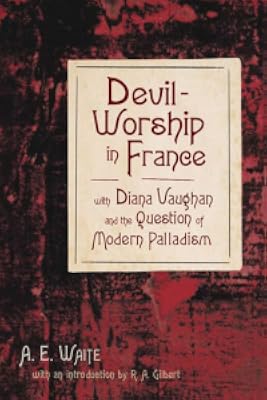
Devil-Worship in France With Diana Vaughan and the Question of Modern Palladism
by Arthur Edward Waite
On This Page
Description
A.E. Waite's Devil-Worship in France, rather than being an infernal how-to book or even a history of what the title purports, is in fact an examination of a most sensational hoax perpetrated by Parisian journalist, Leo Taxil. Taxil and fictitious associate, Diana Vaughan, created a scandal in the late 1800s by reporting on a most heinous occult sect, the "Palladian Masons," that admitted women and performed diabolic acts of "Luciferian Spiritism." Taxil's "revelation" of this secret society show more and its supposed links to Freemasonry and other occult organizations, created a public hysteria and outcry against all things occult, especially secret societies. A.E. Waite's response, Devil-Worship in France, is his satirical and somewhat farcical interpretation of this sensationalization and persecution of occult groups in France at that time. This work, along with similar refutations by French occultist Papus, raised questions Taxil could not answer, and he was forced to admit that the reports were a hoax meant to ridicule both the Catholic Church and Freemasonry. This republication of Devil-Worship in France is the first reprint of the book in nearly one hundred years. A.E. Waite then wrote Diana Vaughan and the Question of Modern Palladism, the sequel to Devil-Worship in France, where he reexamined and re-presented the telling of the hoax in a straightforward manner- without the satire and farce. Published for the first time, here, finally, is the whole story behind the hoax that slandered occult communities throughout Europe in the late 1800s. R.A. Gilbert's introduction places the book in historical and contemporary context. show lessTags
Recommendations


















Member Recommendations
paradoxosalpha Initiated debunking of anti-masonic propaganda.
Member Reviews
Arthur Edward Waite wrote Devil-Worship in France in 1896, before Gabriel Jogand ("Leo Taxil") exposed the great hoax he and his confederates had perpetrated regarding a supposed Luciferian Palladian Order at the heart of global Freemasonry. Although Waite gets a few details wrong, he was correct in casting the most thorough suspicion on this particular constellation of anti-Masonic literature. He was not the first to do so; the noted esotericist and Theosophist C.C. Massey had already voiced his objections. But Waite's criticisms were more substantial and extensive, and received more attention than Massey's had.
The micro-genre of Palladian conspiracy literature produced under the bylines of Leo Taxil, Dr. Bataille, and Diana Vaughan show more enjoyed a considerable vogue in late 19th-century France. Its popularity among the credulous invites comparison with Dan Brown's Da Vinci Code and its concomitant cottage industry in the early 21st century--although the valence was exactly the opposite as far as the Roman Catholic Church was concerned. (That is to say, that church's fond welcome for the anti-Masonic revelations of Taxil matched in scope its offended distaste for The Da Vinci Code.) The fact that Brown's novel is an overt fiction--albeit bearing an appeal to some alleged underlying facts--does not skew the parallel. Much of the material about Palladian Freemasonry was published in the Penny Dreadful periodical format associated more with Victorian Gothic than sober journalism.
Designed as it was for a French Catholic readership, the Taxil material also vilified the English, and in passing, Americans. Waite observes this trend throughout, but reserves special outrage for Dr. Bataille's slander against HRH the Queen! (172-3) Waite's knowledge of the US is a bit limited, though. For instance, he refers to Scottish Rite organizer Albert Pike's role in "[t]he admission of Arkansas into the confederation of the United States," which while strictly accurate, is likely to sound a muddled note for American readers. (28)
Although Waite is notorious for his plodding and convoluted prose, Devil-Worship in France is a comparatively lively exercise, perhaps because it was a matter of such great currency when he wrote it. In several cases, he references personal statements from his own associates and acquaintances, such as W. Wynn Westcott and John Yarker. And I am certain that I detected deliberate, though bone-dry, wit at various points in the book. The several chapters dedicated to summarizing Bataille's Le Diable au XIXe Siecle are quite entertaining. Having cast sufficient doubts on the tales of the Palladium, Waite concludes Devil-Worship in France with an encomium regarding the virtues of Freemasonry, and its points of functional intersection with mysticism.
The 2003 Red Wheel/Weiser reissue of Waite's book appends his previously-unpublished sequel, Diana Vaughan and the Question of Modern Palladism. Much shorter than the first work, it merely supplies updates after feuding among the fabulists and Jogand's public admission of the hoax. Waite takes the opportunity to correct a few incidental errors from Devil-Worship. In particular he admits that Pike did plagiarize considerably from Eliphas Levi, but he also praises a specific text in which Pike did so: the lecture for the 32° in Morals and Dogma.
The Palladian episode is not only a cautionary tale regarding an anti-Masonic scare; this very thorough treatment of it has much to hold the attention of anyone interested in the esotericism of the period. The Taxil collaborator "Jean Kostka" was in fact Jules Doinel, founding patriarch of the French Gnostic Church from which today's Gnostic Catholic Church (E.G.C.) descends. He comes off fairly pitiably in Waite's account, and it is hard to see him as a hero during the early 1890s. Even more importantly, much of the outrage intended to be stoked by the stories of the Palladium had to do with its initiation of women into a secret society. Waite, concurring with Pike, indicates that women are excluded from Masonry, but doubts whether they should be. Of course, the Hermetic Order of the Golden Dawn was initiating men and women on equal terms at the time, the Grand Loge Symbolique Eccosais Mixte which was to eventuate in Theosophical Co-Masonry had been founded in 1893, and a short decade after Diana Vaughan O.T.O. would apply Masonic techniques of initiation to women as well as men.
And as a final enticement to those who might benefit from reading this book, I quote from page eighty-four: "Who would possess a lingam which was an Open Sesame to devildom and not make use thereof?" show less
The micro-genre of Palladian conspiracy literature produced under the bylines of Leo Taxil, Dr. Bataille, and Diana Vaughan show more enjoyed a considerable vogue in late 19th-century France. Its popularity among the credulous invites comparison with Dan Brown's Da Vinci Code and its concomitant cottage industry in the early 21st century--although the valence was exactly the opposite as far as the Roman Catholic Church was concerned. (That is to say, that church's fond welcome for the anti-Masonic revelations of Taxil matched in scope its offended distaste for The Da Vinci Code.) The fact that Brown's novel is an overt fiction--albeit bearing an appeal to some alleged underlying facts--does not skew the parallel. Much of the material about Palladian Freemasonry was published in the Penny Dreadful periodical format associated more with Victorian Gothic than sober journalism.
Designed as it was for a French Catholic readership, the Taxil material also vilified the English, and in passing, Americans. Waite observes this trend throughout, but reserves special outrage for Dr. Bataille's slander against HRH the Queen! (172-3) Waite's knowledge of the US is a bit limited, though. For instance, he refers to Scottish Rite organizer Albert Pike's role in "[t]he admission of Arkansas into the confederation of the United States," which while strictly accurate, is likely to sound a muddled note for American readers. (28)
Although Waite is notorious for his plodding and convoluted prose, Devil-Worship in France is a comparatively lively exercise, perhaps because it was a matter of such great currency when he wrote it. In several cases, he references personal statements from his own associates and acquaintances, such as W. Wynn Westcott and John Yarker. And I am certain that I detected deliberate, though bone-dry, wit at various points in the book. The several chapters dedicated to summarizing Bataille's Le Diable au XIXe Siecle are quite entertaining. Having cast sufficient doubts on the tales of the Palladium, Waite concludes Devil-Worship in France with an encomium regarding the virtues of Freemasonry, and its points of functional intersection with mysticism.
The 2003 Red Wheel/Weiser reissue of Waite's book appends his previously-unpublished sequel, Diana Vaughan and the Question of Modern Palladism. Much shorter than the first work, it merely supplies updates after feuding among the fabulists and Jogand's public admission of the hoax. Waite takes the opportunity to correct a few incidental errors from Devil-Worship. In particular he admits that Pike did plagiarize considerably from Eliphas Levi, but he also praises a specific text in which Pike did so: the lecture for the 32° in Morals and Dogma.
The Palladian episode is not only a cautionary tale regarding an anti-Masonic scare; this very thorough treatment of it has much to hold the attention of anyone interested in the esotericism of the period. The Taxil collaborator "Jean Kostka" was in fact Jules Doinel, founding patriarch of the French Gnostic Church from which today's Gnostic Catholic Church (E.G.C.) descends. He comes off fairly pitiably in Waite's account, and it is hard to see him as a hero during the early 1890s. Even more importantly, much of the outrage intended to be stoked by the stories of the Palladium had to do with its initiation of women into a secret society. Waite, concurring with Pike, indicates that women are excluded from Masonry, but doubts whether they should be. Of course, the Hermetic Order of the Golden Dawn was initiating men and women on equal terms at the time, the Grand Loge Symbolique Eccosais Mixte which was to eventuate in Theosophical Co-Masonry had been founded in 1893, and a short decade after Diana Vaughan O.T.O. would apply Masonic techniques of initiation to women as well as men.
And as a final enticement to those who might benefit from reading this book, I quote from page eighty-four: "Who would possess a lingam which was an Open Sesame to devildom and not make use thereof?" show less
Ratings
Members
- Recently Added By
Lists

Best Books Involving Satan
63 works; 26 members
Author Information

213+ Works 5,630 Members
Arthur Edward Waite was born on October 2, 1857 in Brooklyn, New York. He was a poet and scholarly mystic who wrote extensively on occult and esoteric matters, and was the co-creator of the Rider-Waite Tarot deck. Waite joined the Outer Order of the Hermetic Order of the Golden Dawn in January 1891 after being introduced by E.W. Berridge. In 1899 show more he entered the Second order of the Golden Dawn. He became a Freemason in 1901, and entered the Societas Rosicruciana in Anglia in 1902. In 1903 Waite founded the Independent and Rectified Order R. R. et A. C. Waite was a prolific author and many of his works were well received in academic circles. He wrote occult texts on subjects including divination, esotericism, Rosicrucianism, Freemasonry, and ceremonial magic, Kabbalism and alchemy; he also translated and reissued several important mystical and alchemical works. His works on the Holy Grail, influenced by his friendship with Arthur Machen, were particularly notable. A number of his volumes remain in print, including The Book of Ceremonial Magic (1911), The Holy Kabbalah (1929), A New Encyclopedia of Freemasonry (1921), and his edited translation of Eliphas Levi's 1896 Transcendental Magic, its Doctrine and Ritual (1910), having seen reprints in recent years. Waite also wrote two allegorical fantasy novels, Prince Starbeam (1889) and The Quest of the Golden Stairs (1893). (Bowker Author Biography) show less
Common Knowledge
- Original publication date
- 1896
- People/Characters
- Leo Taxil; Dr. Bataille; W. Wynn Westcott; John Yarker; Jean Kostka; Diana Vaughan (show all 7); Albert Pike
- Important events
- Taxil Hoax
Classifications
- Genres
- Nonfiction, Religion & Spirituality, History
- DDC/MDS
- 133.4220944 — Philosophy & psychology Parapsychology & occultism Specific topics in parapsychology and occultism Demonology and witchcraft Demonology Satanism (Devil worship)
- LCC
- BF1548 .W2 — Philosophy, Psychology and Religion Psychology Occult sciences Demonology. Satanism. Possession
- BISAC
Statistics
- Members
- 41
- Popularity
- 716,632
- Reviews
- 1
- Rating
- (4.00)
- Languages
- English
- Media
- Paper, Ebook
- ISBNs
- 2
- UPCs
- 1