On This Page
Description
Set in an African village, this follow-up to the Man Booker Prize-winning novel is "sometimes whimsical, sometimes bawdy . . . Fraught with wild visions" (The Times). "All is not well in the African village where Azaro lives. The child narrator of poet and novelist Okri's The Famished Road, who had outwitted death in the previous book, again relates the oppressive events that continue to plague his village and his family. While political factionalization shatters the community's show more cohesiveness, the prodigious bar owner Madame Koto, chief exponent of the 'Party of the Rich,' alternately exudes portentous metaphysical malaise and miraculous erotic force. Little Azaro, himself touched and distracted by a series of animuses, follows the heels of 'dad,' who is a resounding vessel, by turns, of cantankerous egotism and abased self-sacrifice. This Nigerian epic reveals a violent provincial world, opaque with magical spirits which place horrendous ethical demands on fragile and fickle humanity, as if to test each individual for a thread of virtuous constancy at the core. Events drench the essentially linear narrative with all the ruthless sensuousness of a tropical storm, and Okri's prose is lucid and deft." --Publishers Weekly "Okri conjures up the fabulous with the same ease as he affectingly details the ways of the human spirit in a lovingly evoked African setting teeming with life--both real and mythic . . . Stunning." --Kirkus Reviews "Once again we're bedazzled and bedeviled by Okri's phantasmagoric prose and the strange and wondrous sensibility of Azaro, a spirit-child living in a poor African village." --Booklist "Both a love story and an account of the political turmoil between the parties of Rich and Poor." --The Independent "Passages of extraordinary beauty . . . Okri paints a convincing surrealist picture." --The Sunday Times show lessTags
Recommendations









Member Reviews
A sequel to Famished Road, Azaro the spirit child draws us into darker and more terrifying visions as Nigeria is torn apart by fear and violence, war, poverty and political corruption. The evil Masquerade towers in our nightmares and the blend of African story telling, the glimpses into the Yoruba spirit world. the myths, the metaphors, the poetry are both disturbing and mesmerising. And yet it is not without all hope, Azaro's Dad chooses the right act in burying the carpenter and the blindness that afflicted him and the community is lifted. Whilst this returns him to the harsh realities of his life and much is lost, it also reveals that it is possible to choose, to escape from passivity and fatalism, that in life there are many show more possibilities, "there could be more astonishing lives beyond the mirror" (p.288). The main message of the book perhaps is that things are never what they seem. The dedication to his father refers to Virgil's beatitude; "Blessed are those who know the causes of things" and this book reveals the hearts and souls of men and women, of the choices they make, the dreams they cling to and the fears they face, and how history is made from those choices, reactions and dreams. The dream world Okri creates takes you on a journey that lingers long in the mind afer the book itself is read. For Okri himself on his writing, listen to: http://www.youtube.com/watch?v=orNNO90R-JI show less
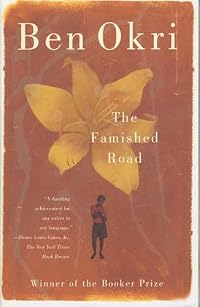
I first encountered Ben Okri in a post-colonial fiction class in grad school – oh how I miss those days of nothing but reading, writing, and discussing great literature! We read The Famished Road, which won the Booker Prize in 1991. I really loved that book of magic spirit children and an interesting West African culture. Road currently sits on my list of books read long ago and due for a re-read.
Songs of Enchantment also has the magic of spirit children, -- and many of the same characters from The Famished Road -- but this novel goes way over the top. It reads like magic realism on steroids. Virtually the entire novel has visions, dreams, spirits, and all sorts of supernatural doings.
Reading Okri’s work requires getting accustomed show more to the style, but it does take on a lyrical flow. Unfortunately, the symbolism, cultural references, and allegorical elements of Nigerian history eluded me. This book needs to be read in a group setting – a graduate school class, for example – or with a dictionary of West African mythology.
Songs tells the story of Azara, a spirit-child, and his family in a Nigerian village. This example of a passage represents the style of almost the entire novel. Azara and his father have walked into the forest. The child’s father comments, “The forest is dreaming” (24), and they decide to go home. Suddenly they find themselves beset by strange sounds.
“We ran into a quivering universe, into resplendent and secret worlds. We ran through an abode of spirits, through the disconsolate forms of mesmeric dreams of hidden gods, through a sepia fog thick with hybrid beings, through the yellow village of invisible crows, past susurrant marketplaces of the unborn, and into the sprawling ghomind-infested alabaster landscapes of the recently dead. We kept pushing on through the inscrutable resistance of the moon-scented air, trying to find the road back into our familiar reality. But the road eluded us and we troubled the invisible forms of great trees with our breathing, and the spirits of extinct animals with our fear. Our heads pulsated with an infernal violet heat” (25).
I think I might do some research and give this one another try, but right now, only the poetic language and the flow save it. 3 stars
--Jim, 8/27/10 show less
Songs of Enchantment also has the magic of spirit children, -- and many of the same characters from The Famished Road -- but this novel goes way over the top. It reads like magic realism on steroids. Virtually the entire novel has visions, dreams, spirits, and all sorts of supernatural doings.
Reading Okri’s work requires getting accustomed show more to the style, but it does take on a lyrical flow. Unfortunately, the symbolism, cultural references, and allegorical elements of Nigerian history eluded me. This book needs to be read in a group setting – a graduate school class, for example – or with a dictionary of West African mythology.
Songs tells the story of Azara, a spirit-child, and his family in a Nigerian village. This example of a passage represents the style of almost the entire novel. Azara and his father have walked into the forest. The child’s father comments, “The forest is dreaming” (24), and they decide to go home. Suddenly they find themselves beset by strange sounds.
“We ran into a quivering universe, into resplendent and secret worlds. We ran through an abode of spirits, through the disconsolate forms of mesmeric dreams of hidden gods, through a sepia fog thick with hybrid beings, through the yellow village of invisible crows, past susurrant marketplaces of the unborn, and into the sprawling ghomind-infested alabaster landscapes of the recently dead. We kept pushing on through the inscrutable resistance of the moon-scented air, trying to find the road back into our familiar reality. But the road eluded us and we troubled the invisible forms of great trees with our breathing, and the spirits of extinct animals with our fear. Our heads pulsated with an infernal violet heat” (25).
I think I might do some research and give this one another try, but right now, only the poetic language and the flow save it. 3 stars
--Jim, 8/27/10 show less
I was astounded by The Famished Road when I first read it, and proceeded to collect as many of Okri's other works as possible. Although Songs maintains the poetic language and imagery of the Famished Road, there is virtually no plot or message. It's a giant acid trip of a novel - great images, no substance.
Read way back in college in a Sandy Feinstein class, in a unit on ethnic cleansing in Africa. Flipping through it, I was vaguely horrified to discover that I read it during a phase when I underlined in books. On the other hand, it let me quickly find some excerpts that I'd found the most moving...
Onirique. L'auteur est anglo-nigerien.Il faut que je m'y remette, je n'ai pas réussi au premier coup, mais il y a quelque chose, là.
Ratings
Members
- Recently Added By
Author Information

51+ Works 5,202 Members
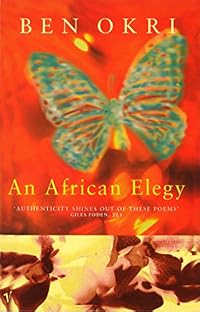
Ben Okri, 1959 - Nigerian novelist, Ben Okri was born in Minna. After his birth, his family moved to England so his father could study law. At the age of seven, his family returned to Nigeria and his father practiced in Lagos. His childhood was influenced by the Nigerian civil war. He was constantly being withdrawn from schools so most of his show more education was at home. After failing to be placed in a university, Okri began writing articles on social and political issues. Most of them were not published, but he began writing short stories based on these articles and they began finding their way into women's journals and evening papers. In 1978, he moved back to England where he studied comparative literature at Essex University but was forced to leave without a degree because of a lack of funds. He was a poetry editor of West Africa and worked also for the BBC. At nineteen, he finished his first novel "Flowers and Shadows" and it was published in 1980. The story attacked corruption in newly independent Nigeria and tells of a successful businessman whose jealous relatives make his life difficult. Okri's second novel, "The Landscapes Within" (1981), traces the adventures of a young, poor painter in Lagos. This novel was followed by two collections of short stories, "Incidents at the Shrine" (1986), and "Starts of the New Curfew" (1988). Several of the stories tell of the Biafran War from a child's eyes. The novel "The Famished Road" (1991) tells the story of a character who must choose between the pain of mortality and the land of the spirits. Okri's next novel, "Songs of Enchantment" (1993), continued with the mythical and poetical view of the world. "An African Elegy" (1992), is a collection of poems with classical themes. Okri has won several awards, which include the Booker Prize (1991), the Commonwealth Writers' Prize for Africa (1987), the Paris Review Aga Khan prize for fiction, the Chianti Rufino-Antico Fattore International Literary Prize, and the Premio Grinzane Cavour. (Bowker Author Biography) show less
Some Editions
Series

Common Knowledge
- Canonical title*
- Toverzangen
- Original title
- Songs of Enchantment
- Alternate titles*
- Toverzangen : roman
- Original publication date
- 1993
- People/Characters*
- Azaro
- Important places*
- Nigeria, Afrika
- Dedication*
- Voor Silver Okri
'felix, qui potuit rerum cognoscere causas'
Vergilius, Georgica, Zang 11, 490 - First words*
- De zeven bergen in de verte zagen we niet. We zagen niet dat ze daar lagen, altijd in het verschiet, als een roep, een altijd durende herinnering aan alles wat er nog meer te doen staat, dromen om te verwezenlijken, vreugden ... (show all)om opnieuw te ontdekken, beloften van voor de geboorte die gestand moeten worden gedaan, de schoonheid die wil incarneren, de liefde die wil worden belichaamd.
- Last words*
- (Click to show. Warning: May contain spoilers.)Misschien zien we op een dag de bergen in de verte. Misschien zien we op een dag de zeven bergen van onze geheimzinnige lotsbestemming. Zien we op een dag dat er voorbij onze chaos altijd nieuw zonlicht is en sereniteit.
- Original language*
- Engels
*Some information comes from Common Knowledge in other languages. Click "Edit" for more information.
Classifications
Statistics
- Members
- 319
- Popularity
- 99,525
- Reviews
- 5
- Rating
- (3.38)
- Languages
- 6 — Danish, Dutch, English, Norwegian (Bokmål), Polish, Spanish
- Media
- Paper, Ebook
- ISBNs
- 13
- ASINs
- 5