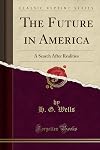
The Future in America: A Search After Realities
by H. G. Wells
On This Page
Description
In this pioneering 1906 work of futurology, the prophetic novelist set out to predict what the next thirty years held for America. Wells, an advocate of socialism, asked whether American capitalism had taken individualism and self-sufficiency to an extreme. He exemplifies his ideas through discussing New York City, Washington, wealth, labor, immigration, and race.Tags
Recommendations






























Member Reviews
The H. G. Wells travelogue of 1906 gives his impressions of and visions for America. As a renowned author, he had the chance to interview almost anyone, and he took broad advantage of that chance. His subjects range from President Roosevelt to a prison inmate, from Jane Addams at Hull House to immigrants at Ellis Island, from porters and cab-drivers to the president of Harvard. The detail and style that so greatly contribute to his fiction are also applied here.
What Wells found seemed to him to be chaos, given more rapid transit and massive capacity. From New York City, the Flatiron Building, the Brooklyn and the Williamsburg Bridge; he notes that everyone expects a better, cleaner, bigger and more prosperous future, but almost none show more have plans to bring it about. Then in Boston he encounters planning, “And nowhere is it passing more certainly from the first phase of a mob-like rush of individualistic undertakings into a planned and ordered progress.”
At Niagara, Wells was most impressed by the power plant, its dynamos and quiet efficiency a marvelous source of power and proof of ingenuity; then depressed with the brick box-like exterior and likely use of power for things like “night advertisements for drug shops and music halls.”
When he starts to review society and politics Wells makes two broad observations; that the classes of English society are missing, and that so are political party differences. In terms of classes there is no aristocracy, with its noblesse oblige, and no proper serving class with its deference. In politics, both parties are liberal and are equivalent to European Christian and Social Democrats, with no Labor Party and no Conservative or Tory Party. European immigrants seem to absorb this view immediately. Thus Americans all remind him of the Englishmen of Birmingham and Lancashire, with their roots in manufacture, trade, and commerce. Wells refers to the process that creates this situation as homologisation. But English liberals “remained within”…”the frame of regal, aristocratic and feudal institutions” while America “escaped to complete self development.” He views the American Revolution as yielding the absolute right of property, while the Europeans still views it as limited, even after the English and French revolutions; and even further that this set of property rights is more anarchistic than democratic. Property is necessary since “without property…” (Meaning “the possession, acquisition, and development…” of it) “…freedom is a featureless and unsubstantial theory”. But Wells viewed this equality as fleeting, since riches accumulate, and the rich constitute Well’s new class. “That steady trend towards concentration under individualistic rules, until individual competition becomes disheartened and hopeless, is the essential form of economic and social process in America as I see it now, and it has become the cardinal topic of thought and discussion in the American mind.”
Ever true to his Fabian roots, Wells sees hope for intellectual, university, and government expansion to learn from Europe and grow a more socialist future. There are powerful observations along the way, such as “Congress is not sovereign; there is no national sovereign power in America.” He sees elements of that struggle toward social planning and quotes Andrew White of Cornell who said in 1883 that “The greatest work which the coming century has to do in this country is to build up a aristocracy of thought and feeling which shall hold its own against the aristocracy of mercantilism.” With disappointment, he characterizes Boston and New York as archetypes, the Scylla and Charybdis of creative minds; one sacrificed to progress of business the other to excessive details of history. Wells concludes that on the whole, “that in America, by sheer virtue of its size, its free traditions, and the habit of initiative in its people, the leadership of progress must ultimately rest.”
Just as much of Wells’ science fiction was strongly predictive, his social and political musings are also of value. Much of the struggle he expected in the 20’s in still going un and coming to fruition now. Regardless of your choice between individualist capitalism or government directed socialism, this book gives an excellent snapshot of some of the rots of the struggle; and is well worth a scan. show less
What Wells found seemed to him to be chaos, given more rapid transit and massive capacity. From New York City, the Flatiron Building, the Brooklyn and the Williamsburg Bridge; he notes that everyone expects a better, cleaner, bigger and more prosperous future, but almost none show more have plans to bring it about. Then in Boston he encounters planning, “And nowhere is it passing more certainly from the first phase of a mob-like rush of individualistic undertakings into a planned and ordered progress.”
At Niagara, Wells was most impressed by the power plant, its dynamos and quiet efficiency a marvelous source of power and proof of ingenuity; then depressed with the brick box-like exterior and likely use of power for things like “night advertisements for drug shops and music halls.”
When he starts to review society and politics Wells makes two broad observations; that the classes of English society are missing, and that so are political party differences. In terms of classes there is no aristocracy, with its noblesse oblige, and no proper serving class with its deference. In politics, both parties are liberal and are equivalent to European Christian and Social Democrats, with no Labor Party and no Conservative or Tory Party. European immigrants seem to absorb this view immediately. Thus Americans all remind him of the Englishmen of Birmingham and Lancashire, with their roots in manufacture, trade, and commerce. Wells refers to the process that creates this situation as homologisation. But English liberals “remained within”…”the frame of regal, aristocratic and feudal institutions” while America “escaped to complete self development.” He views the American Revolution as yielding the absolute right of property, while the Europeans still views it as limited, even after the English and French revolutions; and even further that this set of property rights is more anarchistic than democratic. Property is necessary since “without property…” (Meaning “the possession, acquisition, and development…” of it) “…freedom is a featureless and unsubstantial theory”. But Wells viewed this equality as fleeting, since riches accumulate, and the rich constitute Well’s new class. “That steady trend towards concentration under individualistic rules, until individual competition becomes disheartened and hopeless, is the essential form of economic and social process in America as I see it now, and it has become the cardinal topic of thought and discussion in the American mind.”
Ever true to his Fabian roots, Wells sees hope for intellectual, university, and government expansion to learn from Europe and grow a more socialist future. There are powerful observations along the way, such as “Congress is not sovereign; there is no national sovereign power in America.” He sees elements of that struggle toward social planning and quotes Andrew White of Cornell who said in 1883 that “The greatest work which the coming century has to do in this country is to build up a aristocracy of thought and feeling which shall hold its own against the aristocracy of mercantilism.” With disappointment, he characterizes Boston and New York as archetypes, the Scylla and Charybdis of creative minds; one sacrificed to progress of business the other to excessive details of history. Wells concludes that on the whole, “that in America, by sheer virtue of its size, its free traditions, and the habit of initiative in its people, the leadership of progress must ultimately rest.”
Just as much of Wells’ science fiction was strongly predictive, his social and political musings are also of value. Much of the struggle he expected in the 20’s in still going un and coming to fruition now. Regardless of your choice between individualist capitalism or government directed socialism, this book gives an excellent snapshot of some of the rots of the struggle; and is well worth a scan. show less
H.G. Wells report of his visit to the U.S. 1906. Interesting as the views of an intelligent Fabian observer just before World War I and the great changes of the early 20th century. Interested in predicting about the next 30 years of US history; opens with interesting comparisons between this exercise and his early SF such as The Time Machine, when he tried to predict much further ahead. It goes on to include very interesting interviews with Booker T. Washington--with a comparison with W.E.B. DuBois, whose Souls of Black Folk Wells ha read -- and with Teddy Roosevelt, and with a British "Anarchist" named MacQueen who was imprisoned for speaking at the Patterson strike, and Maxim Gorky, who was harassed for living with a woman not his show more wife (though, as Wells points out, Ben Franklin did the same). Also very vivid accounts of New York, Chicago, Washington, child labor, Wellesley College etc. show less
Ratings
Members
- Recently Added By
Author Information

1,560+ Works 109,276 Members
H. G. Wells was born in Bromley, England on September 21, 1866. After a limited education, he was apprenticed to a draper, but soon found he wanted something more out of life. He read widely and got a position as a student assistant in a secondary school, eventually winning a scholarship to the Royal College of Science in South Kensington, where show more he studied biology. He graduated from London University in 1888 and became a science teacher. He also wrote for magazines. When his stories began to sell, he left teaching to write full time. He became an author best known for science fiction novels and comic novels. His science fiction novels include The Time Machine, The War of the Worlds, The Wonderful Visit, The Island of Doctor Moreau, The Invisible Man, The First Men in the Moon, and The Food of the Gods. His comic novels include Love and Mr. Lewisham, Kipps: The Story of a Simple Soul, The History of Mr. Polly, and Tono-Bungay. He also wrote several short story collections including The Stolen Bacillus, The Plattner Story, and Tales of Space and Time. He died on August 13, 1946 at the age of 79. (Bowker Author Biography) show less
Common Knowledge
- Canonical title*
- Amerika och framtiden: En upptäckarfärd till realiteternas land
- Original title
- The Future in America: A Search After Realities
- Original publication date
- 1906
*Some information comes from Common Knowledge in other languages. Click "Edit" for more information.
Classifications
Statistics
- Members
- 45
- Popularity
- 663,788
- Reviews
- 2
- Rating
- (3.50)
- Languages
- English, Swedish
- Media
- Paper, Ebook
- ISBNs
- 14
- ASINs
- 4