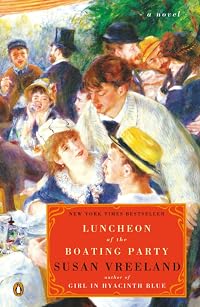
Luncheon of the Boating Party
by Susan Vreeland
On This Page
Description
From the bestelling author of GIRL IN HYACINTH BLUE, "A vivid exploration of one of the most beloved Renoir paintings in the world, done with a flourish worthy of Renoir himself" (USA Today)With her richly textured novels, Susan Vreeland has offered pioneering portraits of artists' lives. As she did in Girl in Hyacinth Blue, Vreeland focuses on a single painting, Auguste Renoir's instantly recognizable masterpiece, which depicts a gathering of Renoir's real friends enjoying a summer Sunday show more on a café terrace along the Seine. Narrated by Renoir and seven of the models, the novel illuminates the gusto, hedonism, and art of the era. With a gorgeous palette of vibrant, captivating characters, Vreeland paints their lives, loves, losses, and triumphs so vividly that "the painting literally comes alive" (The Boston Globe). show less
Tags
Recommendations

































Member Reviews
Luncheon of the Boating Party – Susan Vreeland
4 stars
“I regret I must interrupt your gastronomic delight in order to finish what we came for,” Auguste said.
Imagine a large group of animated people with a wide variety of interests and backgrounds. They are all enjoying a gourmet lunch, good wine and the intersection of four or five different simultaneous conversations. Now ask them to freeze in place for several hours while the light lasts. This is the task of Auguste Renoir as he painted his Luncheon of the Boating Party. Vreeland’s book gives names, personality and personal histories to each of the faces in the Renoir’s masterpiece. Renoir captures la vie moderne in one moment in time. Vreeland captures this modern life with show more all of its social complexity. She also describes the seemingly insurmountable difficulties involved in the creation of Renoir’s painting. I feel as if I were privileged to be the proverbial fly on the wall anonymously watching all of the action. (Although, since it is Renoir, I’d have to be something prettier, a butterfly or a ladybug.)
I began this as an audio book, but I did not like the reader at all. It worked much better to read it. At first I had difficulty keeping track of the characters. I know the painters and writers of this time period by their last names. When Vreeland used only first names, I was confused. It helped a great deal to open the website for the book. It has some important background information, thumbnails of all the paintings mentioned in the text, and each character is identified with a close-up from the painting.
As soon as I finished the book, I wanted to get a flight to Washington D.C. and head straight to the Phillips Gallery to see the painting. show less
4 stars
“I regret I must interrupt your gastronomic delight in order to finish what we came for,” Auguste said.
Imagine a large group of animated people with a wide variety of interests and backgrounds. They are all enjoying a gourmet lunch, good wine and the intersection of four or five different simultaneous conversations. Now ask them to freeze in place for several hours while the light lasts. This is the task of Auguste Renoir as he painted his Luncheon of the Boating Party. Vreeland’s book gives names, personality and personal histories to each of the faces in the Renoir’s masterpiece. Renoir captures la vie moderne in one moment in time. Vreeland captures this modern life with show more all of its social complexity. She also describes the seemingly insurmountable difficulties involved in the creation of Renoir’s painting. I feel as if I were privileged to be the proverbial fly on the wall anonymously watching all of the action. (Although, since it is Renoir, I’d have to be something prettier, a butterfly or a ladybug.)
I began this as an audio book, but I did not like the reader at all. It worked much better to read it. At first I had difficulty keeping track of the characters. I know the painters and writers of this time period by their last names. When Vreeland used only first names, I was confused. It helped a great deal to open the website for the book. It has some important background information, thumbnails of all the paintings mentioned in the text, and each character is identified with a close-up from the painting.
As soon as I finished the book, I wanted to get a flight to Washington D.C. and head straight to the Phillips Gallery to see the painting. show less
While it’s historical fiction, this novel has much to say about art. I loved that it succeeds in giving the reader a glimpse into how much effort, coordination, not to mention talent, went into creating a single painting.
The cast of characters gathered to model for Renoir’s masterpiece, “The Luncheon of the Boating Party”, is vividly and sympathetically portrayed. They are a very patched group – from the self-sacrificing and clever Alphonsine and her serious brother to the completely frivolous and pleasure-seeking Angele. You get a glimpse into each character’s way of life and values. Renoir’s struggles with his painting technique and the eternal artist’s problem of getting the necessary funding or finding a patron for show more his paintings are well described and based in fact.
Perhaps what I liked least in the novel was Renoir himself. He just wasn’t a very sympathetic character, somehow, mostly focused on finding the right colors for his painting and avoiding emotional responsibility in his many friendships and relationships.
All in all, however, I’d recommend this book to anyone interested in Impressionist art or in 19th century Paris. show less
The cast of characters gathered to model for Renoir’s masterpiece, “The Luncheon of the Boating Party”, is vividly and sympathetically portrayed. They are a very patched group – from the self-sacrificing and clever Alphonsine and her serious brother to the completely frivolous and pleasure-seeking Angele. You get a glimpse into each character’s way of life and values. Renoir’s struggles with his painting technique and the eternal artist’s problem of getting the necessary funding or finding a patron for show more his paintings are well described and based in fact.
Perhaps what I liked least in the novel was Renoir himself. He just wasn’t a very sympathetic character, somehow, mostly focused on finding the right colors for his painting and avoiding emotional responsibility in his many friendships and relationships.
All in all, however, I’d recommend this book to anyone interested in Impressionist art or in 19th century Paris. show less
The Impressionists, Renoir, convivial gatherings along the Seine, various shades of love, the birth of a masterpiece, and visuals, visuals, visuals. What's not to love? I started this one last year and got sidetracked by other books that had firm deadlines but kept sneaking back to this whenever I had a spare moment to sink into it. And in all fairness, that is not the way to read this expansive and lush novel. The way to read it is what I did for the second half: luxuriate in it and it alone.
At the opening of the novel, Renoir is just about penniless and desperate to create a new painting that will answer the criticism that the Impressionists as a group are incapable of the kind of important, lasting work that they have striven for in show more their break with traditional French art. Renoir's vision is a statement definitively refuting this while getting his work hung in the prestigious Paris Salon. Choosing to paint the aftermath of a vibrant, genial luncheon composed of friends and models, the painting is larger in scope than anything the Impressionists have attempted before. The novel tells the tale of the conception and execution of the painting as well as the tales of the people involved, touching on the terrible recent history post Franco-Prussian War, the different sections of Paris, class distinction, and enduring love.
The different characters in the painting all revolve around the character of Renoir; he being, in many cases, their only tie to each other. But amazingly, considering the sheer number of models posing, Vreeland manages to make them distinct personalities with different back stories and all come off as sympathetic. She manages to tie in much history without the book coming off as textbookish. Her research both into the art, Renoir's life, and the local Paris times is obviously thorough and well done. The writing is lush and very visual and will make the reader wish to be at the idyllic Maison Fournaise on the Seine as well. There seems to be a sun-dappled wash over the whole of the book. The end of the book is never in any doubt (after all, the painting is on the cover of the book) and Renoir's life is fairly well documented. But the journey with these characters, the gentleness of the love stories and disappointments, and the insight into Renoir's artistic genius, makes this a welcome and appealing read. Fans of fictionalized art histories will love this one but even those with no interest in the Impressionists will find much to please them in these pages. show less
At the opening of the novel, Renoir is just about penniless and desperate to create a new painting that will answer the criticism that the Impressionists as a group are incapable of the kind of important, lasting work that they have striven for in show more their break with traditional French art. Renoir's vision is a statement definitively refuting this while getting his work hung in the prestigious Paris Salon. Choosing to paint the aftermath of a vibrant, genial luncheon composed of friends and models, the painting is larger in scope than anything the Impressionists have attempted before. The novel tells the tale of the conception and execution of the painting as well as the tales of the people involved, touching on the terrible recent history post Franco-Prussian War, the different sections of Paris, class distinction, and enduring love.
The different characters in the painting all revolve around the character of Renoir; he being, in many cases, their only tie to each other. But amazingly, considering the sheer number of models posing, Vreeland manages to make them distinct personalities with different back stories and all come off as sympathetic. She manages to tie in much history without the book coming off as textbookish. Her research both into the art, Renoir's life, and the local Paris times is obviously thorough and well done. The writing is lush and very visual and will make the reader wish to be at the idyllic Maison Fournaise on the Seine as well. There seems to be a sun-dappled wash over the whole of the book. The end of the book is never in any doubt (after all, the painting is on the cover of the book) and Renoir's life is fairly well documented. But the journey with these characters, the gentleness of the love stories and disappointments, and the insight into Renoir's artistic genius, makes this a welcome and appealing read. Fans of fictionalized art histories will love this one but even those with no interest in the Impressionists will find much to please them in these pages. show less
One of my all time favorite books. It combines several of my passions, art, reading and France. It tells the story of how the painting "Luncheon of the Boating Party" came about. It's partly fiction, but it certainly could have happened that way. The characters are real. Make sure you have a copy of the painting handy as you read the book. The book captures the specifics and the beautiful atmosphere of the painting just as well as the artist did.
Reading this novel about Renoir's creation of his famous painting was like watching paint dry. Oof! Vreeland gives us tons of information about the artist, his lifestyle and the models that he used for the painting; but the novel moves at a snail's pace. If I hadn't had to read it for my reading group I never would have finished. Yes, I learned things about Renoir and his Impressionist group but oh! this book could have used some editing.
This is the story of Renoir’s famous painting Luncheon of the Boating Party, a work completed on the balcony of the restaurant Maison Fournaise, just outside of Paris. Combining historical fact with Ms. Vreeland’s vivid imagination we learn how the painting came into existence and how the models were chosen and gathered, as well as a sense of the time and place. The models’ identities are largely based on historical fact, but as with all works of historical fiction the author uses her colorful imagination in guessing their conversations, relationships and emotions. At the beginning of the story, Auguste Renoir is struggling even to cover the costs of purchasing several tubes of paint, but by the time the painting is finished the show more reader gets a sense that Luncheon represents a fortunate turning point in his career.
There is something compelling about an author bringing to life the story of a work of art. The characters become familiar and spark curiosity about who they were, the location becomes a real place one could visit, and the art itself becomes an intimate friend. Susan Vreeland first piqued my interest with her biographical historical fiction, The Passion of Artemisia. Her background in and her passion for fine art is clearly a prerequisite in producing a story like this. The descriptions of the colors, clothing and food I can only describe as “delicious” and nearly caused me to feel that I was actually there among them.
One suggestion: Print a color copy of the painting to reference as you read. Otherwise you’ll be flipping to look at the cover approximately 3,496 times. show less
There is something compelling about an author bringing to life the story of a work of art. The characters become familiar and spark curiosity about who they were, the location becomes a real place one could visit, and the art itself becomes an intimate friend. Susan Vreeland first piqued my interest with her biographical historical fiction, The Passion of Artemisia. Her background in and her passion for fine art is clearly a prerequisite in producing a story like this. The descriptions of the colors, clothing and food I can only describe as “delicious” and nearly caused me to feel that I was actually there among them.
One suggestion: Print a color copy of the painting to reference as you read. Otherwise you’ll be flipping to look at the cover approximately 3,496 times. show less
What a great story! The author actually researched every person in the painting Luncheon of the Boating Party (except 1 whose identity is debatable) and Renoir himself, and made it all into a super cool historical fiction story. The story spans the 2 months Renoir took to paint it outside. Even though there are 14 people in the painting, Renoir, the paint store owners, and art dealers stories to hear, it didn't drag.
My favorite part was a story about the girl who's leaning on her hand on the railing in the painting. She recalls starving in her house during Franco-Prussian War (before the painting). She was lucky to get horse meat rationed to her. During the painting she decides to go back to that old house and finds it's now a food show more store. She goes inside and has an incredible moment looking at all this food and remembering starving on the floor. It was a moving scene.
Also I learned that Renoir and Monet were friends in real life! Whoa. What a time.
If you enjoy art or historical fiction you will probably like Luncheon of the Boating Party. show less
My favorite part was a story about the girl who's leaning on her hand on the railing in the painting. She recalls starving in her house during Franco-Prussian War (before the painting). She was lucky to get horse meat rationed to her. During the painting she decides to go back to that old house and finds it's now a food show more store. She goes inside and has an incredible moment looking at all this food and remembering starving on the floor. It was a moving scene.
Also I learned that Renoir and Monet were friends in real life! Whoa. What a time.
If you enjoy art or historical fiction you will probably like Luncheon of the Boating Party. show less
Members
- Recently Added By
Published Reviews
ThingScore 83
This complex novel will appeal to those who favor well-developed characters and atmospheric setting over nonstop action and nail-biting suspense.
added by Christa_Josh
Highly recommended.
added by Christa_Josh
Vreeland achieves a detailed and surprising group portrait, individualized and immediate.
added by Christa_Josh
Lists

covers with paintings / paintings as covers .
37 works; 1 member

Blue Pyramid 1,276 Best Books of All Time
1,248 works; 32 members

Top Five Books of 2024
795 works; 264 members
Author Information

27+ Works 9,048 Members
Susan Vreeland was born in Racine, Wisconsin on January 20, 1946. She received a bachelor's degree in literature from San Diego State University. After graduating, she taught high school English in San Diego from 1969 to 2000. In 1980, she began writing articles about art, culture, and travel for newspapers and magazines. Her first novel What Love show more Sees was published in 1988. Her other novels include Girl in Hyacinth Blue, The Passion of Artemisia, Luncheon of the Boating Party, Life Studies, The Forest Lover, Lisette's List, and Clara and Mr. Tiffany. Her short fiction has appeared in numerous publications including The Missouri Review, Ploughshares, New England Review, Alaska Quarterly Review, and Connecticut Review. She died after heart surgery on August 23, 2017 at the age of 71. (Bowker Author Biography) show less
Some Editions
Awards and Honors
Awards
Distinctions
Common Knowledge
- Canonical title
- Luncheon of the Boating Party
- Original publication date
- 2007
- People/Characters
- Pierre-Auguste Renoir; Alphonsine Fournaise; Gustave Caillebotte; Ellen Andrée; Charles Ephrussi; Paul Lhôte (show all 20); Eugène Pierre Lestringez; Baron Raoul Barbier; Julien Tanguy; Jules Laforgue; Antonio Maggiolo; Jeanne Samary; Cecile-Louise Valtesse de la Bigne; Aline Charigot; Alphonse Fournaise; Louise Fournaise; Angèle; Madame Charpentier; Guy de Maupassant; Paul Durand-Ruel
- Important places
- Paris, France; Chatou, France
- Epigraph
- To my mind, a picture should be something pleasant, cheerful, and pretty, yes pretty! There are too many unpleasant things in life as it is without creating still more of them.
- Pierre-August Renoir
Whatever you can do, or dream you can, begin it. Boldness has genius, power, and magic in it.
- Johann Wolfgang von Goethe - Dedication
- To him who is specially hers, Joseph Kip Gray, from she who is singularly his.
In memory of his brother, Michael Francis Gray. - First words
- He rode the awkward steam-cycle along the ridge to catch glimpses of the domes and spires of Paris to the east, then turned west and careened headlong down the long steep hill toward the village of Bougival and the Seine.
- Quotations
- a saint is one with light shining through him;
art is love made visible;
painting about the goodness of life - Last words
- (Click to show. Warning: May contain spoilers.)That ought to satisfy me for another forty years.
- Blurbers
- Naslund, Sena Jeter; Butler, Robert Olen; Rutherford, Edward
Classifications
Statistics
- Members
- 1,041
- Popularity
- 24,880
- Reviews
- 26
- Rating
- (3.71)
- Languages
- 5 — Dutch, English, German, Hebrew, Italian
- Media
- Paper, Audiobook, Ebook
- ISBNs
- 17
- ASINs
- 9