On This Page
Description
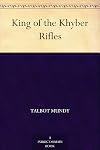
If you're craving a classic adventure novel from times gone by, King of the Khyber Rifles will definitely do the trick. Set in India around the time of the outbreak of World War I, the tale outlines the tensions between the restless and defiant natives of India and the British forces, which have been weakened by the demands of fighting against the Germans. Can secret agent Athelstan King quell the simmering conflict before it's too late?.
Tags
Recommendations



















Member Recommendations
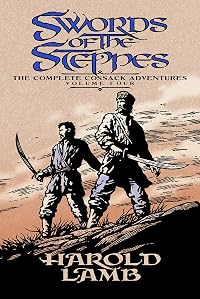
bespen Stirling wrote something of a spiritual successor to Mundy's book set in an alternate timeline. The protagonist of Stirling's book is a descendant of Athelstan King.
Member Reviews
Harkening back to the days of Saturday afternoons watching old movies on TV's Adventure Theatre, King of the Khyber Rifles is a posturing, swaggering adventure story of a British army secret agent in the early days of World War I as he infiltrates and manages to thwart the plot of the Turkish mullah, Muhammed Anim and the mysterious, beautiful Yasmini. As the military is being shipped off to the European front, India is wide open for the tribes from the other side of the Khyber Pass to sweep down and stage a jihad, pushing the British out of India.
Athelstane King is a master of disguise and although British to the core, is able to think and act like a native. The mysterious Yasminni, of mixed Russian and Indian heritage is a masterful show more foe, and has gathered a force that will follow her blindly. Her downfall however is her love for Captain King. Throw in a mad Mullah, secret caves, charging lancers and you have an adventure story that will keep the pages turning.
I found Talbot Mundy’s writing reminded me of both Edgar Rice Burroughs and H Rider Haggard, slightly dated, rather unbelievable, yet still highly readable and altogether King of the Khyber Rifles was a ripping good yarn. show less
Athelstane King is a master of disguise and although British to the core, is able to think and act like a native. The mysterious Yasminni, of mixed Russian and Indian heritage is a masterful show more foe, and has gathered a force that will follow her blindly. Her downfall however is her love for Captain King. Throw in a mad Mullah, secret caves, charging lancers and you have an adventure story that will keep the pages turning.
I found Talbot Mundy’s writing reminded me of both Edgar Rice Burroughs and H Rider Haggard, slightly dated, rather unbelievable, yet still highly readable and altogether King of the Khyber Rifles was a ripping good yarn. show less
Athelstan King is a British Secret Agent stationed in India at the beginning of WWI. He is attached to the Khyber Rifles regiment as a cover, but his real job is to prevent a holy war. "To stop a holy war single-handed would be rather like stopping the wind--possibly easy enough, if one knew the way." King is ordered to work with a mysterious and powerful Eastern woman, Yasmini. Can King afford to trust her? Can he afford not to?
Ignoring all the stuff that we would find racist today (the main character literally does brown face) I wanted to read this book to get a sense of what adventure books were like back in the day.
This book in particular felt a bit repetitive and reductive with its descriptions of people. Many times there was a hand waviness about describing the reasons for a character's actions, boiled down to "the east" or "the orient" or "the savages". I expected this going in but, it was just a constant stream of this boring fluff interrupting the action and it made the characters one dimensional. Every 2-3 pages when a character was surprised, killed or rude, you could expect another "the east is mysterious/savage in that way and that's why this show more character is x"
The main character is pretty likeable and interesting as a secret agent and I wouldn't be surprised to see the ideas of suave british secret agents influenced by this. The first part of the book is also rife with intrigue, and the plot moves at an excellent pace. By the second half however you'll be tired due to issue above. Maybe due to the fact that this was first serialized in a magazine, the first part needed to draw you in and the second part was drawn out for extra dollars? Who knows.
This book is certainly a product of its times, thank god Hemingway came along afterwards. show less
This book in particular felt a bit repetitive and reductive with its descriptions of people. Many times there was a hand waviness about describing the reasons for a character's actions, boiled down to "the east" or "the orient" or "the savages". I expected this going in but, it was just a constant stream of this boring fluff interrupting the action and it made the characters one dimensional. Every 2-3 pages when a character was surprised, killed or rude, you could expect another "the east is mysterious/savage in that way and that's why this show more character is x"
The main character is pretty likeable and interesting as a secret agent and I wouldn't be surprised to see the ideas of suave british secret agents influenced by this. The first part of the book is also rife with intrigue, and the plot moves at an excellent pace. By the second half however you'll be tired due to issue above. Maybe due to the fact that this was first serialized in a magazine, the first part needed to draw you in and the second part was drawn out for extra dollars? Who knows.
This book is certainly a product of its times, thank god Hemingway came along afterwards. show less
A somewhat mixed adventure story, King of the Khyber Rifles fails at its aspirations towards poetic imagery and the mundane philosophic bromides taken from the worst excesses of Theosophy. On the other hand, Mundy is clever with the turn of a phrase, the working of words, and often contradictory thoughts of his characters. It is a wonderful period piece, a glimpse of a vulnerable British Raj at the beginning of the Great War. And it plots out itself in a fashion that maintains interest, although the Great Reveal of the novel is clear from the moment King meets with the Rangar in Delhi.
There are better adventure writers. Some such as Haggard were actually more experimental with teasing out an element of Darwinian Naturalism as well as show more Realism in their writing. (And, of course, Mundy all but steals directly from Haggard's She in one of his plot elements, here.) Kipling was much more the master of the lyrical than Mundy. Give him his due, nonetheless, Mundy and his mix of 19th century mannerisms under assault by a new age of machine guns in war on one hand and old style Victorian spiritualism on the other, makes for a worthy read. There is an almost tangible feel of its times in its pages. show less
There are better adventure writers. Some such as Haggard were actually more experimental with teasing out an element of Darwinian Naturalism as well as show more Realism in their writing. (And, of course, Mundy all but steals directly from Haggard's She in one of his plot elements, here.) Kipling was much more the master of the lyrical than Mundy. Give him his due, nonetheless, Mundy and his mix of 19th century mannerisms under assault by a new age of machine guns in war on one hand and old style Victorian spiritualism on the other, makes for a worthy read. There is an almost tangible feel of its times in its pages. show less
King–of the Khyber Rifles
by Talbot Mundy
Carrol and Graf 1985
$3.95; 395 pages
ISBN 0881841692
I enjoy reading old books. This one is only 101 years old at this point, but I enjoy the act of getting into the mind of someone from another age. Written in 1916, Talbot Mundy's adventure story isn't that remote, but there was some dialogue at the beginning that I found very difficult to follow. A slangy exchange between Athelstan King and another officer reminded me how far language can change in 100 years.
I've had this one on the shelf for years, and I'm glad I finally read it. It inspired S. M. Stirling's Peshawar Lancers, and it was fun to read, but I doubt I'll ever come back to it. Mundy's Theosophy is just too weird for me. Other books show more of a similar vintage are a little easier for me to get into. show less
by Talbot Mundy
Carrol and Graf 1985
$3.95; 395 pages
ISBN 0881841692
I enjoy reading old books. This one is only 101 years old at this point, but I enjoy the act of getting into the mind of someone from another age. Written in 1916, Talbot Mundy's adventure story isn't that remote, but there was some dialogue at the beginning that I found very difficult to follow. A slangy exchange between Athelstan King and another officer reminded me how far language can change in 100 years.
I've had this one on the shelf for years, and I'm glad I finally read it. It inspired S. M. Stirling's Peshawar Lancers, and it was fun to read, but I doubt I'll ever come back to it. Mundy's Theosophy is just too weird for me. Other books show more of a similar vintage are a little easier for me to get into. show less
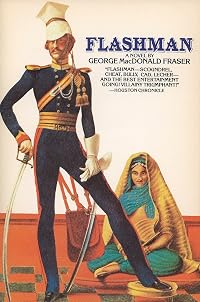
A great title, and later made into a movie. (Note this is a "movie" not an act of "Cinema".) It's a series of vignettes rather than a constructed novel, but it created an image of the Northwest Frontier of India that remains to this day. It was at its time a good seller and was even encountered by both John Masters, and William Slim who served there. One should read it, and pick out those strands of "Kim" (1901) that created it, and "Flashman" who profited by it.
By the way, The Khyber Rifles was disbanded in 1919, after the irregular Regiment of that name, suffered a great many desertions when facing the latest Afghan invasion of India.
By the way, The Khyber Rifles was disbanded in 1919, after the irregular Regiment of that name, suffered a great many desertions when facing the latest Afghan invasion of India.
Amazing illustrations by J. C. Coll executed from May 1916 to Jan. of 1917. Published in the pulp magazine "Everybody's Magazine". The complete nine issue epic adventure are all collected here in facsimilie form. All pages and illustrations have been scanned from the original pages.
Members
- Recently Added By
Author Information

123+ Works 1,461 Members
Some Editions
Series


Work Relationships
Common Knowledge
- Canonical title
- King—of the Khyber Rifles
- Original publication date
- 1916-05 to 1917-01 (serialised) (serialised); 1916-11 (book) (book)
- People/Characters
- Captain Athelstan King
- Important places
- Khyber Pass, Hindu Kush; Peshawar, Pakistan
- Related movies
- The Black Watch (1929 | IMDb); King of the Khyber Rifles (1953 | IMDb)
- First words
- The men who govern India--more power to them and her!--are few.
- Last words
- (Click to show. Warning: May contain spoilers.)A man and his promise--a woman and intrigue--are one!"
Classifications
Statistics
- Members
- 133
- Popularity
- 246,327
- Reviews
- 8
- Rating
- (3.35)
- Languages
- English
- Media
- Paper, Ebook
- ISBNs
- 36
- ASINs
- 12