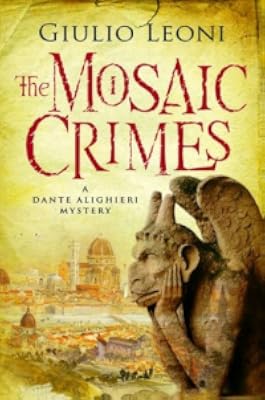
On This Page
Description
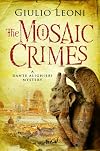
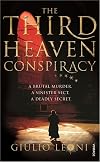
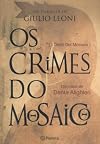
Italy, June 1300. In a disused church on the outskirts of Florence, the master craftsman, Ambrogio, is found murdered at the foot of an unfinished mosaic. A young Dante Alighieri, (future author of The Divine Comedy) the recently elected Prior to the City of Florence, is called upon to investigate. He learns that the church is being transformed into a university at the behest of the new Pope, Bonifacius VIII. Closer inspection reveals catacombs beneath the floor, populated with beggars and show more thieves, who speak of witchcraft and satanic rituals practised above. Meanwhile, the Church, on learning of Dante's involvement, begins to show an unusual interest in Ambrogio's fate. But Dante has one further lead; Ambrogio belonged to a society of learned men, The Third Heaven. Dante hears they are in Florence for the founding of the new university, and believes that if he can infiltrate this group he may uncover the significance of Ambrogio's work. Perhaps the key to the murder is the mosaic itself. Leoni sets this clever thriller in a city on edge, nervously recovering from civil war. Medieval Florence is portrayed with stunning clarity; a city on the cusp of the Renaissance, in which new learning - in the guise of Dante - takes on the dark forces of old. The Third Heaven Conspiracy is a breathtaking whodunnit. show lessTags
Recommendations





















Member Reviews
An historical novel written by a professor of Italian Literature and it shows. That is not to say that the book suffers from any academic dryness, because it doesn't, but you do get an historical novel written by an author who attempts to give the reader some idea of the world view of his medieval characters. How much of this will be of interest to the reader will depend on their feel for turn of the 14th century Florence. It may well be confusing for some. Here is an example of a conversation of learned men who are looking/gazing at a dancer in a Tavern in Florence.
"her presence undoubtedly ignites heat in mens bodies and predisposes them for copulation. This occurs by operation of the luminous rays that emit from her body and show more penetrate the ocular cavities, dilating the mucous ducts through the action of their heat. It is a virtue that is characteristic of the female nature. Any shapely women who exposes herself to a man's eyes. generates the same reaction which is at the root of reproduction"
The conversation goes on to expound a theory about the effects of Pagan gods on human passion, however Leoni does not stray into Academic jargon and keeps his arguments on a level that general readers would understand.
Leon's novel is one of a series of four where he imagines that the famous Italian poet Dante Alighieri (1265-1321) was involved in murder mysteries. It dates from 1300 when Dante was a Prior (elected member of the ruling council) of Florence. The deadly feud between the Guelph and Ghibelline groupings and the divisions within the Florentine Council concerning the influence of the Pope in Rome form the historical backdrop to the story. Leoni is very good at providing his readers with a feel for 14th century Florence and together with his knowledge of how his characters would have thought about the issues of their day gives the novel some authenticity
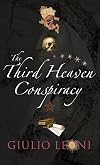
The murder mystery itself is adequate and he comes up with a spectacular finale. He provides a glossary of Characters and historical items for those who don't know their Guelphs from their Ghibellines as well as a list characters within the novel. The novel was originally translated as "The Mosaic Murders" but later changed to "The Third Heaven Conspiracy" I enjoyed the read and because it chimed with how I imagined the characters might have behaved: I rate it at 3.5 stars but I don't think I will read any more in the series. show less
"her presence undoubtedly ignites heat in mens bodies and predisposes them for copulation. This occurs by operation of the luminous rays that emit from her body and show more penetrate the ocular cavities, dilating the mucous ducts through the action of their heat. It is a virtue that is characteristic of the female nature. Any shapely women who exposes herself to a man's eyes. generates the same reaction which is at the root of reproduction"
The conversation goes on to expound a theory about the effects of Pagan gods on human passion, however Leoni does not stray into Academic jargon and keeps his arguments on a level that general readers would understand.
Leon's novel is one of a series of four where he imagines that the famous Italian poet Dante Alighieri (1265-1321) was involved in murder mysteries. It dates from 1300 when Dante was a Prior (elected member of the ruling council) of Florence. The deadly feud between the Guelph and Ghibelline groupings and the divisions within the Florentine Council concerning the influence of the Pope in Rome form the historical backdrop to the story. Leoni is very good at providing his readers with a feel for 14th century Florence and together with his knowledge of how his characters would have thought about the issues of their day gives the novel some authenticity
The murder mystery itself is adequate and he comes up with a spectacular finale. He provides a glossary of Characters and historical items for those who don't know their Guelphs from their Ghibellines as well as a list characters within the novel. The novel was originally translated as "The Mosaic Murders" but later changed to "The Third Heaven Conspiracy" I enjoyed the read and because it chimed with how I imagined the characters might have behaved: I rate it at 3.5 stars but I don't think I will read any more in the series. show less
A little difficult to read. I think the translation led to more stilted prose but if I just imagined reading it with an Italian accent it went along better. I was interested in the insight into Italian politics and I have a whole new view of Dante as well. Now I just need to read the Divine Comedy and I'll understand all the references.
Set in Florence in June 1300, two years before the Black Guelphs defeated the Whites, and Dante was permanently exiled from Florence, a sense of prevailing doom hangs over The Mosaic Crimes. Dante is serving as one of the six Priors elected to rule the City of Venice. When a master mosaicist is murdered in a gruesome fashion, he is bidden to investigate the crime. His investigations lead him to a group of non-Florentine scholars, known as the Third Heaven, who have come to Florence at the behest of Pope Boniface to found a studium, a university, in the city. The tavern where the group meets is also frequented by an exotic Eastern dancer, Antilia, who enchants all who look upon her.
The novel is dense with allusions to Dante's works and show more full of conversations about late medieval theology, philosophy, and theories of art, which may seem arcane to the modern reader, but certainly lend authenticity to the locale and time. Although Leoni's Dante is a bitter man beset by recurring migraines -- arrogant, vengeful, self-righteous, but always curious -- not a particularly sympathetic protagonist, I did find The Mosaic Crimes a satisfying read. show less
The novel is dense with allusions to Dante's works and show more full of conversations about late medieval theology, philosophy, and theories of art, which may seem arcane to the modern reader, but certainly lend authenticity to the locale and time. Although Leoni's Dante is a bitter man beset by recurring migraines -- arrogant, vengeful, self-righteous, but always curious -- not a particularly sympathetic protagonist, I did find The Mosaic Crimes a satisfying read. show less
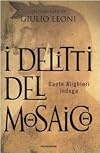
La quarta di copertina cita Faletti "Il Dante che avrei voluto studiare a scuola": direi che Giorgio non ha capito un cavolo sia di Dante che del romanzo in questione.
L'Alighieri di Leoni ha, a mio parere, in comune con il sommo poeta solo il nome: a parte qualche citazione poetica qua e là, non dà grandi motivi di identificazione.
In ogni caso, il giallo è ben strutturato, con momenti di suspense e talvolta di comicità ben equilibrati.
Nonostante sia il seguito di "Dante Alighieri e i delitti della Medusa", si può leggere anche senza aver affrontato il primo romanzo: non ci sono eccessivi riferimenti al passato o sono esaurientemente spiegati.
L'Alighieri di Leoni ha, a mio parere, in comune con il sommo poeta solo il nome: a parte qualche citazione poetica qua e là, non dà grandi motivi di identificazione.
In ogni caso, il giallo è ben strutturato, con momenti di suspense e talvolta di comicità ben equilibrati.
Nonostante sia il seguito di "Dante Alighieri e i delitti della Medusa", si può leggere anche senza aver affrontato il primo romanzo: non ci sono eccessivi riferimenti al passato o sono esaurientemente spiegati.
Translates well into English but a number of references within the story tend to be obscure. One does get a bit tired of Dante Alighieri's complaints and his rather high handed approach to various activities. I suppose, though, that it thus provides substance to his character.
Very difficult read - lots of obscure twists, turns, and repetitions, but a fascinating end. I wish I could read it in the original - it might be more lyrical.
This was an interesting story but a really hard read.
Members
- Recently Added By
Author Information
33 Works 616 Members
Series

Belongs to Publisher Series
Common Knowledge
- Canonical title
- The Mosaic Crimes
- Original title
- I delitti del mosaico
- Original publication date
- 2004
- People/Characters
- Dante Alighieri (1265-1321); Boniface VIII, Pope (Benedetto Caetani, c. 1230 -1303)
- Important places
- Florence, Tuscany, Italy
- Dedication
- For Anna
- First words
- It came with a hiss that pierced the air as if all the snakes of the desert had raised their heads from the sand.
- Last words
- (Click to show. Warning: May contain spoilers.)Yes, he would attain it.
- Original language
- Italian
- Disambiguation notice
- The Mosaic Crimes, also published as The Third Heaven Conspiracy
Classifications
- Genres
- Fiction and Literature, Mystery, Historical Fiction
- DDC/MDS
- 853.914 — Literature & rhetoric Italian, Romanian & related literatures Italian fiction 1900- 20th Century 1945-1999
- LCC
- PQ4912 .E665 .D4513 — Language and Literature French, Italian, Spanish and Portuguese literatures Italian literature Individual authors, 2001-
- BISAC
Statistics
- Members
- 397
- Popularity
- 78,555
- Reviews
- 13
- Rating
- (2.83)
- Languages
- 17 — Bulgarian, Czech, Danish, Dutch, English, Estonian, Finnish, French, German, Greek, Hungarian, Italian, Norwegian (Bokmål), Polish, Portuguese, Spanish, Swedish
- Media
- Paper, Ebook
- ISBNs
- 28
- UPCs
- 1
- ASINs
- 5