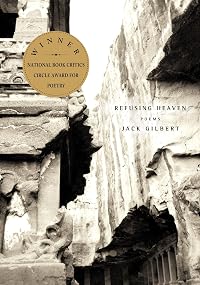
Refusing Heaven
by Jack Gilbert
On This Page
Description
More than a decade after Jack Gilbert's The Great Fires, this highly anticipated new collection shows the continued development of a poet who has remained fierce in his avoidance of the beaten path. In Refusing Heaven, Gilbert writes compellingly about the commingled passion, loneliness, and sometimes surprising happiness of a life spent in luminous understanding of his own blessings and shortcomings: "The days and nights wasted ... Long hot afternoons / watching ants while the cicadas show more railed / in the Chinese elm about the brevity of life." Time slows down in these poems, as Gilbert creates an aura of curiosity and wonder at the fact of existence itself. Despite powerful intermittent griefs?over the women he has parted from or the one lost to cancer (an experience he captures with intimate precision)?Gilbert's choice in this volume is to "refuse heaven." He prefers this life, with its struggle and alienation and delight, to any paradise. His work is both a rebellious assertion of the call to clarity and a profound affirmation of the world in all its aspects. It braces the reader in its humanity and heart. show lessTags
Recommendations


































Member Reviews
Poet Jack Gilbert was 80 years old when he published this collection of poems in 2005. That’s a long time to observe how life works and Gilbert has spent much of it in introspection. He was there in San Francisco during the first flowering of the Beats, yet he never really became one of the gang. To read Gilbert is to realize that he is a man who relishes his space; many of the poems in Refusing Heaven paint a picture of self-imposed exile, whether physically, as in a remote Greek island, or spiritually—hence the title.
This tendency to separate himself from his peers does not reveal him to be a curmudgeon; quite the opposite is true. It seems that Gilbert appreciates the contrast between company and isolation so that each might show more stand out more clearly in relief.
In the Buddhist-inflected poem, Happening Apart From What’s Happening Around It, Gilbert starts out by giving practical examples of his philosophy.
There is a vividness to eleven years of love
because it is over. A clarity of Greece now
because I live in Manhattan or New England.
Later in the poem he observes a spiritual aspect to this clarity.
… When I was walking
in the mountains with the Japanese man and began
to hear the water, he said, “What is the sound
of the waterfall?” “Silence,” he finally told me.
The stillness I did not notice until the sound
of water falling made apparent the silence I had
been hearing long before.
After absorbing this bit of enlightenment, Gilbert then gets to the crux of the matter by positing one of the greatest questions of all time.
… I ask myself what
is the sound of women? What is the word for
that still thing I have hunted inside them
for so long? …
In the poem, Moreover, Gilbert finally reveals what he suspects that transitory and elusive thing to be.
We are given the trees so we can know
what God looks like. And rivers
so we might understand Him. We are allowed
women so we can get into bed with the Lord,
however partial and momentary that is.
Perhaps it is only with the wisdom that 80 years affords that one can strive to understand women one moment while deftly distilling poetry’s worth and reason down to its essence the next.
We lose everything, but make harvest
of the consequence it was to us. Memory
builds this kingdom from the fragments
and approximation. We are gleaners who fill
the barn for the winter that comes on.
Refusing Heaven is a rare chance to experience a poet still in bold command of his powers looking back at what was a long life full of achievement and adversity in equal measure. In the sublime, Failing and Flying, he reminds us that although we tend to focus on the cautionary aspect of the Icarus myth, we forget that he actually did fly quite well. For awhile. Gilbert seems to be summing up his feelings about his own looming mortality when he writes:
I believe Icarus was not failing as he fell,
but just coming to the end of his triumph. show less
This tendency to separate himself from his peers does not reveal him to be a curmudgeon; quite the opposite is true. It seems that Gilbert appreciates the contrast between company and isolation so that each might show more stand out more clearly in relief.
In the Buddhist-inflected poem, Happening Apart From What’s Happening Around It, Gilbert starts out by giving practical examples of his philosophy.
There is a vividness to eleven years of love
because it is over. A clarity of Greece now
because I live in Manhattan or New England.
Later in the poem he observes a spiritual aspect to this clarity.
… When I was walking
in the mountains with the Japanese man and began
to hear the water, he said, “What is the sound
of the waterfall?” “Silence,” he finally told me.
The stillness I did not notice until the sound
of water falling made apparent the silence I had
been hearing long before.
After absorbing this bit of enlightenment, Gilbert then gets to the crux of the matter by positing one of the greatest questions of all time.
… I ask myself what
is the sound of women? What is the word for
that still thing I have hunted inside them
for so long? …
In the poem, Moreover, Gilbert finally reveals what he suspects that transitory and elusive thing to be.
We are given the trees so we can know
what God looks like. And rivers
so we might understand Him. We are allowed
women so we can get into bed with the Lord,
however partial and momentary that is.
Perhaps it is only with the wisdom that 80 years affords that one can strive to understand women one moment while deftly distilling poetry’s worth and reason down to its essence the next.
We lose everything, but make harvest
of the consequence it was to us. Memory
builds this kingdom from the fragments
and approximation. We are gleaners who fill
the barn for the winter that comes on.
Refusing Heaven is a rare chance to experience a poet still in bold command of his powers looking back at what was a long life full of achievement and adversity in equal measure. In the sublime, Failing and Flying, he reminds us that although we tend to focus on the cautionary aspect of the Icarus myth, we forget that he actually did fly quite well. For awhile. Gilbert seems to be summing up his feelings about his own looming mortality when he writes:
I believe Icarus was not failing as he fell,
but just coming to the end of his triumph. show less
The only thing Gilbert's collection refuses is any sort of significant engagement with life that isn't flaccid, White, and upper middle class. The times when he does cast about for others they feel like objects, strangers.
A smart and varied collection--this is one of those poetry collections that sends you so many beautiful lines and quiet moments of thought and reflection that it reminds you why we read poetry. There are many poems here that I'll come back to, over and over again.
Absolutely recommended for any poetry readers.
Absolutely recommended for any poetry readers.
What a great volume of poetry this is! This poet, now in his 80's, has published only a few books. This man writes the best love poems in English, but eschews sentimentality.
Ratings
Members
- Recently Added By
Published Reviews
ThingScore 100
Those who demand surface complexity to prove a poem’s depth will likely dismiss Gilbert’s work as sentimental, obvious, or thin. Cultural context confuses the reception of work that eschews contemporary received ideas. Gilbert’s aesthetics of exclusion may easily be misread as emptiness, when in fact it’s the result of careful editing of the once full.
added by paradoxosalpha
Lists

Favourite Books
1,820 works; 316 members
Author Information

9+ Works 1,046 Members
Jack Gilbert was born in Pittsburgh, Pennsylvania on February 17, 1925. He received a bachelor's degree in English from the University of Pittsburgh in 1954 and a master's from San Francisco State in 1963. He also attended Jack Spicer's Magic Poetry Workshop. His first collection of poetry, Views of Jeopardy, won the 1961 Yale Younger Poets Prize show more and was published in 1962. His other works include Monolithos, which won the Stanley Kunitz Prize and the American Poetry Review Prize; The Dance Most of All; Transgressions: Selected Poems; Refusing Heaven, which won the National Book Critics Circle Award; and The Great Fires: Poems 1982-1992. He died after developing pneumonia on November 13, 2012 at the age of 87. (Bowker Author Biography) show less
Awards and Honors
Classifications
Statistics
- Members
- 291
- Popularity
- 111,069
- Reviews
- 4
- Rating
- (4.02)
- Languages
- English
- Media
- Paper, Ebook
- ISBNs
- 3
- ASINs
- 1