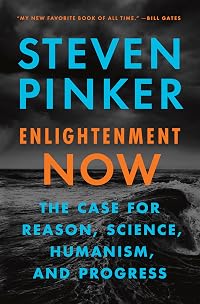
Enlightenment Now: The Case for Reason, Science, Humanism, and Progress
by Steven Pinker
On This Page
Description
INSTANT NEW YORK TIMES BESTSELLERA NEW YORK TIMES NOTABLE BOOK OF 2018
ONE OF THE ECONOMIST'S BOOKS OF THE YEAR
"My new favorite book of all time." —Bill Gates
If you think the world is coming to an end, think again: people are living longer, healthier, freer, and happier lives, and while our problems are formidable, the solutions lie in the Enlightenment ideal of using reason and science. By the author of the new book, Rationality.
Is the world really falling apart? Is the ideal of show more progress obsolete? In this elegant assessment of the human condition in the third millennium, cognitive scientist and public intellectual Steven Pinker urges us to step back from the gory headlines and prophecies of doom, which play to our psychological biases. Instead, follow the data: In seventy-five jaw-dropping graphs, Pinker shows that life, health, prosperity, safety, peace, knowledge, and happiness are on the rise, not just in the West, but worldwide. This progress is not the result of some cosmic force. It is a gift of the Enlightenment: the conviction that reason and science can enhance human flourishing.
Far from being a naïve hope, the Enlightenment, we now know, has worked. But more than ever, it needs a vigorous defense. The Enlightenment project swims against currents of human nature—tribalism, authoritarianism, demonization, magical thinking—which demagogues are all too willing to exploit. Many commentators, committed to political, religious, or romantic ideologies, fight a rearguard action against it. The result is a corrosive fatalism and a willingness to wreck the precious institutions of liberal democracy and global cooperation.
With intellectual depth and literary flair, Enlightenment Now makes the case for reason, science, and humanism: the ideals we need to confront our problems and continue our progress. show less
Tags
Recommendations










Member Recommendations
Member Reviews
A lot of reviews of this book I’ve read set up a false dichotomy that you must love it or hate it, swallow it whole without argument or reject it in its entirety. I think the reality is somewhere in between. Yes, some of Pinker’s arguments are flawed (I rely on better-informed intellectuals’ fact-checking for this assertion). Yes, he tends to hyperbolize and cherry-pick, particularly when finding fault with today’s progressives. But I tend to agree with him that problems are solvable, if we identify the problem and set our will to solving it. Or at least I think catastrophizing our problems is not going to solve them, and approaching them as potentially solvable is the only rational, workable position to take. And I hope he’s show more right about nationalism and populism. show less
I finally finished! It took me two years of reading this book off and on to reach the end. Multiple trips to the library, near-countless days reading one or two pages. I took copies of this book with me camping in Northern California and for Thanksgiving in Southern California. It's been on planes, Muni-trains, and automobiles. It's been around.
I don't know if it's his writing, my attention span for non-fiction, or just feeling like "Okay I get it" early on into it, but I don't think it's ever taken me this long to get through a book before.
I don't even know if I liked it or not, tbh. I did like how it made me feel; between the thrill of accomplishing what turned into a seemingly endless task and the sense that "everything is going to show more be alright" the book engendered in me, I was left feeling triumphant both as an individual and as a human by the time I closed it for the last time.
But then, of course, I read some reviews, both here and elsewhere on the web, and it seems like Pinker might have skirted past some inconvenient facts to make his point. I don't know.
I definitely want to believe his thesis, and I think it's mostly true, but then again (to misquote Chapelle's Rick James) motivated reasoning is a hell of a drug. show less
I don't know if it's his writing, my attention span for non-fiction, or just feeling like "Okay I get it" early on into it, but I don't think it's ever taken me this long to get through a book before.
I don't even know if I liked it or not, tbh. I did like how it made me feel; between the thrill of accomplishing what turned into a seemingly endless task and the sense that "everything is going to show more be alright" the book engendered in me, I was left feeling triumphant both as an individual and as a human by the time I closed it for the last time.
But then, of course, I read some reviews, both here and elsewhere on the web, and it seems like Pinker might have skirted past some inconvenient facts to make his point. I don't know.
I definitely want to believe his thesis, and I think it's mostly true, but then again (to misquote Chapelle's Rick James) motivated reasoning is a hell of a drug. show less
You’ve never had it so good, and Steven Pinker has the stats and charts (over 70!) to prove it. Wars are fewer and less severe, homicides are down, racism is in decline, terrorism is a fading fad, democracy rules, communicable diseases and poverty are on their way out. Life expectancy is up, and police are killing fewer people, both black and white. Even the poor have refrigerators. Inequality is a requisite sign of success. So appreciate the wonderful state of affairs you find yourself in. This is the message of Enlightenment Now, with a title that sounds like a protest placard, but which is actually a survey of the world by the statistics that states collect.
We’re so “progressive”, we’re beating back entropy itself. Steven show more Pinker takes 500 pages to create a world where everything is so fabulously much better than it ever has been, that anyone who says different is perpetuating an intellectual lie. This is why it is your enlightenment. The book is an endless, uplifting editorial. If you’re buying.
He’s at his best criticizing politics and science. He shows precisely how our biases prejudice our most thoughtful conclusions, and bemoans the lack of respect for science and the humanities. He says science is presented in some schools as “just another narrative, or myth”. Humanities are in danger of extinction, and they are critical to progress.
Pinker has a nice tendency to support his arguments with examples and charts. Unfortunately, he balances this with a tendency to ignore states or countries that don’t conform to his claims, and he swings numbers around to make them look better. He claims when he measures what people consume as opposed to what they earn, the poverty rate in the USA is 3%. So really, everyone is thriving. Even if they’re visibly not.
I fully realize Pinker is untouchable and slated for sainthood, but many things he says don’t add up, and a lot of it is just outrageous on its face. Let him speak for himself:
-On war: “Virtually every acre of land that was conquered after 1928 has been returned to the state that lost it.” (Something must have happened in 1927 for him to pick 1928, but he doesn’t say). Where do you even begin to refute this? Kaliningrad? Mauritania? The South China Sea? Crimea? Dnmbass? Palestine?
-He defends the demolition of the middle classes in the West. Yes, a hundred million Americans are worse off. But a billion Chinese are better off. “The tradeoff is worth it,” he says. That the extremely rich got fabulously more rich is fine with him, too.
-On terrorism’s “decline”, Pinker points to recently low numbers of victim deaths to show how safe we really are. He doesn’t mention all the freedom of movement, assembly and privacy we have lost to the terrorists. He’s satisfied they don’t kill that much, and that they will eventually fade away.
-On the mellowing of war: “Weapons don’t come into existence just because they are conceivable or physically possible.” Yes, they do. And worse, everything can be weaponized, from food to mouseclicks. Pinker goes even further, claiming “most historians” don’t think the atomic bombings caused Japan to surrender in three days, but rather it was the potential of Russia turning its attention from west to east.
-There is a great deal of nonsense about how much cheaper life is today. The provision of a light indoors would have cost the equivalent of £40,000 in the middle ages (if anyone could read), while today, lights cost fractions of pennies. And 100 years ago it took 1800 hours’ work to afford a refrigerator (among too many more such examples). But Pinker never bothers with the other side of the coin. That today, everyone must spend $150 a month on cable, $125 on phone (after purchasing a phone every two years, with each costing more than the fridge), a $20,000 car, a mortgage, and $50,000 in school debt (none of which were factors in the cost of living in the middle ages ) or be unable to function in society. His endless comparisons are pointless.
-He keeps repeating that because even the poor have flush toilets and refrigerators, they are much better off today than ever. He says even the fabulously wealthy Rothschilds didn’t have a washing machine like nearly everyone (80%) now supposedly has.
Pinker dismisses ecology as a pastime of the affluent. The more educated and wealthy we become, the more eco-conscious we become, so everything works out. He completely ignores the fact we have crossed the red line. That the oceans are toxic, that there is trash and plastic everywhere, that the carbon levels are at unseemly record levels. That the Paris Accord has not dented the damage one bit. But, he says, the air over London is no longer purple every day.
The book ends with an interminable bashing of religion, which Pinker considers “intellectually bankrupt”. He cites all the usual contradictions and hypocrisy, narrow-mindedness and longing for a cleaner era that never existed. Basically, religion and enlightenment are oil and water.
So you can look at Enlightenment Now in two ways, according to your own various biases. Either the greater message of positivism is too important (and correct) to criticize Pinker’s maddening claims, or the maddening claims make the whole exercise suspect.
David Wineberg show less
We’re so “progressive”, we’re beating back entropy itself. Steven show more Pinker takes 500 pages to create a world where everything is so fabulously much better than it ever has been, that anyone who says different is perpetuating an intellectual lie. This is why it is your enlightenment. The book is an endless, uplifting editorial. If you’re buying.
He’s at his best criticizing politics and science. He shows precisely how our biases prejudice our most thoughtful conclusions, and bemoans the lack of respect for science and the humanities. He says science is presented in some schools as “just another narrative, or myth”. Humanities are in danger of extinction, and they are critical to progress.
Pinker has a nice tendency to support his arguments with examples and charts. Unfortunately, he balances this with a tendency to ignore states or countries that don’t conform to his claims, and he swings numbers around to make them look better. He claims when he measures what people consume as opposed to what they earn, the poverty rate in the USA is 3%. So really, everyone is thriving. Even if they’re visibly not.
I fully realize Pinker is untouchable and slated for sainthood, but many things he says don’t add up, and a lot of it is just outrageous on its face. Let him speak for himself:
-On war: “Virtually every acre of land that was conquered after 1928 has been returned to the state that lost it.” (Something must have happened in 1927 for him to pick 1928, but he doesn’t say). Where do you even begin to refute this? Kaliningrad? Mauritania? The South China Sea? Crimea? Dnmbass? Palestine?
-He defends the demolition of the middle classes in the West. Yes, a hundred million Americans are worse off. But a billion Chinese are better off. “The tradeoff is worth it,” he says. That the extremely rich got fabulously more rich is fine with him, too.
-On terrorism’s “decline”, Pinker points to recently low numbers of victim deaths to show how safe we really are. He doesn’t mention all the freedom of movement, assembly and privacy we have lost to the terrorists. He’s satisfied they don’t kill that much, and that they will eventually fade away.
-On the mellowing of war: “Weapons don’t come into existence just because they are conceivable or physically possible.” Yes, they do. And worse, everything can be weaponized, from food to mouseclicks. Pinker goes even further, claiming “most historians” don’t think the atomic bombings caused Japan to surrender in three days, but rather it was the potential of Russia turning its attention from west to east.
-There is a great deal of nonsense about how much cheaper life is today. The provision of a light indoors would have cost the equivalent of £40,000 in the middle ages (if anyone could read), while today, lights cost fractions of pennies. And 100 years ago it took 1800 hours’ work to afford a refrigerator (among too many more such examples). But Pinker never bothers with the other side of the coin. That today, everyone must spend $150 a month on cable, $125 on phone (after purchasing a phone every two years, with each costing more than the fridge), a $20,000 car, a mortgage, and $50,000 in school debt (none of which were factors in the cost of living in the middle ages ) or be unable to function in society. His endless comparisons are pointless.
-He keeps repeating that because even the poor have flush toilets and refrigerators, they are much better off today than ever. He says even the fabulously wealthy Rothschilds didn’t have a washing machine like nearly everyone (80%) now supposedly has.
Pinker dismisses ecology as a pastime of the affluent. The more educated and wealthy we become, the more eco-conscious we become, so everything works out. He completely ignores the fact we have crossed the red line. That the oceans are toxic, that there is trash and plastic everywhere, that the carbon levels are at unseemly record levels. That the Paris Accord has not dented the damage one bit. But, he says, the air over London is no longer purple every day.
The book ends with an interminable bashing of religion, which Pinker considers “intellectually bankrupt”. He cites all the usual contradictions and hypocrisy, narrow-mindedness and longing for a cleaner era that never existed. Basically, religion and enlightenment are oil and water.
So you can look at Enlightenment Now in two ways, according to your own various biases. Either the greater message of positivism is too important (and correct) to criticize Pinker’s maddening claims, or the maddening claims make the whole exercise suspect.
David Wineberg show less
A po shkatërrohet vërtet bota? A është i vjetruar ideali i progresit? Në këtë vleresim elegant mbi gjendjen njerëzore të mijëvjeçarit të tretë, mendimtari dhe akademiku, Steven Pinker, na nxit të largohemi nga titujt e tmerrshëm dhe profecite fataliste, të cilat luajnë me paragjykimet tona psikologjike. Kështu, do të ishte më mirë të ndiqnit të dhënat në shtatëdhjetë e pesë grafikë të mrekullueshëm, Pinker tregon se jeta, shëndeti, mirëqenia, siguria, paqja, njohuritë dhe lumturia janë në rritje, jo vetëm në Perëndim, por në mbarë botën. Ky progres nuk është rezultat i ndonje force kozmike. Është një dhuratë e lluminizmit: bindja se arsyeja dhe shkenca mund ta rrisin lulëzimin njerëzor. show more Iluminizmi nuk përbën më një shpresë naive, por tashmë e dimë që ka funksionuar dhe ka nevojë më shumë se kurrë për një mbrojtje të fuqishme. Bluminizmi noton kundër rrymave të natyrës njerëzore (tribalizmi, autorita- rizmi, demonizimi, të menduarit irracional) që demagogët janë të gatshëm t'i shfrytëzojnë. Shumë kritikë, të përkushtuar ndaj ideologjive politike, fetare apo romantike, luftojnë kundër tij. Rezultati është një fatalizëm gërryes dhe një gatishmëri për të shkatërruar institucionet e çmuara të demokracisë libe- rale dhe të bashkëpunimit global. Me thellësi intelektuale dhe dhunti letrare, Pinker përkrah arsyen, shkencën dhe humanizmin: idealet që na nevojiten për perballuar problemet dhe për të vazhduar progresin tonë. show less
Francis Bacon once said that “some books should be tasted, some devoured, but only a few should be chewed and digested thoroughly.” This is one of the few.
The main thesis of the book is that the enlightenment values of reason, science, and humanism have led to scientific and moral progress and that the embrace of these values will continue the trend. This, as opposed to counter-enlightenment values (religious faith, nationalism, tribalism, relativism, declinism), is the recipe for the maximization of human flourishing and the minimization of human suffering.
Pinker defends this thesis with massive amounts of data demonstrating that just about every meaningful dimension of human well-being has improved since the Age of Enlightenment. show more He also describes the drivers of progress and provides highly rational and sometimes unexpected conclusions about a variety of issues including climate change, artificial intelligence, and income inequality.
The data, ideas, and philosophy in this book are extremely important, but unfortunately, people’s natural aversion to the concept of progress leads to some common objections that I’d like to address.
Common Objections
Objection #1: I already know all of this
No, you don’t, and you almost certainly haven’t read the book if you say this. This massive undertaking examines the progress of human welfare in almost all aspects of life, and covers the most pressing questions about health, income, inequality, violence, safety, democracy, freedom, human rights, knowledge, happiness, climate change, artificial intelligence, and more.
To claim that you know all of this is the epitome of hubris by suggesting that you already have figured out the best ways to think about and handle the world’s toughest challenges. IF you read the book, you will learn something. Not to mention Pinker is a skilled writer, the content is interesting, and the history of progress is history we should be proud of.
Objection #2: Bad things still happen so isn’t progress an illusion?
Pinker never makes the claim that violence, death, disease, suffering, or poverty has or ever will reach zero instances. This is not a book about achieving some kind of utopia. But pointing out specific examples of bad things that still happen does nothing to refute the overall thesis that astronomical progress has been made over the last few centuries since the Enlightenment.
You can’t measure progress by citing specific examples or anecdotes. For example, the worldwide poverty rate has fallen from 43 percent just in 1990 to 21 percent in 2011. That’s a lot of people that have escaped poverty, and pointing out the people that are still poor says nothing about the trend.
Pinker uses 70 graphs and an overwhelming amount of statistics to make his case, so I’m sure if you wanted to you could find something to nitpick at. But you’ll also probably lose sight of the big picture and the more important numbers, trends, and points.
Also keep in mind that the most troubled parts of the world prove Pinker’s point rather than refute it, as the most violent parts are also the least secular, democratic, literate, educated, and wealthy and embody counter-enlightenment ideals.
Objection #3: Ok, so material well-being has increased, but the world is in no better shape spiritually. Pinker’s view of the world is materialist and reductionist.
This objection usually comes from the religiously-inclined. It results from the false assumption that if you’re not religious you’re a reductionist or that you practice “scientism.”
Science may not be able to determine our values, but philosophy, particularly Enlightenment philosophy, can. With its emphasis on human well-being and flourishing, Enlightenment philosophy sets the agenda to make us healthier, wealthier, wiser, freer, and happier.
And once we all agree that life is better than death, wealth is better than poverty, and well-being is better than suffering, science can help us get there, which it already has and which is painstakingly documented in this book.
The conditions for happiness are available to most of the world’s population. And as for higher purpose, plenty of people find great satisfaction in charity work, championing worthwhile social causes, pursuing meaningful work, spending time with friends and family, enjoying culture, traveling, and taking advantage of unprecedented amounts of leisure time. We’re responsible for creating our own meaning and we now have a plethora of choices in how to achieve this.
Inexplicably, this still leaves some people cold. In the words of Pinker:
“The idea that the ultimate good is to use knowledge to enhance human welfare leaves people cold. Deep explanations of the universe, the planet, life, the brain? Unless they use magic, we don’t want to believe them! Saving the lives of billions, eradicating disease, feeding the hungry? Bo-ring. People extending their compassion to all of humankind? Not good enough—we want the laws of physics to care about us! Longevity, health, understanding, beauty, freedom, love? There’s got to be more to life than that!”
Objection #4: It’s naive to think progress will continue.
Pinker distinguishes between two kinds of optimism. The first is complacency optimism, whereby you expect a positive outcome without extending any effort to influence the outcome. The second is conditional optimism, whereby you directly influence an outcome by identifying problems and proposing solutions.
Pinker is of the second variety. He admits that progress is by no means guaranteed, but at the same time human history has been defined by its ability to identify and solve problems. This is productive optimism and makes you wonder what the benefit of pessimism is, exactly. show less
The main thesis of the book is that the enlightenment values of reason, science, and humanism have led to scientific and moral progress and that the embrace of these values will continue the trend. This, as opposed to counter-enlightenment values (religious faith, nationalism, tribalism, relativism, declinism), is the recipe for the maximization of human flourishing and the minimization of human suffering.
Pinker defends this thesis with massive amounts of data demonstrating that just about every meaningful dimension of human well-being has improved since the Age of Enlightenment. show more He also describes the drivers of progress and provides highly rational and sometimes unexpected conclusions about a variety of issues including climate change, artificial intelligence, and income inequality.
The data, ideas, and philosophy in this book are extremely important, but unfortunately, people’s natural aversion to the concept of progress leads to some common objections that I’d like to address.
Common Objections
Objection #1: I already know all of this
No, you don’t, and you almost certainly haven’t read the book if you say this. This massive undertaking examines the progress of human welfare in almost all aspects of life, and covers the most pressing questions about health, income, inequality, violence, safety, democracy, freedom, human rights, knowledge, happiness, climate change, artificial intelligence, and more.
To claim that you know all of this is the epitome of hubris by suggesting that you already have figured out the best ways to think about and handle the world’s toughest challenges. IF you read the book, you will learn something. Not to mention Pinker is a skilled writer, the content is interesting, and the history of progress is history we should be proud of.
Objection #2: Bad things still happen so isn’t progress an illusion?
Pinker never makes the claim that violence, death, disease, suffering, or poverty has or ever will reach zero instances. This is not a book about achieving some kind of utopia. But pointing out specific examples of bad things that still happen does nothing to refute the overall thesis that astronomical progress has been made over the last few centuries since the Enlightenment.
You can’t measure progress by citing specific examples or anecdotes. For example, the worldwide poverty rate has fallen from 43 percent just in 1990 to 21 percent in 2011. That’s a lot of people that have escaped poverty, and pointing out the people that are still poor says nothing about the trend.
Pinker uses 70 graphs and an overwhelming amount of statistics to make his case, so I’m sure if you wanted to you could find something to nitpick at. But you’ll also probably lose sight of the big picture and the more important numbers, trends, and points.
Also keep in mind that the most troubled parts of the world prove Pinker’s point rather than refute it, as the most violent parts are also the least secular, democratic, literate, educated, and wealthy and embody counter-enlightenment ideals.
Objection #3: Ok, so material well-being has increased, but the world is in no better shape spiritually. Pinker’s view of the world is materialist and reductionist.
This objection usually comes from the religiously-inclined. It results from the false assumption that if you’re not religious you’re a reductionist or that you practice “scientism.”
Science may not be able to determine our values, but philosophy, particularly Enlightenment philosophy, can. With its emphasis on human well-being and flourishing, Enlightenment philosophy sets the agenda to make us healthier, wealthier, wiser, freer, and happier.
And once we all agree that life is better than death, wealth is better than poverty, and well-being is better than suffering, science can help us get there, which it already has and which is painstakingly documented in this book.
The conditions for happiness are available to most of the world’s population. And as for higher purpose, plenty of people find great satisfaction in charity work, championing worthwhile social causes, pursuing meaningful work, spending time with friends and family, enjoying culture, traveling, and taking advantage of unprecedented amounts of leisure time. We’re responsible for creating our own meaning and we now have a plethora of choices in how to achieve this.
Inexplicably, this still leaves some people cold. In the words of Pinker:
“The idea that the ultimate good is to use knowledge to enhance human welfare leaves people cold. Deep explanations of the universe, the planet, life, the brain? Unless they use magic, we don’t want to believe them! Saving the lives of billions, eradicating disease, feeding the hungry? Bo-ring. People extending their compassion to all of humankind? Not good enough—we want the laws of physics to care about us! Longevity, health, understanding, beauty, freedom, love? There’s got to be more to life than that!”
Objection #4: It’s naive to think progress will continue.
Pinker distinguishes between two kinds of optimism. The first is complacency optimism, whereby you expect a positive outcome without extending any effort to influence the outcome. The second is conditional optimism, whereby you directly influence an outcome by identifying problems and proposing solutions.
Pinker is of the second variety. He admits that progress is by no means guaranteed, but at the same time human history has been defined by its ability to identify and solve problems. This is productive optimism and makes you wonder what the benefit of pessimism is, exactly. show less
Is the world going to hell? Are we all doomed? Steven Pinker has consistently argued that not only is this view mistaken, the long-term trends of the world show steady improvement in human well-being. Enlightenment Now: The Case for Reason, Science, Humanism, and Progress provides many specifics in support of this position.
Englightenment Now coverAlarm and disasters sell in the news media. People want to appear serious by citing problems rather than progress. Organizations looking to raise money or get people involved focus on what needs fixing. Taken together, they can create the impression that only terrible things are happening and they’re getting worse.
Most of the book is devoted to rebutting the claims of doom. He cites data show more showing that the proportion of the world population living in poverty has plummeted. Two hundred years ago, the modern definition of extreme poverty fit the large majority of the world’s population; today it’s below 10% and still falling. The average life expectancy has grown vastly, even in poor countries.
Are people happier? This is harder to quantify, but Pinker gives data suggesting they are. Do we face threats to our very existence? They are always there; we can’t rule out a killer asteroid or supervolcano. But the threats that we know about have mostly declined. The book came out well before the COVID-19 pandemic, which has thrown a monkey wrench into many kinds of progress, but the disease will eventually fade into the background through herd immunity (even if it’s acquired the hard way) and vaccinations. In the long run, the pandemic should cause no more than a temporary dip in long-term trends, unless it scares us into permanent hiding.
Politically, Pinker is on the leftish side, but he understands economics better than the large majority of progressives, and he’s an advocate of civil liberties. He’s often been cited favorably in Reason and is a good ally to have. Occasionally he’s been targeted by cancel culture at Harvard. However, he doesn’t seem to grasp how often governmental actions supposedly designed to help people actually trap them in poverty or benefit the politically favored at their expense.
His approach to ethics, which he calls “humanistic,” raises some concern. His criterion is “maximizing human flourishing,” which he insists is not the same as the utilitarian “greatest good for the greatest number.” He recognizes the traps in utilitarianism, which can sacrifice the minority to the majority, but I can’t figure out exactly what difference he claims. He contrasts his approach primarily with deontological (duty-based) ethics. The real alternative is an ethical system that regards all individuals as ends in themselves and doesn’t sanction sacrificing anyone to anyone else, even for a supposed net gain in flourishing.
Sometimes he resorts to straw-man arguments. I’d like to look closely at his analysis of the Y2K issue, where I have some relevant professional expertise. For those who have forgotten, a lot of software in the twentieth century used two-digit years for dates. When storage wasn’t as cheap as it is now, saving two bytes per record was valuable. It ran into an obvious problem as the year 2000 approached; the year “00” would sort before “99.” Ages would become negative, debts would appear to be overdue or might never come due, and so on.
A large number of software developers, often putting in unpaid overtime, averted nearly all the negative consequences by fixing the problems. They were so successful that they were mocked for saying there ever was a problem. Pinker, unfortunately, adds to the mockery by citing unlikely consequences that didn’t happen. “At that moment, bank balances would be wiped out, elevators would stop between floors, incubators in maternity wards would shut off, water pumps would freeze, planes would fall from the sky, nuclear power plants would melt down, and ICBMs would be launched from their silos.” He concludes that “the threat turned out to be barely more serious than the lettering on the sidewalk prophet’s sandwich board.”
Bank balances are time-dependent and were at risk, but I don’t know where he got the rest of his list. Elevator fail-safes have nothing to do with the date, and water freezes because of the temperature, not a calculation error. As for ICBMs, there was some concern back then that Y2K issues could increase the chances of human error, but they were in the context of concerns that there was so little margin of error in the first place. Pinker himself mentions the risks of launch-on-warning elsewhere in the book. I don’t have access to top-secret code, but I hope there has never been any that would automatically launch missiles because of a date calculation error.
The real danger in Y2K calculations lay in schedules, business transactions, and claims upon people. Errors could have led to negative interest, improper overdue charges, misclassification of people, and failure of payments. Some people could have suffered serious financial consequences or mistaken civil claims. Because of developers’ diligent work, not many did.
I’ve just devoted almost as much space in this review to analyzing one small point at Pinker spent making it. It’s a small nitpick, but it irritates me, and others may find a similar pattern where they have more expertise. Consider it a reminder to stay alert even when a book is excellent on the whole — a reminder which I’m sure Pinker would agree with.
Apart from making the case for historical optimism, the book takes a strong position in favor of what’s necessary to make the optimists right: the advancement of reason and science. He takes on the claims from the postmodern left that rationality is impossible (an assertion which, by its own standard, can’t be rational) and from the authoritarian right that we must follow a powerful leader.
It isn’t necessary to agree with Pinker on every point to appreciate the value of what he shows in this book. Rational discourse comes from people examining and improving on other people’s claims or throwing them out when they’re wrong. In a time when people often prefer to denounce each other, it’s important for people who value reason to find and build on areas of agreement. That’s what the Enlightenment in the book’s title is all about. show less
Englightenment Now coverAlarm and disasters sell in the news media. People want to appear serious by citing problems rather than progress. Organizations looking to raise money or get people involved focus on what needs fixing. Taken together, they can create the impression that only terrible things are happening and they’re getting worse.
Most of the book is devoted to rebutting the claims of doom. He cites data show more showing that the proportion of the world population living in poverty has plummeted. Two hundred years ago, the modern definition of extreme poverty fit the large majority of the world’s population; today it’s below 10% and still falling. The average life expectancy has grown vastly, even in poor countries.
Are people happier? This is harder to quantify, but Pinker gives data suggesting they are. Do we face threats to our very existence? They are always there; we can’t rule out a killer asteroid or supervolcano. But the threats that we know about have mostly declined. The book came out well before the COVID-19 pandemic, which has thrown a monkey wrench into many kinds of progress, but the disease will eventually fade into the background through herd immunity (even if it’s acquired the hard way) and vaccinations. In the long run, the pandemic should cause no more than a temporary dip in long-term trends, unless it scares us into permanent hiding.
Politically, Pinker is on the leftish side, but he understands economics better than the large majority of progressives, and he’s an advocate of civil liberties. He’s often been cited favorably in Reason and is a good ally to have. Occasionally he’s been targeted by cancel culture at Harvard. However, he doesn’t seem to grasp how often governmental actions supposedly designed to help people actually trap them in poverty or benefit the politically favored at their expense.
His approach to ethics, which he calls “humanistic,” raises some concern. His criterion is “maximizing human flourishing,” which he insists is not the same as the utilitarian “greatest good for the greatest number.” He recognizes the traps in utilitarianism, which can sacrifice the minority to the majority, but I can’t figure out exactly what difference he claims. He contrasts his approach primarily with deontological (duty-based) ethics. The real alternative is an ethical system that regards all individuals as ends in themselves and doesn’t sanction sacrificing anyone to anyone else, even for a supposed net gain in flourishing.
Sometimes he resorts to straw-man arguments. I’d like to look closely at his analysis of the Y2K issue, where I have some relevant professional expertise. For those who have forgotten, a lot of software in the twentieth century used two-digit years for dates. When storage wasn’t as cheap as it is now, saving two bytes per record was valuable. It ran into an obvious problem as the year 2000 approached; the year “00” would sort before “99.” Ages would become negative, debts would appear to be overdue or might never come due, and so on.
A large number of software developers, often putting in unpaid overtime, averted nearly all the negative consequences by fixing the problems. They were so successful that they were mocked for saying there ever was a problem. Pinker, unfortunately, adds to the mockery by citing unlikely consequences that didn’t happen. “At that moment, bank balances would be wiped out, elevators would stop between floors, incubators in maternity wards would shut off, water pumps would freeze, planes would fall from the sky, nuclear power plants would melt down, and ICBMs would be launched from their silos.” He concludes that “the threat turned out to be barely more serious than the lettering on the sidewalk prophet’s sandwich board.”
Bank balances are time-dependent and were at risk, but I don’t know where he got the rest of his list. Elevator fail-safes have nothing to do with the date, and water freezes because of the temperature, not a calculation error. As for ICBMs, there was some concern back then that Y2K issues could increase the chances of human error, but they were in the context of concerns that there was so little margin of error in the first place. Pinker himself mentions the risks of launch-on-warning elsewhere in the book. I don’t have access to top-secret code, but I hope there has never been any that would automatically launch missiles because of a date calculation error.
The real danger in Y2K calculations lay in schedules, business transactions, and claims upon people. Errors could have led to negative interest, improper overdue charges, misclassification of people, and failure of payments. Some people could have suffered serious financial consequences or mistaken civil claims. Because of developers’ diligent work, not many did.
I’ve just devoted almost as much space in this review to analyzing one small point at Pinker spent making it. It’s a small nitpick, but it irritates me, and others may find a similar pattern where they have more expertise. Consider it a reminder to stay alert even when a book is excellent on the whole — a reminder which I’m sure Pinker would agree with.
Apart from making the case for historical optimism, the book takes a strong position in favor of what’s necessary to make the optimists right: the advancement of reason and science. He takes on the claims from the postmodern left that rationality is impossible (an assertion which, by its own standard, can’t be rational) and from the authoritarian right that we must follow a powerful leader.
It isn’t necessary to agree with Pinker on every point to appreciate the value of what he shows in this book. Rational discourse comes from people examining and improving on other people’s claims or throwing them out when they’re wrong. In a time when people often prefer to denounce each other, it’s important for people who value reason to find and build on areas of agreement. That’s what the Enlightenment in the book’s title is all about. show less
Well, this has been on my "Currently Reading" shelf for a long time and I finished it three weeks ago and haven't put together a review for it. So, a year ago I was watching a documentary on Bill Gates and part of it was filmed in his library. I resisted multiple urges to pause the several scenes to see what books were on his shelves - multiple! - scribbling down just two books, one of which was this one, by Pinker. I started it in September, getting about a third into it, then one thing after another (a wedding, a vacation, holidays, turn of the year, COVID-19,...) conspired to keep pressing it down my list. Then in July, I determined to read the remaining two thirds, which I did. Then I tried to sort the huge collection of notes I show more made and set that aside for some other reading. And here I am now, back to sorting. This is not a difficult book, though it is long. Still, a quarter is the index! Throw in another near quarter for notes and references, and just over half is the meat and potatoes. It's optimistic, in a rather academic way. And it is also not optimistic - I stop short of "pessimistic"...I prefer realistic - as Pinker does point out plenty of problems. With each, though, he shows evidence that progress is made (if some seems like cooking the books, so to speak). Pinker appraises human progress with fifteen measures: Life, Health, Sustenance, Wealth, Inequality, The Environment, Peace, Safety, Terrorism, Democracy, Equal Rights, Knowledge, Quality of Life, and Existential Threats, wrapping with three chapters on Reason, Science and Humanism (cue the subtitle). Lots of graphs. I think someone counted them; I didn't. But I did read them all.
Pinker is hit and miss with me. Sometimes he belabors a point. That academic jab isn't far off - the data can overwhelm the average reader. The data can wear down the not average reader. Regardless of the naysayers, we're better off than we were at...pick any point in history. From the misguided "conservative" remembrances of things past that never were to the unfilled dreams of progressives for a better society, we're still better off. Why defend Reason, Science and Humanism? From the perspective of the US of A, have you looked outside your window lately? Knowledge, experts, science is dismissed, disparaged, ignored and ignorance is elevated. "Liberal", summed up nicely in Wikipedia - "Liberals espouse a wide array of views depending on their understanding of these principles, but they generally support free markets, free trade, limited government, individual rights (including civil rights and human rights), capitalism, democracy, secularism, gender equality, racial equality, internationalism, freedom of speech, freedom of the press and freedom of religion" - has been perverted by the wrongwing and the term co-opted as a pejorative. Sure, Pinker says that "each generational cohort is more liberal than the one born before it" (with a graph), and he also notes an analyst of Islamist movements, "The West is shy of its values - it doesn't speak up for classical liberalism. We are unsure of them. They make us feel uneasy." Now, if the values are "making the world safe for democracy?" historically, all in, buddy, but I think Maher and Pinker are right. And Pinker is right to write this book.
Selected soundbites:
On Science: "To the Enlightenment thinkers the escape from ignorance and superstition showed how mistaken our conventional wisdom could be, and how the methods of science— skepticism, fallibilism, open debate, and empirical testing— are a paradigm of how to achieve reliable knowledge"
Humanism:
"The consequences of negative news are themselves negative. Far from being better informed, heavy newswatchers can become miscalibrated." So true, and no truer than the Ailes network crowd.
"A statement that some measure of violence has gone down is not a 'theory' but an observation of a fact."
"As the columnist Franklin Pierce Adams pointed out, 'Nothing is more responsible for the good old days than a bad memory.'"
"That’s the way evolution works: it myopically selects for individual advantage, not the greater good of the species, let alone the good of some other species."
"The Spirit Level theory has been called 'the left’s new theory of everything,' and it is as problematic as any other theory that leaps from a tangle of correlations to a single-cause explanation." Single cause correlation...
"Rather than tilting at inequality per se it may be more constructive to target the specific problems lumped with it. An obvious priority is to boost the rate of economic growth, since it would increase everyone’s slice of the pie and provide more pie to redistribute."
I highlighted and noted a lot in the environmental and following chapters, but I'll skip to some long passage quotes worth sharing for the TLDR folks.
Bill Gates gushes, haters spew nonsense in their reviews. Take the middle road and read this. If you find nothing of value, I'll just deduce that you didn't read it. show less
Pinker is hit and miss with me. Sometimes he belabors a point. That academic jab isn't far off - the data can overwhelm the average reader. The data can wear down the not average reader. Regardless of the naysayers, we're better off than we were at...pick any point in history. From the misguided "conservative" remembrances of things past that never were to the unfilled dreams of progressives for a better society, we're still better off. Why defend Reason, Science and Humanism? From the perspective of the US of A, have you looked outside your window lately? Knowledge, experts, science is dismissed, disparaged, ignored and ignorance is elevated. "Liberal", summed up nicely in Wikipedia - "Liberals espouse a wide array of views depending on their understanding of these principles, but they generally support free markets, free trade, limited government, individual rights (including civil rights and human rights), capitalism, democracy, secularism, gender equality, racial equality, internationalism, freedom of speech, freedom of the press and freedom of religion" - has been perverted by the wrongwing and the term co-opted as a pejorative. Sure, Pinker says that "each generational cohort is more liberal than the one born before it" (with a graph), and he also notes an analyst of Islamist movements, "The West is shy of its values - it doesn't speak up for classical liberalism. We are unsure of them. They make us feel uneasy." Now, if the values are "making the world safe for democracy?" historically, all in, buddy, but I think Maher and Pinker are right. And Pinker is right to write this book.
For all the prescience of the founders, framers, and philosophes, this is not a book of Enlightenolatry. The Enlightenment thinkers were men and women of their age, the 18th century. Some were racists, sexists, anti-Semites, slaveholders, or duelists. Some of the questions they worried about are almost incomprehensible to us, and they came up with plenty of daffy ideas together with the brilliant ones. More to the point, they were born too soon to appreciate some of the keystones of our modern understanding of reality.Lord Kelvin never said there was nothing new to be discovered in physics, but he did say “Neither the balloon, nor the aeroplane, nor the gliding machine will be a practical success”. We know more and have progressed more, and this book and similar thinking takes nothing away from the shoulders of giants on which it stands.
They of all people would have been the first concede this. If you extol reason, then what matters is the integrity of the thoughts, not the personalities of the thinkers. And if you're committed to progress, you can't very well claim to have it all figured out. It takes nothing away form the Enlightenment thinkers to identify some critical ideas about the human condition and the nature of the progress that we know and they didn't.
Selected soundbites:
On Science: "To the Enlightenment thinkers the escape from ignorance and superstition showed how mistaken our conventional wisdom could be, and how the methods of science— skepticism, fallibilism, open debate, and empirical testing— are a paradigm of how to achieve reliable knowledge"
Humanism:
The idea of a universal human nature brings us to a third theme, humanism. The thinkers of the Age of Reason and the Enlightenment saw an urgent need for a secular foundation for morality, because they were haunted by a historical memory of centuries of religious carnage: the Crusades, the Inquisition, witch hunts, the European wars of religion. They laid that foundation in what we now call humanism, which privileges the well-being of individual men, women, and children over the glory of the tribe, race, nation, or religion.Oh, how that vision was lost. The Enlightenment thinkers had no idea that within 20 years the light would start fading on that Enlightenment and has continued its fade to this day. My words, not his.
Evolution left us with another burden: our cognitive, emotional, and moral faculties are adapted to individual survival and reproduction in an archaic environment, not to universal thriving in a modern one. To appreciate this burden, one doesn’t have to believe that we are cavemen out of time, only that evolution, with its speed limit measured in generations, could not possibly have adapted our brains to modern technology and institutions.We are operating on caveman firmware, but "Thanks to language, ideas are not just abstracted and combined inside the head of a single thinker but can be pooled across a community of thinkers."
So for all the flaws in human nature, it contains the seeds of its own improvement, as long as it comes up with norms and institutions that channel parochial interests into universal benefits. Among those norms are free speech, nonviolence, cooperation, cosmopolitanism, human rights, and an acknowledgment of human fallibility, and among the institutions are science, education, media, democratic government, international organizations, and markets. Not coincidentally, these were the major brainchildren of the EnlightenmentPinker does look at the counter-Enlightenment that mindbogglingly exists in the 21st century. "Let me introduce some of the popular alternatives to reason, science, humanism, and progress; they will reappear in other chapters, and in part III of the book I will confront them head on. The most obvious is religious faith." And "Religion and nationalism are signature causes of political conservatism, and continue to affect the fate of billions of people in the countries under their influence." Now, he calls the spade a spade when he notes
But not so long ago the left was sympathetic to nationalism when it was fused with Marxist liberation movements. And many on the left encourage identity politicians and social justice warriors who downplay individual rights in favor of equalizing the standing of races, classes, and genders, which they see as being pitted in zero-sum competition.I was not on board with this:
Many intellectuals and critics express a disdain for science as anything but a fix for mundane problems. They write as if the consumption of elite art is the ultimate moral good. Their methodology for seeking the truth consists not in framing hypotheses and citing evidence but in issuing pronouncements that draw on their breadth of erudition and lifetime habits of reading. Intellectual magazines regularly denounce “scientism,” the intrusion of science into the territory of the humanities such as politics and the arts. In many colleges and universities, science is presented not as the pursuit of true explanations but as just another narrative or myth.What rot. I submit a quote I use from James Morrow's Only Begotten Daughter: "Science does have all the answers. We just don't have all of the science."
"The consequences of negative news are themselves negative. Far from being better informed, heavy newswatchers can become miscalibrated." So true, and no truer than the Ailes network crowd.
"A statement that some measure of violence has gone down is not a 'theory' but an observation of a fact."
"As the columnist Franklin Pierce Adams pointed out, 'Nothing is more responsible for the good old days than a bad memory.'"
"That’s the way evolution works: it myopically selects for individual advantage, not the greater good of the species, let alone the good of some other species."
"The Spirit Level theory has been called 'the left’s new theory of everything,' and it is as problematic as any other theory that leaps from a tangle of correlations to a single-cause explanation." Single cause correlation...
"Rather than tilting at inequality per se it may be more constructive to target the specific problems lumped with it. An obvious priority is to boost the rate of economic growth, since it would increase everyone’s slice of the pie and provide more pie to redistribute."
A dirty secret of the conservation movement is that wilderness preserves are set up only after indigenous peoples have been decimated or forcibly removed from them, including the national parks in the United States and the Serengeti in East Africa. As the environmental historian William Cronon writes, “wilderness” is not a pristine sanctuary; it is itself a product of civilization.This is spot on and too often not even considered.
The fact that many measures of environmental quality are improving does not mean that everything is OK, that he environment got better by itself, or that we can just sit back and relax. For the cleaner environment we enjoy today we must thank the arguments, activism, legislation, regulations, treaties, and technological ingenuity of the people who sought to improve it in the past. We’ll need more of each to sustain the progress we’ve made, prevent reversals (particularly under the Trump presidency), and extend it to the wicked problems that still face us, such as the health of the oceans and, as we shall see, atmospheric greenhouse gases.Emphasis on particularly - that administration is hell bent on taking us back to Love Canal and worse.
I highlighted and noted a lot in the environmental and following chapters, but I'll skip to some long passage quotes worth sharing for the TLDR folks.
In writing the chapters on progress, I resisted pressure from readers of earlier drafts to end each one by warning, “But all this progress is threatened if Donald Trump gets his way.” Threatened it certainly is. Whether or not 2017 really represents a turning point in history , it’s worth reviewing the threats, if only to understand the nature of the progress they threaten.Pinker concludes with three optimistic, and yet pleading, chapters on Reason, Science and Humanism. Too many notes and this is overly long already
- Life and Health have been expanded in large part by vaccination and other well-vetted interventions, and among the conspiracy theories that Trump has endorsed is the long-debunked claim that preservatives in vaccines cause autism. The gains have also been secured by broad access to medical care, and he has pushed for legislation that would withdraw health insurance from tens of millions of Americans, a reversal of the trend toward beneficial social spending.
- Worldwide improvements in Wealth have come from a globalized economy, powered in large part by international trade. Trump is a protectionist who sees international trade as a zero-sum contest between countries, and is committed to tearing up international trade agreements.
- Growth in Wealth will also be driven by technological innovation, education, infrastructure, an increase in the spending power of the lower and middle classes, constraints on cronyism and plutocracy that distort market competition, and regulations on finance that reduce the likelihood of bubbles and crashes. In addition to being hostile to trade, Trump is indifferent to technology and education and an advocate of regressive tax cuts on the wealthy, while appointing corporate and financial tycoons to his cabinet who are indiscriminately hostile to regulation.
- In capitalizing on concerns about Inequality, Trump has demonized immigrants and trade partners while ignoring the major disrupter of lower-middle-class jobs, technological change. He has also opposed the measures that most successfully mitigate its harms, namely progressive taxation and social spending. - The Environment has benefited from regulations on air and water pollution that have coexisted with growth in population, GDP, and travel. Trump believes that environmental regulation is economically destructive; worst of all, he has called climate change a hoax and announced a withdrawal from the historic Paris agreement.
- Safety, too, has been dramatically improved by federal regulations, toward which Trump and his allies are contemptuous. While Trump has cultivated a reputation for law and order, he is viscerally uninterested in evidence-based policy that would distinguish effective crime-prevention measures from useless tough talk.
- The postwar Peace has been cemented by trade, Democracy, international agreements and organizations, and norms against conquest. Trump has vilified international trade and has threatened to defy international agreements and weaken international organizations. Trump is an admirer of Vladimir Putin, who reversed the democratization of Russia, tried to undermine democracy in the United States and Europe with cyberattacks, helped prosecute the most destructive war of the 21st century in Syria, fomented smaller wars in Ukraine and Georgia, and defied the postwar taboo against conquest in his annexation of Crimea. Several members of Trump’s administration secretly colluded with Russia in an effort to lift sanctions against it, undermining a major enforcement mechanism in the outlawry of war.
- Democracy depends both on explicit constitutional protections, such as freedom of the press, and on shared norms, in particular that political leadership is determined by the rule of law and nonviolent political competition rather than a charismatic leader’s will to power. Trump proposed to relax libel laws against journalists, encouraged violence against his critics at his rallies, would not commit to respecting the outcome of the 2016 election if it went against him, tried to discredit the popular vote count that did go against him, threatened to imprison his opponent in the election, and attacked the legitimacy of the judicial system when it challenged his decisions—all hallmarks of a dictator. Globally, the resilience of democracy depends in part on its prestige in the community of nations, and Trump has praised autocrats in Russia, Turkey, the Philippines, Thailand, Saudi Arabia, and Egypt while denigrating democratic allies such as Germany.
- The ideals of tolerance, equality, and Equal Rights took big symbolic hits during his campaign and early administration. Trump demonized Hispanic immigrants, proposed banning Muslim immigration altogether (and tried to impose a partial ban once he was elected), repeatedly demeaned women, tolerated vulgar expressions of racism and sexism at his rallies, accepted support from white supremacist groups and equated them with their opponents, and appointed a strategist and an attorney general who are hostile to the civil rights movement.
- The ideal of Knowledge—that one’s opinions should be based on justified true beliefs—has been mocked by Trump’s repetition of ludicrous conspiracy theories: that Obama was born in Kenya, Senator Ted Cruz’s father was involved in John F. Kennedy’s assassination, thousands of New Jersey Muslims celebrated 9/ 11, Justice Antonin Scalia was murdered, Obama had his phones tapped, millions of illegal voters cost him the popular vote, and literally dozens of others. The fact-checking site PolitiFact judged that an astonishing 69 percent of the public statements by Trump they checked were “Mostly False,”“False,”or “Pants on Fire”(their term for outrageous lies, from the children’s taunt “Liar, liar, pants on fire”). 27 All politicians bend the truth, and all sometimes lie (since all human beings bend the truth and sometimes lie), but Trump’s barefaced assertion of canards that can instantly be debunked (such as that he won the election in a landslide) shows that he sees public discourse not as a means of finding common ground based on objective reality but as a weapon with which to project dominance and humiliate rivals.
- Most frighteningly, Trump has pushed back against the norms that have protected the world against the possible Existential Threat of nuclear war. He questioned the taboo on using nuclear weapons, tweeted about resuming a nuclear arms race, mused about encouraging the proliferation of weapons to additional countries, sought to overturn the agreement that prevents Iran from developing nuclear weapons, and taunted Kim Jong-un about a possible nuclear exchange with North Korea. Worst of all, the chain of command gives an American president enormous discretion over the use of nuclear weapons in a crisis, on the tacit assumption that no president would act rashly on such a grave matter. Yet Trump has a temperament that is notoriously impulsive and vindictive.
Bill Gates gushes, haters spew nonsense in their reviews. Take the middle road and read this. If you find nothing of value, I'll just deduce that you didn't read it. show less
Members
- Recently Added By
Published Reviews
ThingScore 25
Pinker wants the liberal arts to fit inside a STEM-shaped box, and he is happy to resize them with a chainsaw if need be. For Pinker, concepts like narrative and rhetoric wither before objectivity and reason. He emphasizes figures and facts without considering the framing that allows us to interpret them, or the significance of arguments that would challenge them. “Fashionable academic show more movements like postmodernism and critical theory,” he complains, “hold that reason, truth, and objectivity are social constructions that justify the privilege of dominant groups.” But Pinker does not seriously engage with any of the vast literature on postmodernism and critical theory, apparently assuming that his expertise in psychology and linguistics provides sufficient standing to insert himself into any and every academic conversation. show less
added by danielx
Sixteen years ago, in his book “Blank Slate,” he acknowledged that false conceptions about human nature in unequal societies make it “easy [for the rich] to blame the victim and tolerate inequality.” He allows that if “social status is relative,” then “extreme inequality can make people on the lower rungs of society feel defeated.” He sees real consequences.... But in show more “Enlightenment Now,” Pinker celebrates inequality as “a harbinger of opportunity.” Observing these differences in his work some 16 years apart, it seems that he has not become the champion of Enlightenment ideas in this respect, but rather has forgotten them without even noticing. show less
added by danielx
Enlightenment Now ... is a dogmatic book that offers an oversimplified, excessively optimistic vision of human history and a starkly technocratic prescription for the human future. It also gives readers the spectacle of a professor at one of the world’s great universities treating serious thinkers with populist contempt. The genre it most closely resembles, with its breezy style, bite-size show more chapters, and impressive visuals, is not 18th-century philosophie so much as a genre in which Pinker has had copious experience: the TED Talk show less
added by rybie2
Lists

Wisdom
31 works; 5 members

Fake Top 100 Nonfiction
79 works; 3 members

The Hive Recommends
62 works; 2 members

My 100 Favorite Books of All Time
57 works; 2 members

How it can be.
14 works; 2 members

My wishlist
85 works; 1 member

Books in the Bibliography of The Dawn of Everything by Graeber & Wengrow
478 works; 2 members

Books Cited in Blueprint by Nicholas Christakis
261 works; 1 member
Author Information

41+ Works 31,876 Members
Steven Pinker is an authority on language and the mind. He is Peter de Florez professor of psychology in the department of brain and cognitive sciences at the Massachusetts Institute of Technology. He lives in Cambridge, Massachusetts. Steven Arthur Pinker was born on September 18, 1954 in Canada. He is an experimental psychologist, cognitive show more scientist, linguist, and author. He is a psychology professor at Harvard University. He is the author of several non-fiction books including The Language Instinct, How the Mind Works, Words and Rules, The Blank Slate, The Stuff of Thought, and The Sense of Style: The Thinking Person's Guide to Writing in the 21st Century. His research in cognitive psychology has won the Early Career Award in 1984 and Boyd McCandless Award in 1986 from the American Psychological Association, the Troland Research Award in 1993 from the National Academy of Sciences, the Henry Dale Prize in 2004 from the Royal Institution of Great Britain, and the George Miller Prize in 2010 from the Cognitive Neuroscience Society. He was twice a finalist for the Pulitzer Prize, in 1998 and in 2003. In 2006, he received the American Humanist Association's Humanist of the Year award for his contributions to public understanding of human evolution. (Bowker Author Biography) show less
Some Editions
Awards and Honors
Awards
Distinctions
Series
Belongs to Publisher Series
Common Knowledge
- Canonical title
- Enlightenment Now: The Case for Reason, Science, Humanism, and Progress
- Original title
- Enlightenment Now
- Original publication date
- 2018
- Dedication
- TO
Harry Pinker (1928–2015)
optimist
Solomon Lopez (2017– )
and the 22nd century - First words
- PREFACE
The second half of the second decade of the third millennium would not seem to be an auspicious time to publish a book on the historical sweep of progress and its causes.
What is enlightenment?
In the course of several decades giving public lectures on language, mind, and human nature, I have been asked some mighty strange questions. [Introduction] - Last words
- (Click to show. Warning: May contain spoilers.)For it requires only the convictions that life is better than death, health is better than sickness, abundance is better than want, freedom is better than coercion, happiness is better than suffering, and knowledge is better than superstition and ignorance.
- Canonical DDC/MDS
- 303.44
- Canonical LCC
- HM891.P56
Classifications
- Genres
- Sociology, Philosophy, General Nonfiction, Science & Nature, Nonfiction, History
- DDC/MDS
- 303.44 — Society, government, & culture Social sciences, sociology & anthropology Social processes Social change Growth and development
- LCC
- HM891 .P56 — Social sciences Sociology (General) Sociology Social change
- BISAC
Statistics
- Members
- 2,588
- Popularity
- 7,325
- Reviews
- 63
- Rating
- (4.00)
- Languages
- 12 — Czech, Dutch, English, French, German, Hungarian, Italian, Polish, Portuguese, Spanish, Swedish, Chinese, traditional
- Media
- Paper, Audiobook, Ebook
- ISBNs
- 43
- ASINs
- 13