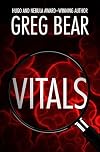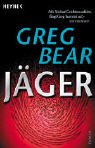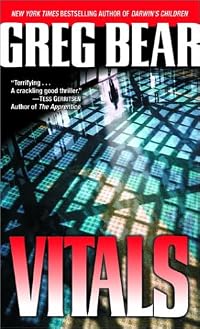
Vitals
by Greg Bear
On This Page
Description
Hal Cousins is one of a handful of scientists nearing the most sought after discovery in human history: the key to short-circuiting the aging process. Fueled by a wealth of research, an overdose of self-confidence, and the money of influential patrons to whom he makes outrageous promises, Hal experiments with organisms living in the hot thermal plumes in the ocean depths. But as he journeys beneath the sea, his other world is falling apart. Across the country, scientists are being show more inexplicably murdered--including Hal's identical twin brother, who is also working to unlock the key to immortality. Hal himself barely eludes a cold-blooded attack at sea, and when he returns home to Seattle, he finds himself walking into an eerie realm where voices speak to him from the dead ... where a once-brilliant historian turned crackpot is leading him on a deadly game of hide-and-seek ... and where the beautiful, rich widow of his twin is more than willing to pick up the pieces of Hal's life--and take him places he's never been before. Suddenly Hal is trapped inside an ever-twisting maze of shocking revelations. For he is not the first person to come close to ending aging forever--and those who came before him will stop at nothing to keep the secret to themselves. Now every person on earth is at risk of being made an unsuspecting player in one man's spectacular and horrifying master plan. From the bottom of Russia's Lake Baikal to a billionaire's bionic house built into the cliffs of the Washington seashore, from the darkest days of World War II and the reign of Josef Stalin to the capitalist free-for-all that is the United States, Vitals tells an astounding tale of the most unimaginable scientific secret of all--exposed by the quest for immortality itself. show lessTags
Recommendations













Member Reviews
Vitals by Greg Bear
I remember the fact of having read this book (in 2008), but no more than that. There’s something about “the little mothers” that resonated with me—and frightened me and stuck with me. It was only recently that I stumbled upon the book again and it all came back and inspired me to re-read Bear’s warning.
In 2003 Greg Bear painted a horrific picture of how humans could be manipulated by the very bacteria that make us what we are, much less keep us alive. While the basic story focuses on the mitochondria that form the basis of our genetic make-up, it’s only now that we can see how our gut bacteria are molding our physical and mental health…and desires. And that’s what makes this story so frightening. In show more “Vitals” Bear describes how the average man/woman on the street can be influenced to try to kill the protagonist and force him to try to hide from everyone—because he knows that anyone/everyone is capable of destroying him. How do you hide from ‘everyone’? Who can you trust? What does he know that makes him so dangerous to “someone”? This is a dark and gloomy tale with no real ending. And all the more exciting for being a bit prescient.
In Michael Pollan’s book “Cooked: A Natural History of Transformation”, his chapter on fermentation provides a most succinct statement of what we should be aware of, and why, while avoiding any scaremongering. And I definitely recommend “Super Gut” by Dr. William Davis, for more detail of how humans are manipulated by our gut bacteria for their own ends; and how to use them intentionally for our own ends. In fact, Davis gave me the strength to eliminate almost all sugar from my diet when he pointed out that my craving for sugar was caused by a particular bacteria, that feeds on sugar, manipulating me to “want” sugar…with all its negative effects on my body. After working with his recommended “good” bacteria for a few weeks I’ve come to accept his claims by seeing my “cravings” disappear.
And that’s why “Vitals” is so scary. Look up “Toxoplasma gondii” and read how this parasite manipulates mice so that they allow themselves to be eaten by cats so that the parasite can complete its life-cycle within the cat’s body. For sure, I don’t believe we have any real danger of someone gaining control over us in this way, but Bear’s story might frighten you into putting more attention into what you eat from now on. show less
I remember the fact of having read this book (in 2008), but no more than that. There’s something about “the little mothers” that resonated with me—and frightened me and stuck with me. It was only recently that I stumbled upon the book again and it all came back and inspired me to re-read Bear’s warning.
In 2003 Greg Bear painted a horrific picture of how humans could be manipulated by the very bacteria that make us what we are, much less keep us alive. While the basic story focuses on the mitochondria that form the basis of our genetic make-up, it’s only now that we can see how our gut bacteria are molding our physical and mental health…and desires. And that’s what makes this story so frightening. In show more “Vitals” Bear describes how the average man/woman on the street can be influenced to try to kill the protagonist and force him to try to hide from everyone—because he knows that anyone/everyone is capable of destroying him. How do you hide from ‘everyone’? Who can you trust? What does he know that makes him so dangerous to “someone”? This is a dark and gloomy tale with no real ending. And all the more exciting for being a bit prescient.
In Michael Pollan’s book “Cooked: A Natural History of Transformation”, his chapter on fermentation provides a most succinct statement of what we should be aware of, and why, while avoiding any scaremongering. And I definitely recommend “Super Gut” by Dr. William Davis, for more detail of how humans are manipulated by our gut bacteria for their own ends; and how to use them intentionally for our own ends. In fact, Davis gave me the strength to eliminate almost all sugar from my diet when he pointed out that my craving for sugar was caused by a particular bacteria, that feeds on sugar, manipulating me to “want” sugar…with all its negative effects on my body. After working with his recommended “good” bacteria for a few weeks I’ve come to accept his claims by seeing my “cravings” disappear.
And that’s why “Vitals” is so scary. Look up “Toxoplasma gondii” and read how this parasite manipulates mice so that they allow themselves to be eaten by cats so that the parasite can complete its life-cycle within the cat’s body. For sure, I don’t believe we have any real danger of someone gaining control over us in this way, but Bear’s story might frighten you into putting more attention into what you eat from now on. show less
Bear, Greg. Vitals. Del Rey, 2002.
Sometimes a good premise just isn’t enough. Vitals begins with a crew exploring deep sea volcanic vents for hoping to find primitive forms of life that may provide clues to the human aging process. All this is well explained, but then, most unfortunately, the plot moves into high gear and the novel becomes a true mess. I can buy that our hero’s brother might be murdered to find the secrets hidden in the biological research, but super villains appear, and the action gets hard to follow. When you can follow it, you wonder why you wonder why bothered. Greg Bear has done much better—almost always.
Sometimes a good premise just isn’t enough. Vitals begins with a crew exploring deep sea volcanic vents for hoping to find primitive forms of life that may provide clues to the human aging process. All this is well explained, but then, most unfortunately, the plot moves into high gear and the novel becomes a true mess. I can buy that our hero’s brother might be murdered to find the secrets hidden in the biological research, but super villains appear, and the action gets hard to follow. When you can follow it, you wonder why you wonder why bothered. Greg Bear has done much better—almost always.
Reading Vitals, Greg Bear's dark, suspenseful, paranoid thriller of high-tech bioterrorism, would be terrifying even without real-world anthrax attacks. But the news stories of late 2001 add layers of resonance to the book.
You'd think the secret of eternal life would be an eagerly awaited boon to humanity. Yet when cutting-edge researcher Hal Cousins travels deep below the ocean's surface in a two-man submersible, seeking primitive lifeforms that may hold the key to immortality, his pilot attacks him. Barely surviving, Hal maneuvers the sub to the surface--and finds a fellow scientist has shot up his research ship. Then his lab is destroyed, his twin brother leaves a mysterious message saying they're both being pursued by an unknown show more force, and his sister-in-law calls to tell him his twin, who is also researching life extension, has been murdered. Someone or something has already discovered the secret of eternal life. It has immense power and influence, and it will stop at nothing to protect its secret. --Cynthia Ward show less
You'd think the secret of eternal life would be an eagerly awaited boon to humanity. Yet when cutting-edge researcher Hal Cousins travels deep below the ocean's surface in a two-man submersible, seeking primitive lifeforms that may hold the key to immortality, his pilot attacks him. Barely surviving, Hal maneuvers the sub to the surface--and finds a fellow scientist has shot up his research ship. Then his lab is destroyed, his twin brother leaves a mysterious message saying they're both being pursued by an unknown show more force, and his sister-in-law calls to tell him his twin, who is also researching life extension, has been murdered. Someone or something has already discovered the secret of eternal life. It has immense power and influence, and it will stop at nothing to protect its secret. --Cynthia Ward show less
I've been a fan of Bear for a while, but Quantico failed to engage me, and unfortunately Vitals left me cold about half way through. It's a conspiracy theory based around a scientist's search for immortality, as a result of modifying bacteria in the body. It starts early, with shock after shock, building credibility with Bear's usual factual and informed approach to fiction. However, midway the story starts to rotate the central character, and although this is a vehicle to accelerate the plot and offer anther angle, it created a disjointed approach. As the end approached I had lost interest in the actual characters, although I was still intrigued enough regards the actual story to continue until the finale.
Vitals sets itself up as a novel about a scientist researching how to extend life through the use of certain bacteria, which is an interesting enough premise. Unfortunately, the book turned out to be a complete and utter mess, disappointing in so many ways. Hal Cousins is a scientist who seeks the favor of the super wealthy to fund his projects but things go haywire after his twin brother is murdered and his life begins to crumble around him. Ultimately the story becomes about this ancient scientist who was around in pre World War 2 Soviet Union and discovered bacteria that can mysteriously brainwash people and put them under his control. At least that’s what I think it was about, since it was so all over the place that I’m not even show more sure.
This novel is so utterly convoluted and hard to follow. It was almost as if the author was intentionally trying to confuse the reader, and after a while it caused me to lose interest. There is absolutely not a shred of believability to the novel. The premise is neat but the mechanics of the plot is groan inducing. The characterization in the novel is weak. There were loose plot points that were never resolved. It was solid for about the first quarter of the book before it became dreadful to read. I kept holding out hope that this novel would right itself and get better but that never came to fruition, and toward the end I just wanted it to be over. This was the first and last book by Greg Bear that I will read.
Carl Alves - author of Reconquest: Mother Earth show less
This novel is so utterly convoluted and hard to follow. It was almost as if the author was intentionally trying to confuse the reader, and after a while it caused me to lose interest. There is absolutely not a shred of believability to the novel. The premise is neat but the mechanics of the plot is groan inducing. The characterization in the novel is weak. There were loose plot points that were never resolved. It was solid for about the first quarter of the book before it became dreadful to read. I kept holding out hope that this novel would right itself and get better but that never came to fruition, and toward the end I just wanted it to be over. This was the first and last book by Greg Bear that I will read.
Carl Alves - author of Reconquest: Mother Earth show less
Good read, but kind of a downer. Inconclusive ending begs for a sequel.
Near future SF with a complex biological plot. Not one of my favourites of his
Members
- Recently Added By
Author Information

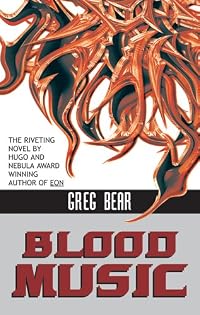
Greg Bear was born in San Diego, California, on August 20, 1951. He received a Bachelor of Arts degree from San Diego State University in 1973. At age 14, he began submitting pieces to magazines and at 15 he sold his first story to Robert Lowndes' Famous Science Fiction. It would be five years before he sold another piece, but by 23 he was selling show more stories regularly. He has written more than 30 science fiction and fantasy books and has won numerous awards for his work. In 1984, Hardfought and Blood Music won the Nebula Awards for best novella and novelette; Blood Music went on to win the Hugo Award. The novel version of that story, also called Blood Music, won the Prix Apollo in France. In 1987, Tangents won the Hugo and Nebula awards for best short story. He also won a Nebula in 1994 for Moving Mars and in 2001 for Darwin's Radio. Both Dinosaur Summer and Darwin's Radio have been awarded the Endeavour for best novel published by a Northwest science fiction author. He is also an illustrator and his work has appeared in Galaxy, Fantasy and Science Fiction, and Vertex, and in both hardcover and paperback books. He was a founding member of ASFA, the Association of Science Fiction Artists. His works include City at the End of Time, Hull Zero Three, The Mongoliad, Mariposa, Halo: Cryptum, Halo: Primordium and Halo: Silentium. (Bowker Author Biography) show less
Some Editions
Awards and Honors
Series
Belongs to Publisher Series
Heyne Allgemeine Reihe (13759)
Common Knowledge
- Original title
- Vitals
- Original publication date
- 2002-01-02
- Epigraph
- My mitochondria compose a very large proportion of me. I cannot do the calculation, but I suppose there is almost as much of them in sheer dry bulk as there is the rest of me. Looked at in this way, I could be taken for a l... (show all)arge, motile colony of bacteria, operating as a complex system of nuclei, micro-tubules, and neurons, for the pleasure and sustenance of their families, and running, at the moment, a typewriter.
--Lewis Thomas, "Organelles as Organism," 1974
We love Comrade Stalin more than Mommy and Daddy. May Comrade Stalin live to be one hundred! Now, two hundred! No, three hundred!
--Song sung by Soviet children, early 1950s. - Dedication
- Poul Anderson (For Poul Anderson, my friend, who long ago decided not to)
- First words
- The last time I talked to Rob, I was checking my luggage at Lindbergh Field to fly to Seattle and meet with an angel.
- Last words
- (Click to show. Warning: May contain spoilers.)My stomach hurts.
- Original language*
- Inglés
*Some information comes from Common Knowledge in other languages. Click "Edit" for more information.
Classifications
Statistics
- Members
- 913
- Popularity
- 29,180
- Reviews
- 14
- Rating
- (3.15)
- Languages
- English, French, German, Spanish
- Media
- Paper, Audiobook, Ebook
- ISBNs
- 19
- UPCs
- 1
- ASINs
- 9