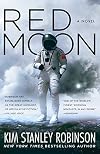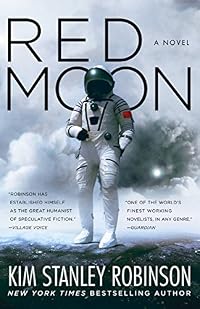
Red Moon
by Kim Stanley Robinson
On This Page
Description
"It is twenty-five years since China established the first colony on the moon, and the lives of three people are about to collide. American Fred Fredericks is making his first trip there, his purpose to install a communications system for China's Lunar Science Foundation. But hours after his arrival he witnesses a murder and is forced into hiding. It is also the first visit to the moon for celebrity travel reporter Ta Shu. He has contacts and influence, but he too will find that the moon can show more be a perilous place for any traveler. Finally, there is Chan Qi. Daughter of the Minister of Finance, and without doubt a person of interest to those in power. She is on the moon for reasons of her own, but when she attempts to return home to China, in secret, the events that unfold will change everything - on the moon, and on Earth"-- show lessTags
Recommendations











Member Reviews
More often than not a Kim Stanley Robinson book is on my list of yearly favorites. This is both a tribute to his productivity as a writer, and to his poetic and thoughtful style. I’ve been hooked ever since his acclaimed Mars Trilogy from the early 1990s beginning with Red Mars, the long tale of the terraforming of that planet.
But Robinson has written many other worthy and delightful books, all with fidelity to the science, linguistic experimentalism, and an introspective narrative voice, distinct and unmistakable.
In Red Moon, he turns his attention to the near-future politics of lunar life, China having gained ascendancy there. It is no surprise that his vision of the human experience on the moon is convincing and informed, from the show more challenges of locomotion to the perception of Sun and Earth from the lunar surface. As with many of Robinson’s novels, his utopian aspirations and concerns for the future of humanity rest close at hand. This inspires some and tires others. I’m in the former camp. This book also feels like the author’s attempt to grapple with the rise of the world’s future hegemon. Chinese society thirty years hence is energetic and vibrant, riven and restrictive. I found the grand stew that is Red Moon quintessential Robinson. show less
But Robinson has written many other worthy and delightful books, all with fidelity to the science, linguistic experimentalism, and an introspective narrative voice, distinct and unmistakable.
In Red Moon, he turns his attention to the near-future politics of lunar life, China having gained ascendancy there. It is no surprise that his vision of the human experience on the moon is convincing and informed, from the show more challenges of locomotion to the perception of Sun and Earth from the lunar surface. As with many of Robinson’s novels, his utopian aspirations and concerns for the future of humanity rest close at hand. This inspires some and tires others. I’m in the former camp. This book also feels like the author’s attempt to grapple with the rise of the world’s future hegemon. Chinese society thirty years hence is energetic and vibrant, riven and restrictive. I found the grand stew that is Red Moon quintessential Robinson. show less
Robinson’s first book was first published in 1984, and there are many sf reviewers and voters these days who won’t read him for that reason. It’s true that Robinson writes a particular type of science fiction, but after nearly forty years he’s got pretty damn good at it. Better than some random debut author, anyway. Not every Robinson book has impressed me, although he has consistently produced work that I think speaks more to science fiction than many sf writers. Red Moon is… mostly a good sf novel. It reads, in parts, like off-cuts from the Mars trilogy. And the whole set-up does seem somewhat… accelerated for being set thirty years from now. Red Moon is definitely techno-utopian, and I’d sooner see sf like that than show more some jack-booted interstellar slavery space opera, which is all too sadly common these days, but that doesn’t mean I can’t criticise its vision or the points Red Moon makes. A US engineer who works for a Swiss firm delivers a qubit-entangled phone to the head of the Chinese settlement about the south pole of the Moon. Except the Chinese official dies seconds after meeting the engineer, who himself is rendered seriously ill, and he’s charged with murder by poison. It’s all about factions within the Chinese government, and partly related to the daughter of one minister who is the figurehead of a movement to seek justice for internal migrants within China. There’s a whole lot of stuff going on here, mostly to do with China’s recent history and its government; but there’s also a lot about the colonisation of the Moon – not just by the Chinese, but also the Americans and a group of techno-utopian freethinkers who run their own lunar colony (whose precepts I don’t think actually work because they rely on defined identities). I think Robinson’s timeline for the novel is somewhat unrealistic, although I can see how his story forced him into that situation. And I can disagree with the political arc of the story. I likely can’t say this enough: Red Moon is a novel about politics, and the politics in the novel are laid out for discussion. Unlike far too many sf novels where the politics is baked into the world-building, and a rejection of the politics is by definition a rejection of the entire novel. Red Moon is not the best novel Robinson has written, but is ample demonstration of why his novels are worth reading. Each new one has added something to the genre ur-conversation, whether you like them, or agree with them, or not. show less
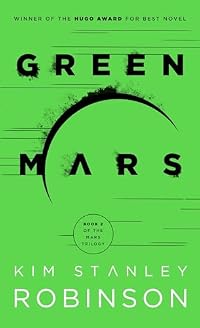
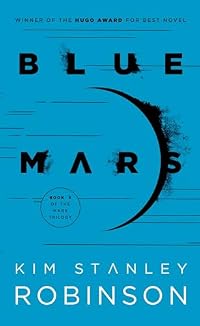
Kim Stanley Robinson's best-known work is probably his 1990s Mars series - Red Mars, Green Mars, and Blue Mars - about the settlement and terraforming of Mars from the points of view of its first 100 settlers. Toward the end of the trilogy, someone says that the people of Mars have eliminated patriarchy and capitalism, over a couple of centuries. In this book, Robinson's latest, those goals appear much further off.
Earth's Moon is figuratively red in 2047 because China has built much the largest base there, at its South Pole. Lunar development by China and other nations is peaceful and collegial, but no place is free of politics. An American, Fred Fredericks, is tasked with delivering a quantum-entanglement communications device to the show more chief of the Chinese station; the gadget will permit untappable communication with the unknown person at the device's other end. The chief is assassinated and Fred is framed for the murder, setting off a series of captures, escapes, and chases both on the Moon and on Earth.
Fred's fate becomes linked to Chan Qi, a Chinese "princessling". Her father, the "tiger" who heads up the Finance Ministry, is one of China's most powerful men, and she could inherit his power. But Qi has radical, dangerous ideas about transferring power from the Chinese Communist Party to the people. She is pursued or aided by various factions within the country. The two are observed, and helped, by Ta Shu, an elderly poet and media personality whose popularity as a broadcaster gives him a small measure of political power. Ta Shu also counts another powerful "tiger" as a former student. Meanwhile, an anonymous, powerful intelligence operative is training an AI to be an agent among the world's networks. Everyone's personal story is connected to a worldwide economic and governmental crisis in both China and the United States; civil unrest is rising in both societies, and may be put down with military violence. The quantum entanglement devices and computers, where Fred's expertise lies, serve as metaphor for the social, economic, and political entanglements connecting every human being. Can friendship compete with panopticon social media, capitalism, and governmental structures in refiguring a great nation? Fred is on the Asperger's spectrum, giving him an outsider's viewpoint on society that serves as an entryway for the reader. The Moon's lifeless, deadly surface reminds us of the fragility of the human world - as does Qi's pregnancy, progressing throughout the course of the story.
This novel feels like the author's attempt to get a handle on modern China and its march toward becoming the next world hegemon. We see a lot of China, and a lot about how things work there three decades from now. The sleek technology of the Moon settlements is contrasted with Ta Shu's older, more poetic sensibility - yet he, too, is involved in the modern world. Robinson is a utopian writer, but also a realist about history, seeing its complexity and rejecting easy tales of renewal. His utopian hopes are still there, but more shaded than in his 1990s books. His imagined "carboncoin," a blockchain-based money minted by removing CO2 from the biosphere, is a fun idea. If money is a socially constructed illusion, can we substitute a better one? But in the end carboncoin is satirical, and not fleshed out in any way.
The book ends rather abruptly, with Fred and Qi on the run, aided by powerful allies but still in peril. I fear this may indicate an unannounced sequel to come; a publishing practice we need less of. The story as it stands reads perfectly well; no such sequel is needed. I think Red Moon doesn't give us a real understanding of China here, but then what novel could? show less
Earth's Moon is figuratively red in 2047 because China has built much the largest base there, at its South Pole. Lunar development by China and other nations is peaceful and collegial, but no place is free of politics. An American, Fred Fredericks, is tasked with delivering a quantum-entanglement communications device to the show more chief of the Chinese station; the gadget will permit untappable communication with the unknown person at the device's other end. The chief is assassinated and Fred is framed for the murder, setting off a series of captures, escapes, and chases both on the Moon and on Earth.
Fred's fate becomes linked to Chan Qi, a Chinese "princessling". Her father, the "tiger" who heads up the Finance Ministry, is one of China's most powerful men, and she could inherit his power. But Qi has radical, dangerous ideas about transferring power from the Chinese Communist Party to the people. She is pursued or aided by various factions within the country. The two are observed, and helped, by Ta Shu, an elderly poet and media personality whose popularity as a broadcaster gives him a small measure of political power. Ta Shu also counts another powerful "tiger" as a former student. Meanwhile, an anonymous, powerful intelligence operative is training an AI to be an agent among the world's networks. Everyone's personal story is connected to a worldwide economic and governmental crisis in both China and the United States; civil unrest is rising in both societies, and may be put down with military violence. The quantum entanglement devices and computers, where Fred's expertise lies, serve as metaphor for the social, economic, and political entanglements connecting every human being. Can friendship compete with panopticon social media, capitalism, and governmental structures in refiguring a great nation? Fred is on the Asperger's spectrum, giving him an outsider's viewpoint on society that serves as an entryway for the reader. The Moon's lifeless, deadly surface reminds us of the fragility of the human world - as does Qi's pregnancy, progressing throughout the course of the story.
This novel feels like the author's attempt to get a handle on modern China and its march toward becoming the next world hegemon. We see a lot of China, and a lot about how things work there three decades from now. The sleek technology of the Moon settlements is contrasted with Ta Shu's older, more poetic sensibility - yet he, too, is involved in the modern world. Robinson is a utopian writer, but also a realist about history, seeing its complexity and rejecting easy tales of renewal. His utopian hopes are still there, but more shaded than in his 1990s books. His imagined "carboncoin," a blockchain-based money minted by removing CO2 from the biosphere, is a fun idea. If money is a socially constructed illusion, can we substitute a better one? But in the end carboncoin is satirical, and not fleshed out in any way.
The book ends rather abruptly, with Fred and Qi on the run, aided by powerful allies but still in peril. I fear this may indicate an unannounced sequel to come; a publishing practice we need less of. The story as it stands reads perfectly well; no such sequel is needed. I think Red Moon doesn't give us a real understanding of China here, but then what novel could? show less
Kim Stanley Robinson’s Red Moon will be different things to different people. Science Fiction fans will embrace this near future novel because so much of it takes place on the moon in the year 2047 – and because Robinson hits relatively heavily on the scientific aspects of exploring and colonizing the moon. Thriller fans will be equally entertained because of the long, involved chase of the novel’s two central characters by some very powerful and evil people, a chase that sees Fred Fredericks and Chan Qi in great danger whether they are trying to hide on Earth or on the moon. Fans of novels about political infighting are likely to be intrigued by Robinson’s insights into how the Chinese government functions and how tenuously it show more holds itself together in moments of succession at the top. And those who enjoy learning history via solid historical fiction, are going to be left with a lot to think about when they turn the final page of Red Moon.
Fred Fredericks, to be kind, is a rather shy, naïve young American traveling to the moon to deliver some communications hardware to the Chinese colony for his Swiss employer. It is Fred’s first trip to the moon, making it easy for him to befriend the elderly Chinese poet/television personality who is also landing on the moon for the first time. The two men bond over their shared fear that their landing craft is approaching the moon’s surface much too rapidly for anyone to survive the looming crash. By the time that a landing so gentle that neither man felt it has been accomplished, the two are fast friends.
But Fred, unbeknownst to him, had more than a lunar landing to worry about because almost immediately he is caught up in a Chinese power struggle that leaves him on the run with Chan Qi, the pregnant daughter of an influential Chinese politician. Fred is accused of a crime he has no memory of, and Chan Qi is believed to be behind the massive political protests taking place on Earth. Now both of them are running for their lives, and neither Earth nor the moon is a big enough place for them to hide.
Red Moon has a lot going for it. Robinson always takes the “science” part of “Science Fiction” seriously, and among the other aspects of colonial life on the moon he explores, he has particular fun revealing the difficulties of moving around in a gravity only one-sixth of Earth’s – which proves to be a major problem for someone as unathletic as Fred. The book’s plot is certainly thriller-like, but Robinson never gets in a big hurry to move it along. Instead, he spends as much time developing his main characters – especially the budding relationship between Fred and Chan Qi – as he does moving them in and out of danger. The novel is highly atmospheric, even to the point that Robinson is never afraid to slow the action down long enough to describe an earthrise or some exotic lunar location Fred and Chan Qi are traveling through.
Bottom Line: Red Moon is science fiction with a message. It manages to combine philosophy, politics, and scientific speculation in a manner that remains entertaining from the first page to the last, and it moves along at just the right pace to do that. But if you prefer your thrillers to maintain a frantic pace from beginning to end, Red Moon may not be for you. My one quibble with the book is that it ended before I expected it to end, leaving me with a few unanswered questions to wonder about. show less
Fred Fredericks, to be kind, is a rather shy, naïve young American traveling to the moon to deliver some communications hardware to the Chinese colony for his Swiss employer. It is Fred’s first trip to the moon, making it easy for him to befriend the elderly Chinese poet/television personality who is also landing on the moon for the first time. The two men bond over their shared fear that their landing craft is approaching the moon’s surface much too rapidly for anyone to survive the looming crash. By the time that a landing so gentle that neither man felt it has been accomplished, the two are fast friends.
But Fred, unbeknownst to him, had more than a lunar landing to worry about because almost immediately he is caught up in a Chinese power struggle that leaves him on the run with Chan Qi, the pregnant daughter of an influential Chinese politician. Fred is accused of a crime he has no memory of, and Chan Qi is believed to be behind the massive political protests taking place on Earth. Now both of them are running for their lives, and neither Earth nor the moon is a big enough place for them to hide.
Red Moon has a lot going for it. Robinson always takes the “science” part of “Science Fiction” seriously, and among the other aspects of colonial life on the moon he explores, he has particular fun revealing the difficulties of moving around in a gravity only one-sixth of Earth’s – which proves to be a major problem for someone as unathletic as Fred. The book’s plot is certainly thriller-like, but Robinson never gets in a big hurry to move it along. Instead, he spends as much time developing his main characters – especially the budding relationship between Fred and Chan Qi – as he does moving them in and out of danger. The novel is highly atmospheric, even to the point that Robinson is never afraid to slow the action down long enough to describe an earthrise or some exotic lunar location Fred and Chan Qi are traveling through.
Bottom Line: Red Moon is science fiction with a message. It manages to combine philosophy, politics, and scientific speculation in a manner that remains entertaining from the first page to the last, and it moves along at just the right pace to do that. But if you prefer your thrillers to maintain a frantic pace from beginning to end, Red Moon may not be for you. My one quibble with the book is that it ended before I expected it to end, leaving me with a few unanswered questions to wonder about. show less
Let's be real here. I didn't come to KSR's dinner table for a simple adventure story.
I always come to eat a novel so rich with ideas that I tent to forget that there's a core story underneath all the cool bits of political revolution, economic warfare, the problem of representation, quantum intelligence, cultural identity, and of course... CHANGE.
But like a rice dish with WAY too many spices, the core story to this novel is somewhat overwhelmed by this plethora of great ideas.
Did I enjoy the characters represented? The popular-revolution pregnant-princess on the run with an American quantum physicist as they hop throughout the heart of China and the moon, angling toward a war of hearts, minds, and wallets?
Yeah. I did. :) But it was show more downright SUBTLE compared to the rich mess of other ideas popping all around me!
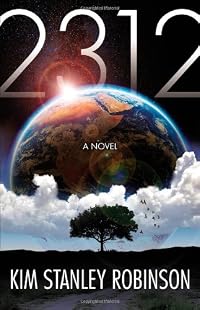
In this respect, it's quite on par with [b:2312|11830394|2312|Kim Stanley Robinson|https://images.gr-assets.com/books/1405778758s/11830394.jpg|16785236]. Less space-opera, more revolution, and very wonderfully full of Chinese. :) show less
I always come to eat a novel so rich with ideas that I tent to forget that there's a core story underneath all the cool bits of political revolution, economic warfare, the problem of representation, quantum intelligence, cultural identity, and of course... CHANGE.
But like a rice dish with WAY too many spices, the core story to this novel is somewhat overwhelmed by this plethora of great ideas.
Did I enjoy the characters represented? The popular-revolution pregnant-princess on the run with an American quantum physicist as they hop throughout the heart of China and the moon, angling toward a war of hearts, minds, and wallets?
Yeah. I did. :) But it was show more downright SUBTLE compared to the rich mess of other ideas popping all around me!
In this respect, it's quite on par with [b:2312|11830394|2312|Kim Stanley Robinson|https://images.gr-assets.com/books/1405778758s/11830394.jpg|16785236]. Less space-opera, more revolution, and very wonderfully full of Chinese. :) show less
The near future. China has established an elaborate moonbase. A great power dance between it and a much-reduced USA is underway; the two powers are sometimes called the 'G2'. Leadership struggles within the Party are another backdrop to this novel, along with the emergence of AI. Two fugitives: Party princess and activist Chan Qi and American quantum mechanics nerd Fred Fredericks become embroiled in these ambient politics and fly back and forth from the moon to escape pursuit. Along the way we are shown glimpses of Moon ("Lunatic") culture and the fragmented surveillance state of China.
This book was written before the pandemic of 2020 so it doesn't cover China's subsequent dip in population and economic power; but it does look at AI, show more which didn't enter public consciousness until 2023.
As is often the case with KSR novels, neither plot nor characters are fully the focus. Some of the novel is also a 'tour guide of the future' (a bit like Green Mars or 2312 by the same author); at least of the engineering and technology deployed to the Moon. I found the character of Fred Fredericks particularly annoying - an autistic, socially and culturally ignorant quantum mechanic nevertheless sent by his Swiss company with no translator or assistant to the Chinese moonbase to deliver and set up a quantum phone (entangled with exactly one other such device). Chan Qi didn't have a whole lot more depth as an aristocratic Chinese agitator. Their deepening relationship as fellow fugitives was similar but less convincing than than that of the protagonists of 2312. show less
This book was written before the pandemic of 2020 so it doesn't cover China's subsequent dip in population and economic power; but it does look at AI, show more which didn't enter public consciousness until 2023.
As is often the case with KSR novels, neither plot nor characters are fully the focus. Some of the novel is also a 'tour guide of the future' (a bit like Green Mars or 2312 by the same author); at least of the engineering and technology deployed to the Moon. I found the character of Fred Fredericks particularly annoying - an autistic, socially and culturally ignorant quantum mechanic nevertheless sent by his Swiss company with no translator or assistant to the Chinese moonbase to deliver and set up a quantum phone (entangled with exactly one other such device). Chan Qi didn't have a whole lot more depth as an aristocratic Chinese agitator. Their deepening relationship as fellow fugitives was similar but less convincing than than that of the protagonists of 2312. show less
I've read a handful of books by Kim Stanley Robinson and if there's one thing I can say for sure about him, it's that he really puts the science in science fiction. As much as I liked the Mars trilogy, what I remember most about them is slogging my way through dozens of pages that I couldn't understand. Red Moon definitely had paragraphs here and there that did the same thing, but I don't think it took away from the story. Or maybe I'm wrong, and someone who actually knows a thing about science would get something completely different from this book than I did.
Even without understanding the scientific descriptions, I liked Red Moon. It was part sci-fi, part revolutionary tale, part murder mystery. Not all the characters were able to show more hold my interest, but the three main folks kept me turning the pages. There are uprisings happening in both the US and China in the near future and all the characters of this book are wrapped up in them one way or another. Even though the action is happening on Earth, the politics are carrying over to the Moon, where many countries have bases set up, but China has the biggest presence. The characters bounce back and forth between to the locations (mostly China on Earth and the poles of the Moon), as they're trying to outwit people who want to take them prisoner and kill them.
As anyone who has read KSR could probably guess, this is a fat book. But unlike some others, the pages turn easily. I found myself halfway through before I realized, and the story was entertaining enough to distract me from the rough time I'm having with life right now. As much as I liked it though, it probably wouldn't even be in the top ten books I read this year. show less
Even without understanding the scientific descriptions, I liked Red Moon. It was part sci-fi, part revolutionary tale, part murder mystery. Not all the characters were able to show more hold my interest, but the three main folks kept me turning the pages. There are uprisings happening in both the US and China in the near future and all the characters of this book are wrapped up in them one way or another. Even though the action is happening on Earth, the politics are carrying over to the Moon, where many countries have bases set up, but China has the biggest presence. The characters bounce back and forth between to the locations (mostly China on Earth and the poles of the Moon), as they're trying to outwit people who want to take them prisoner and kill them.
As anyone who has read KSR could probably guess, this is a fat book. But unlike some others, the pages turn easily. I found myself halfway through before I realized, and the story was entertaining enough to distract me from the rough time I'm having with life right now. As much as I liked it though, it probably wouldn't even be in the top ten books I read this year. show less
Members
- Recently Added By
Lists

2019 Hugo Eligible Novels
40 works; 12 members

Read Next
5 works; 1 member

2018 New SF Releases
24 works; 1 member

Books Read in 2018
4,360 works; 110 members

Books Read in 2021
5,361 works; 114 members
Author Information

143+ Works 49,331 Members
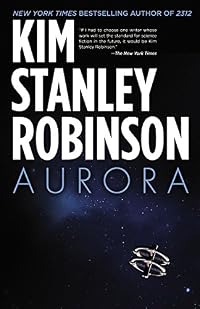
Kim Stanley Robinson was born in Orange County, California on March 23, 1952. He received a B. A. and Ph. D. from the University of California at San Diego and an M. A. from Boston University. His first trilogy of books, Orange County, collectively won a Nebula Award and two Hugo Awards. His other works include the Mars trilogy, 2312, and Aurora. show more He has won an Asimov Award, a World Fantasy Award, a Locus Reader's Poll Award, and a John W. Campbell Award. (Bowker Author Biography) show less
Some Editions
Awards and Honors
Awards
Common Knowledge
- Canonical title*
- Roter Mond
- Original publication date
- 2018-10-23
- People/Characters
- Fred Fredericks; Chan Qi; Ta Shu
- Important places
- The Moon; China; Hong Kong
- First words
- Someone had told him not to look while landing on the moon, but he was strapped in his seat right next to a window and could not help himself: he looked.
- Quotations
- The withouts and the young people have joined together into something called a householders' union, and now they're all withdrawing whatever they have in the banks and converting their savings to a cryptocurrency called carbo... (show all)ncoin. Basically they've started a political run on the banks, and the banks are so over leveraged that they've had to close.mand that's caused a general panic. It looks like their federal government will soon nationalize their banks to stabilize their economy.
- Last words
- (Click to show. Warning: May contain spoilers.)"I don't know."
- Publisher's editor
- Holman, Tim
- Original language
- English
*Some information comes from Common Knowledge in other languages. Click "Edit" for more information.
Classifications
Statistics
- Members
- 661
- Popularity
- 43,402
- Reviews
- 25
- Rating
- (3.37)
- Languages
- 6 — English, French, German, Hungarian, Italian, Spanish
- Media
- Paper, Audiobook, Ebook
- ISBNs
- 25
- ASINs
- 6