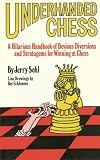
Underhanded Chess: A Hilarious Handbook of Devious Diversions and Stratagems for Winning at Chess
by Jerry Sohl
On This Page
Description
With tongue in cheek and laughter aforethought, Jerry Sohl takes his readers on a merry romp through all the deceits and tricks of one-upmanship as it is practiced in the game of chess. Drawing from his own experiences, he sets out in amusing detail a host of put-offs, come-ons, psychological maneuverings, lures, and frauds to accomplish checkmate. All illustrated with drawings by artist Roy Schlemme.The author's inventiveness is limitless. All kinds of ploys are carefully described: the show more amazing effectiveness of reverse polarity; adopting some of Bobby Fischer's tactics; the Freudian gambit; the Blencher; the Hassled Castle; befuddling rule fanatics; talking your way to victory; coffeehouse counter-gambits; when and how to lose; advanced duplicity; and chess of the last resort.TABLE OF CONTENTS:1: THE FIRST MOVE2: PRELIMINARIES AND PREPARATIONS3: THE PROPER SPIRIT4: HOW TO TALK A GOOD GAMBIT5: HOW TO BEFUDDLE RULE FANATICS6: HOW TO PLAY AGAINST WEIRDOS7: COFFEEHOUSE CHESS COUNTERGAMBITS8: WHEN TO LOSE9: ADVANCED DUPLICITY10: DESPERATE MOVES CHESS OF THE LAST RESORTAPPENDIX: USEFUL TRIVIA show lessTags
Recommendations



















Member Recommendations


Member Reviews
Sohl's Underhanded Chess is a quick read, and entertaining enough for anyone fond of chess who has a little sociopathic streak. No, honestly, it is pretty funny throughout, whether analyzing Bobby Fischer's methods of psyching out Boris Spassky, recounting anecdotes from Sohl's own games, or offering hypothetical tactics to disorient and demoralize chess opponents.
All of this is for entertainment purposes only, of course. You wouldn't really (often) want to win a chess game so badly that you would arrange for duplicitous confederates, work up conversational routines for the sole purpose of distracting your opponent, or specially engineer the furniture to discomfit him. But if winning really is the chief priority, Sohl suggests quite a show more few devastating rudenesses, and sagely notes, "Then you say you're sorry. You can always be sorry." (40)
The high point for me was chapter six, "How to Play against Weirdos," full of funniness about players who see fairies and perform divinations. Yet here the author also observes, "Just the same, it really does come down to a hard embrace of this question: Whose magic is more powerful, yours or his?" (65) (On a related note, occultists who read this book will have an opportunity to recognize the chess aptitude of Aufnahmevermoegen as a crucial faculty in the development and deployment of the subtle body.)
There is an appendix on "Useful Trivia," but a second promised appendix, to inventory names of various obscure openings, variations, and stratagems, is absent. show less
All of this is for entertainment purposes only, of course. You wouldn't really (often) want to win a chess game so badly that you would arrange for duplicitous confederates, work up conversational routines for the sole purpose of distracting your opponent, or specially engineer the furniture to discomfit him. But if winning really is the chief priority, Sohl suggests quite a show more few devastating rudenesses, and sagely notes, "Then you say you're sorry. You can always be sorry." (40)
The high point for me was chapter six, "How to Play against Weirdos," full of funniness about players who see fairies and perform divinations. Yet here the author also observes, "Just the same, it really does come down to a hard embrace of this question: Whose magic is more powerful, yours or his?" (65) (On a related note, occultists who read this book will have an opportunity to recognize the chess aptitude of Aufnahmevermoegen as a crucial faculty in the development and deployment of the subtle body.)
There is an appendix on "Useful Trivia," but a second promised appendix, to inventory names of various obscure openings, variations, and stratagems, is absent. show less
Note: the majority of the ideas suggested are illegal in tournement play. However, this is a very funny book for anyone who's ever played chess and really, really wanted to win. i.e every chess player, ever. Even non-chess players might find the lengths that some players will go to to win entertaining.
I remember this book as only mildly entertaining, and I hope no one took it seriously. It did inspire me to read more about Bobby Fischer's games, though.
Ratings
Members
- Recently Added By
Lists

Guilty Pleasures
223 works; 86 members
Author Information

63+ Works 756 Members
All Editions
Common Knowledge
- Canonical title
- Underhanded Chess: A Hilarious Handbook of Devious Diversions and Stratagems for Winning at Chess
- Original publication date
- 1973
- People/Characters
- Bobby Fischer; Wendell Ridgeway; Walter Kennerdell
- Epigraph
- "Moral victories do not count." International Grandmaster Savielly Grigorievitch Tartakover
- First words
- Ordinarily you're a pretty normal guy.
- Last words
- (Click to show. Warning: May contain spoilers.)Only a boor would try to take a game from a dying man.
Classifications
Statistics
- Members
- 39
- Popularity
- 748,599
- Reviews
- 4
- Rating
- (4.00)
- Languages
- English
- Media
- Paper, Ebook
- ISBNs
- 2
- ASINs
- 1