On This Page
Description
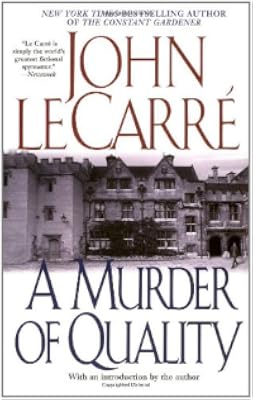
Beautifully intelligent, satiric and witty - Daily Telegraph For Alisa Brimley, editor of the small magazine Christian Voice, receiving a letter from a longtime subscriber might otherwise be a perfectly normal occasion-except Stella Rode, the reader in question, writes that her husband is planning to kill her. Brimley calls upon an old wartime friend to help her investigate: retired Circus spy, George Smiley. Before Smiley can begin, Rode is found murdered, and Brimley asks Smiley to venture show more to the small town of Carne, home of the elite Carne School where Rode's husband is a public school junior master. Once there, he sets about peeling back the layers of pretense and artifice that cloak both town and institution, and discovers that there's more to Rode's murder than a simple crime of passion. John le Carré's second novel finds George Smiley in a classic whodunnit-style mystery. Trading the international intrigue of the Circus for the small village of Carne, A Murder of Quality is a deft examination of another uniquely British institution: the elite public school. show lessTags
Recommendations






















Member Recommendations
Member Reviews
George Smiley has retired from 'The Service" having turned away from intelligence work. Contemplating retirement he receives a call from Ailsa Brimley, an old wartime colleague, who is concerned that a murder is about to take place at the Carne public school in south west England. One of the schoolmaster's wive has written to Brimley claiming that her husband is plotting to kill her. Before Smiley can intervene on Brimley's behalf, the woman is murdered and he finds himself on his way to Carne seeking to contribute to the police investigation.
This turned out to be something very different to what I was expecting. Le Carre, Smiley- it's got to be Cold War spies, surely? No, no, no, this is a murder mystery set in a public school. So that show more was a surprise, but nonetheless this is a really good murder mystery. The plot is suitably thick and the denouement unexpected. The writing rich and skilful and turns something that could easily be an Agatha Christie Miss Marple novel into something of much greater quality and interest. It's of it's time (1962) and I suppose chronicles the tawdriness of the dying public school system. It's a damning indictment of what is deemed 'seemly' and the wafer thin veneer of manners and respectability that can cover up wickedness, bullying and criminality. An enjoyable read, but with the first two Smiley novels turning out to be whodunnits, I find myself wondering how the character morphs into the master spy depicted in the later iterations. show less
This turned out to be something very different to what I was expecting. Le Carre, Smiley- it's got to be Cold War spies, surely? No, no, no, this is a murder mystery set in a public school. So that show more was a surprise, but nonetheless this is a really good murder mystery. The plot is suitably thick and the denouement unexpected. The writing rich and skilful and turns something that could easily be an Agatha Christie Miss Marple novel into something of much greater quality and interest. It's of it's time (1962) and I suppose chronicles the tawdriness of the dying public school system. It's a damning indictment of what is deemed 'seemly' and the wafer thin veneer of manners and respectability that can cover up wickedness, bullying and criminality. An enjoyable read, but with the first two Smiley novels turning out to be whodunnits, I find myself wondering how the character morphs into the master spy depicted in the later iterations. show less
'A Murder Of Quality' is a book fuelled by hatred and compassion. Hatred for minor public schools in post-war England and compassion for the people who staffed and attended them.
Le Carré vivisects the vanity, cruelty, mediocrity and relentless conformity of an English boarding school with an insight that only someone who has suffered through such a place can bring. He shows that the school is more concerned with instilling loyalty to one's class and a belief in one's superiority and entitlement than it is with either educating or caring for the boys who attend it. He captures the claustrophobia and myopia of living in an enclosed institution that turns staff and boys into inmates bound together by their shared incarceration.
Le show more Carré's compassion for the masters and the boys is what prevents this book from becoming a polemic. Le Carré shows Masters who understand the hollowness of the life they lead, who know that the war left their school short on teaching talent and out of step with the mood of the times, and who, knowing this cling to the status afforded them by tradition and class. The boys he shows as abandoned by their parents, brutalised by their school, burdened with expectation and starving for any form of kindness.
'At its heart 'A Murder Of Quality' is a good murder mystery., with a complex plot, an intriguing setting and a memorable main character.
George Smiley, a quiet, unobtrusive man with no positional authority, makes the perfect amateur sleuth to investigate a death at the school. He comes from the same class and educational background as the Masters but does not share their world view. He has connections to the local gentry but has no affection for them. He is armed with personal introductions to the local police and has access to the players that they can never achieve. Smiley sees the world clearly. So clearly that he has no expectations of anyone other than that they will behave like the flawed people that we all are.
Smiley is capable of both insight and empathy but he remains emotionally distant. He pursues the truth with a quiet, calm relentlessness. He doesn't get caught up in the joy of the chase. He's not playing a game. Rather, he's resigned to uncovering the veniality and weakness and anger and shame that leads someone to murder and the unpleasant necessity of holding them to account.
The puzzle Smiley has to solve is not straight forward and its resolution contained a number of surprises which made me reassess everything I thought I knew but didn't leave me feeling cheated.
The novel is only 177 pages long yet it is filled with clearly drawn believable, memorable characters whose presence transforms what could have been a puzzle-solving exercise into a set of personal tragedies.
Published in 1961, 'A Murder Of Quality' was Le Carré's second novel. His third novel, 'The Spy Who Came In From The Cold', another George Smiley book, established Le Carré as a leading writer of spy fiction. It seems to me that, based on reading this novel, that if spy fiction hadn't worked out for him, he could have gone on to become a master of crime fiction. show less
This is Le Carre's second published Smiley novel. Like the first one, Call for the Dead, this is much less well remembered now than his later novels. Unlike its predecessor and also unlike most of its successors, it is not a spy novel, simply a very English murder mystery. While set around 1960, the feel of the novel was I thought redolent of the 1930s mysteries of Agatha Christie or Ethel Lina White. Stella Rode, the wife of a staff member of an exclusive private school, Carne School in the south west of England, is found murdered. Smiley is called in to investigate by a former wartime colleague of his in British intelligence Ailsa Brimley, who now edits a Christian magazine to which the murdered woman had reached out for support. show more There is of course the expected range of red herrings and twists and turns, but I found the final plot resolution a little confusing. The novel felt very much of it own, or as I have said, an earlier time, and I also found it difficult to relate to or feel empathy with any of the characters. That said, I quite enjoyed this novel and have slightly warmed to the notion of reading the Smiley and other Le Carre novels I have not read before. show less
Aside from being a decent mystery (some of the characters are spies, but not essentially a spy novel), it is the most devastating send up of English public schools since Waugh's Decline and Fall. D'Arcy, Fielding, et al. deserve Wackford Squeers as a headmaster.
Le Carré has a talent for striking prose and images:
"Gloom and cold. The cold was crisp and sharp as flint. It cut the faces of the boys as they moved slowly from the deserted playing fields after the school match. It pierced their black topcoats and turned their stiff pointed collars into icy rings around their necks."
"Fielding talked on, at random and always in superlatives, sometimes groping in the air with his hand as if to catch the more elusive metaphors; now of his show more colleagues with caustic derision; now of the boys with compassion if not with understanding; now of the Arts with fervour--and the studied bewilderment of the lonely disciple."
Much of Carne is captured in these short passages. The mystery is really carried more by the quality of the writing than anything else. show less
Le Carré has a talent for striking prose and images:
"Gloom and cold. The cold was crisp and sharp as flint. It cut the faces of the boys as they moved slowly from the deserted playing fields after the school match. It pierced their black topcoats and turned their stiff pointed collars into icy rings around their necks."
"Fielding talked on, at random and always in superlatives, sometimes groping in the air with his hand as if to catch the more elusive metaphors; now of his show more colleagues with caustic derision; now of the boys with compassion if not with understanding; now of the Arts with fervour--and the studied bewilderment of the lonely disciple."
Much of Carne is captured in these short passages. The mystery is really carried more by the quality of the writing than anything else. show less
Quite possibly my favorite George Orwell essay is "Such, Such Were the Joys" in which our man Eric Blair recalls his days as a sort of charity case at a posh English boarding school that thought it was even posher than it actually was. He was miserable there, of course; one can see the beginnings of the great man whose every work is in some way or another a crie de couer against the banal (and not so banal) evils of collectivism. It's also, because Orwell was a prose stylist and a storyteller so close to perfect as makes no odds, a fascinating read, descriptive and honest and sort of bleakly lovely. His Crossgates was a place one survived, rather than graduated from.
It's hard, then, for someone like me, so in love with that essay, not show more to keep thinking of it as our man George Smiley, ex-intelligence man whose life is still very much shaped by his experiences plying his then still unofficial trade during World War II, finds himself in the role of cozy mystery detective again as he comes to a posh English boarding school, Carnes, to help figure out who killed a schoolmaster's wife in a bloody, gruesome and bizarre fashion. I always thought Bingo and Sim had more going on than poor little Eric Blair realized, don't you know, and I feel the little boy who would be come my hero sort of peeking around corners and watching Smiley at work throughout the book.* I wish he could have seen someone like Smiley, at any rate, to see that not all grown-ups are perfidious jerks. But of course, he wouldn't have grown up to be the hero he was if he'd had an easy, trusting childhood, would he?
But that's neither here nor there. Except in that it takes place at an English public school (like so many other novels and plays and films and whatnot, hmm? But as Orwell observed, for many people, their school days were the most eventful and dramatic and interesting of all their days. Poor benighted souls, they, hmm?) at which Secrets Are Being Kept. But of course, where in Orwell's essay, those secrets are largely socio-economic and class-based, in A Murder of Quality, well, there are elements of socio-economic and class struggle there, too, no doubt, and these elements are thwarting the murder investigation in true Town vs. Gown fashion, but... this is Smiley, dammit. Smiley! Come on, bust out the spy stuff!
News flash: there isn't much spy stuff, except in Smiley's back story and insomuch as it has formed his character as a careful thinker and observer and analyst -- who has a tremendous loyalty to his circle of colleagues from the War. One of whom edits and writes an advice column for a journal, and who received an alarming letter from the murder victim just before her death, a letter that may be a Giant Freaking Clue or an equally Giant Red Herring. And since the victim is very much Gown and the police are very much Town, the investigation could use someone like George, sometime academic, mild-mannered, unpretentious but trustworthy and obviously intelligent, to cut through the bulldung and figure out what happened.
Look, murder mysteries really aren't my thing. I always get a little depressed about how a person can be and usually is regarded as Only Interesting After She's Dead and only because someone Did A Bad Thing by killing her (or him). And yes, I know, a life only really takes shape when it's complete, i.e. over, and all that, but mostly I like watching lives in progress, decisions being made, actions taken or not taken, conversations had or suppressed, etc. There is plenty of this in a murder mystery, of course, but it's generally on the part of the detective, to whom the victim is usually a stranger; the detective is not, therefore, showing us the victim/stranger so much as leading us through a careful examination of the hole she has left and who might have wanted to make that hole happen. We're not really interested in the victim, but in the detective; the victim is just a means to the detective's end. See? Depressing. But lots of people like that stuff, and they're free to. It's just not usually for me.
But every once in a while, I like to take a look at a genre that I usually avoid, just to make sure that I'm avoiding it for good reasons and not just out of habit or of intellectual (or pretend anti-intellectual) posturing. And sometimes I do find that I've been unfair; witness my great enjoyment of Louis L'Amour's Sackett novels, "frontier tales" which, while not precisely westerns, are still more like westerns than most other kinds of stories, and thus are generally chucked into my mental "avoid" bin. I'm terribly, terribly glad I grew up to give those another chance.**
And so, A Murder of Quality, which basically seduced me into reading a straight up mystery novel, just out of love for its hero. Tsk tsk, Mr. le Carre. Now my guard is up, you!
That being said, there's still a lot to recommend this novel. As one could expect from a novel taking place largely at an upper-class school, there are a lot of moments in which the class-consciousness of certain elements of the community gets wickedly skewered. The best bits of these happen whenever a minor character, a teacher's wife named Shane, speaks, to wit:
"I'm never quite sure about funerals, are you? I have a suspicion that they are largely a lower-class recreation; cherry brandy and seed cake in the parlor."
And:
"Baptists are the people who don't like private pews, aren't they?"
Oh, is she ever quotable, is Mrs. Shane Hecht. And everything that comes out of her mouth will make you want to slap her.
Strangely enough, Shane is not the murder victim, or really anyone of any importance at all, except as a mouthpiece for the gentry, struggling to reassert their dominance over English life after the great social leveling of two world wars and not coming off well at all. No apologia for the ruling class, here (another quality, one might say, that this book shares a bit with Orwell's work, no?)! No, the murder victim is another teacher's wife, who comes off as a bit of a paragon of humility and independent thought for most of the novel, until [REDACTED] is discovered.
Through it all, Smiley is Smiley. Utterly forgettable, unprepossessing, mild, hard even to notice, but with a mind tuned by years of unglamorous spy work for uncovering secrets that makes him a perfect amateur detective. We only occasionally get a hint of what he's thinking, which I appreciate, not being a fan of the omni-omniscient narrator who knows all characters' thoughts anyway. Even when a nasty so-and-so like Shane teases him about his "unfortunate" marriage to a woman far above his social station (and who just happened to have grown up in the neighborhood of the Posh School in Question), he keeps his cool and just calmly lets her think she's gotten the better of him. She can sneer all she wants; in the end she has to keep being nasty old Shane Hecht (who, now that I think of it, reminds me rather a lot of Bingo from "Such, Such Were the Joys") and Smiley gets to keep being Smiley, knower of things he doesn't tell, friend of people of actual quality versus upper-crust Quality.
I know with whom I'd choose to pass an evening, at any rate.
*This is of course odd because Orwell/Blair was a little student many, many years before the period in which this novel is set, but those English Public Schools do have a sort of timeless quality to them, don't they? One would almost think it an effect for which they strive deliberately!
**I still avoid romance novels, though. Like the plague. Unless they're written by close and dear friends to whom I can't say no and find entertaining no matter what they're doing. show less
It's hard, then, for someone like me, so in love with that essay, not show more to keep thinking of it as our man George Smiley, ex-intelligence man whose life is still very much shaped by his experiences plying his then still unofficial trade during World War II, finds himself in the role of cozy mystery detective again as he comes to a posh English boarding school, Carnes, to help figure out who killed a schoolmaster's wife in a bloody, gruesome and bizarre fashion. I always thought Bingo and Sim had more going on than poor little Eric Blair realized, don't you know, and I feel the little boy who would be come my hero sort of peeking around corners and watching Smiley at work throughout the book.* I wish he could have seen someone like Smiley, at any rate, to see that not all grown-ups are perfidious jerks. But of course, he wouldn't have grown up to be the hero he was if he'd had an easy, trusting childhood, would he?
But that's neither here nor there. Except in that it takes place at an English public school (like so many other novels and plays and films and whatnot, hmm? But as Orwell observed, for many people, their school days were the most eventful and dramatic and interesting of all their days. Poor benighted souls, they, hmm?) at which Secrets Are Being Kept. But of course, where in Orwell's essay, those secrets are largely socio-economic and class-based, in A Murder of Quality, well, there are elements of socio-economic and class struggle there, too, no doubt, and these elements are thwarting the murder investigation in true Town vs. Gown fashion, but... this is Smiley, dammit. Smiley! Come on, bust out the spy stuff!
News flash: there isn't much spy stuff, except in Smiley's back story and insomuch as it has formed his character as a careful thinker and observer and analyst -- who has a tremendous loyalty to his circle of colleagues from the War. One of whom edits and writes an advice column for a journal, and who received an alarming letter from the murder victim just before her death, a letter that may be a Giant Freaking Clue or an equally Giant Red Herring. And since the victim is very much Gown and the police are very much Town, the investigation could use someone like George, sometime academic, mild-mannered, unpretentious but trustworthy and obviously intelligent, to cut through the bulldung and figure out what happened.
Look, murder mysteries really aren't my thing. I always get a little depressed about how a person can be and usually is regarded as Only Interesting After She's Dead and only because someone Did A Bad Thing by killing her (or him). And yes, I know, a life only really takes shape when it's complete, i.e. over, and all that, but mostly I like watching lives in progress, decisions being made, actions taken or not taken, conversations had or suppressed, etc. There is plenty of this in a murder mystery, of course, but it's generally on the part of the detective, to whom the victim is usually a stranger; the detective is not, therefore, showing us the victim/stranger so much as leading us through a careful examination of the hole she has left and who might have wanted to make that hole happen. We're not really interested in the victim, but in the detective; the victim is just a means to the detective's end. See? Depressing. But lots of people like that stuff, and they're free to. It's just not usually for me.
But every once in a while, I like to take a look at a genre that I usually avoid, just to make sure that I'm avoiding it for good reasons and not just out of habit or of intellectual (or pretend anti-intellectual) posturing. And sometimes I do find that I've been unfair; witness my great enjoyment of Louis L'Amour's Sackett novels, "frontier tales" which, while not precisely westerns, are still more like westerns than most other kinds of stories, and thus are generally chucked into my mental "avoid" bin. I'm terribly, terribly glad I grew up to give those another chance.**
And so, A Murder of Quality, which basically seduced me into reading a straight up mystery novel, just out of love for its hero. Tsk tsk, Mr. le Carre. Now my guard is up, you!
That being said, there's still a lot to recommend this novel. As one could expect from a novel taking place largely at an upper-class school, there are a lot of moments in which the class-consciousness of certain elements of the community gets wickedly skewered. The best bits of these happen whenever a minor character, a teacher's wife named Shane, speaks, to wit:
"I'm never quite sure about funerals, are you? I have a suspicion that they are largely a lower-class recreation; cherry brandy and seed cake in the parlor."
And:
"Baptists are the people who don't like private pews, aren't they?"
Oh, is she ever quotable, is Mrs. Shane Hecht. And everything that comes out of her mouth will make you want to slap her.
Strangely enough, Shane is not the murder victim, or really anyone of any importance at all, except as a mouthpiece for the gentry, struggling to reassert their dominance over English life after the great social leveling of two world wars and not coming off well at all. No apologia for the ruling class, here (another quality, one might say, that this book shares a bit with Orwell's work, no?)! No, the murder victim is another teacher's wife, who comes off as a bit of a paragon of humility and independent thought for most of the novel, until [REDACTED] is discovered.
Through it all, Smiley is Smiley. Utterly forgettable, unprepossessing, mild, hard even to notice, but with a mind tuned by years of unglamorous spy work for uncovering secrets that makes him a perfect amateur detective. We only occasionally get a hint of what he's thinking, which I appreciate, not being a fan of the omni-omniscient narrator who knows all characters' thoughts anyway. Even when a nasty so-and-so like Shane teases him about his "unfortunate" marriage to a woman far above his social station (and who just happened to have grown up in the neighborhood of the Posh School in Question), he keeps his cool and just calmly lets her think she's gotten the better of him. She can sneer all she wants; in the end she has to keep being nasty old Shane Hecht (who, now that I think of it, reminds me rather a lot of Bingo from "Such, Such Were the Joys") and Smiley gets to keep being Smiley, knower of things he doesn't tell, friend of people of actual quality versus upper-crust Quality.
I know with whom I'd choose to pass an evening, at any rate.
*This is of course odd because Orwell/Blair was a little student many, many years before the period in which this novel is set, but those English Public Schools do have a sort of timeless quality to them, don't they? One would almost think it an effect for which they strive deliberately!
**I still avoid romance novels, though. Like the plague. Unless they're written by close and dear friends to whom I can't say no and find entertaining no matter what they're doing. show less
This is the second book by [a:John le Carré|1411964|John le Carré|https://images.gr-assets.com/authors/1234571122p2/1411964.jpg] featuring unlikely spy George Smiley.
To begin my mission to read all the Smiley books in 2020 I did a quick search to identify the titles. Regardless of where Google sent me, the observations regarding [b:A Murder of Quality|622855|A Murder of Quality (George Smiley #2)|John le Carré|https://i.gr-assets.com/images/S/compressed.photo.goodreads.com/books/1347598479l/622855._SY75_.jpg|2334425] were similar, ranging from "not really a Smiley novel", to "don't bother to read it in sequence". That's because it's not a spy novel, it's a crime novel.
Fair enough, but nevertheless I'm glad I did read it after show more [b:Call for the Dead|46460|Call for the Dead (George Smiley #1)|John le Carré|https://i.gr-assets.com/images/S/compressed.photo.goodreads.com/books/1347597241l/46460._SY75_.jpg|1176737] for a couple of reasons. The first that it occupies the same place in time as the previous book - England in the early 1960's. This is still very much a post-war world, where the personal histories of the characters generally reflect their service or their losses in the war. It's not the freshly remade, high energy post-war world of the US, but one where privations are still felt and people are still haunted by memories. It's an extension of the feel of Call for the Dead, where the plot reaches back to events in WWII and before, but the current action takes place in the London of 1961.
The second reason I'm glad I took it in sequence is that it marks a big uptick in le Carré's writing. The story is more well rounded and complete, and that sense of a novella being stretched to novel length that was present in Call for the Dead is no longer there.
Considering the book on its own, and not as part of the Smiley canon, it's an excellent mystery of the "closed group" variety. Someone from the faculty community at an upper class school is murdered, and through tangential wartime connections, the now-retired Smiley is brought in to help the local police determine what happened. The town vs. gown phenomenon is an impediment to a proper investigation, and Smiley can bridge that gap.
If you're looking for a spy thriller, this won't be your cup of tea. But if you want a well constructed mystery with some social commentary thrown in, I can highly recommend it. show less
To begin my mission to read all the Smiley books in 2020 I did a quick search to identify the titles. Regardless of where Google sent me, the observations regarding [b:A Murder of Quality|622855|A Murder of Quality (George Smiley #2)|John le Carré|https://i.gr-assets.com/images/S/compressed.photo.goodreads.com/books/1347598479l/622855._SY75_.jpg|2334425] were similar, ranging from "not really a Smiley novel", to "don't bother to read it in sequence". That's because it's not a spy novel, it's a crime novel.
Fair enough, but nevertheless I'm glad I did read it after show more [b:Call for the Dead|46460|Call for the Dead (George Smiley #1)|John le Carré|https://i.gr-assets.com/images/S/compressed.photo.goodreads.com/books/1347597241l/46460._SY75_.jpg|1176737] for a couple of reasons. The first that it occupies the same place in time as the previous book - England in the early 1960's. This is still very much a post-war world, where the personal histories of the characters generally reflect their service or their losses in the war. It's not the freshly remade, high energy post-war world of the US, but one where privations are still felt and people are still haunted by memories. It's an extension of the feel of Call for the Dead, where the plot reaches back to events in WWII and before, but the current action takes place in the London of 1961.
The second reason I'm glad I took it in sequence is that it marks a big uptick in le Carré's writing. The story is more well rounded and complete, and that sense of a novella being stretched to novel length that was present in Call for the Dead is no longer there.
Considering the book on its own, and not as part of the Smiley canon, it's an excellent mystery of the "closed group" variety. Someone from the faculty community at an upper class school is murdered, and through tangential wartime connections, the now-retired Smiley is brought in to help the local police determine what happened. The town vs. gown phenomenon is an impediment to a proper investigation, and Smiley can bridge that gap.
If you're looking for a spy thriller, this won't be your cup of tea. But if you want a well constructed mystery with some social commentary thrown in, I can highly recommend it. show less
Second in the Smiley series - this is another one of those sets of books that I waited too long to revisit. As mentioned in my review of the first novel, it was the tone and style of Le Carre's narration of AGENT RUNNING IN THE FIELD that tweeked my interest and when listened to in that downplayed, controlled manner, they really work. Helped by the narrator of recent listens being Michael Jayston. His tone and style makes for really enjoyable listening.
The second novel in the series really reminded me of the subtle differences between these and standard spy fiction, there's a lot of the classic detective in Smiley and the cases he fixates on. In this example he's doing a favour for an old friend and editor of a small newspaper - show more tracking down the story behind a letter from a worried reader suggesting her husband is trying to kill her. By the time the letter arrived, and Smiley investigates, the writer is already dead and the small town / university faculty setting plays a big part in the way that the truth is ultimately revealed.
Interestingly when I was thinking about re-reading this series, I came across a comment by Le Carre many years after he'd written this book along the lines of when he reread it, he considered it a flawed thriller, lifted by the pointed and very funny social commentary along the way. He certainly doesn't seem to think much of the English boarding-school system, which I believe he might have been a victim of himself. But it's not just the snobbishness and cruelty of that system that gets a roasting in A MURDER OF QUALITY, non-conformist Christian communities, particularly those connected with the working classes cop a bit of well-placed kicking this reader had absolutely no issue with at all along the way.
Originally published in 1962, A MURDER OF QUALITY was still extremely readable, ageing very elegantly indeed.
https://www.austcrimefiction.org/review/murder-quality-john-le-carre show less
The second novel in the series really reminded me of the subtle differences between these and standard spy fiction, there's a lot of the classic detective in Smiley and the cases he fixates on. In this example he's doing a favour for an old friend and editor of a small newspaper - show more tracking down the story behind a letter from a worried reader suggesting her husband is trying to kill her. By the time the letter arrived, and Smiley investigates, the writer is already dead and the small town / university faculty setting plays a big part in the way that the truth is ultimately revealed.
Interestingly when I was thinking about re-reading this series, I came across a comment by Le Carre many years after he'd written this book along the lines of when he reread it, he considered it a flawed thriller, lifted by the pointed and very funny social commentary along the way. He certainly doesn't seem to think much of the English boarding-school system, which I believe he might have been a victim of himself. But it's not just the snobbishness and cruelty of that system that gets a roasting in A MURDER OF QUALITY, non-conformist Christian communities, particularly those connected with the working classes cop a bit of well-placed kicking this reader had absolutely no issue with at all along the way.
Originally published in 1962, A MURDER OF QUALITY was still extremely readable, ageing very elegantly indeed.
https://www.austcrimefiction.org/review/murder-quality-john-le-carre show less
Members
- Recently Added By
Lists

Top Cops (Detectives in Fiction)
86 works; 24 members

Jean's Thriller List
19 works; 3 members

Books mentioned in Julian Symons’ Bloody Murder
438 works; 6 members

Best Books Set in Boarding Schools
160 works; 57 members

Books Read in 2018
4,360 works; 110 members

Books Read in 2019
4,052 works; 108 members

Books Read in 2022
5,166 works; 112 members

Book wishlist
78 works; 1 member

Reading LIst
648 works; 1 member

Books - Le Carre, John: George Smiley
10 works; 1 member
Author Information

215+ Works 98,988 Members
David John Moore Cornwell was born in Poole, Dorsetshire, England in 1931. He attended Bern University in Switzerland from 1948-49 and later completed a B.A. at Lincoln College, Oxford. He taught at Eton from 1956-58 and was a member of the British Foreign Service from 1959 to 1964. He writes espionage thrillers under the pseudonym John le Carré. show more The pseudonym was necessary when he began writing, in the early 1960s because, at that time, he held a diplomatic position with the British Foreign Office and was not allowed to publish under his own name. When his third book, The Spy Who Came in from the Cold, became a worldwide bestseller in 1964, he left the foreign service to write full time. His other works include Call for the Dead; A Murder of Quality; Tinker, Tailor, Soldier, Spy; The Honourable Schoolboy; and Smiley's People. He has received numerous awards for his writing, including the Grand Master Award from the Mystery Writers of America in 1986 and the Diamond Dagger from the Crime Writers Association in 1988. In 2011 he accepted the Goethe Medal. And in 2020, he accepted the Olof Palme Prize. Ten of his books have been adapted for television and motion pictures including The Spy Who Came in from the Cold, The Russia House, The Constant Gardener, A Most Wanted Man, and Our Kind of Traitor. Le Carré's memoir, The Pigeon Tunnel: Stories from my Life, became a New York Times bestseller in 2016. In 2019, he published a spy thriller, Agent Running in the Field. John Le Carré died on December 12, 2020 from pneumonia at the age of 89. (Bowker Author Biography) John le Carre was born in 1931. After attending the univesities of Berne and Oxford, he spent five years in the British Foreign Service. He's the author of eighteen novels, translated into twenty-five languages. He lives in England. (Publisher Provided) show less
Some Editions
Awards and Honors
Series

Belongs to Publisher Series
Ster-Detectives (10)
Work Relationships
Is contained in
Call for the Dead + A Murder of Quality + The Spy who came in from the Cold + The Looking-Glass War + A Small Town in Germany by John le Carré
Common Knowledge
- Canonical title*
- Asesinato de calidad
- Original title
- A Murder of Qualty
- Original publication date
- 1962-07-01
- People/Characters
- George Smiley; Terence Fielding; Ailsa Brimley; Stella Rode; Inspector Rigby; Mr. Rode
- Related movies
- A Murder of Quality (1991 | IMDb)
- Dedication
- To Ann
- First words
- The greatness of Carne School has been ascribed by common consent to Edward VI, whose educational zeal is ascribed by history to the Duke of Somerset.
- Last words
- (Click to show. Warning: May contain spoilers.)Only the half-lit street, and the shadows moving along it.
- Original language
- Engels; English
- Canonical DDC/MDS
- 823.914
*Some information comes from Common Knowledge in other languages. Click "Edit" for more information.
Classifications
Statistics
- Members
- 2,768
- Popularity
- 6,625
- Reviews
- 70
- Rating
- (3.57)
- Languages
- 17 — Catalan, Czech, Danish, Dutch, English, Estonian, Finnish, French, German, Greek, Italian, Korean, Norwegian (Bokmål), Portuguese, Spanish, Swedish, Turkish
- Media
- Paper, Audiobook, Ebook
- ISBNs
- 123
- UPCs
- 2
- ASINs
- 52