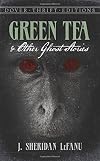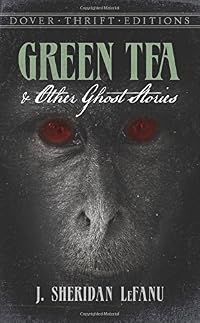
Green Tea and Other Ghost Stories
by J. Sheridan LeFanu
On This Page
Description
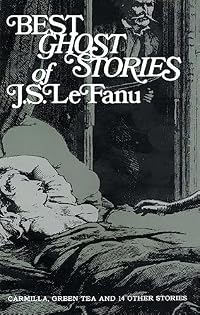
Regarded as the Victorian era's greatest writer of ghost stories, J. Sheridan LeFanu (1814-73) gave expression to the fears and dread that often haunt sensitive individuals. This collection contains four of his finest ghost stories, each crafted with remarkable ingenuity and storytelling skill. The title story offers a petrifying account of an English cleric's bouts with a malignant spectral presence; ""Squire Toby's Will"" recounts a sibling rivalry and disputed inheritance; ""The Fortunes show more of Sir Robert Ardagh"" concerns a country gentleman's mysterious relationship with a sinister valet; and ""Sir Dominick's Bargain"" presents LeFanu's masterly variation on the theme of a pact with the devil.All four tales embody not only the suspense and terror expected of a ghost story but also a subtlety, awareness, and psychological depth that elevate them far above most efforts in the genre. This inexpensive edition provides gripping entertainment as well as an excellent introduction to the intelligence and imagination that characterize LeFanu's work. show lessTags
Recommendations

























Member Reviews
I'm glad I read this. I am not sure LeFanu has more to offer, really, than what was here. Somewhat repetitive four stories, all have similar elements, all have hefty Victorian writing. Setting is key, unexplained is key. I liked "Green Tea" and "Squire Toby's Will" the best. "Sir Dominick's Bargain" is pretty rough.
As Le Fanu explains, the more one thinks about specters, the more likely it is that one will see them. After making this comment he attempts to scare readers with short stories of the supernatural that are always tied to the devil. "Green Tea" was particularly creepy and I was amazed at Le Fanu's skill in this well-aged story (1886). I knew there was something unappealing about drinking green tea (tea lovers please take no offense), but who could have guessed how important it would be to avoid it! All of Le Fanu's stories tried to tie virtue to salvation and foul deeds to despair. The reader can take or leave this moral component and still enjoy the stories.
LeFanu is highly thought of by a lot of horror aficionados, so I was exciting to have a chance to read this book. Dover’s edition is not the full volume that was published in the 40s; this book has four stories in it. “Green Tea” is the tale of a man haunted because he’s overstimulated his brain and body with, well, green tea; a demon of sorts follows him everywhere. “Squire Toby’s Will” is the tale of a father and two sons, and what happens when a parent favors one child too much over the other, creating hatred that transcends the grave. “The Fortunes of Robert Ardagh” and “Sir Dominic’s Bargain” are both deals with the devil tales, the second being a superior story. ‘Ardagh’ fails to deliver the creepiness show more for some reason.
LeFanu’s prose is lovely, if slow, to read. It comes from the era where something being ‘a fast read’ wasn’t a concern. It’s ornamental and lyrical in high Gothic manner. It creates an air of extreme tension in ‘Green Tea’, and dread in the others. If you like old school horror, try these tales. show less
LeFanu’s prose is lovely, if slow, to read. It comes from the era where something being ‘a fast read’ wasn’t a concern. It’s ornamental and lyrical in high Gothic manner. It creates an air of extreme tension in ‘Green Tea’, and dread in the others. If you like old school horror, try these tales. show less
If I mention Poe, Lovecraft, or Bierce, I end up having a long conversation on them but if I mention Le Fanu sometimes I get "who"? It is really a shame as he was a master of the gothic tale and his tales are just as wonderful as the other masters of classic horror. His stories are always original, and I love the style of writing. it takes a little getting used to but it worth it. I have to admit that I took my time with this one and read the stories late at night. Don't miss these wonderful tales of gothic horror. I received a copy of this book via the publishers and Netgalley for free in exchange for an honest review. Thank you for the treat.
Le Fanu's stories are a great example of gothic horror. I did think it was strange that the last two stories were a little repetitive in their plot, but I still liked them both. Made me want to find more Le Fanu stories.
This book contained 4 short stories. The first was about a guy who drank too much green tea and started imagining a talking spectral monkey. My reaction to that was pretty much LOL, WUT? The second was a pretty basic "guilty conscience makes guy see/hear things until he's driven mad/mysteriously found dead etc. The third was a lackluster sold his soul to the devil story. The fourth, and in my opinion the best, was another sold his soul to the devil deal but it had a bit more finesse about it.
Ratings
Members
- Recently Added By
Author Information

265+ Works 12,260 Members
The greatest author of supernatural fiction during the nineteenth century was undoubtedly J. Sheridan Le Fanu. Le Fanu was born in Dublin and, as with so many other English popular fiction authors of his time, entered the genre of fiction by way of journalism, working on such publications as the Evening Mail and the Dublin University Magazine. Le show more Fanu came from a middle-class background; his family was of Huguenot descent. He graduated from Trinity College and married in 1844. After his wife died in 1858, until his own death, Le Fanu was known as a recluse, creating his ghost fiction late at night in bed. Probably he began writing ghost fiction in 1838; his earliest supernatural story is often cited as being either "The Ghost and the Bone-Setter" or the "Fortunes of Sir Robert Ardagh," both of which were later collected in the anthology entitled The Purcell Papers (1880). Writing most effectively in the short story form, Le Fanu's tales such as "Carmilla" (a vampire story that is thought possibly to have influenced Bram Stoker's Dracula) and the problematic "Green Tea" are considered by many literary scholars to be classics of the supernatural genre. His lengthy Gothic novels, such as Uncle Silas (1864), though less highly regarded than his shorter fiction, are nonetheless wonderfully atmospheric. Le Fanu's particular brand of literary horror tends toward the refined, subtle fright rather than the graphic sensationalism of Matthew Gregory Lewis. His work influenced other prominent horror fiction authors, including M. R. James. (Bowker Author Biography) show less
Some Editions
Series
Belongs to Publisher Series
Work Relationships
Common Knowledge
- Canonical title
- Green Tea and Other Ghost Stories
- Original publication date
- 1886 "Green Tea"; 1923 "Squire Toby's Will"; "Sir Dominick's Bargain"; 1838 "The Fortunes of Sir Robert Ardagh"; 1993 (this collection) (this collection); 2015 (reprint) (reprint)
- Original language
- English
- Disambiguation notice
- There are several different collections with stories by LeFanu starting Green Tea and .... The Dover edition titled "Green Tea and Other Ghost Stories" includes Green Tea, Squire Toby's Will, The Fortunes of Sir Robert Ardagh... (show all), and Sir Dominick's Bargain. (96 pages, ISBN ). "Green Tea and Other Strange Tales" from Ægypan Press (also listed as being from Lightning Press, Inc.) has Green Tea, Mr. Justice Harbottle, Madam Crowl's Ghost, and The Dead Sexton. (128 pages, ISBN 1598187074).
Google Books and Amazon record an edition from Wildside Press (176 pages, ISBN 1587159899) that has the same title, contents and cover (!) as the Ægypan Press edition (which I checked the physical copy of.)
The 1945 Arkham Press edition "Green Tea and Other Stories" (http://en.wikipedia.org/wiki/Green_Te...) has no ISBN, 350 pages and 15 stories.
There are several different collections with stories by LeFanu starting Green Tea and .... The Dover edition titled "Green Tea and Other Ghost Stories" includes Green Tea, Squire Toby's Will, The Fortunes of Sir Robert Ardagh... (show all), and Sir Dominick's Bargain. (96 pages, ISBN ). "Green Tea and Other Strange Tales" from Ægypan Press (also listed as being from Lightning Press, Inc.) has Green Tea, Mr. Justice Harbottle, Madam Crowl's Ghost, and The Dead Sexton. (128 pages, ISBN 1598187074).
Google Books and Amazon record an edition from Wildside Press (176 pages, ISBN 1587159899) that has the same title, contents and cover (!) as the Ægypan Press edition (which I checked the physical copy of.)
The 1945 Arkham Press edition "Green Tea and Other Stories" (http://en.wikipedia.org/wiki/Green_Te...) has no ISBN, 350 pages and 15 stories.
Classifications
Statistics
- Members
- 223
- Popularity
- 145,688
- Reviews
- 6
- Rating
- (3.85)
- Languages
- English
- Media
- Paper, Ebook
- ISBNs
- 4
- UPCs
- 1
- ASINs
- 4