On This Page
Description
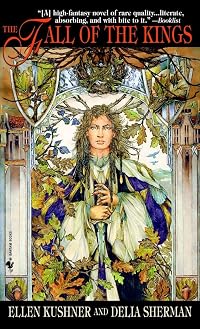
This stunning follow-up to Ellen Kushner’s cult-classic novel, Swordspoint, is set in the same world of labyrinthine intrigue, where sharp swords and even sharper wits rule. Against a rich tapestry of artists and aristocrats, students, strumpets, and spies, a gentleman and a scholar will find themselves playing out an ancient drama destined to explode their society’s smug view of itself–and reveal that sometimes the best price of uncovering history is being forced to repeat it…. The show more Fall of the Kings Generations ago the last king fell, taking with him the final truths about a race of wizards who ruled at his side. But the blood of the kings runs deep in the land and its people, waiting for the coming together of two unusual men, Theron Campion, a young nobleman of royal lineage, is heir to an ancient house and a modern scandal. Tormented by his twin duties to his family and his own bright spirit, he seeks solace in the University. There he meets Basil St. Cloud, a brilliant and charismatic teacher ruled by a passion for knowledge–and a passion for the ancient kings. Of course, everyone now knows that the wizards were charlatans and the kings their dupes and puppets. Only Basil ins not convinced–nor is he convinced that the city has seen its last king… show lessTags
Recommendations






















Member Reviews
Summary: Everyone knows that the kings were mad and corrupt, the wizards that attended the kings were manipulative greedy frauds, and the country has been much better off in the centuries since the last king was deposed, the wizards were outlawed, and the power was handed over to the ruling council of nobility. But for the most part, nobody ever thinks about the subject much… except for Basil St. Cloud, a scholar of Ancient History at the University. His unconventional methods of searching for the truth attracts students, among them the young noble Theron Campion, son of the Mad Duke Tremontaine. Theron is not particularly interested in settling down, following his passions where they lead him. And when they lead him to St. Cloud, show more both of their lives will be turned upside down, for when it comes to the subject of kings and wizards, the personal can all too easily become political.
Review: Oooh, this was really good. I'm not going to say that it's better or worse than Kushner's other Riverside books; it is quite different. It takes place thirty to forty years after The Privilege of the Sword - Katherine is now Duchess Tremontaine and in her 50s. The city is recognizably the same - Theron lives with his mother in his father's Riverside House - but dueling has more or less fallen out of fashion, and this novel focuses on a part of the city we haven't seen much of before: namely, the University. This book also has a broader worldbuilding scope than the previous two: we learn more about the rest of the country (other than being "that place where nobles go for the summer"), and about its history. This book is also quite different from the previous two in terms of approach to the genre. While Swordspoint and The Privilege of the Sword were fantasy only inasmuch as they did not take place in a real historical world and time, The Fall of the Kings is much more decidedly fantasy - there is a fair bit of magic, although it's largely mysticism blending into magic, replacing the swordsplay and some of the political machinations of the first two.
As much as I did enjoy this book - and I did, for reasons I'll get to in a minute - it did take me a while to get into and read. Part of this may have been the sudden uptick in historical worldbuilding; some amount of infodumping is unavoidable when one of your main characters is a history professor, I suspect. It wasn't uninteresting by any means, but it also didn't suck me in right off the bat, either. I also didn't really feel a strong connection to either Basil or Theron right away. They both have strong shells up to start with, for legitimate reasons, but it almost felt as though they were keeping the reader at a distance along with everyone else. As the story went on, those defenses started to come down, and I got more and more involved with the characters (although I don't know that I ever loved them as much as I did Alec and Richard) and more involved with the story, but it was a bit of a slow build for me.
But it turns out that I didn't mind, because "build" is exactly what this story does, and does so very well. Kushner and Sherman co-opt a lot of Celtic/Druidic imagery, of the oak grove and the horned king and the sacrifice to the land. But it almost didn't feel like borrowing, because this story imbues that imagery with so much power, such a strong feeling of portent and magic and significance. And even though it's clear fairly early on what everything is building up to, all of the story elements have so much resonance that watching each one slot into place and build up to the conclusion that you know is coming still manages to be almost breathtakingly tense. It's the kind of book whose power of imagery and illusion is so strong, so real, and so resonant that you can feel it in your chest. 4 out of 5 stars.
Recommendation: Because this book involves the next generation, it would be just fine as a standalone. Recommended for people who like stories of the past impinging on the present, and books with scenes and images that will linger in your head long after you've finished them. show less
Review: Oooh, this was really good. I'm not going to say that it's better or worse than Kushner's other Riverside books; it is quite different. It takes place thirty to forty years after The Privilege of the Sword - Katherine is now Duchess Tremontaine and in her 50s. The city is recognizably the same - Theron lives with his mother in his father's Riverside House - but dueling has more or less fallen out of fashion, and this novel focuses on a part of the city we haven't seen much of before: namely, the University. This book also has a broader worldbuilding scope than the previous two: we learn more about the rest of the country (other than being "that place where nobles go for the summer"), and about its history. This book is also quite different from the previous two in terms of approach to the genre. While Swordspoint and The Privilege of the Sword were fantasy only inasmuch as they did not take place in a real historical world and time, The Fall of the Kings is much more decidedly fantasy - there is a fair bit of magic, although it's largely mysticism blending into magic, replacing the swordsplay and some of the political machinations of the first two.
As much as I did enjoy this book - and I did, for reasons I'll get to in a minute - it did take me a while to get into and read. Part of this may have been the sudden uptick in historical worldbuilding; some amount of infodumping is unavoidable when one of your main characters is a history professor, I suspect. It wasn't uninteresting by any means, but it also didn't suck me in right off the bat, either. I also didn't really feel a strong connection to either Basil or Theron right away. They both have strong shells up to start with, for legitimate reasons, but it almost felt as though they were keeping the reader at a distance along with everyone else. As the story went on, those defenses started to come down, and I got more and more involved with the characters (although I don't know that I ever loved them as much as I did Alec and Richard) and more involved with the story, but it was a bit of a slow build for me.
But it turns out that I didn't mind, because "build" is exactly what this story does, and does so very well. Kushner and Sherman co-opt a lot of Celtic/Druidic imagery, of the oak grove and the horned king and the sacrifice to the land. But it almost didn't feel like borrowing, because this story imbues that imagery with so much power, such a strong feeling of portent and magic and significance. And even though it's clear fairly early on what everything is building up to, all of the story elements have so much resonance that watching each one slot into place and build up to the conclusion that you know is coming still manages to be almost breathtakingly tense. It's the kind of book whose power of imagery and illusion is so strong, so real, and so resonant that you can feel it in your chest. 4 out of 5 stars.
Recommendation: Because this book involves the next generation, it would be just fine as a standalone. Recommended for people who like stories of the past impinging on the present, and books with scenes and images that will linger in your head long after you've finished them. show less
This book has been on my to-read list for ages and ages, long enough for me to forget pretty much everything about Swordspoint. But that didn't matter. I wasn't quite sure what I was expecting from this book, but throughout, I kept finding it surprising in its imagination, its vision, and how it carried the story forward.
Reread, and adjusting the rating a bit. This novel reads like contemporary urban fantasy set in Kushner's Riverside setting. It does a lot to expand the world of Riverside, giving it folk customs and ancient history and a lively academic scene, and I definitely had fun rereading it. But as a narrative it didn't totally gel for me, especially the second time round.
The Fall of the Kings follows the messy romance of a young nobleman who hasn't quite figured himself out and a young scholar who is really, really bad at departmental politics. Their attempts to realize their destinies get tangled up in ancient magic. I liked Theron and Basil an awful lot, but their lack of self-awareness (and self-preservation!) is frustrating. They are both show more such earnest, clueless guys and as a result they become passive characters, swept along by magic and the engine of the story. I have a notion that Kushner and Sherman didn't have an ending in mind when they started writing, and the plot, while pleasingly organic, lacks the intensity of the other Riverside novels.
That said, after a muddy middle, there was a lot to enjoy in the third act. Theron's swashbuckling art dealer/pirate half-sister Jessica is a delightful character who absolutely works despite showing up late in the game. I found Theron's resolution satisfying as well, even if it's a bit out of left field.
As for Basil, this time round I realized this is a novel about dealing with the legacy of problematic intellectual pioneers, who are brilliant one moment and weighed down with scandal and junk theories the next. I think this is one of the strongest themes in the book and would have liked to see it more in the forefront.
At the end of the day, The Fall of the Kings is a book as messy and fascinating as Basil St. Cloud's scholarship. I wouldn't recommend it to those who haven't read Kushner and Sherman's other works, but it's certainly a must-read for Riverside completists. show less
The Fall of the Kings follows the messy romance of a young nobleman who hasn't quite figured himself out and a young scholar who is really, really bad at departmental politics. Their attempts to realize their destinies get tangled up in ancient magic. I liked Theron and Basil an awful lot, but their lack of self-awareness (and self-preservation!) is frustrating. They are both show more such earnest, clueless guys and as a result they become passive characters, swept along by magic and the engine of the story. I have a notion that Kushner and Sherman didn't have an ending in mind when they started writing, and the plot, while pleasingly organic, lacks the intensity of the other Riverside novels.
That said, after a muddy middle, there was a lot to enjoy in the third act. Theron's swashbuckling art dealer/pirate half-sister Jessica is a delightful character who absolutely works despite showing up late in the game. I found Theron's resolution satisfying as well, even if it's a bit out of left field.
As for Basil, this time round I realized this is a novel about dealing with the legacy of problematic intellectual pioneers, who are brilliant one moment and weighed down with scandal and junk theories the next. I think this is one of the strongest themes in the book and would have liked to see it more in the forefront.
At the end of the day, The Fall of the Kings is a book as messy and fascinating as Basil St. Cloud's scholarship. I wouldn't recommend it to those who haven't read Kushner and Sherman's other works, but it's certainly a must-read for Riverside completists. show less
Fifteen years ago, Ellen Kushner's Swordspoint delighted appreciative readers with complex, interesting characters, a richly textured setting, and a fantasy novel with no magic at all. The Fall of the Kings admits magic into the picture, but the characters are as interesting, and the setting at least as textured and lived-in.
It's sixty years later, and Alec Campion, now remembered as the Mad Duke, has been dead for twenty years. Before he died, though, he brought back from his travels a wife, Sophia, who gave birth to a son a few months after the Mad Duke's death. That posthumous son, Theron, is heir to his cousin Katherine, the Duchess Tremontaine. Theron and his mother live, not in Tremontaine House, but in Riverside House, the great show more house Alec built where the little house he once lived in with Richard St. Vier had stood. The Riverside neighborhood has ha d some of the edge taken off of it by the effects of the presence of a great household, and the civilizing influence of Sophia. (Sophia, not long after arriving in the city, successfully badged the University into letting her study medicine, and operates a clinic for the residents of Riverside.) It's still a rough and dangerous place, though, and naturally Theron likes it better than the Hill, where all proper young noblemen belong.
He likes the University even better, especially after he meets Basil St. Cloud, a magister who teaches, and studies, ancient history--the early history of the Kings who came down from the north and ruled with wizards by their sides. Everyone knows that the wizards were charlatans and the kings were dupes and puppets. Basil wonders if everyone is right, and persists in his academically unfashionable practice of reading contemporary documents rather than just the official and unofficial histories, until he find a very dangerous book.
Meanwhile, as Basil and Theron become lovers, the Serpent Chancellor, Lord Arlen, becomes concerned about a possible northern plot to restore the kings. He sets an ambitious young nobleman, Lord Nicholas Galing, to investigate. Galing quickly becomes less interested in finding out if there's a plot than in proving that Theron and Basil are part of it.
The politics of the city and the politics of the University are sticky and intricate, and get more so when they become tangled up in each other. Theron's idealism and his self-absorption both feel quite convincingly real. The same is true of Basil, who really isn't very many years older, and in some ways is even less realistic than Theron about what he can get away. No one in this story is perfect, and no one in it is just a cardboard bad guy, either. These are real people, with real motivations. Beautifully done, and worth the wait. show less
It's sixty years later, and Alec Campion, now remembered as the Mad Duke, has been dead for twenty years. Before he died, though, he brought back from his travels a wife, Sophia, who gave birth to a son a few months after the Mad Duke's death. That posthumous son, Theron, is heir to his cousin Katherine, the Duchess Tremontaine. Theron and his mother live, not in Tremontaine House, but in Riverside House, the great show more house Alec built where the little house he once lived in with Richard St. Vier had stood. The Riverside neighborhood has ha d some of the edge taken off of it by the effects of the presence of a great household, and the civilizing influence of Sophia. (Sophia, not long after arriving in the city, successfully badged the University into letting her study medicine, and operates a clinic for the residents of Riverside.) It's still a rough and dangerous place, though, and naturally Theron likes it better than the Hill, where all proper young noblemen belong.
He likes the University even better, especially after he meets Basil St. Cloud, a magister who teaches, and studies, ancient history--the early history of the Kings who came down from the north and ruled with wizards by their sides. Everyone knows that the wizards were charlatans and the kings were dupes and puppets. Basil wonders if everyone is right, and persists in his academically unfashionable practice of reading contemporary documents rather than just the official and unofficial histories, until he find a very dangerous book.
Meanwhile, as Basil and Theron become lovers, the Serpent Chancellor, Lord Arlen, becomes concerned about a possible northern plot to restore the kings. He sets an ambitious young nobleman, Lord Nicholas Galing, to investigate. Galing quickly becomes less interested in finding out if there's a plot than in proving that Theron and Basil are part of it.
The politics of the city and the politics of the University are sticky and intricate, and get more so when they become tangled up in each other. Theron's idealism and his self-absorption both feel quite convincingly real. The same is true of Basil, who really isn't very many years older, and in some ways is even less realistic than Theron about what he can get away. No one in this story is perfect, and no one in it is just a cardboard bad guy, either. These are real people, with real motivations. Beautifully done, and worth the wait. show less
The relationship between a scholar and his noble lover sets in motion a chain of events that seem destined to restore magic to their society.
This book is so intense that I just about gave myself a heart attack the first time through. The tension is brilliant. There's one hell of a downward spiral. The story is complex and multi-layered. It's a damned good read.
This time, of course, I didn't suffer quite so badly. I knew how it would end. I read on not to see my worst fears confirmed or denied but to revisit a gorgeously realized setting, interesting characters and a satisfying plot. And I must say, I wasn't at all disappointed. It wasn't quite as good the second time through, but it was still rich and rewarding. I had a wonderful time show more with it.
It's the layers that really make this book. Kushner and Sherman weave their subplots together with consumate skill. Everything builds off of everything else. The characters' interests and preoccupations drive the plot forward even as the plot pushes them in particular directions. Basil's story feeds off of Theron's; Theron's story feeds off of Basil's. Basil's students comment on the larger themes in play. Both the scholarship and the Council's investigations illuminate certain ideas. The magic is simultaneously ethereal and firmly rooted in the reality of this beautifully realized world.
And there's some wonderful stuff going on within this rich, complex, gorgeously layered world. I particularly enjoyed the scholarship. I've spent many years now in a university setting, and I found many of the scholarly scenes recognizable and easy to relate to. They got me thinking about my own connections to scholarship, and damn do I ever want to take some more classes now! I also appreciated how Kushner and Sherman worked through issues of family and social responsibility. There's a lot of big, sweeping stuff going on, but they never ignore the human element.
I read the last two hundred pages or so in a marathon three-hour reading session, and it flew right on by. I felt like I was there, immersed in the life of the city. I was bitterly sorry to see it end. It just kills me that Ellen Kushner and Delia Sherman have only published four books apiece. I'd gladly devour forty more from each of them.
(A slightly different version of this review originally appeared on my blog, Stella Matutina). show less
This book is so intense that I just about gave myself a heart attack the first time through. The tension is brilliant. There's one hell of a downward spiral. The story is complex and multi-layered. It's a damned good read.
This time, of course, I didn't suffer quite so badly. I knew how it would end. I read on not to see my worst fears confirmed or denied but to revisit a gorgeously realized setting, interesting characters and a satisfying plot. And I must say, I wasn't at all disappointed. It wasn't quite as good the second time through, but it was still rich and rewarding. I had a wonderful time show more with it.
It's the layers that really make this book. Kushner and Sherman weave their subplots together with consumate skill. Everything builds off of everything else. The characters' interests and preoccupations drive the plot forward even as the plot pushes them in particular directions. Basil's story feeds off of Theron's; Theron's story feeds off of Basil's. Basil's students comment on the larger themes in play. Both the scholarship and the Council's investigations illuminate certain ideas. The magic is simultaneously ethereal and firmly rooted in the reality of this beautifully realized world.
And there's some wonderful stuff going on within this rich, complex, gorgeously layered world. I particularly enjoyed the scholarship. I've spent many years now in a university setting, and I found many of the scholarly scenes recognizable and easy to relate to. They got me thinking about my own connections to scholarship, and damn do I ever want to take some more classes now! I also appreciated how Kushner and Sherman worked through issues of family and social responsibility. There's a lot of big, sweeping stuff going on, but they never ignore the human element.
I read the last two hundred pages or so in a marathon three-hour reading session, and it flew right on by. I felt like I was there, immersed in the life of the city. I was bitterly sorry to see it end. It just kills me that Ellen Kushner and Delia Sherman have only published four books apiece. I'd gladly devour forty more from each of them.
(A slightly different version of this review originally appeared on my blog, Stella Matutina). show less
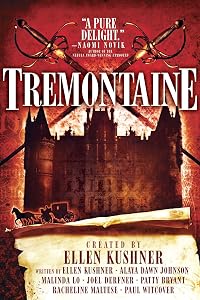
The Fall of Kings is chronologically the last novel set in Ellen Kushner’s Riverside. While it stands on its own, I would recommend starting with one of the other works – Tremontaine, Swordspoint or The Privilege of the Sword.
In her novel Swordspoint, Ellen Kushner crafted a fantasy setting without magic, full of scheming nobles and swordsmen for hire. It’s a setting without homophobia or heteronormativity, and same-sex relationships are common. Much of the cast of the series is either gay, lesbian, or, most commonly, bisexual. The Fall of Kings is set sixty years after Swordspoint. Most of the original characters are dead, and the torch has been passed down to their children and grandchildren.
Theron Campion is the heir to the show more house of Tremontaine, but has recently exited a scandalous love affair with an artist. He takes solace in the university where he meets Basil St. Cloud, a young magister who holds controversial views regarding the ancient kings and their wizards and historical methodology. But with unrest in the North and some agitating for the return of the kings, Theron and Basil find themselves at the center of something greater than they ever could have imagined.
The Fall of Kings is much more mythic in tone than other Riverside stories. It’s a larger perspective, looking back into the history of the country and of its old kings and wizards. It’s also the only Riverside story so far to feature magic in any capacity. And while I wouldn’t say any of the other Riverside books I’ve read have been necessarily happily ever after (although The Privilege of the Sword comes the closest), The Fall of Kings is the most tragic. It’s basically a slowly unfolding disaster, and by a certain point I knew it couldn’t possibly end well.
On the other hand, it can be hard to grieve for either Theron or Basil. There were moments where I felt sympathetic for them, but they are both so utterly self centered. Despite their protestations of love, there didn’t seem to be much more to their relationship than sex. Combined with some atrocious behavior on Theron’s part, it’s no wonder that the relationship implodes. Seriously, if Alec’s famously been called the “boyfriend from hell,” Theron gives him a run for his money.
The cast of characters is almost predominantly male. There are a few female characters (Katherine, Sophia, Jessica), but we never get to spend much time with them, although Jessica at least does get to effect the plot. It actually makes a lot of sense that this was written before The Privilege of the Sword, where the female characters do have more of a presence at the story line actually examines the patriarchal society it’s established instead of leaving it unquestioned.
While The Fall of Kings is far from my favorite Riverside story, it has reminded me of two things. Firstly, Ellen Kushner (and presumably Delia Sherman, her co-author here) is an absolutely brilliant writer. She’s someone who really knows how to craft prose. Secondly, Riverside has one a place in my heart. I love seeing the same setting and sometimes characters over the course of the eighty odd years this series spans. I really need to track down those short stories Ellen Kushner set between books…
I would strongly recommend the Riverside novels to anyone who’s a fan of fantasy driven by intrigue instead of magic or stories focused around queer characters. However, The Fall of Kings is not the book I would recommend starting the series with.
Originally posted on The Illustrated Page. show less
In her novel Swordspoint, Ellen Kushner crafted a fantasy setting without magic, full of scheming nobles and swordsmen for hire. It’s a setting without homophobia or heteronormativity, and same-sex relationships are common. Much of the cast of the series is either gay, lesbian, or, most commonly, bisexual. The Fall of Kings is set sixty years after Swordspoint. Most of the original characters are dead, and the torch has been passed down to their children and grandchildren.
Theron Campion is the heir to the show more house of Tremontaine, but has recently exited a scandalous love affair with an artist. He takes solace in the university where he meets Basil St. Cloud, a young magister who holds controversial views regarding the ancient kings and their wizards and historical methodology. But with unrest in the North and some agitating for the return of the kings, Theron and Basil find themselves at the center of something greater than they ever could have imagined.
The Fall of Kings is much more mythic in tone than other Riverside stories. It’s a larger perspective, looking back into the history of the country and of its old kings and wizards. It’s also the only Riverside story so far to feature magic in any capacity. And while I wouldn’t say any of the other Riverside books I’ve read have been necessarily happily ever after (although The Privilege of the Sword comes the closest), The Fall of Kings is the most tragic. It’s basically a slowly unfolding disaster, and by a certain point I knew it couldn’t possibly end well.
On the other hand, it can be hard to grieve for either Theron or Basil. There were moments where I felt sympathetic for them, but they are both so utterly self centered. Despite their protestations of love, there didn’t seem to be much more to their relationship than sex. Combined with some atrocious behavior on Theron’s part, it’s no wonder that the relationship implodes. Seriously, if Alec’s famously been called the “boyfriend from hell,” Theron gives him a run for his money.
The cast of characters is almost predominantly male. There are a few female characters (Katherine, Sophia, Jessica), but we never get to spend much time with them, although Jessica at least does get to effect the plot. It actually makes a lot of sense that this was written before The Privilege of the Sword, where the female characters do have more of a presence at the story line actually examines the patriarchal society it’s established instead of leaving it unquestioned.
While The Fall of Kings is far from my favorite Riverside story, it has reminded me of two things. Firstly, Ellen Kushner (and presumably Delia Sherman, her co-author here) is an absolutely brilliant writer. She’s someone who really knows how to craft prose. Secondly, Riverside has one a place in my heart. I love seeing the same setting and sometimes characters over the course of the eighty odd years this series spans. I really need to track down those short stories Ellen Kushner set between books…
I would strongly recommend the Riverside novels to anyone who’s a fan of fantasy driven by intrigue instead of magic or stories focused around queer characters. However, The Fall of Kings is not the book I would recommend starting the series with.
Originally posted on The Illustrated Page. show less
A really, really fascinating book, replete with history and University intrigue and power plays and repressed learning. The history of Riverside and its mainland involves kings who came from the North to the South and wizards who controlled them. Maybe. Maybe it was control, or maybe it was love, but the kings gave up their lives for the land. But none of this is really documented and this is where both Kushner and Sherman excel.
The University world that they populate is full of young men with aspirations and a lust for learning (and sometimes for each other), with professors who encourage their students and discourage those who dispute them, and the progeny of their first book [Swordspoint]. While the majority of the characters are show more young men, there are a number of women in power behind the scenes who are powers in their own rights. And this book and its characters transcend gender because of the vulnerability and learning that serves as the focus of this particular sequel. show less
The University world that they populate is full of young men with aspirations and a lust for learning (and sometimes for each other), with professors who encourage their students and discourage those who dispute them, and the progeny of their first book [Swordspoint]. While the majority of the characters are show more young men, there are a number of women in power behind the scenes who are powers in their own rights. And this book and its characters transcend gender because of the vulnerability and learning that serves as the focus of this particular sequel. show less
Members
- Recently Added By
Lists

Best Fantasy Novels
821 works; 361 members

Books I've Read More Than Once
602 works; 49 members

Diversity in Fantasy and Science Fiction
219 works; 33 members

Female Author
1,234 works; 67 members
Speculative Fiction to Read
706 works; 32 members

LGBTQ+ Speculative Fiction
821 works; 51 members

Fiction written by couples
7 works; 2 members

Best Campus Novels
99 works; 18 members

Books Read in 2013
1,630 works; 51 members

I Can't Finish This Book
189 works; 22 members
Five star books
1,767 works; 110 members
Author Information

54+ Works 8,804 Members

48+ Works 3,604 Members
Some Editions
Awards and Honors
Awards
Distinctions
Series

Work Relationships
Common Knowledge
- Original publication date
- 2002-11
- People/Characters
- Basil St. Cloud; Theron Campion; Katherine Talbert; Jessica Campion
- Important places
- Riverside
- Epigraph
- For in art there is no such thing as universal truth. A Truth in art is that whose contradictory is also true. - Oscar Wilde, The Truth of Masks
What thou lovest well remains,
the rest is dross,
What thou lov'st well shall not be reft from thee
What thou lov'st well is thy true heritage.
- Ezra Pound, Pisan Cantos, LXXXI - First words
- A splatter of red on a discarded boot.
- Last words
- (Click to show. Warning: May contain spoilers.)The voyage is well begun.
- Original language
- English
Classifications
Statistics
- Members
- 1,098
- Popularity
- 23,197
- Reviews
- 31
- Rating
- (3.59)
- Languages
- English, German, Spanish
- Media
- Paper, Audiobook, Ebook
- ISBNs
- 8
- ASINs
- 3