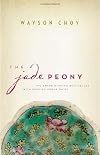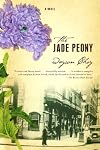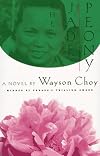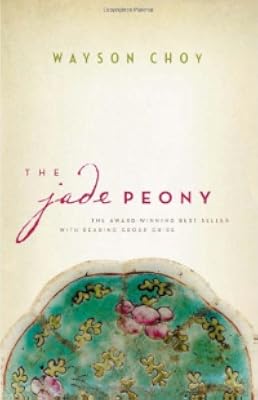
The Jade Peony
by Wayson Choy
On This Page
Description
Three siblings tell the stories of their very different childhoods in Vancouver's Chinatown before and during World War II.Tags
Recommendations













Member Recommendations
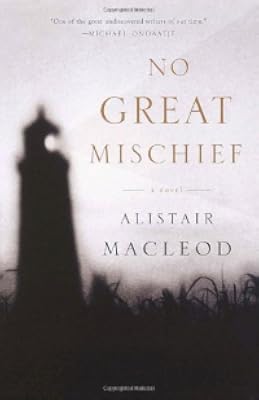
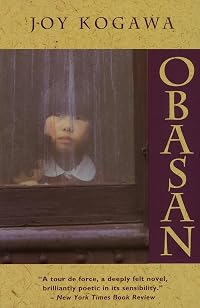
laytonwoman3rd This novel explores similar themes of the generation gap in immigrant Chinese families---the "old ways" in conflict with the new world.
11
MarieCTremblay mariectremblay

Member Reviews
Three children of immigrant Chinese parents each tell a story from their childhood in Vancouver's Chinatown between 1933 and 1941. We begin with Jook-Liang, the only daughter, as she meets for the first time the ancient Wong-Suk known by everyone as "The Monkey Man". Despite the fact that most people find him ugly and even frightening in appearance, Liang is immediately drawn to him, and he becomes, all too briefly, her best friend and companion. The second section is in the voice of Liang's older, adopted brother, Jung-Sum, who tells us how he came to be part of the family, and how he became the protege of an older youth with a tough reputation who eventually decided to go to Seattle to join the U. S. Marine Corps. Finally, we hear show more from the Little Brother, Sek-Lung, his Grandmother's special project, who has suffered from birth with lung ailments that require extraordinary attention and keep him from starting school at the normal time. Each of these children develops a unique personal relationship that supports them, but ultimately teaches them about loss and letting go. Over all the stories hangs the cloud of world events--the war between China and Japan, and the impending calamities of WWII; the ongoing conflict between Chinese and Japanese immigrant communities; and the eternal struggle of the immigrants and their children to find a balance between Old Ways and Canadian (American) ways. Although I found the ending a bit abrupt, and there isn't an over-arching story line connecting the three sections, I was very impressed with the novel, and would recommend it. Parts of this story are similar to the later novel, [Hotel on the Corner of Bitter and Sweet], set down the coast in the American Northwest--the Chinese/Japanese racial and cultural divide, the Romeo and Juliet motif, the assimilation vs. tradition themes. I'm rating [The Jade Peony] slightly higher than Ford's novel, however, as it avoided any glaring anachronisms and kept me more fully engaged with the characters.
The strength of Choy's work is excellently anticipated by the book's epigraph:
T'ong Yahn Gaai was what
we once called
where we lived: "China-People Street".
Later, we mimicked
Demon talk
and wrote down only
Wah Fauh--"China-Town."
The difference
is obvious: the people
disappeared.
---Wing Tek Lum, "Translations" show less
The strength of Choy's work is excellently anticipated by the book's epigraph:
T'ong Yahn Gaai was what
we once called
where we lived: "China-People Street".
Later, we mimicked
Demon talk
and wrote down only
Wah Fauh--"China-Town."
The difference
is obvious: the people
disappeared.
---Wing Tek Lum, "Translations" show less
The Jade Peony, Choy’s debut novel set in Vancouver’s Chinatown during WWII, is a vibrant and moving story of one family’s immigrant experience. Grandmother Poh Poh, one of Chinatown’s few elder women, the keeper of the old ways, and the undisputed heart of the family, lives with her son and daughter-in-law and their four children. Three of the children narrate the story: Jook-Liang, Only Sister; Jung-Sum, Second Brother; and Sek-Lung (Sekky), Third Brother.
Through the voices of his characters, Choy writes poignantly of what it means to belong to a family living in two worlds, East and West, with loyalties to two countries. Forging new identities is complicated by the war: Canada is fighting Germany, and Japan is invading China. show more Poh Poh is adamant that the children are Chinese, that they must know of Old China. Father and Stepmother (so called by even her biological children, by Poh Poh’s declaration) worry that their children are “neither this nor that, neither Chinese nor Canadian.” (152) And the children, struggling to belong, find their loyalties torn between family and the desire to establish Canadian identities: “What would white people in Vancouver think of us? We were Canadians now, Chinese-Canadians, a hyphenated reality that our parents could never accept. So it seemed, for different reasons, we were all holding our breath, waiting for something." (162)
Choy strikes a perfect tone between poignant and comical. Wholly respectful of the painful challenges of an immigrant family, he realizes that the experience is not without its own particular humour. For Sekky, the youngest, who has the closest relationship with Poh Poh but is also the most “Western” member of the family, the confusion occasionally becomes all too much. I couldn’t help but delight when he came out with this:
“The Chinese rankings for acquaintances and relatives were overwhelming. There were different titles for those persons related to us according to the father’s age, the mother’s age, and even the ages of the four grandparents, and according to whether they were from the mother’s or father’s side – never mind if you threw in a stepmother and her best friend. And if those persons were also tied to us by false papers to obtain immigration visas, they became “paper sons” or “paper uncles,” heirs to a web of illegal subterfuge brought on by laws that stipulated only relatives of official “merchant-residents” or “scholars” could immigrate from China to Canada. Paper money could buy paper relatives. But whose papers were connected to whose relatives? My head pounded.” (148)
I was completed charmed by The Jade Peony and will look for more of Choy’s work. Highly recommended. show less
Through the voices of his characters, Choy writes poignantly of what it means to belong to a family living in two worlds, East and West, with loyalties to two countries. Forging new identities is complicated by the war: Canada is fighting Germany, and Japan is invading China. show more Poh Poh is adamant that the children are Chinese, that they must know of Old China. Father and Stepmother (so called by even her biological children, by Poh Poh’s declaration) worry that their children are “neither this nor that, neither Chinese nor Canadian.” (152) And the children, struggling to belong, find their loyalties torn between family and the desire to establish Canadian identities: “What would white people in Vancouver think of us? We were Canadians now, Chinese-Canadians, a hyphenated reality that our parents could never accept. So it seemed, for different reasons, we were all holding our breath, waiting for something." (162)
Choy strikes a perfect tone between poignant and comical. Wholly respectful of the painful challenges of an immigrant family, he realizes that the experience is not without its own particular humour. For Sekky, the youngest, who has the closest relationship with Poh Poh but is also the most “Western” member of the family, the confusion occasionally becomes all too much. I couldn’t help but delight when he came out with this:
“The Chinese rankings for acquaintances and relatives were overwhelming. There were different titles for those persons related to us according to the father’s age, the mother’s age, and even the ages of the four grandparents, and according to whether they were from the mother’s or father’s side – never mind if you threw in a stepmother and her best friend. And if those persons were also tied to us by false papers to obtain immigration visas, they became “paper sons” or “paper uncles,” heirs to a web of illegal subterfuge brought on by laws that stipulated only relatives of official “merchant-residents” or “scholars” could immigrate from China to Canada. Paper money could buy paper relatives. But whose papers were connected to whose relatives? My head pounded.” (148)
I was completed charmed by The Jade Peony and will look for more of Choy’s work. Highly recommended. show less
The Jade Peony, Wayson Choy's first novel and a RUSA Notable Book, is a genre-bending, memoirlike collection of stories about a family in Vancouver's Chinatown before and during World War II. Three siblings tell the stories of their very different childhoods in a world defined by change, each in their own way wresting autonomy from the strictures of history, family, and poverty. Sister Jook-Liang aspires to be Shirley Temple; adopted Second Brother Jung-Sum, who struggles with his sexuality, finds his way through boxing. Third Brother Sekky, who never feels comfortable with the multitude of Chinese dialects swirling around him, becomes obsessed with war games, and learns a devastating lesson about what war really means when his show more 17-year-old babysitter dates a Japanese man, with terrible consequences.
One of Choy's most compelling subjects is the fluidity of the extended family. The shadowy woman everyone calls Stepmother is a house servant and concubine who moves into the role of mother, giving birth to two of the siblings but never quite achieving full status. Many chapters focus on the powerful effects friends and neighbors have on the family and the importance of their names and titles.
Choy's evocations of life in Depression-era and wartime Vancouver are especially memorable: the bewildered air of Little Tokyo during the first Christmas after Pearl Harbor, a burned-down church that Sekky and his grandmother pick through for bits of the stained-glass windows--a metaphor for the family's task of sorting out what to keep and what to abandon as it moves into the future. Like the jade peony of the title, Choy's storytelling is at once delicate, powerful, and lovely. show less
One of Choy's most compelling subjects is the fluidity of the extended family. The shadowy woman everyone calls Stepmother is a house servant and concubine who moves into the role of mother, giving birth to two of the siblings but never quite achieving full status. Many chapters focus on the powerful effects friends and neighbors have on the family and the importance of their names and titles.
Choy's evocations of life in Depression-era and wartime Vancouver are especially memorable: the bewildered air of Little Tokyo during the first Christmas after Pearl Harbor, a burned-down church that Sekky and his grandmother pick through for bits of the stained-glass windows--a metaphor for the family's task of sorting out what to keep and what to abandon as it moves into the future. Like the jade peony of the title, Choy's storytelling is at once delicate, powerful, and lovely. show less
This book is divided into three sections and, whereas the first two are beautifully told with a unique perspective and insights into Chinese culture and integration, it is the third that is the most powerful through a young boy's eyes into the world of adults. Sekky's world is doubly gripping: firstly through his world of school and war, his relationship with his family and friends; secondly through his understanding of the adult world and his friendship with Meiying which is revealed to the reader through secrets, gestures and observations. These glimpses are masterful: never are Sekky's age and voice betrayed, but adult alliances, fears, loves, defiances clearly emerge from utterances, quick descriptions and minute details.
These are show more lingering tales from which stem the complexities of life regardless of age, time and culture. Wonderfully written. show less
These are show more lingering tales from which stem the complexities of life regardless of age, time and culture. Wonderfully written. show less
Deceptively gentle book about growing up Chinese in Vancouver, Canada before and during WWll. At first not much seems to be happening but after a few pages the reader has become another family member, with a detailed knowledge of Chinese history, customs and beliefs, knowing how it feels like to be foreign. In parallel, the Chinese fear and hatred of the Japanese propel the story to a sad and shocking climax. This is the double mirror of the past in which we see today's reflection of modern Canada. Hard to put down, yet you don't want it to finish.
Set in Vancouver’s Chinatown during the 1930s and into the 40s, The Jade Peony tells the story of one Chinese family through the words of three of the family’s children. Jook-Liang, the only girl child in the family; Jung-Sum, the adopted son; and Sek-Lung, the youngest and third boy in the family. Although the book fills us in on world politics, the Japanese invasion of China, and conditions that Canadian Chinese live under, at heart it is a simple story of family. A little girl discovers that a kindred soul can be a person of any age, a young boy deals with his sexual identity while another young boy learns to adjust to life in Grade Three.
These children are the first born Canadians in their Chinese family and all are bothered by show more questions of whether they are Chinese first or Canadian. As their elders, particularly their venerable grandmother, try to instil a sense of tradition and ancestry, their thoughts often fly to Shirley Temple or Joe Lewis. While Canada is at war with the Germans, the Chinese are aghast at the Japanese invasion of mainline China. The youngest child dreams of being a fighter pilot and bringing down Japanese planes. He is confused by the growing relationship between his neighbour, Meiying and a young Japanese boy.
A poignant, heart-felt story both of Canada’s shameful treatment of these immigrants and of growing up in a family that has ties to two countries. Beautiful written, with realistic settings and characters. The grandmother, Poh-Poh, with her “heart-cramps” and catch phrase of “I die soon” when things don’t go her way are priceless. The Jade Peony was an insightful and eloquent read. show less
These children are the first born Canadians in their Chinese family and all are bothered by show more questions of whether they are Chinese first or Canadian. As their elders, particularly their venerable grandmother, try to instil a sense of tradition and ancestry, their thoughts often fly to Shirley Temple or Joe Lewis. While Canada is at war with the Germans, the Chinese are aghast at the Japanese invasion of mainline China. The youngest child dreams of being a fighter pilot and bringing down Japanese planes. He is confused by the growing relationship between his neighbour, Meiying and a young Japanese boy.
A poignant, heart-felt story both of Canada’s shameful treatment of these immigrants and of growing up in a family that has ties to two countries. Beautiful written, with realistic settings and characters. The grandmother, Poh-Poh, with her “heart-cramps” and catch phrase of “I die soon” when things don’t go her way are priceless. The Jade Peony was an insightful and eloquent read. show less
The Jade Peony is the story of a Chinese family living in Vancouver's China Town during the depression and World War II. It is told from the point of view of three of the children, which made the story more interesting in that the children speak the truth, as they experience it, rather than try to conceal feelings and information -- which is what the adults are doing.
The writing is just lovely with strikig images. This is a character-driven book more than plot-dirven. Auther Wayson Choy has used everyday events to paint a vivid picture of what it means to be an immigrant, the struggle between the old ways and the new country, and what war can do to relationships and families. Really, really good.
The writing is just lovely with strikig images. This is a character-driven book more than plot-dirven. Auther Wayson Choy has used everyday events to paint a vivid picture of what it means to be an immigrant, the struggle between the old ways and the new country, and what war can do to relationships and families. Really, really good.
Members
- Recently Added By
Lists

The Best of Canadian Literature
235 works; 33 members
CBC Books - Canada's 100 (+ bonus 10): Which have you read?
110 works; 23 members

Canada Reads Winners and Nominees
129 works; 9 members

Canadian Historical Fiction 🇨🇦
157 works; 8 members
Author Information

4+ Works 1,187 Members
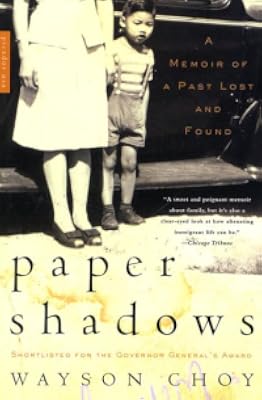
Wayson Choy was born in Vancouver, Canada on April 20, 1939. He graduated from the University of British Columbia in 1962. After working in advertising, he became a professor at Humber College. He taught there for more than 25 years. His first novel, The Jade Peony, was published in 1995 and received a Trillium Award and the City of Vancouver Book show more Award. His second novel, All That Matters, was published in 2004 and received the Trillium Prize. He also wrote two memoirs entitled Paper Shadows: A Chinatown Childhood, which received the Edna Staebler Prize for Creative Non-Fiction, and Not Yet: A Memoir of Living and Almost Dying. In 2005, he was named to the Order of Canada. In 2015, he received the George Woodcock Lifetime Achievement Award for an outstanding literary career in B.C. He died after suffering cardiac arrest on April 27, 2019 at the age of 80. (Bowker Author Biography) show less
Some Editions
Awards and Honors
Awards
Distinctions
Common Knowledge
- Original title
- The Jade Peony
- Original publication date
- 1995
- Important places
- Vancouver, British Columbia, Canada; British Columbia, Canada
- Epigraph
- Tohng Yahn Gaai was what we once called where we lived: "China-People-Street". Later, we mimicked Demon talk and wrote down only Wah Fauh - "China-Town". The difference is obvious: the people disappeared.
- W... (show all)ing Tek Lum, "Translations" - Dedication
- To my aunts, Freda and Mary
and in memory of Toy and Lilly Choy. - First words
- The old man first visited our house when I was five, in 1933.
- Last words
- (Click to show. Warning: May contain spoilers.)I took her hand and pressed into her palm the carved pendant Grandmama had left to me.
Classifications
Statistics
- Members
- 717
- Popularity
- 39,760
- Reviews
- 24
- Rating
- (3.54)
- Languages
- Dutch, English
- Media
- Paper, Audiobook, Ebook
- ISBNs
- 10
- ASINs
- 6