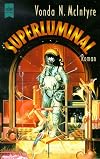
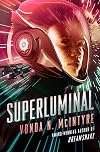
Superluminal
by Vonda N. McIntyre
On This Page
Description
A novel of star-crossed love from the New York Times-bestselling author of Nebula and Hugo Award-winning novel Dreamsnake.In a future where space travel moves at faster-than-light speed, starship crews can only survive transit if drugged nearly to death. Then there are those like Laenea Trevelyan, who want to become pilots so badly they will go through years of training and major surgery to free themselves of biological rhythms. But though they become literally heartless, their emotions are show more just as human as before.Laenea discovers this herself when she immediately falls for crewman Radu Dracul upon her early release--some might say escape--from the hospital after her procedure. She is not unknown to Radu; Laenea was the first offworlder he ever saw when she and her crew delivered a vaccine for the cryptovirus that decimated his family and his planet.However, their intense attraction cannot last. Laenea's modifications will not survive in close proximity to Radu's biorhythms, which are too strong to allow him to become a pilot.But even in the vastness of space, where ships and hearts can be lost, fate--and danger--can have a hand in bringing two people together again..."Smoothly told... with the sturdy character conflicts snugly worked into the hyperspace-navigation backdrop." --Kirkus Reviews show lessTags
Recommendations




















Member Reviews
Stayed up until 2 am re-reading Superluminal. Something reminded me of this story, and I wanted to reacquaint myself with it. I particularly love the scene where Orca tells off Dr Kristen van de Graaf, the administrator who is supervising the debriefing of the pilots and crew from the unprecedented search and rescue success of a lost space ship and subjecting them to a battery of medical tests and generally keeping them locked away from everyone and everything:
At the hatch of the shuttle, Orca stopped short.
"Wait a minute," she said, "Where are you planning to take us?"
"Back to earth," Van de Graaf said.
"Very funny," Orca snapped. "Landing where?"
"White Sands."
"I can't land at White Sands."
"Why not?"
"Because I have no intention of being show more and arrested and interned as a prisoner of war. Surely you know that my family has never made peace with the United States government."
"After a moment of incomprehension, van de Graaf said, "Oh. I'd forgotten all about that. Surely in an emergency--"
"No! Even if they promised me free passage I wouldn't believe them. Besides, I'd be in trouble with my own people if I accepted it."
"We all have more important things to think about than ancient history."
"Do you think this is some kind of joke?" Orca said angrily. "It may be ancient history to you, but my family has an even longer memory than the U.S. Navy--and the U.S. Navy blows us out of the water whenever they have a chance. They still consider us traitors, if not spies."
"I'll get you a world council safe-conduct on the way down--"
"Let me explain it to you in terms you may understand, doctor," Orca said. "Not landing in the United States is in my contract."
I like the characters and the concepts in this story. Maybe the news story about researchers recording an apparent conversation between dolphins brought this novel to mind. Or returning to visit the PNW earlier this year (I so miss that area!).
Orca is a genetically engineered diver--humans adapted to become marine mammals who have formed clans with adoptive family ties to different whale species with whom they have created a shared society. The divers can still operate on land, and Orca has taken a job as a spaceship crew member, though some of the divers never interact with the landers, preferring to stay within their own territory, learning from the wisdom of the great whales, such as Orca's younger brother. I like this vision of a future where a subset of humanity has found a way to not only coexist with other dominant species, but to thrive with them in a cooperative society of mutual learning.
But actually, all of that is just backstory and subplot. The novel opens with Laenea Trevelyan waking up from the surgery to remove her heart. The story is really an exploration of love and loss, identity and transformation and even transcendence, in many flavors: star-crossed lovers whose passionate affair is intense but all too brief, family members who love but don't quite understand each other either, friends with mysterious pasts, the transition from crew to pilot, from sea to land to space, from the 3 dimensions that everyone experiences to higher dimensions that so few people can perceive or experience, the sacrifices and difficult choices people must make when they don't quite fit in anymore, and finding connections between the familiar and the alien.
The story is full of strong female characters--in fact, I think there might be more female characters than male, or perhaps they're at parity. But the men have strong roles too. And there is a great diversity of representation in terms of race and ethnicity--from a new world colonized by Australian aboriginals (and a crew member returning home to them), to crew and pilots with French Canadian, Japanese, Latino, eastern European, Russian, and various Anglo names. There's plenty of action, interesting characters, good dialogue, adventure and wonder. What more can you ask for in science fiction? show less
At the hatch of the shuttle, Orca stopped short.
"Wait a minute," she said, "Where are you planning to take us?"
"Back to earth," Van de Graaf said.
"Very funny," Orca snapped. "Landing where?"
"White Sands."
"I can't land at White Sands."
"Why not?"
"Because I have no intention of being show more and arrested and interned as a prisoner of war. Surely you know that my family has never made peace with the United States government."
"After a moment of incomprehension, van de Graaf said, "Oh. I'd forgotten all about that. Surely in an emergency--"
"No! Even if they promised me free passage I wouldn't believe them. Besides, I'd be in trouble with my own people if I accepted it."
"We all have more important things to think about than ancient history."
"Do you think this is some kind of joke?" Orca said angrily. "It may be ancient history to you, but my family has an even longer memory than the U.S. Navy--and the U.S. Navy blows us out of the water whenever they have a chance. They still consider us traitors, if not spies."
"I'll get you a world council safe-conduct on the way down--"
"Let me explain it to you in terms you may understand, doctor," Orca said. "Not landing in the United States is in my contract."
I like the characters and the concepts in this story. Maybe the news story about researchers recording an apparent conversation between dolphins brought this novel to mind. Or returning to visit the PNW earlier this year (I so miss that area!).
Orca is a genetically engineered diver--humans adapted to become marine mammals who have formed clans with adoptive family ties to different whale species with whom they have created a shared society. The divers can still operate on land, and Orca has taken a job as a spaceship crew member, though some of the divers never interact with the landers, preferring to stay within their own territory, learning from the wisdom of the great whales, such as Orca's younger brother. I like this vision of a future where a subset of humanity has found a way to not only coexist with other dominant species, but to thrive with them in a cooperative society of mutual learning.
But actually, all of that is just backstory and subplot. The novel opens with Laenea Trevelyan waking up from the surgery to remove her heart. The story is really an exploration of love and loss, identity and transformation and even transcendence, in many flavors: star-crossed lovers whose passionate affair is intense but all too brief, family members who love but don't quite understand each other either, friends with mysterious pasts, the transition from crew to pilot, from sea to land to space, from the 3 dimensions that everyone experiences to higher dimensions that so few people can perceive or experience, the sacrifices and difficult choices people must make when they don't quite fit in anymore, and finding connections between the familiar and the alien.
The story is full of strong female characters--in fact, I think there might be more female characters than male, or perhaps they're at parity. But the men have strong roles too. And there is a great diversity of representation in terms of race and ethnicity--from a new world colonized by Australian aboriginals (and a crew member returning home to them), to crew and pilots with French Canadian, Japanese, Latino, eastern European, Russian, and various Anglo names. There's plenty of action, interesting characters, good dialogue, adventure and wonder. What more can you ask for in science fiction? show less
Superluminal by Vonda N. McIntyre
"She gave up her heart quite willingly" is the arresting first line of Superluminal.
Figuratively? Literally? Or both?
This novel has three protagonists who seem equally important to the story. Laenea Trevelyan has submitted to physical alterations in order to pilot starships at superluminal speeds safely. Ordinary crew members must remain in a drug-induced sleep during transit in order to survive, and waking up prematurely means certain death. Laenea is anxious to embark on her first training flight so that she can experience for herself what no pilot has ever been able or willing to explain to any outsiders.
Radu Dracul is a crew member who accidentally regains consciousness during faster-than-light show more travel, but who suffers no ill effects. He eventually discovers he can even perceive dimensions which are closed to most pilots, and this deepens his special relationship with Laenea.
Another crew member, Orca, is a "diver", a genetically modified human who is most at home in the ocean with her killer-whale "cousins".
As the plot unfolds, the adventures of these well-drawn characters take them to the end of the universe and among the wise denizens of the oceans, and they begin to discern that these seemingly largely dissimilar realms may in fact be closely connected with each other.
The story is not as tightly plotted as McIntyre's The Exile Waiting, which packed a huge amount of detail into just over two hundred pages. Superluminal moves at a relatively slow place in parts, but this may be in keeping with the more transcendent subject matter.
An overall theme would seem to be the limitations of language to express the unique experiences of individuals, although by the end of the book at least partial solutions to this difficulty are entering within the range of possibility.
The narrative ends quite abruptly, and the fact that many of the fascinating ideas introduced are never fully explored may disappoint some readers. The author could certainly have extended this novel or written a sequel, but she did not do so. In some ways, it might be more poignant to leave to our imaginations the eventual fates of the characters. show less
"She gave up her heart quite willingly" is the arresting first line of Superluminal.
Figuratively? Literally? Or both?
This novel has three protagonists who seem equally important to the story. Laenea Trevelyan has submitted to physical alterations in order to pilot starships at superluminal speeds safely. Ordinary crew members must remain in a drug-induced sleep during transit in order to survive, and waking up prematurely means certain death. Laenea is anxious to embark on her first training flight so that she can experience for herself what no pilot has ever been able or willing to explain to any outsiders.
Radu Dracul is a crew member who accidentally regains consciousness during faster-than-light show more travel, but who suffers no ill effects. He eventually discovers he can even perceive dimensions which are closed to most pilots, and this deepens his special relationship with Laenea.
Another crew member, Orca, is a "diver", a genetically modified human who is most at home in the ocean with her killer-whale "cousins".
As the plot unfolds, the adventures of these well-drawn characters take them to the end of the universe and among the wise denizens of the oceans, and they begin to discern that these seemingly largely dissimilar realms may in fact be closely connected with each other.
The story is not as tightly plotted as McIntyre's The Exile Waiting, which packed a huge amount of detail into just over two hundred pages. Superluminal moves at a relatively slow place in parts, but this may be in keeping with the more transcendent subject matter.
An overall theme would seem to be the limitations of language to express the unique experiences of individuals, although by the end of the book at least partial solutions to this difficulty are entering within the range of possibility.
The narrative ends quite abruptly, and the fact that many of the fascinating ideas introduced are never fully explored may disappoint some readers. The author could certainly have extended this novel or written a sequel, but she did not do so. In some ways, it might be more poignant to leave to our imaginations the eventual fates of the characters. show less
There is something special about the way McIntyre writes. She is expert in advancing plot through character dialog while keeping informational exposition to a minimum. When she does delve into exposition, it is done effectively with direct prose that paints vivid scenery while sticking to the point. Nary a word is wasted as everything means something within the overall scope of this story. This is definitely a book to file on the 'To Re-read' shelf.
Before I even knew anything about the author - this story became my favourite (Sci-Fi/Fan) short fiction. Vonda's writing style is indeed very 'fluid' with each pargraph just lapping against the shore like a gentle ripple of imagination. Who needs a 'still pond' as the Zen Masters say - nothing would be written! Maybe I am biased though as I am a Diver and read this while relaxing at Scotts Heads (northern New South Wales).
Unusual classic SF.
Ratings
Members
- Recently Added By
Lists

Favorite Science Fiction by Women Authors
737 works; 202 members

Books Read in 2017
4,249 works; 129 members
Author Information

70+ Works 14,574 Members
Vonda Neel McIntyre was born in Louisville, Kentucky on August 28, 1948. She received a bachelor's degree in biology from the University of Washington in 1970 and studied genetics there as a postgraduate until ending her studies in 1971. In 1973, her short story, Of Mist, Grass, and Sand, won a Nebula Award for best novelette. Her novel, show more Dreamsnake, won a Nebula Award and a Hugo Award in 1978. She wrote five Star Trek novels including The Entropy Effect and Enterprise: The First Adventure. Her other novels included Curve of the World and The Moon and the Sun, which won a Nebula Award in 1997. She died from pancreatic cancer on April 1, 2019 at the age of 70. (Bowker Author Biography) show less
Some Editions
Series
Belongs to Publisher Series
Work Relationships
Is contained in
Is an expanded version of
Common Knowledge
- Original publication date
- 1983
- People/Characters
- Laenea Trevelyan; Dr. Kristen van de Graaf (Kri); Orca (diver and crewmember); Mark Harris (Orca's brother); Minoru (crewmember); Alannai (crewmember) (show all 19); Ruth (crewmember); Miikala (pilot); Ramona-Teresa (pilot); Radu Dracul (crewmember, from Twilight); Kathell Stafford; Gray (diver); Marc; Atnaterta (crewmember, from Ngthummulun); Vasili Nikolaievitch (pilot); Chase (pilot, from Earth); Wolf (diver); Jenneth (pilot, from Earth); Quentin (pilot, from Ngthummulun)
- Important places
- Northwest spaceport; Victoria, British Columbia, Canada; Vancouver Island, Canada; White Sands, New Mexico, USA; Twilight (colony planet); Ngthummulun (colony planet)
- Dedication
- For Carolyn
- First words
- She gave up her heart quite willingly.
- Last words
- (Click to show. Warning: May contain spoilers.)They hugged each other, like crew members saying goodbye, like friends saying hello.
Classifications
Statistics
- Members
- 354
- Popularity
- 89,391
- Reviews
- 6
- Rating
- (3.42)
- Languages
- 5 — English, French, German, Italian, Spanish
- Media
- Paper, Audiobook, Ebook
- ISBNs
- 15
- ASINs
- 7