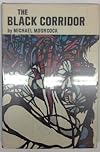
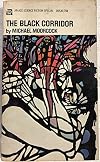
The Black Corridor
by Michael Moorcock
Sailing to Utopia (2), Travelling to Utopia (book 3), The Eternal Champion (Travelling to Utopia book 3)
On This Page
Tags
Recommendations












Member Reviews
Not always well-written. (Actually at times almost comically badly written, see the chapter wherein he sleeps with his competitor's daughter for instance). However it perfectly encapsulates all the reasons why I love Moorcock's fiction, especially this style of dreamlike space-horror which - guilty pleasure or not - ticks all my boxes.
Az én kezdetleges sci-fi definícióm szerint (sci-fi: amiben űrhajó van) ez vígan az: a nevezetes égi jármű a Föld irányából tart valami állítólag lakható bolygó felé, fedélzetén egy halom hibernált emberrel, és egy ébren lévővel, aki felügyeli az egész miskulanciát, miközben meglehetősen száraz beszélgetéseket folytat a hajó fedélzeti számítógépével. Az űr ebben a kontextusban tulajdonképpen metafora – a végtelen magányé, ami lassan kiszörpölgeti az emberből a józan észt –, az űrhajó pedig ezen belül a koporsónyi színpad, ami a szereplő(k)nek játszani rendeltetett. A regény másik fontos kérdése pedig az, vajon hogyan jutottak el hőseink odáig, hogy egy ilyen minimum show more kockázatos vállalkozásba kezdjenek. Ennek keretében pedig Moorcock méregerős visszatekintő fejezetek hadában mutatja be, ahogy a földi társadalom atomjaira hullik a nacionalizmus, az idegengyűlölet* és az általában vett emberi ostobaság hármas csapásai alatt, olyan helyzetet teremtve, amiből (talán) megmenthetik a szereplők a puszta bőrüket, de hogy az emberségüket nem, az biztos.
Olyan könyv ez, aminek a kérdései egy szemernyit sem koptak az eltelt kb. ötven évben. Sőt. És attól tartok, nem kopnak még el egy darabig. Engem lenyűgözött.
* Ha már idegengyűlölet. Érdekes volt látni, Moorcock mennyire máshogy kezeli az „idegen” fogalmát, mint A. C. Clarke. Clarke esetében ugyanis az „idegen” szó jelentéstartalma a feltérképezendő szóhoz közelít, és a szereplőkből kíváncsiságot vált ki. Ezzel szemben Moorcocknál a szóhoz az elpusztítandó kapcsolódik, tehát a szereplőkből gyűlöletet vált ki. Ez egyben remekül megmutatja a két szerző közötti különbséget: hogy Clarke-nál az emberiségből akár még lehet is valami, Moorcocknál viszont az egészet megette a fene. A szerző pedig egy politikus szájával zseniálisan fogalmazza meg, hogyan is kell felismerni az idegeneket: „Első látásra megismeritek őket. Mások. Más a szemük. Kételkednek, amikor ti biztosan vagytok a dolgotokban. Ők azok, akik összefognak az idegenekkel meg a kétes jelleműekkel; gyanú árnyékét borítják arra, amiért mi küzdünk. (…) Akik nevetnek, és gyanúsan sokat mosolyognak. Élcelődnek, hogy rossz fényt vessenek eszményeinkre. Ők azok, akik félreállnak, amikor terveket készítünk elő a haza megtisztítására.” (81. oldal) Ebbe nekem a hátam beleborsódzott. Talán ez a pár mondat billentette fel öt csillagra a könyvet. show less
Olyan könyv ez, aminek a kérdései egy szemernyit sem koptak az eltelt kb. ötven évben. Sőt. És attól tartok, nem kopnak még el egy darabig. Engem lenyűgözött.
* Ha már idegengyűlölet. Érdekes volt látni, Moorcock mennyire máshogy kezeli az „idegen” fogalmát, mint A. C. Clarke. Clarke esetében ugyanis az „idegen” szó jelentéstartalma a feltérképezendő szóhoz közelít, és a szereplőkből kíváncsiságot vált ki. Ezzel szemben Moorcocknál a szóhoz az elpusztítandó kapcsolódik, tehát a szereplőkből gyűlöletet vált ki. Ez egyben remekül megmutatja a két szerző közötti különbséget: hogy Clarke-nál az emberiségből akár még lehet is valami, Moorcocknál viszont az egészet megette a fene. A szerző pedig egy politikus szájával zseniálisan fogalmazza meg, hogyan is kell felismerni az idegeneket: „Első látásra megismeritek őket. Mások. Más a szemük. Kételkednek, amikor ti biztosan vagytok a dolgotokban. Ők azok, akik összefognak az idegenekkel meg a kétes jelleműekkel; gyanú árnyékét borítják arra, amiért mi küzdünk. (…) Akik nevetnek, és gyanúsan sokat mosolyognak. Élcelődnek, hogy rossz fényt vessenek eszményeinkre. Ők azok, akik félreállnak, amikor terveket készítünk elő a haza megtisztítására.” (81. oldal) Ebbe nekem a hátam beleborsódzott. Talán ez a pár mondat billentette fel öt csillagra a könyvet. show less
In a world where people indulge in every paranoid thought and act on it, where everyone medicates to cut off the anxieties the society brings, the privacy has become a synonym for happiness and sleeping pills and antidepressants are the means to this end.
And one rational man tries to escape this nightmare by trying to colonize and create a new and better life on a new world. Alone in his spaceship, Ryan observes the ship's functioning and the hibernation pods where his family and friends sleep. During these long lonely hours of most strict regime he will find out if he is as rational as he things.
Overall it's a short easy and enjoyable read, for some reason compared to 1984. I'd say it's far from it. In "The Black Corridor", although show more there is government the public is left to their own ideas and they are the ones that bring severe punishments. I wouldn't say it is a Dystopian peace of literature as much as psychological fiction. show less
And one rational man tries to escape this nightmare by trying to colonize and create a new and better life on a new world. Alone in his spaceship, Ryan observes the ship's functioning and the hibernation pods where his family and friends sleep. During these long lonely hours of most strict regime he will find out if he is as rational as he things.
Overall it's a short easy and enjoyable read, for some reason compared to 1984. I'd say it's far from it. In "The Black Corridor", although show more there is government the public is left to their own ideas and they are the ones that bring severe punishments. I wouldn't say it is a Dystopian peace of literature as much as psychological fiction. show less
Ryan is alone. He is a member of a 13 person crew of a spaceship going at 0.9 of the speed of light away from Earth and to a potential new life and new civilization on a distant star. He is the only one not in suspended animation. He is lonely and haunted by his past - the things he did to save his family and friends and this guilt and isolation triggers a bout of depression and mental instability. And, goody for us, we get to read about it.
As I'm sure was the intent, I've got a lot more questions about Ryan and the others after finishing the book. I feel like very little was resolved and all we've done is leave me hanging - wondering what IS going to happen and probably more importantly - wondering what really happened. The only reason show more I'm at all convinced that any time at all passed during the book is because the days Ryan writes in his journal are incrementing normally. Other than that, I'd be not at all surprised to have the author just pull a nasty trick and say the whole thing was a dream - or a flashback.
Odd, odd book. For all his protestations to the contrary, Ryan is neither particularly sane, practical or humane. He certainly has no moral grounding. It's always interesting to try to imagine how you'd act in a similar situation - but I can't imagine myself in a similar situation. The society that Ryan comes from has degenerated almost completely - individuals are isolated from one another. Xenophobia is running rampant. Drug use is the norm. Almost everyone has a pathological fear of talking to other people. And Ryan is bred from that society. I guess, looking at it that way, it's easier to see how he could do what he did. Quite simply, he hates people and sees very little wrong with treating them like obstacles in his path to be maneuvered, avoided, or removed as convenient. show less
As I'm sure was the intent, I've got a lot more questions about Ryan and the others after finishing the book. I feel like very little was resolved and all we've done is leave me hanging - wondering what IS going to happen and probably more importantly - wondering what really happened. The only reason show more I'm at all convinced that any time at all passed during the book is because the days Ryan writes in his journal are incrementing normally. Other than that, I'd be not at all surprised to have the author just pull a nasty trick and say the whole thing was a dream - or a flashback.
Odd, odd book. For all his protestations to the contrary, Ryan is neither particularly sane, practical or humane. He certainly has no moral grounding. It's always interesting to try to imagine how you'd act in a similar situation - but I can't imagine myself in a similar situation. The society that Ryan comes from has degenerated almost completely - individuals are isolated from one another. Xenophobia is running rampant. Drug use is the norm. Almost everyone has a pathological fear of talking to other people. And Ryan is bred from that society. I guess, looking at it that way, it's easier to see how he could do what he did. Quite simply, he hates people and sees very little wrong with treating them like obstacles in his path to be maneuvered, avoided, or removed as convenient. show less
This is a pretty short science fiction book, taking place in two time periods. The main story line is the story of Ryan and twelve travel companions, traveling through space for Munchen 15040. His companions are in suspended animation, and he has been captaining the ship alone for years. While he is slowly losing mind, he remembers how they came to leave earth. At the beginning of the twenty-first century Earth descents into chaos. People are paranoid because of over population. All foreigners are kicked out of England, and slowly the people turn on themselves. Paranoia is huge, forcing people to stay in their houses, not have contact with each other and sleep most of their days away.
The book flips between Ryan on the ship, and his show more flashbacks of life before they left Earth. There is no clean separation between the two, and it gets more confusing as the story goes on, as Ryan gets more confused. Because of the confusing lines in the story, at the end, you don't know what is real and what is paranoid delusion. Is Ryan really alone? Are the rest of the travelers really 'asleep'? And did they even leave? Despite the book not being very clear, and the ending very vague, I really liked the story, because it conveyed the emotions very well. Four out of five stars. show less
The book flips between Ryan on the ship, and his show more flashbacks of life before they left Earth. There is no clean separation between the two, and it gets more confusing as the story goes on, as Ryan gets more confused. Because of the confusing lines in the story, at the end, you don't know what is real and what is paranoid delusion. Is Ryan really alone? Are the rest of the travelers really 'asleep'? And did they even leave? Despite the book not being very clear, and the ending very vague, I really liked the story, because it conveyed the emotions very well. Four out of five stars. show less
An early book by Moorcock that doesn't quite hint at the genius of his later trilogy, "The Dancers at the End of Time", but it is a decent read, about a small band of the last survivors from Earth who stole an experimental ship during Earth's last war and fled to a distant star. During the journey, the men find that they have not entirely left the problems of Earth behind.
URANIA COLLEZIONE NR. 133
Apr 12, 2018Italian
Members
- Recently Added By
Author Information

659+ Works 65,170 Members
Michael Moorcock, 1939 - Writer Michael Moorcock was born December 18, 1939 in Mitcham, Surrey, England. Moorcock was the editor of the juvenile magazine Tarzan Adventures from 1956-58, an editor and writer for the Sexton Blake Library and for comic strips and children's annuals from 1959-61, an editor and pamphleteer for Liberal Party in 1962, show more and became editor and publisher for the science fiction magazine New Worlds in 1964. He has worked as a singer-guitarist, has worked with the rock bands Hawkwind and Blue Oyster Cult and is a member of the rock band Michael Moorcock and the Deep Fix. Moorcock's writing covers a wide range of science fiction and fantasy genres. "The Chronicles of Castle Brass" was a sword and sorcery novel, and "Breakfast in the Ruins: A Novel of Inhumanity" uses the character Karl Glogauer as a different person in different times. Karl participates in the political violence of the French Revolution, the Paris Commune, and a Nazi concentration camp. Moorcock also wrote books and stories that featured the character Jerry Cornelius, who had no consistent character or appearance. "The Condition of Muzak" completed the initial Jerry Cornelius tetralogy and won Guardian Literary Prize in 1977. "Byzantium Endures" and "The Laughter of Carthage" are two autobiographical novels of the Russian emigre Colonel Pyat and were the closest Moorcock came to conventional literary fiction. "Byzantium Endures" focuses on the first twenty years of Pyat's life and tells of his role in the Russian revolution. Pyat survives the revolution and the subsequent civil war by working first for one side and then another. "The Laughter of Carthage" covers Pyat's life from 1920-1924 telling of his escape from Communist Russia and his travels in Europe and America. It's a sweeping picture of the world during the 1920's because it takes the character from living in Constantinople to Hollywood. Moorcock returned to the New Wave style in "Blood: A Southern Fantasy" (1994) and combined mainstream fiction with fantasy in "The Brothel of Rosenstrasse," which is set in the imaginary city of Mirenburg. MoorCock won the 1967 Nebula Award for Behold the Man and the 1979 World Fantasy Award for his novel, Gloriana. (Bowker Author Biography) show less
All Editions
Some Editions
Series

Sailing to Utopia
4 works (2)

Travelling to Utopia
3 works (book 3)

The Eternal Champion
63 works (Travelling to Utopia book 3)
Belongs to Publisher Series
Work Relationships
Common Knowledge
- Original title
- The Black Corridor
- Original publication date
- 1969
- People/Characters
- Ryan; Josephine Ryan (Ryan's wife); Rupert Ryan (Ryan's son); Alexander Ryan (Rupert's brother); Sydney Ryan (Ryan's uncle); John Ryan (Ryan's brother) (show all 20); Isabel Ryan (John's first wife); Janet Ryan (John's second wife); Fred Masterson; Tracy Masterson; James Henry; Ida Henry; Felicity Henry; Owen Powell; Saunders; Colin Beesley; Sarah Carson; Tischenko; Schonberg; Boulez
- Important places
- London, England, UK; Siberia, Russia, U.S.S.R.
- Dedication
- For Hilary - who did more than help
- First words
- Space is infinite.
- Quotations
- 'It confirms what I already believed,' said Masterson. 'Ten per cent of your employees, chiefly from factories in the North, are actually of wholly foreign parentage - Australian and Irish in the main. Another ten per cent ... (show all)had parents born outside England itself, i.e. in Scotland, Wales and the Republic of Ireland. Three per cent of your staff, although born and educated in England are Jewish. About half a per cent have Negro or Asiatic blood. That's the general picture.'
Ryan rubbed his nose. 'Bloody difficult, eh, Masterson?'
True to his word, Mr. Ryan has his cold shower. It does the trick. He feels much better. Humming to himself he enters his won cabin, selects the tape of Messiaen's Turangalila Symphony and sits down to the strange and bea... (show all)utiful melodies of the Ondes Martenot. By the Sixth Movement (Jardin du sommeil d'amour) he is asleep... - Last words
- (Click to show. Warning: May contain spoilers.)And it is infinite.
Classifications
Statistics
- Members
- 363
- Popularity
- 86,627
- Reviews
- 7
- Rating
- (3.32)
- Languages
- 5 — Dutch, English, German, Hungarian, Italian
- Media
- Paper, Ebook
- ISBNs
- 7
- ASINs
- 19