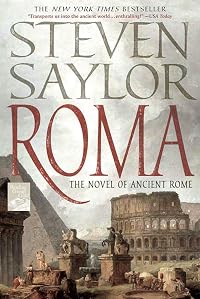
On This Page
Description
Spanning a thousand years, and following the shifting fortunes of two families though the ages, this is the epic saga of Rome, the city and its people.Tags
Recommendations





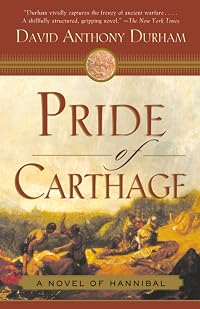
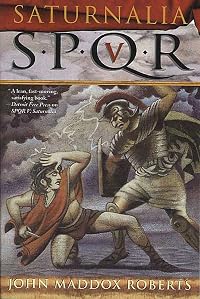
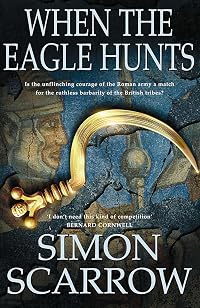
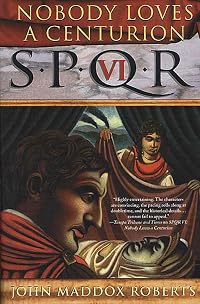

Member Recommendations
Member Reviews
Steven Saylor definitely took on a huge task when he chose to write a novelized history of Rome from the viewpoint of one of the oldest patrician families, but least-known in modern times --- the Pinarii, and their cousins the Potitii. The novel touches on the important turning-points of Rome's history, when members of the Pinarii or the Potitii are constantly being caught up in momentous events --- the sack of Rome by Gauls, the Carthaginian wars, the campaign of Scipio, the dictatorship of Sulla, and so on --- and actually living the events, with the uncertainty and awe of a person caught up in the middle of something with no idea how it will end. The Pinarius or Potitius central to each episode of the book is our main character but show more not history's main character, and as the family descends through time and is influenced by past character's actions, so are we as readers. This is half-story, half-history, in the Livian vein and a great homage to Livy's history of Rome. The facts are mostly solid, and if two "facts" were available, well we are writing a novel here, not a textbook, and we (the writer) are allowed to pick whichever one fits the story we want to tell the best. I feel compelled now to check a few of Saylor's facts, like was Julius Caesar's sister Julia really married to a Pinarius, or has Saylor made that up out of whole cloth; because if all these occurrences of Pinarii and Potitii were Saylor has them occurring are documentable fact, then Saylor's masterful filling-in-of-the-blanks is even more refined and elegant than I thought.
The source material Saylor lists in the book's Afterword is also excellent, including his use of T.P. Wiseman's [b:Remus A Roman Myth|1315802|Remus A Roman Myth|T.P. Wiseman|http://photo.goodreads.com/books/1182703905s/1315802.jpg|1305104] as source material on the pre-foundation history of Rome and the various foundation myths. I cannot praise enough this decision on Saylor's part. Saylor's Remus was not a carbon copy of Wiseman's Remus, but many of Wiseman's observations seem to have influenced Saylor's character creation, and his imagination of the earliest layout of the city. Whereas Wiseman deals academically with the Romulus & Remus story, Saylor says to himself "How can I make this plausible in the real world, not the world of myth?" and then he goes and does so. I can't say enough, even in the review of a different book, about the value of Wiseman's work on Remus to classical scholars; and if you are going to take on the task of tackling Saylor's Roma, then Wiseman's Remus: A Roman Myth will subsequently be no trouble at all and might help the reader flesh out the pre-historic Roman world as presented by Saylor. The one is so clearly, and well, informed by the other.
The omniscient narration of Roma does not have the same voice as the character-centric narration of Saylor's Gordianus the Finder mystery series, for which I am truly grateful. The writing style employed for mysteries would not suit a larger work such as Roma. Different genres require different approaches, and it is not every writer who can go from one to another easily and successfully. The tone and style of Roma is suitable to a long fiction work with many characters and a complex plot full of details. The book has been broken up into historical episodes, loosely based on a single generation of characters, but of course the common thread running through all the episodes is the family being focussed on (usually the Pinarii). You only need to worry about one Lucius Pinarius at a time, which is a relief, as Romans were not very creative namers and you tended to get two or three of every name in a single generation. When one Lucius Pinarius thinks back to the actions of another Lucius Pinarius, Saylor says something like "Lucius remembered that his great-great-grandfather, also named Lucius Pinarius, did such-and-such or knew so-and-so," and that is enough to jog the reader's memory: "Oh yeah, I remember that," or "Oh my gosh kid, you are so misinformed!" But as misinformation (or lies?) from a previous generation become enshrined in popular memory, they become historical fact, and it seems to me that in the book itself Saylor has found a way to comment on the veracity (or not) of the historical "facts" we're operating with today. Did it really happen the way we think it did? Or is there a historical truth there that will never come to light? And how does knowing that is a possibility change the way we view history itself?
In short: This may be a bit overwhelming for the Roman history novice, who isn't vaguely familiar with the people and places Saylor employs in his narrative. There's a lot in this book to soak up. If you aren't daunted by that, all the better for you. For the reader fairly familiar with Roman history, especially the the early books of Livy and the half-forgotten period of the Kings and the early Republic, my recommendation is "have at with abandon, you will love this." show less
The source material Saylor lists in the book's Afterword is also excellent, including his use of T.P. Wiseman's [b:Remus A Roman Myth|1315802|Remus A Roman Myth|T.P. Wiseman|http://photo.goodreads.com/books/1182703905s/1315802.jpg|1305104] as source material on the pre-foundation history of Rome and the various foundation myths. I cannot praise enough this decision on Saylor's part. Saylor's Remus was not a carbon copy of Wiseman's Remus, but many of Wiseman's observations seem to have influenced Saylor's character creation, and his imagination of the earliest layout of the city. Whereas Wiseman deals academically with the Romulus & Remus story, Saylor says to himself "How can I make this plausible in the real world, not the world of myth?" and then he goes and does so. I can't say enough, even in the review of a different book, about the value of Wiseman's work on Remus to classical scholars; and if you are going to take on the task of tackling Saylor's Roma, then Wiseman's Remus: A Roman Myth will subsequently be no trouble at all and might help the reader flesh out the pre-historic Roman world as presented by Saylor. The one is so clearly, and well, informed by the other.
The omniscient narration of Roma does not have the same voice as the character-centric narration of Saylor's Gordianus the Finder mystery series, for which I am truly grateful. The writing style employed for mysteries would not suit a larger work such as Roma. Different genres require different approaches, and it is not every writer who can go from one to another easily and successfully. The tone and style of Roma is suitable to a long fiction work with many characters and a complex plot full of details. The book has been broken up into historical episodes, loosely based on a single generation of characters, but of course the common thread running through all the episodes is the family being focussed on (usually the Pinarii). You only need to worry about one Lucius Pinarius at a time, which is a relief, as Romans were not very creative namers and you tended to get two or three of every name in a single generation. When one Lucius Pinarius thinks back to the actions of another Lucius Pinarius, Saylor says something like "Lucius remembered that his great-great-grandfather, also named Lucius Pinarius, did such-and-such or knew so-and-so," and that is enough to jog the reader's memory: "Oh yeah, I remember that," or "Oh my gosh kid, you are so misinformed!" But as misinformation (or lies?) from a previous generation become enshrined in popular memory, they become historical fact, and it seems to me that in the book itself Saylor has found a way to comment on the veracity (or not) of the historical "facts" we're operating with today. Did it really happen the way we think it did? Or is there a historical truth there that will never come to light? And how does knowing that is a possibility change the way we view history itself?
In short: This may be a bit overwhelming for the Roman history novice, who isn't vaguely familiar with the people and places Saylor employs in his narrative. There's a lot in this book to soak up. If you aren't daunted by that, all the better for you. For the reader fairly familiar with Roman history, especially the the early books of Livy and the half-forgotten period of the Kings and the early Republic, my recommendation is "have at with abandon, you will love this." show less
One of my all-time favourite historical novels is Edward Rutherfurd’s Sarum, which follows several families through the generations that it took to build Salisbury Cathedral. Steven Saylor’s Roma takes the same tack: here we follow the Potitius and Penarius clans from the beginnings of the geographic area of Italy that became Rome, a crossroads where goods were traded, through to the assassination of Julius Ceasar in 44 BC and its aftermath. Covering some thousand years of the ebbs and flows of human existence, this is a sprawling novel, but one that manages to keep its focus by honing in on two specific (fictional) families who are at times friends and at other times rivals of each other and who are in various ways witnesses to the show more great events of the times. As such, the reader gets a lesson in the true history of Rome while also enjoying the benefits of the imagined human interactions on the page. This is the first of a trilogy and sets the bar high for the next two books; Mr. Saylor’s writing style is one I’ve enjoyed for years, having read most of his Roma Sub Rosa series, and I enjoyed this book a lot as well. Recommended, but be prepared for some gore, as these ancient Romans could be quite vicious! show less
Through this massive book we learn not only about the lives and lineage of two Roman families, we learn about the history and making of Rome itself. Many subtle misunderstandings we have as to how the empire was formed are corrected and many other things we suspected were confirmed. History is truly shown to repeat itself chapter by chapter as we follow families and citizens struggle for safety and power.
Is this a novel, a blueprint for a television series on the History Channel, or a craftily written textbook on Roman history? Quite frankly it's hard to tell. The basic premise that history repeats itself is both the pivotal intelligence of the book and its downfall. It took me a few pages into the second chapter to realize I did not show more have a misprint in my hands and that the two chapters were actually different. The chapters are extremely similar in that they tell of how beginning of Rome started in a small settlement through the earthly desires of the men and women who are struggling to come to terms with their harsh environment. In order to compress large stretches of history in a few pages the author, at least on the surface, takes liberties with character descriptions. Some of the people we encounter therefor are larger than life, even larger than could be historically possible, but most of the natives of this book are either caricatures of what we expect of Romans or incredibly flat lending support that we're actually reading a history text book.
This book could have been a remarkable in-depth look at how many generations of dedicated families it takes to form the nexus of a stable and long lasting society. Rome wasn't built in a day and this novel could have been the proof. Instead we read chapter after chapter the same cycle, which although true to life and honest, doesn't drive the reader forwards and doesn't provide those glimpses of personal struggle we know must have been the foundation of the city we know today. show less
Is this a novel, a blueprint for a television series on the History Channel, or a craftily written textbook on Roman history? Quite frankly it's hard to tell. The basic premise that history repeats itself is both the pivotal intelligence of the book and its downfall. It took me a few pages into the second chapter to realize I did not show more have a misprint in my hands and that the two chapters were actually different. The chapters are extremely similar in that they tell of how beginning of Rome started in a small settlement through the earthly desires of the men and women who are struggling to come to terms with their harsh environment. In order to compress large stretches of history in a few pages the author, at least on the surface, takes liberties with character descriptions. Some of the people we encounter therefor are larger than life, even larger than could be historically possible, but most of the natives of this book are either caricatures of what we expect of Romans or incredibly flat lending support that we're actually reading a history text book.
This book could have been a remarkable in-depth look at how many generations of dedicated families it takes to form the nexus of a stable and long lasting society. Rome wasn't built in a day and this novel could have been the proof. Instead we read chapter after chapter the same cycle, which although true to life and honest, doesn't drive the reader forwards and doesn't provide those glimpses of personal struggle we know must have been the foundation of the city we know today. show less
I approached Roma with a great deal of enthusiasm. I assumed that Roma was going to be similar to many of the Roma Sub Rosa works of Mr. Saylor. I was wrong!!
Roma, while sharing the same basics (time/place) with the Roma Sub Rosa series, stands on its own. It creates a multi-generational story line using the possession of an amulet to tie the many generations together. And it renders a fascinating tale of early Rome, from its foundation as a crossroads of commerce to its eventual rise to become the center of the known world.
Once again, Saylor gives us a lesson in history by making history come alive. All of the prominent characters are here, beginning with Romulus and Remus, as well as characters of Saylor’s own very fertile show more imagination.
Initially, I was a little wary of how this plot device was going to work. However, after reading three chapters, I was hooked. I found myself completely losing track of real-world time. Before I knew it I’d finished the book!! Then I picked it up and started at the beginning again. It’s safe to say that I enjoyed it even more upon the second reading.
Saylor has the unique ability to create three dimensional characters and believable plots. For anyone familiar with his work this will come as no surprise. For those who have yet to discover Saylor – this is a perfect way to become acquainted with him. The man is a master storyteller!!
My advice is: READ IT and then READ IT again!
There’s a reason that Steven Saylor is my favorite author. Roma adds to that reason!!! show less
Roma, while sharing the same basics (time/place) with the Roma Sub Rosa series, stands on its own. It creates a multi-generational story line using the possession of an amulet to tie the many generations together. And it renders a fascinating tale of early Rome, from its foundation as a crossroads of commerce to its eventual rise to become the center of the known world.
Once again, Saylor gives us a lesson in history by making history come alive. All of the prominent characters are here, beginning with Romulus and Remus, as well as characters of Saylor’s own very fertile show more imagination.
Initially, I was a little wary of how this plot device was going to work. However, after reading three chapters, I was hooked. I found myself completely losing track of real-world time. Before I knew it I’d finished the book!! Then I picked it up and started at the beginning again. It’s safe to say that I enjoyed it even more upon the second reading.
Saylor has the unique ability to create three dimensional characters and believable plots. For anyone familiar with his work this will come as no surprise. For those who have yet to discover Saylor – this is a perfect way to become acquainted with him. The man is a master storyteller!!
My advice is: READ IT and then READ IT again!
There’s a reason that Steven Saylor is my favorite author. Roma adds to that reason!!! show less
 This review was written for LibraryThing Early Reviewers.
This is a honkin, great big book (as in lots and lots of pages) - but don't be scared, come back out from behind that chair or bookcase - you *can* read this and even...enjoy it. I know I know honkin big books are scary, they tend to be dense and require time and effort and you get tired just thinking about reading them. But it's ok. No really It's OK. This book is a delightful read. Think of yourself catching glimpses into windows (time periods) of an enormous building (Rome). Get sucked along with an ancestral line and witness the changes of fortune which occur both to the family and Rome herself. Roma's accessible and easy style makes reading in small or large chunks possible. It's size may be intimidating, but that only lasts until show more you've read the first sentence then you'll see it is a light but interesting read. Rome's history is long and varied but never uninteresting. The book covers from Rome's early days as a point on trade routes until the time of Cesar Augustus. show less
This review was written for LibraryThing Early Reviewers.Over three thousand years ago, a murder takes place on an island in a river flowing through the hilly region of Italy later known as the ruma. This bloody act presages the rise of one of the ancient world’s most ruthless empires. In Roma: The Novel of Ancient Rome, Steven Saylor takes us on a thousand-year journey from Rome’s mythical beginnings as a trading post for salt sellers through its evolution into an empire, in a style reminiscent of James Michner. Along the way we witness Hercules‘ destruction of the monster Cacus; the founding of the walled city of Rome by a couple of young bandits named Romulus and Remus; the abduction of the Sabine women; invasions by enemies; and revolutions by generals, plebians and slaves. show more Throughout, Saylor provides us with real people and understandable motivations, whose stories have been transformed over time into the stuff of myth and legend.
Covering a thousand years in 555 pages is impossible, so Saylor uses a series of eleven linked chapters, dipping in and out of the stream of time; while following two families, the Potitii and Penarii, through the generations. Through it all, these families interact with key players in Roman history: Coriolanus, the rebel general; Scipio, known as Africanus for his defeat of Carthage; the heroes of the people, the Gracchi brothers; Sulla the dictator; and, of course, Julius Caesar. Saylor gives several key female characters some space, as well; from Lara, the founder of the line; to Potitia, a Vestal Virgin trapped on the Capitoline Hill during the siege of Rome by the Gauls; to Cornelia, the mother of the Gracchi.
The stories are not only linked by the generations, but also a physical object—a gold amulet in the shape of a winged phallus representative of an ancient nature god Fascinus. The main character—whether warrior, slave, vestal virgin, or murderer—always wears the fascinum. It begins its existence as a simple lump of gold on a chain, is later molded into the winged phallus, and ends the book worn into the shape of a simple cross. Saylor tells us in his Author’s Note that Fascinus was the name of a god sacred to the Vestal Virgins. They would place a fascinum under the chariot of those who triumphed through Rome to avoid “fascination” or the “evil eye.”
This book required a tremendous amount of research, above and beyond the stories of individual people. Saylor deftly weaves in information about the evolution of place names, food, clothing, religious institutions and practices, public holidays and celebrations, political ebb and flow. The problems faced by the growing Republic are eerily reminiscent of the challenges faced by our own, much younger country: class war, religious intolerance and witch hunts, cynical political manipulation by the rich and powerful, and war mongering to avoid domestic unrest.
I truly enjoyed this reading experience. Roma introduces the reader to events that receive short shrift in most history books. Although it covered a vast sweep of time, I felt the story telling was consistent and the characters varied and interesting. This is a wonderful achievement in both effort and results. Among the “extras”–including an interview with the author, a historical essay and reading group questions–I particularly liked the maps of Rome at the beginning of each chapter, showing the walls, major landmarks, public buildings, temples, and altars. It’s a great way of showing Rome’s expansion and evolution. “Thanks” to Saylor for a great read. show less
Covering a thousand years in 555 pages is impossible, so Saylor uses a series of eleven linked chapters, dipping in and out of the stream of time; while following two families, the Potitii and Penarii, through the generations. Through it all, these families interact with key players in Roman history: Coriolanus, the rebel general; Scipio, known as Africanus for his defeat of Carthage; the heroes of the people, the Gracchi brothers; Sulla the dictator; and, of course, Julius Caesar. Saylor gives several key female characters some space, as well; from Lara, the founder of the line; to Potitia, a Vestal Virgin trapped on the Capitoline Hill during the siege of Rome by the Gauls; to Cornelia, the mother of the Gracchi.
The stories are not only linked by the generations, but also a physical object—a gold amulet in the shape of a winged phallus representative of an ancient nature god Fascinus. The main character—whether warrior, slave, vestal virgin, or murderer—always wears the fascinum. It begins its existence as a simple lump of gold on a chain, is later molded into the winged phallus, and ends the book worn into the shape of a simple cross. Saylor tells us in his Author’s Note that Fascinus was the name of a god sacred to the Vestal Virgins. They would place a fascinum under the chariot of those who triumphed through Rome to avoid “fascination” or the “evil eye.”
This book required a tremendous amount of research, above and beyond the stories of individual people. Saylor deftly weaves in information about the evolution of place names, food, clothing, religious institutions and practices, public holidays and celebrations, political ebb and flow. The problems faced by the growing Republic are eerily reminiscent of the challenges faced by our own, much younger country: class war, religious intolerance and witch hunts, cynical political manipulation by the rich and powerful, and war mongering to avoid domestic unrest.
I truly enjoyed this reading experience. Roma introduces the reader to events that receive short shrift in most history books. Although it covered a vast sweep of time, I felt the story telling was consistent and the characters varied and interesting. This is a wonderful achievement in both effort and results. Among the “extras”–including an interview with the author, a historical essay and reading group questions–I particularly liked the maps of Rome at the beginning of each chapter, showing the walls, major landmarks, public buildings, temples, and altars. It’s a great way of showing Rome’s expansion and evolution. “Thanks” to Saylor for a great read. show less
Somehow I forgot that this was a novel and not a straight up history similar to Rubicon by Tom Holland. While I wasn't disappointed by the reality exactly, I found the constraints of the novel to be too narrow and too open to a kind of Mary-Sue-ism. That is that the people used to illustrate the big moments of any particular time just happen to always be directly connected with that big moment. That and because this novel was meant to instruct and relate vast amounts of information, there was a lot of 'As you know, Bob' in the way it was presented. Parent - child instruction, teacher - pupil questioning, people who should and would have known the reasons or history behind a certain event were inexplicably having to endure explanations show more from someone else. It got to be a bit annoying after a while and I think on the whole I would have liked a series of loosely or wholly unconnected stories to bring me through the foundation of Rome and its early Republic.
A lot of it was fascinating and while I know a lot of information is simply undocumented and unprovable, many of the vignettes had a ring of plausibility about them. The rise of Romulus and Remus and the monster Cacus are almost completely without basis, but were fun to imagine happening the way laid out in Roma. I especially liked the mass of poisoner women and wondered if it were true in any sense (even if it were just a handful of women and not hundreds as portrayed) and was cringingly delighted to find out Livy reported the incident hundreds of years ago. I'm even inspired now to go read some Livy since I've never actually read Roman history as written by a Roman historian (unless Seutonius counts). So while I may not seek out the sequel to Roma as I'm not that interested in following the Pinarii any longer, it did ratchet up my curiosity about pre-Empire Rome and think Roma should serve anyone looking for a greatest hits of ancient Rome to cut their teeth on.
Read more: http://thebookmarque.blogspot.com/#ixzz0xLyyV3lf show less
A lot of it was fascinating and while I know a lot of information is simply undocumented and unprovable, many of the vignettes had a ring of plausibility about them. The rise of Romulus and Remus and the monster Cacus are almost completely without basis, but were fun to imagine happening the way laid out in Roma. I especially liked the mass of poisoner women and wondered if it were true in any sense (even if it were just a handful of women and not hundreds as portrayed) and was cringingly delighted to find out Livy reported the incident hundreds of years ago. I'm even inspired now to go read some Livy since I've never actually read Roman history as written by a Roman historian (unless Seutonius counts). So while I may not seek out the sequel to Roma as I'm not that interested in following the Pinarii any longer, it did ratchet up my curiosity about pre-Empire Rome and think Roma should serve anyone looking for a greatest hits of ancient Rome to cut their teeth on.
Read more: http://thebookmarque.blogspot.com/#ixzz0xLyyV3lf show less
This review was written for LibraryThing Early Reviewers.Members
- Recently Added By
Published Reviews
ThingScore 67
Like James Michener, Saylor the novelist (A Gladiator Dies Only Once, 2005, etc.) is upstaged by Saylor the historian—except when he suggests that history itself is fact-based fiction.
added by Christa_Josh
This work will attract a different fan base from Saylor's other work (e.g., Arms of Nemesis ) but should prove appealing to history and political buffs who enjoy comparing our current events with ancient Rome
added by Christa_Josh
Author of the critically acclaimed Roma Sub Rosa series of historical mysteries, Saylor (The Judgment of Caesar) breaks out on an epic scale in this sprawling novel tracing Rome's extraordinary development over five centuries, as seen through the eyes of succeeding generations of one of its founding families.
added by Christa_Josh
Lists

Best Historical Fiction
620 works; 257 members

Historical Fiction
889 works; 91 members

Best historical fiction set in the ancient world
126 works; 40 members

Best family sagas
244 works; 32 members

Best Historical Fiction authors
41 works; 9 members

Majkia's Mystery/ Thriller TBR
86 works; 3 members

KayStJ's to-read list
1,616 works; 11 members

History in the long view
55 works; 3 members

al.vick-series
381 works; 2 members
Author Information

61+ Works 13,632 Members
Steven Saylor (born March 23, 1956) is an American author of historical novels. He is a graduate of the University of Texas at Austin, where he studied history and Classics. Although he also has written novels about Texas history, Saylor's best-known work is his Roma Sub Rosa series, set in ancient Rome. The novels' hero is a detective named show more Gordianus the Finder, active during the time of Sulla, Cicero, Julius Caesar, and Cleopatra. He divides his time residing in California and texas. (Bowker Author Biography) show less
Some Editions
Series

Common Knowledge
- Canonical title
- Roma
- Original publication date
- 2007
- People/Characters
- Julius Caesar; Coriolanus; Romulus; Remus; Scipio Africanus; Tiberius Sempronius Gracchus (show all 8); Gaius Sempronius Gracchus; Hercules
- Important places
- Rome, Italy (ancient)
- Dedication
- To the shade of Titus Livius, known in English as Livy, who preserved for us the earliest tales of earliest Rome.
- First words
- As they rounded a bend in the path that ran beside the river, Lara recognized the silhouette of a fig tree atop a nearby hill.
- Last words
- (Click to show. Warning: May contain spoilers.)The boy gazed at the pendant, then silently placed the necklace over his head.
Classifications
Statistics
- Members
- 1,322
- Popularity
- 18,200
- Reviews
- 68
- Rating
- (3.65)
- Languages
- 10 — Dutch, English, German, Hungarian, Korean, Norwegian (Bokmål), Polish, Portuguese, Spanish, Swedish
- Media
- Paper, Audiobook, Ebook
- ISBNs
- 27
- ASINs
- 6
