
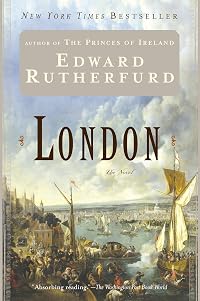
London
by Edward Rutherfurd
On This Page
Description
"A TOUR DE FORCE . . . London tracks the history of the English capital from the days of the Celts until the present time. . . . Breathtaking."--The Orlando Sentinel A master of epic historical fiction, Edward Rutherford gives us a sweeping novel of London, a glorious pageant spanning two thousand years. He brings this vibrant city's long and noble history alive through his saga of ever-shifting fortunes, fates, and intrigues of a half-dozen families, from the age of Julius Caesar to the show more twentieth century. Generation after generation, these families embody the passion, struggle, wealth, and verve of the greatest city in the Old World. Praise for London "Remarkable . . . The invasion by Julius Caesar's legions in 54 B.C. . . . The rise of chivalry and the Crusades . . . The building of the Globe theatre . . . and the coming of the Industrial Revolution. . . . What a delightful way to get the feel of London and of English history. . . . We witness first-hand the lust of Henry VIII. We overhear Geoffrey Chaucer deciding to write The Canterbury Tales. . . . Each episode is a punchy tale made up of bite-size chunks ending in tiny cliffhangers."--The New York Times "Hold-your-breath suspense, buccaneering adventure, and passionate tales of love and war."--The Times (London) "Fascinating . . . A sprawling epic."--San Francisco Chronicle show lessTags
Recommendations









Member Recommendations
raidergirl3 Both follow London throughout history
Member Reviews
As I’ve said multiple times over the course of reading this, if I didn’t have a plot bunny this was relevant to, I’d have quit about three or four chapters in, tops. It has … not aged well, let us say, and I kept putting it down out of a mix of boredom and outrage.
First, the things Rutherfurd does well:
tell a pleasant story (if you’re looking not to think, and are a straight white man)
relate history with reasonable accuracy, at least to the understandings current in 1999 (he clearly did do a lot of research)
show how events influence others, and be more obvious about multiple generations being present at once than the history books generally do
hit all the major events and landmarks of London, like the Romans and Shakespeare show more and the Crystal Palace
describe historical places and buildings that no longer exist in ways that bring them to mind, and historical inventions as the marvels they would been at the time
portray Londoners’ love of their city and play into that at every chance.
And now, the things that bugged me:
holy cats his treatment of women! Not only does he subscribe to the belief that every historical woman ever was either obedient, submissive, or under the thumb of her husband, or independent and controlling and therefore someone to be feared, and to the belief that abuse was the norm, but he also has a marked tendency to describe their physical appearance enticingly, introduce them as “the woman” or “she” pages before he gives them names or dialogue, and to give them plots related to their relationship status and children.
that last one is probably an understatement; so, so many of the mini-plots have to do with getting a wife, getting a husband, having children, being married off, being unfaithful in marriage, etc.
there’s also one family who occasionally have very fat daughters who do nothing but sit around and eat constantly, who are noticeably dimmer than their relatives and never speak a word of dialogue
very whitewashed and straightwashed, with two Black characters, one a sexualized woman and one the kidnapping pirate who “inspired” Othello and no queer people I can recall except for one or two kings, who aren’t really characters.
Additionally, a lot of the history segments are reasonably infodumpy for all they’re smooth reading, and the writing’s simply average. There’s nothing that really shines about it and nothing that sucks. Part of what got me, and this is a me problem, is that I knew a whole lot of the history of London from reading other things, and so there wasn’t a whole lot that was new to me apart from some of the landmark histories. (I also know of some of the historical discoveries and current opinions re: racial diversity, female agency, etc. which no longer sync with their presentation here.) I can see someone who knows very little about the city being more enthused with all the historical tidbits Rutherfurd weaves in, and he’s clearly writing for those people because of the “oh ho ho” tone he frequently adopts when presenting them.
Overall, I found the story boring and reductive, the characters average to offensive, and Rutherfurd’s inability to think of plots outside family relationships aggravating. It keeps the threads connected, sure, but a more modern or creative take on this story would have been so much better.
Recommended if you want to see what people are complaining about when they say novels are neither diverse or kind to women, and to get a better appreciation for how far publishing’s come in the last 19 years.
Warnings: Rampant misogyny, including but not limited to abuse, sexual harassment and assault, rape, and lack of female agency. Fatphobia. Very Straight™. Incredibly white and not great with its the only two Black characters.
2/10 (was a 5 before the stuff in warnings) show less
First, the things Rutherfurd does well:
tell a pleasant story (if you’re looking not to think, and are a straight white man)
relate history with reasonable accuracy, at least to the understandings current in 1999 (he clearly did do a lot of research)
show how events influence others, and be more obvious about multiple generations being present at once than the history books generally do
hit all the major events and landmarks of London, like the Romans and Shakespeare show more and the Crystal Palace
describe historical places and buildings that no longer exist in ways that bring them to mind, and historical inventions as the marvels they would been at the time
portray Londoners’ love of their city and play into that at every chance.
And now, the things that bugged me:
holy cats his treatment of women! Not only does he subscribe to the belief that every historical woman ever was either obedient, submissive, or under the thumb of her husband, or independent and controlling and therefore someone to be feared, and to the belief that abuse was the norm, but he also has a marked tendency to describe their physical appearance enticingly, introduce them as “the woman” or “she” pages before he gives them names or dialogue, and to give them plots related to their relationship status and children.
that last one is probably an understatement; so, so many of the mini-plots have to do with getting a wife, getting a husband, having children, being married off, being unfaithful in marriage, etc.
there’s also one family who occasionally have very fat daughters who do nothing but sit around and eat constantly, who are noticeably dimmer than their relatives and never speak a word of dialogue
very whitewashed and straightwashed, with two Black characters, one a sexualized woman and one the kidnapping pirate who “inspired” Othello and no queer people I can recall except for one or two kings, who aren’t really characters.
Additionally, a lot of the history segments are reasonably infodumpy for all they’re smooth reading, and the writing’s simply average. There’s nothing that really shines about it and nothing that sucks. Part of what got me, and this is a me problem, is that I knew a whole lot of the history of London from reading other things, and so there wasn’t a whole lot that was new to me apart from some of the landmark histories. (I also know of some of the historical discoveries and current opinions re: racial diversity, female agency, etc. which no longer sync with their presentation here.) I can see someone who knows very little about the city being more enthused with all the historical tidbits Rutherfurd weaves in, and he’s clearly writing for those people because of the “oh ho ho” tone he frequently adopts when presenting them.
Overall, I found the story boring and reductive, the characters average to offensive, and Rutherfurd’s inability to think of plots outside family relationships aggravating. It keeps the threads connected, sure, but a more modern or creative take on this story would have been so much better.
Recommended if you want to see what people are complaining about when they say novels are neither diverse or kind to women, and to get a better appreciation for how far publishing’s come in the last 19 years.
Warnings: Rampant misogyny, including but not limited to abuse, sexual harassment and assault, rape, and lack of female agency. Fatphobia. Very Straight™. Incredibly white and not great with its the only two Black characters.
2/10 (was a 5 before the stuff in warnings) show less
Even though London follows the same narrative pattern as Paris, I didn’t find it quite as engaging and I’m still struggling to figure out why. The history of the City is fascinating, but I am much more familiar with English history and there was therefore much less to “discover” per se, even through the eyes of Rutherfurd’s unique group of characters. His focus is typically on the common people of London - only straying to a minor encounter with Henry VIII and a few characters to rise to high middle class from common roots - but their stories are no less poignant than that of their social betters. Rife with mercantile greed, Roman gold, and peppered with the great happenings of a great city, these characters may have lived show more “common” lives, but they definitely seem to be representative of the people. What possibly made their stories less engaging than those of their Parisian counterparts is that Rutherfurd chose to focus on characters driven by economics. Sure, they fall in love, they hatch murder schemes, but the common thread that ties the pre-Roman fisherman to the cash-strapped Renaissance playwright to the slag-heap Baron is money. Tradition in economics is strong in the British Isles, so the passing on of ale-brewing businesses and marrying into the right-guild families is much more common than in laissez-faire Paris, where many of the characters seemed to fall into their circumstances merely by chance or through breaking with tradition. Of course, this doesn’t make the book any less good, since Rutherfurd’s prose and storytelling is still wonderful within each micro-tale, but it definitely sets a different literary tone than the one that I was expecting! show less
I tried, I really, really tried, but this book is never-ending and was also dragging down my reading quota; I had to abandon ship 100 pages from finishing, even after skipping through tedious chapters like 'Lavender Hill', for my sanity, but I'm still counting this towards my total for the year. I deserve the credit!
I struggled with New York too but enjoyed the structure and the characters, and actually learned about American history. London is an unfortunate mix of general historical infodumps, weak fictional characters built on quirks like webbed fingers and long noses, and not enough detail about the city itself, which was why I actually wanted to read this epic tome. I am fascinated with London history, even though I live in the show more north, and follow all kinds of history accounts on social media, but Rutherfurd only occasionally picks out gems like the history of St Paul's.
The author also writes women and minorities like Charles Dickens and Stephen King. I know he's writing about the past, but I feel like he agrees with the archaic takes on what makes a 'good wife' and the 'flood of immigrants' into the city. Also, he is strangely fixated with defining women by their physical attributes, which is obnoxious but also fairly typical - if none of the women actually 'breasted boobily' into a room, I suspect that is only because the meme came after the book.
Did I learn a little more about the history of London? Yes. Did I need fake family dynasties and lengthy infodumps about kings and playwrights straight out of textbooks to do so? Nope. Could this book have been half the length and still worked? 100%! Will I probably try to read Paris at some point in the future, when, like labour pains, I've forgotten about this experience? No doubt! show less
I struggled with New York too but enjoyed the structure and the characters, and actually learned about American history. London is an unfortunate mix of general historical infodumps, weak fictional characters built on quirks like webbed fingers and long noses, and not enough detail about the city itself, which was why I actually wanted to read this epic tome. I am fascinated with London history, even though I live in the show more north, and follow all kinds of history accounts on social media, but Rutherfurd only occasionally picks out gems like the history of St Paul's.
The author also writes women and minorities like Charles Dickens and Stephen King. I know he's writing about the past, but I feel like he agrees with the archaic takes on what makes a 'good wife' and the 'flood of immigrants' into the city. Also, he is strangely fixated with defining women by their physical attributes, which is obnoxious but also fairly typical - if none of the women actually 'breasted boobily' into a room, I suspect that is only because the meme came after the book.
Did I learn a little more about the history of London? Yes. Did I need fake family dynasties and lengthy infodumps about kings and playwrights straight out of textbooks to do so? Nope. Could this book have been half the length and still worked? 100%! Will I probably try to read Paris at some point in the future, when, like labour pains, I've forgotten about this experience? No doubt! show less
In the grand scale of an epic, Rutherfurd tells the history of London, from pre-Roman times when it was still inhabited by local Celtic tribes to the modern era. The characters are almost too many to number, but connected to the history of England itself, from the Celts, to the Anglo-Saxons, from the Danes to the French Huegonots. We experience the rise and fall of these fictional families with the rises and falls of London. Rutherfurd takes us through the city's first great rise to prominence as the Roman capital, Londinium, through the invasions of the various Nordic peoples, the Protestant Reformation, the War of the Roses, Victorian granduer, WWII, and so much more. Somehow, despite the extreme number of characters, he manages to show more make each of them distinctly their own person, making the reader love them or hate them, cheer them on or root for their come-uppance. This is exactly what I love about Rutherfurd. London is my fourth novel by him, and each time I am reminded anew of just how much I enjoy these stories. show less
Wow, this is just an absolutely fascinating novel---one of the best I've ever read, for sure. There are so many wonderful things to say about it that I know I'll miss most of them in this review, but I just have to say how happy I am that I took the time to read this incredible story! One of the things I loved the most about it is that there were not a lot of emotional highs and lows. Most situations turn out positively---often times comically so---and the story just moves along steadily with endearing characters, both strong and weak. The real genius, I think, is how well the feel of the story mirrors the truth of London, itself; along with its inhabitants, its places, the Thames---steady, strong, endearing.
I've studied the history of show more London, and England as a whole, quite a bit, and I think that made this saga easier to follow, as I was placing family lines within familiar places. As I said, there are so many fantastic bits, but here are a few things I took note of:
It was interesting to read about the origin of the naming of "pounds sterling" (see page 280)
It was fun to imagine how surnames were given and changed over time---especially as it seems my own was upon entering the US in the early 1900s.
It was fascinating to read about the origin of terms and ideas like impeachment or grocers or Greenwich time.
I had to laugh and then look up videos of the practice of slamming the door in the face of Black Rod upon opening Parliament. Ha!
Of course it was fantastic to read about one of my favorite historical figures, Samuel Pepys!
Pg. 837 was a little surprising, informing me that at this point in history (1701), it was decided that a Catholic could not sit on the throne, nor could a monarch be married to a Catholic. This taking place in the late 17th century wasn't the shock---it was that, upon research, I learned that it is still unlawful for a Catholic to hold the monarchy! (Though Catholic spouses have been allowed since 2011). I understand the reason why, since they are head of the Anglican church, yet I still find it interesting that they wouldn't find a work around in this anti-God age of liberality.
The story only really lagged a little for me in the time period from Charles I to George II, but that time of history has never interested me so I doubt it's the fault of the author.
I almost just want to start this lovely story all over again now---but I'll wait a year or two. Highly recommended! show less
I've studied the history of show more London, and England as a whole, quite a bit, and I think that made this saga easier to follow, as I was placing family lines within familiar places. As I said, there are so many fantastic bits, but here are a few things I took note of:
It was interesting to read about the origin of the naming of "pounds sterling" (see page 280)
It was fun to imagine how surnames were given and changed over time---especially as it seems my own was upon entering the US in the early 1900s.
It was fascinating to read about the origin of terms and ideas like impeachment or grocers or Greenwich time.
I had to laugh and then look up videos of the practice of slamming the door in the face of Black Rod upon opening Parliament. Ha!
Of course it was fantastic to read about one of my favorite historical figures, Samuel Pepys!
Pg. 837 was a little surprising, informing me that at this point in history (1701), it was decided that a Catholic could not sit on the throne, nor could a monarch be married to a Catholic. This taking place in the late 17th century wasn't the shock---it was that, upon research, I learned that it is still unlawful for a Catholic to hold the monarchy! (Though Catholic spouses have been allowed since 2011). I understand the reason why, since they are head of the Anglican church, yet I still find it interesting that they wouldn't find a work around in this anti-God age of liberality.
The story only really lagged a little for me in the time period from Charles I to George II, but that time of history has never interested me so I doubt it's the fault of the author.
I almost just want to start this lovely story all over again now---but I'll wait a year or two. Highly recommended! show less
I’ve owned this book, the First American Edition, since 1997. It took me over 2-1/2 decades to finally get to it.
I was disappointed in this book. I’d expected to give it 5 or at least 4 stars.
2-1/2 stars rounded up because I suspect my mood influenced by enjoyment of it and because I enjoyed enough about it that it was a bit more than just okay for me. I kind of liked it.
I thought it would be a page-turner but for me it was not. I struggled to pick it up and didn’t have that hard a time putting it down. I was eager to be done with it. I’m glad that I stuck with it but I barely liked it, true of both when I was reading and now that I’ve finished. I’ll probably keep the book though.
It was sheer stubbornness that made me show more want to finish. That and thinking that I’d enjoy the last few chapters the most and I sort of did.
The chapters are: 1. The River; 2. Londinium; 3. The Rood; 4. The Conqueror; 5. The Tower; 6. The Saint; 7. The Mayor; 8. The Whorehouse; 9. London Bridge; 10. Hampton Court; 11. The Globe; 12. God’s Fire; 13. London’s Fire; 14. St. Paul’s; 15. Gin Lane; 16. Lavender Hill; 17. The Crystal Palace; 18. The Cutty Sark; 19. The Suffragette; 20. The Blitz; 21. The River.
The maps are: a general map shows southeast England and some of mainland Europe and the English Channel and the North Sea; Roman and Saxon London; Medieval and Tudor London; Georgian and Victorian London; and one of London’s Village and Suburbs.
The characters/family trees have a timeline double page showing those who appear in each chapter.
This story should have been my cup of tea given that London is my number one bucket list destination and I’ve always been interested in the city & area. Also, I’m fascinated with genealogy/family trees and now each generation affects the next one(s) and this multigenerational story does a good job of showing this.
What I liked:
I loved how it started with the area prior to human habitation.
I loved how it ended with an archeological dig and its particular participants.
I appreciated the maps.
I did care about a few of the many characters and I delighted in seeing how each generation impacted on the next generations.
I loved the history.
I liked seeing how life was for average people in various time periods. I think that a good job was done with this.
What was neither here nor there:
The characters/families timeline was definitely helpful but if used properly (and I did that) it contained a lot of spoilers such as who got married to which people and who their children, grandchildren, etc. were, and also when their line ended in some cases.
The author seemed to do thorough research and I learned a lot but I’d have much rather read a nonfiction book covering the same content.
I tried an audio version to read simultaneously with the hardcover but listened to only maybe a quarter of it. It didn’t help me concentrate or focus or get more enjoyment from the book.
I did look up some of the real history and the real people as I was reading the novel. I was motivated to want to do that.
What I didn’t like:
The premise was interesting but only a very few characters were memorable for me. So little time is spent with most of them and for me they were sometimes hard to remember and at times I was confused and I felt as though I didn’t get to know most well enough to feel fully invested in their lives. Most were forgettable once I left their chapters.
I thought the fictional characters would bring history to life. They often do and I’m sure they were meant to here but while that was sometimes the case I don’t think it worked well enough of the time.
There was too much reliance connecting the characters down the generations on genetic physical descriptions.
I think many of the characters could have been better drawn. I hate when real people/events such as Beckett and Chaucer and King Henry VIII and the Mayflower and King Charles I and II and Pepys and James the Duke of York and Sir Christopher Wren and others are too involved with fictional characters. I realize this is done to flesh out a narrative and I know this is done to some extent in nonfiction too but I really didn’t like it in this story.
It was a slog to read it. I love long books when I am engrossed in them but that didn’t really happen for me with this book. It was easy to put down and I wasn’t yearning to pick it up.
It is a heavy book and hard to read with it sitting on my chest. This is an instance when an e-book might have been better than a paper book.
What might have been different:
I think if I’d read this book with my book club or with a friend or friends I’d have liked it more than I did. Discussing it with other readers chapter by chapter would have made reading it more fun and more absorbing.
I’ve been struggling to read and to find the right book for my mood so if I’d been in a different frame of mind I might have loved or at least liked this book more than I did.
All this said about how underwhelmed I was with this book I do want to read the author’s book about New. York. I’ve always been interested in the Indigenous people of the area and its early immigrants and I spent a couple of formative times there and I think I would enjoy reading about its history. I do wonder if I had spent time in London and knew it well whether I might have enjoyed this book more than I did. show less
I was disappointed in this book. I’d expected to give it 5 or at least 4 stars.
2-1/2 stars rounded up because I suspect my mood influenced by enjoyment of it and because I enjoyed enough about it that it was a bit more than just okay for me. I kind of liked it.
I thought it would be a page-turner but for me it was not. I struggled to pick it up and didn’t have that hard a time putting it down. I was eager to be done with it. I’m glad that I stuck with it but I barely liked it, true of both when I was reading and now that I’ve finished. I’ll probably keep the book though.
It was sheer stubbornness that made me show more want to finish. That and thinking that I’d enjoy the last few chapters the most and I sort of did.
The chapters are: 1. The River; 2. Londinium; 3. The Rood; 4. The Conqueror; 5. The Tower; 6. The Saint; 7. The Mayor; 8. The Whorehouse; 9. London Bridge; 10. Hampton Court; 11. The Globe; 12. God’s Fire; 13. London’s Fire; 14. St. Paul’s; 15. Gin Lane; 16. Lavender Hill; 17. The Crystal Palace; 18. The Cutty Sark; 19. The Suffragette; 20. The Blitz; 21. The River.
The maps are: a general map shows southeast England and some of mainland Europe and the English Channel and the North Sea; Roman and Saxon London; Medieval and Tudor London; Georgian and Victorian London; and one of London’s Village and Suburbs.
The characters/family trees have a timeline double page showing those who appear in each chapter.
This story should have been my cup of tea given that London is my number one bucket list destination and I’ve always been interested in the city & area. Also, I’m fascinated with genealogy/family trees and now each generation affects the next one(s) and this multigenerational story does a good job of showing this.
What I liked:
I loved how it started with the area prior to human habitation.
I loved how it ended with an archeological dig and its particular participants.
I appreciated the maps.
I did care about a few of the many characters and I delighted in seeing how each generation impacted on the next generations.
I loved the history.
I liked seeing how life was for average people in various time periods. I think that a good job was done with this.
What was neither here nor there:
The characters/families timeline was definitely helpful but if used properly (and I did that) it contained a lot of spoilers such as who got married to which people and who their children, grandchildren, etc. were, and also when their line ended in some cases.
The author seemed to do thorough research and I learned a lot but I’d have much rather read a nonfiction book covering the same content.
I tried an audio version to read simultaneously with the hardcover but listened to only maybe a quarter of it. It didn’t help me concentrate or focus or get more enjoyment from the book.
I did look up some of the real history and the real people as I was reading the novel. I was motivated to want to do that.
What I didn’t like:
The premise was interesting but only a very few characters were memorable for me. So little time is spent with most of them and for me they were sometimes hard to remember and at times I was confused and I felt as though I didn’t get to know most well enough to feel fully invested in their lives. Most were forgettable once I left their chapters.
I thought the fictional characters would bring history to life. They often do and I’m sure they were meant to here but while that was sometimes the case I don’t think it worked well enough of the time.
There was too much reliance connecting the characters down the generations on genetic physical descriptions.
I think many of the characters could have been better drawn. I hate when real people/events such as Beckett and Chaucer and King Henry VIII and the Mayflower and King Charles I and II and Pepys and James the Duke of York and Sir Christopher Wren and others are too involved with fictional characters. I realize this is done to flesh out a narrative and I know this is done to some extent in nonfiction too but I really didn’t like it in this story.
It was a slog to read it. I love long books when I am engrossed in them but that didn’t really happen for me with this book. It was easy to put down and I wasn’t yearning to pick it up.
It is a heavy book and hard to read with it sitting on my chest. This is an instance when an e-book might have been better than a paper book.
What might have been different:
I think if I’d read this book with my book club or with a friend or friends I’d have liked it more than I did. Discussing it with other readers chapter by chapter would have made reading it more fun and more absorbing.
I’ve been struggling to read and to find the right book for my mood so if I’d been in a different frame of mind I might have loved or at least liked this book more than I did.
All this said about how underwhelmed I was with this book I do want to read the author’s book about New. York. I’ve always been interested in the Indigenous people of the area and its early immigrants and I spent a couple of formative times there and I think I would enjoy reading about its history. I do wonder if I had spent time in London and knew it well whether I might have enjoyed this book more than I did. show less
Of the three Rutherfurd novels I've read so far (the other two being The Princes of Ireland and The Rebels of Ireland), this one is definitely the most exhausting. London is a bustling place, and almost 2000 years of history are crammed into this novel's pages. Even when it's not more obviously info-dumpy (the section on how family crests are put together falls under this category), it's a lot to take in. I may also have found it more difficult to get through than the other two because I kept getting lots of library books out during that time period and would naturally have to get through those ones first. But that's my problem, not the book's.
Overall I did enjoy my journey through London's history, especially Londinium, Henry II (I show more really need to dig out a good biography of him, as he keeps showing up in my historical fiction), Charles II and the Blitz. It was also especially fascinating to see the various families' characteristics and personality traits passed down through the ages, particularly with the Barnikels and the Merediths. I did think a couple of generations had a few too many conveniently (for plot purposes) long-lived relatives, but I guess by that time life expectancies had increased. And I was very much amused by Captain Jack Meredith, if only because as a Doctor Who fan I mentally changed his surname to "Harkness".
Other things I liked included the brief scene from the viewpoint of a dog, and all of the intertextuality I could draw upon. For example, I was reading the section on Charles II at the same time as The Great Mortality, by John Kelly, which talks about the plague. It primarily focuses on the Black Death of course but also mentions the outbreak during Charles II's time. And when the Puritans were becoming more prevalent up to the sailing of the Mayflower, I was able to recall my knowledge from Sarah Vowell's The Wordy Shipmates. Very rewarding when that sort of thing happens.
I also thought the last couple of chapters tied up the running threads very nicely, and the very end of the book had a good message.
However, I had a few niggling issues: the name "Silversleeves" grated at me for most of the book, really only becoming acceptable once the Victorians came in. It is a fictional name on purpose, but I guess it was a bit too fictional for me. I could probably also have done without the section at the very beginning on how the geological processes of the Ice Age or whatever formed the area that would eventually become London... probably because I prefer books to start out with people and action, not descriptions of scenery.
Anyway, even if it took me a long time to get through, I still think this is a very good read, packed with characters and history. All I suggest is be prepared for the long haul once you start. show less
Overall I did enjoy my journey through London's history, especially Londinium, Henry II (I show more really need to dig out a good biography of him, as he keeps showing up in my historical fiction), Charles II and the Blitz. It was also especially fascinating to see the various families' characteristics and personality traits passed down through the ages, particularly with the Barnikels and the Merediths. I did think a couple of generations had a few too many conveniently (for plot purposes) long-lived relatives, but I guess by that time life expectancies had increased. And I was very much amused by Captain Jack Meredith, if only because as a Doctor Who fan I mentally changed his surname to "Harkness".
Other things I liked included the brief scene from the viewpoint of a dog, and all of the intertextuality I could draw upon. For example, I was reading the section on Charles II at the same time as The Great Mortality, by John Kelly, which talks about the plague. It primarily focuses on the Black Death of course but also mentions the outbreak during Charles II's time. And when the Puritans were becoming more prevalent up to the sailing of the Mayflower, I was able to recall my knowledge from Sarah Vowell's The Wordy Shipmates. Very rewarding when that sort of thing happens.
I also thought the last couple of chapters tied up the running threads very nicely, and the very end of the book had a good message.
However, I had a few niggling issues: the name "Silversleeves" grated at me for most of the book, really only becoming acceptable once the Victorians came in. It is a fictional name on purpose, but I guess it was a bit too fictional for me. I could probably also have done without the section at the very beginning on how the geological processes of the Ice Age or whatever formed the area that would eventually become London... probably because I prefer books to start out with people and action, not descriptions of scenery.
Anyway, even if it took me a long time to get through, I still think this is a very good read, packed with characters and history. All I suggest is be prepared for the long haul once you start. show less
Members
- Recently Added By
Lists

Historical Fiction
889 works; 89 members
Favourite Books
1,817 works; 316 members

Favorite Long Books
330 works; 42 members

Best family sagas
244 works; 34 members

SantaThing 2014 Gifts
299 works; 17 members

To Read
8 works; 2 members

Urban Fiction
74 works; 7 members

Books Set in London
49 works; 3 members

History in the long view
55 works; 3 members

All Things Great Britain
66 works; 1 member

Books With Place Names in the Title
215 works; 10 members
Books We Couldn't Put Down
443 works; 197 members
Author Information

35+ Works 24,673 Members
Edward Rutherford is a pseudonym for Francis Edward Wintle. A writer of historical novels, he has also found success with multigenerational epics. His first book Sarum: The Novel of England was published in 1987. It was followed in 1991 with Russka: The Novel of Russia. He has also published two novels which cover the story of Ireland from the show more time just before Saint Patrick to the twentieth century: Dublin: Foundation (The Princes of Ireland) and Ireland: Awakening (The Rebels of Ireland). His books have been translated into twenty languages. Wintle was born in 1948, in Wiltshire, England. He attended Cambridge University and graduated with honors in English. His title's Paris and Sarum: The Novel of England made The New York Times Best Seller List. (Bowker Author Biography) show less
Awards and Honors
Work Relationships
Is contained in
Contains
Is abridged in
Common Knowledge
- Canonical title
- London
- Original title
- London
- Alternate titles*
- Londres : La novela
- Original publication date
- 1997
- People/Characters
- Edmund Meredith; Julius; Dame Barnikel; Geoffrey Ducket
- Important places
- London, England, UK
- Important events
- Great Fire of London (1666); Norman Conquest of England
- Epigraph*
- Roman van een stad
- Dedication
- This book is dedicated to the curators and staff of the Museum of London, where history comes alive.
- First words
- Many times since the Earth was young, the place had lain under the sea.
- Last words
- (Click to show. Warning: May contain spoilers.)And standing there in the trench, looking at the place where perhaps Julius Caesar had stood, she reached out her hand, and touched the past.
- Original language
- English
*Some information comes from Common Knowledge in other languages. Click "Edit" for more information.
Classifications
Statistics
- Members
- 4,974
- Popularity
- 2,810
- Reviews
- 88
- Rating
- (3.94)
- Languages
- 14 — Czech, Danish, Dutch, English, Estonian, French, German, Hungarian, Italian, Polish, Portuguese, Russian, Spanish, Turkish
- Media
- Paper, Audiobook, Ebook
- ISBNs
- 54
- ASINs
- 21